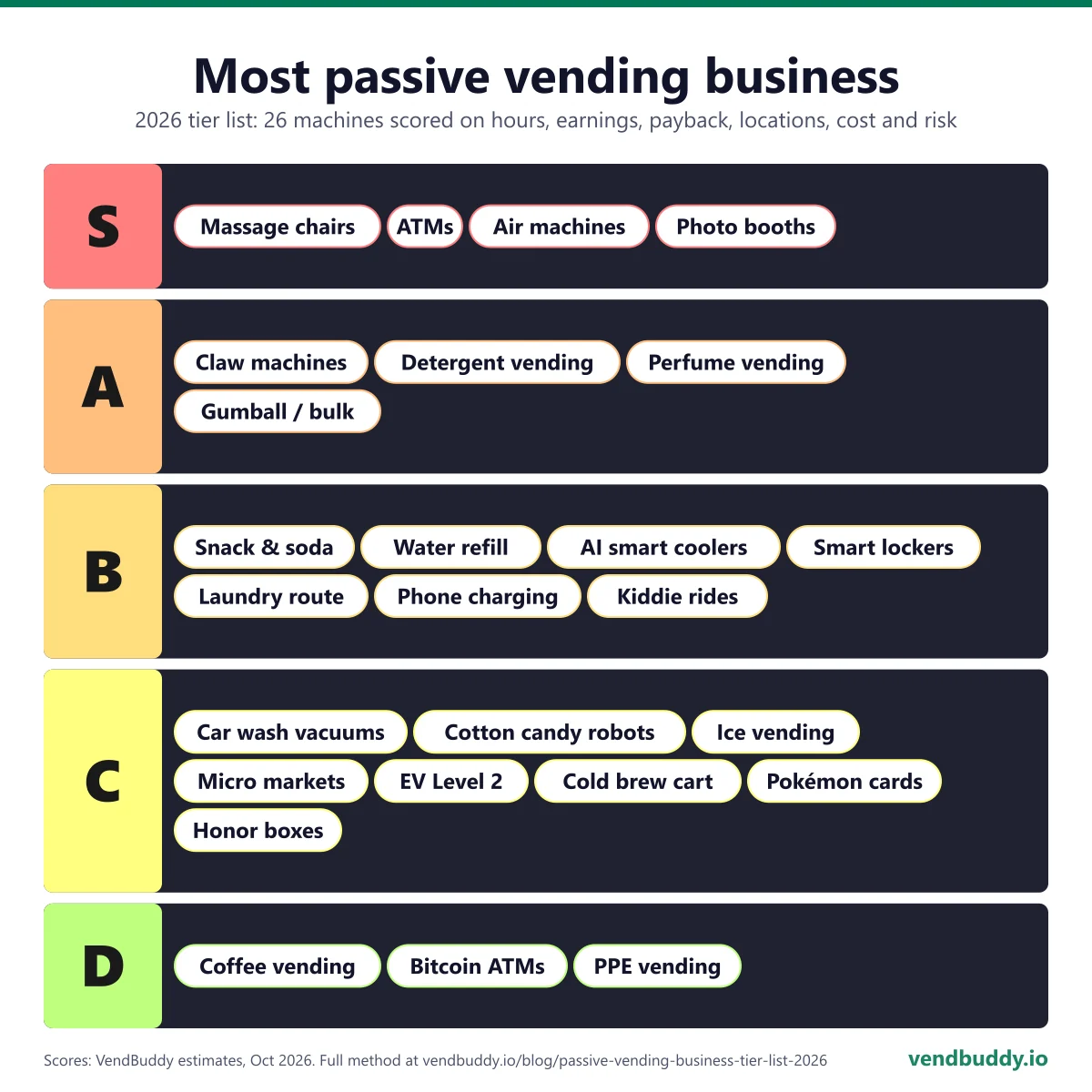
- No vending business is fully passive. The closest are the ones with nothing to restock: massage chairs (6.7), ATMs (6.5), air machines (6.3) and photo booths (6.3) make S tier.
- Passivity carries 30% of the score; earnings, payback speed, location supply and risk carry 15% each, and startup cost 10%.
- The biggest earners per unit (micro markets, ice, Pokémon cards) take the most hours or capital, so they land in C tier.
- Bitcoin ATM operating, PPE vending and coffee vending land in D tier on regulation, data gaps and maintenance.
- Most revenue claims come from machine sellers. Use the ranges as a starting point and run your own numbers in the ROI calculator.
The most passive vending business is the one you can forget about for a week while you are at your kid’s game, and it still earns. We scored 26 vending and unattended-retail businesses on how hands-off they really are, what they earn, how fast they pay back, how many locations want them, what they cost, and what can go wrong. Here is the tier list, with the numbers and sources behind every grade.
- The 2026 passive vending business tier list at a glance
- How we scored each business
- Comparison table: cost, revenue, payback and hours
- S tier: nothing to restock, nothing to spoil
- A tier: cheap, simple, limited by location
- B tier: good businesses with a catch
- C tier: real money, real work, or real doubts
- D tier: skip unless you have an edge
Part of our complete guide: how much does a vending machine cost.
The short answer: no machine is fully passive. The ones that come closest have nothing to restock and nothing to spoil: massage chairs, ATMs, air machines and photo booths. The trade-off is that they live or die on the spot you put them in. The machines that earn the most per unit, like micro markets, ice and Pokémon cards, also take the most hours. If you want the honest version of how much time vending takes, our hours-per-week breakdown is a good companion to this page.
The 2026 passive vending business tier list at a glance
Scores run from 1 to 10, higher is better for you. A tier is a band of overall scores: S is 6.3 and up, A is 5.8 to 6.2, B is 5.2 to 5.7, C is 4.5 to 5.1, and D is below that. Nothing on this list scores an 8, because every business here has a real catch somewhere.
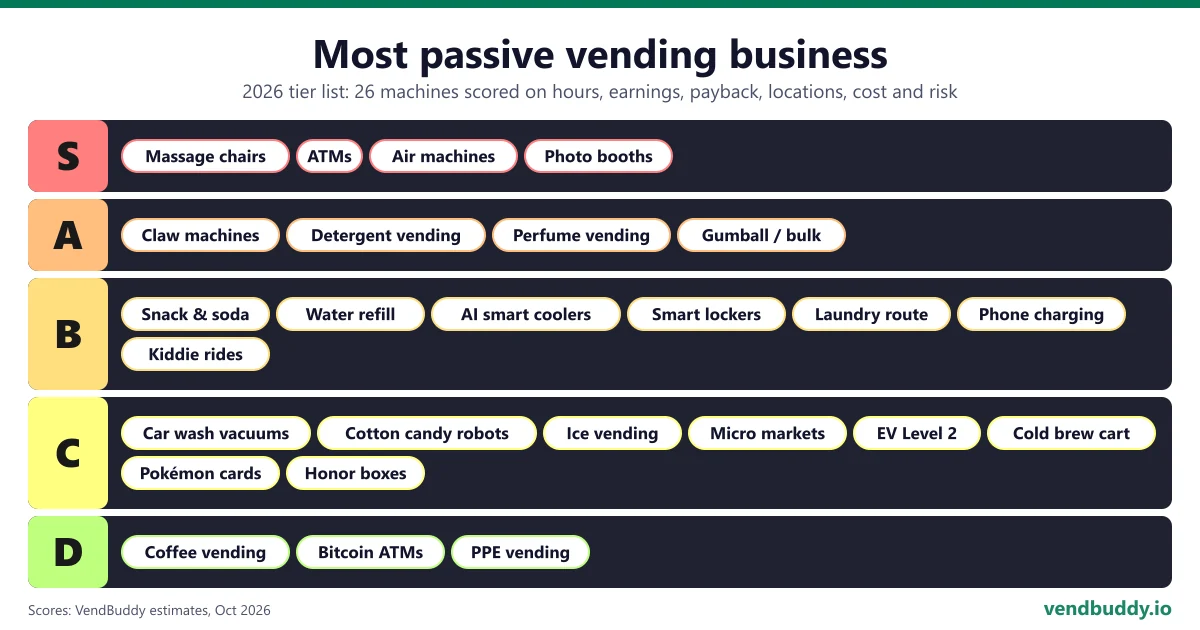
- S tier: Massage chairs, ATMs, Air machines, Photo booths
- A tier: Claw machines, Detergent vending, Perfume vending, Gumball / bulk
- B tier: Snack & soda, Water refill, AI smart coolers, Smart lockers, Laundry route, Phone charging, Kiddie rides
- C tier: Car wash vacuums, Cotton candy robots, Ice vending, Micro markets, EV Level 2, Cold brew cart, Pokémon cards, Honor boxes
- D tier: Coffee vending, Bitcoin ATMs, PPE vending
Two things surprised us. Ice, often sold as the most hands-off machine you can buy, lands in C because the capital, power bills and summer breakdowns are heavy for a single unit. And snack and soda, the business most people picture first, sits in B: it has the most locations of anything here, but restocking and expiry dates make it the least passive classic.
How we scored each business
Every business got six scores, each from 1.0 to 10.0 with one decimal. We weighted them toward what this list is about, which is time back:
- Passivity, 30%. Hours per unit per week, plus restocking, spoilage and cleaning. Gumball machines take minutes per visit, but it takes dozens of them to matter, so they lose points here.
- Earning potential, 15%. Monthly gross and net per unit at a decent site.
- ROI speed, 15%. Estimated months to break even at a typical site.
- Location supply, 15%. How many hosts realistically want one, and how many of the good spots are already taken.
- Startup cost, 10%. Cheaper per unit scores higher.
- Risk, 15%. Regulation, demand, theft, product supply and platform lock-in. Safer scores higher.
A warning about the numbers. Most revenue figures in this niche come from companies selling the machines, and they run high. Where sources disagreed, we show the range and lean on operator reports and independent data. Payback and cash-on-cash figures marked “estimate” are our math on the sourced numbers, not reported results, and none of this is a promise of what a machine will earn for you. Your location decides that. To run your own numbers, plug them into the vending ROI calculator.
Picture the machines paying you while you sleep
That’s the real promise of vending — income that doesn’t cost you your time, and a life on your own terms. VendBuddy turns this guide into a step-by-step plan so you actually build it instead of just reading about it. Start free today.
Start building free →Comparison table: cost, revenue, payback and hours
Sorted from highest overall score to lowest. Gross is before the location’s cut, product and fees. Hours are per unit once it is placed and running, not counting the time it takes to land the spot.
| Tier | Business | Score | Startup cost per unit | Gross per month per unit | Payback (estimate) | Hours/week per unit |
|---|---|---|---|---|---|---|
| S | Massage chairs | 6.7 | $3,000-$5,500 (chairs list $2,300-$7,000) | $300-$1,200 | ~5-35 mo (base ~13) | 0.5-1 |
| S | ATMs | 6.5 | $1,500-$8,000 + $1,000-$3,000 vault cash (est.) | ~$720-$1,700 surcharge at 240-500 txns | ~5-24 mo | 0.5-2 (self-load) |
| S | Air / tire inflation machines | 6.3 | $1,550-$3,800 air only; $3,350-$5,600 air+vac | ~$600-$1,000 combo (derived) | ~8-30 mo (base ~15) | 0.25-0.5 |
| S | Photo booths (unattended) | 6.3 | $2,000-$20,000 (business-ready $3,000-$15,000) | $2,000-$4,500 | ~9-17 mo | 0.5-1.5 (est.) |
| A | Claw / crane machines | 6.1 | $1,000-$7,000+ | $300-$1,500 ($4,000+ prime) | ~6-30 mo | 1-2 |
| A | Laundry detergent vending | 6.1 | $450-$4,500 | $150-$450 | ~9-33 mo | 0.25-0.5 |
| A | Perfume / fragrance vending | 6.1 | $600-$3,500 | $160-$1,100 (claims to $3,000) | ~7-15 mo | 0.25-0.5 |
| A | Gumball / bulk candy | 5.9 | $50-$300 per machine | $7-$45 per machine | ~15-42 mo | 0.1-0.25 per machine |
| B | Snack & soda machines | 5.6 | $1,000-$17,650 (used combos at the low end) | $150-$1,200 | ~6-40 mo | 0.5-2 |
| B | Water vending / refill stations | 5.5 | $3,000-$25,000+ (kiosk ~$15k-$25k installed) | ~$750-$1,900 | ~20 mo strong site; 70+ weak | 1-2 |
| B | AI smart coolers | 5.5 | $2,899-$6,899 (HAHA); fresh-food units to $20,000 | $300-$1,200 | ~15-35 mo | 1-2 |
| B | Smart lockers (rental) | 5.3 | $2,500-$21,000 per bank | ~£3,000/mo at a busy venue (vendor example) | 3-24 mo (vendor claims) | 0.5-1 |
| B | Apartment laundry route | 5.3 | $2,400-$5,000 per washer/dryer pair (est.) | ~$190-$250 per pair before landlord split (derived) | 48-60 mo (SAHF) | 0.1-0.3 per pair |
| B | Phone charging kiosks | 5.3 | $1,500-$5,000 per kiosk | $150-$1,500 (network sellers) | ~6-72 mo | 0.25-1 |
| B | Coin-op kiddie rides | 5.2 | $1,000-$7,750 | Unclear: ~$90 to $1,200+ (thin data) | ~9-110 mo | 0.5-1 |
| C | Car wash vacuums | 5.1 | $3,000-$5,600 + island/electrical | $200-$300 per vacuum | ~33-65 mo | 0.25-0.5 |
| C | Cotton candy robots | 5.1 | $2,500-$15,000 (+$1,000-$2,000 freight on imports) | $1,200-$4,300 (seller-reported) | ~8-20 mo (est.) | 1-3 |
| C | Ice vending machines | 4.9 | $20,000-$150,000 (most $35k-$60k installed) | $1,350-$5,000 | ~24-34 mo; weak sites may never | 2-5 per unit (one source: 10/wk business) |
| C | Micro markets | 4.9 | ~$12,000 per full market | $3,000-$8,000 | ~9-14 mo | 3-6 |
| C | EV charging (Level 2 at host sites) | 4.9 | $3,500-$15,000 per port installed | ~$40-$400 per port (utilization-driven) | 100+ mo or never at 1 session/day | 0.25-0.5 |
| C | Cold brew event cart (weddings/events) | 4.7 | $4,900-$16,100 cart | ~$2,800-$8,000 at 4-8 events/mo (est.) | ~3-6 mo | 5-8 per event |
| C | Pokémon / trading card vending | 4.5 | $3,800-$22,000 + $2,000-$5,000 inventory | $150 to $6,000+ (sellers disagree ~10x) | ~11-65 mo | 3-6 |
| C | Honor boxes / farm stands | 4.5 | Under ~$500 (est.; not sourced) | ~$870/mo in season (one example) | 1-3 mo in season (est.) | 2-5 |
| D | Coffee vending / robotic kiosks | 4.4 | $5,000-$15,000 bean-to-cup; $15,000-$80,000+ robotic | $500-$2,000 bean-to-cup | ~6-40 mo | 2-4 |
| D | Bitcoin ATMs (as operator) | 4.1 | $10,000-$15,000 all-in + compliance program | ~$4,800-$7,250 gross margin (pre-2025 data) | 3-6 mo on paper; longer or never where capped | 2-5 |
| D | PPE vending | 3.1 | Not found for independent owners | Not derivable for independents | Not derivable | 1-2 (est.) |
And the six scores behind each grade:
| Tier | Business | Passivity (30%) | Earnings (15%) | ROI speed (15%) | Locations (15%) | Low cost (10%) | Low risk (15%) | Overall |
|---|---|---|---|---|---|---|---|---|
| S | Massage chairs | 8.6 | 4.8 | 6.2 | 4.7 | 6.8 | 7.3 | 6.7 |
| S | ATMs | 7.6 | 4.6 | 6.6 | 5.7 | 7.1 | 6.3 | 6.5 |
| S | Air machines | 8.8 | 4.3 | 5.6 | 4.1 | 7.2 | 5.9 | 6.3 |
| S | Photo booths | 7.2 | 7.6 | 6.8 | 4.2 | 4.7 | 6.1 | 6.3 |
| A | Claw machines | 5.3 | 6.1 | 7.4 | 6.4 | 6.6 | 5.7 | 6.1 |
| A | Detergent vending | 8.3 | 2.2 | 5.4 | 3.1 | 8.4 | 7.6 | 6.1 |
| A | Perfume vending | 8.1 | 3.4 | 6.6 | 2.6 | 7.4 | 6.7 | 6.1 |
| A | Gumball / bulk | 5.8 | 1.3 | 4.6 | 7.4 | 9.6 | 8.3 | 5.9 |
| B | Snack & soda | 3.7 | 4.7 | 5.1 | 8.3 | 6.2 | 7.4 | 5.6 |
| B | Water refill | 6.7 | 6.6 | 4.3 | 4.6 | 3.3 | 5.6 | 5.5 |
| B | AI smart coolers | 4.6 | 5.3 | 4.4 | 7.6 | 5.3 | 6.4 | 5.5 |
| B | Smart lockers | 7.9 | 4.4 | 4.1 | 2.9 | 3.9 | 5.8 | 5.3 |
| B | Laundry route | 7.4 | 3.4 | 1.9 | 4.9 | 5.1 | 7.1 | 5.3 |
| B | Phone charging | 7.8 | 3.1 | 3.3 | 3.8 | 6.4 | 5.4 | 5.3 |
| B | Kiddie rides | 8.2 | 2.9 | 2.8 | 2.4 | 6.3 | 6.2 | 5.2 |
| C | Car wash vacuums | 8.1 | 2.7 | 2.1 | 2.3 | 6.1 | 6.9 | 5.1 |
| C | Cotton candy robots | 3.9 | 7.4 | 6.4 | 4.8 | 4.1 | 4.6 | 5.1 |
| C | Ice vending | 5.4 | 8.4 | 3.4 | 4.4 | 1.3 | 5.1 | 4.9 |
| C | Micro markets | 2.7 | 8.1 | 7.3 | 4.3 | 2.9 | 5.9 | 4.9 |
| C | EV Level 2 | 8.4 | 2.4 | 1.1 | 5.3 | 4.4 | 4.2 | 4.9 |
| C | Cold brew cart | 1.2 | 6.8 | 8.7 | 5.6 | 5.4 | 4.3 | 4.7 |
| C | Pokémon cards | 2.8 | 7.3 | 5.3 | 6.3 | 3.8 | 3.1 | 4.5 |
| C | Honor boxes | 3.3 | 2.1 | 8.2 | 1.7 | 9.2 | 5.2 | 4.5 |
| D | Coffee vending | 3.4 | 5.4 | 4.6 | 4.4 | 3.4 | 5.6 | 4.4 |
| D | Bitcoin ATMs | 3.9 | 7.1 | 6.1 | 2.6 | 3.6 | 1.2 | 4.1 |
| D | PPE vending | 3.6 | 2.3 | 1.4 | 1.8 | 4.9 | 4.4 | 3.1 |
S tier: nothing to restock, nothing to spoil
Massage chairs (6.7). The most passive business on the list. There is no product: a chair needs a wipe-down, a look at the upholstery and the occasional service call, which is roughly half an hour to an hour a week. Operators on Reddit call $300 a month per chair acceptable and $600 great, and one industry estimate puts the average at $400 to $900 before a location commission that often runs 30% to 50%. At a typical $4,000 setup, our estimate is about 13 months to pay back, longer at a weak venue. Dwell time decides everything: malls, gyms, hotel lobbies and casinos. Start with the massage chair vending business guide, then the cost and where-to-buy guide.
ATMs (6.5). Nothing spoils, the math is simple, and a used machine costs $1,500 to $3,500. At a $3 surcharge, 240 withdrawals a month is about $720 before the merchant’s split and processing; one bank’s worked example nets about $532 a month, which pays back a $2,800 machine in under six months. Weak sites net much less. The work is keeping cash loaded, which an armored service can do for $150 to $300 a month. The catch is that cash use is falling and most good corner stores already have one, so you often win the spot by offering a better split. See how much ATMs make and whether an ATM business is worth it.
Air and tire inflation machines (6.3). No product, no spoilage, a coin pull every few weeks. Dealer prices run about $1,550 to $3,800 for air only and $3,350 to $5,600 for an air and vacuum combo. One operator puts the owner’s share at $300 to $500 a month on a combo after a 50/50 split. Supply is the problem: national operators place machines for free and California requires free air for fuel customers, and Connecticut requires stations to give free air to anyone who asks. Read air vending machines before you call a gas station.
Photo booths (6.3). The sleeper of the list. A print costs about 15 to 17 cents, a session sells for $5 to $7, and there is no inventory to rotate. One mall operator reported about $2,000 in his first month; a Korean-style self photo store listing showed roughly $4,300 a month per booth. Business-ready booths cost $3,000 to $15,000. The bottleneck is space in malls, arcades and cinemas, where revenue-share companies already install booths for free, so expect to compete on the split. We found little data on what hosts take, so treat the payback estimate of 9 to 17 months as soft.
You can run the payback period on your own numbers in the revenue calculator instead of borrowing ours. It asks for property type and headcount, which is where nearly all of the difference comes from.
A tier: cheap, simple, limited by location
Claw machines (6.1). The fastest payback of the arcade machines in a busy spot: operators report $100 to $150 a week net after prizes and the venue’s cut, which pays back a $4,000 machine in six to nine months. It loses passivity points because you buy prizes, restock and tune the claw every week, and skill-crane rules vary by state, with some states capping prize values. Read claw machine profit and locations.
Laundry detergent vending (6.1). A $450 to $4,500 dispenser that grosses $150 to $450 a month at 60% to 80% margin, and it takes minutes to refill. The catch is that most laundromat owners run their own, so you are pitching unattended stores. See laundry detergent vending machines.
Perfume and cologne vending (6.1). A spray costs pennies, a bottle refill lasts weeks, and machines run $600 to $3,500. One maker’s own base case is only about €150 to €210 a month at six to eight sprays a day, while social posts claim $1,000 to $3,000. The venue list is short: clubs, bars, gyms. We put it in A on low cost and low effort, not on the big claims.
Gumball and bulk candy (5.9). The cheapest start on the list: about $191 gets a machine, a stand and a case of gum. Product runs about 21% of sales and there is no power or card fee. But one long-running forum figure puts the average at about $7 a month per machine, so it only adds up across dozens of machines on a tight route. Here is the full bulk vending business guide.
B tier: good businesses with a catch
Snack and soda machines (5.6). More locations want these than anything else here, financing is easy, and a used combo can start around $1,000. Product is roughly half of sales, and a good machine can net $100 to $300 a month. You restock one to five times a week depending on volume, and you manage expiry dates, which is why passivity scores low. If you go this way, how to make vending more passive covers telemetry and route planning, and the soda vending guide covers drinks.
Water refill stations (5.5). Water costs pennies a gallon and a strong kiosk can gross $1,000 to $1,900 a month where people distrust their tap. But licensed states make you work for it: California requires servicing at least every 31 days, coliform tests every six months and a $60 per machine license. Kiosks run $15,000 to $25,000 installed. See reverse osmosis water vending.
AI smart coolers (5.5). Fewer jams than spiral machines, and hosts like fresh food. A HAHA-style cooler costs $2,899 to $6,899 and owners report $300 to $1,200 a month. You still restock product weekly, and fees of about 5.95% plus a nickel per sale bite on $2 items. Read is a smart cooler worth it as a first machine.
Smart lockers (5.3). Rental lockers at beaches, water parks and stadiums barely need you once installed. Most of the numbers come from UK vendor examples, and the best venues sign with national networks that install for free, so independents fight for the leftovers.
Apartment laundry route (5.3). Boring in a good way: card or app machines, little cash handling, and tenants who need clean clothes every week. But landlords commonly take 50% to 60%, and a multifamily housing laundry study puts route operator paybacks at four to five years. If you like laundry, also look at laundromat vending and ATM add-ons.
Phone charging kiosks (5.3). Low touch, but the revenue numbers ($300 to $1,500 a month) come from the networks that sell the kiosks, and software fees of $100 to $300 a month eat slow months. Lost power banks are a running cost. See phone charging vending machines.
Coin-op kiddie rides (5.2). Durable and simple; some rides from the 1960s still run. But locations typically take 40% to 50%, grocery and mall placements are shrinking, and we found no independent monthly revenue figure, only a maker’s claim. Buying used makes the math far easier.
C tier: real money, real work, or real doubts
Car wash vacuums (5.1). Hands-off, but one distributor puts the national average at $200 to $300 a month per vacuum, most washes own theirs, and express washes now give vacuums away to members. If you already work with washes, vending at car washes is the better play.
Cotton candy robots (5.1). Sugar costs pennies per cone and sellers report $1,200 to $4,300 a month. Every revenue figure we found came from a manufacturer, the spinning head needs regular cleaning, and machines that serve open food can need a health permit and plan check. See cotton candy robot cost and ROI.
Ice vending (4.9). The highest ceiling per unit: reports range from about $1,350 to $5,000 a month. But installed machines cost $20,000 to $150,000, power runs $200 to $600 a month in hot climates, and breakdowns hit in July when you can least afford them. One well-known example puts payback near two years and the work near 10 hours a week across the business. Read the ice vending business guide and ice machine costs.
Micro markets (4.9). The best money per site on the list: $3,000 to $8,000 a month gross, and an estimated 9 to 14 month payback on a $12,000 build. It is also among the most hands-on, with two or three restocks a week, fresh food and 2% to 6% shrink, and it needs 75 to 250-plus people on site. Compare in smart cooler vs micro market.
EV charging, Level 2 at host sites (4.9). The network handles payments and support, so it is very passive. The money is the problem. Research for New York’s energy agency puts retail Level 2 at 0.5 to 1 session a day early on and 3 to 5 at maturity, about 7.3 kWh each. At those numbers a port barely clears its network fees, and the federal 30C credit ended for chargers placed in service after June 30, 2026.
Cold brew event cart (4.7). A cold brew by-the-ounce cart for weddings and events pays back fast: drop-off coffee service often books for $600 to $1,700 an event, and a serving costs well under $1.50. But this is catering, with mobile food permits, staff time and Saturdays you do not get back. It scores the lowest on passivity of anything here. If you want event income with less labor, look at pop-up vending at events.
Pokémon and trading card vending (4.5). Demand is real, and the best machines report big months. But sellers’ figures disagree by about ten times, pack prices rose from $3.99 to $4.49 for newer sets, and finding product at a margin is a weekly hunt. The Pokémon Company also began pulling its own card kiosks in May 2026 over scalping. See Pokémon card vending machines.
Honor boxes and farm stands (4.5). Cheap and quick to pay back in season, and 85% to 95% of customers pay. But you restock produce daily, lose 5% to 15% to non-payers on busy roads, and it only works on your own frontage. Newspaper-style honor racks are not a 2026 business.
D tier: skip unless you have an edge
Coffee vending and robot kiosks (4.4). Good margins per cup, but grinders, water lines and cleaning make these some of the highest-maintenance machines you can own, and robotic kiosks cost $15,000 to $80,000-plus. Read coffee vending machine cost first.
Bitcoin ATMs as an operator (4.1). Big margins on paper, but the rules changed fast. FinCEN issued a notice on kiosk scams in August 2025, Minnesota is banning kiosks statewide in 2026, and California and Illinois now cap fees and daily amounts. Hosting a machine for $300 to $700 a month in rent is passive; operating them is a compliance business. See bitcoin ATM vs regular ATM and how to host a bitcoin ATM.
PPE vending (3.1). Industrial PPE vending is a distributor sales channel: Fastenal and Grainger place machines at no hardware cost to win the product spend. We found no workable numbers for an independent owner. Our PPE vending guide covers the niches that can work.
Which one fits you? A 60-second check
Three questions narrow this list fast. Be honest with yourself on the second one.
1. What can you put in without losing sleep?
- Under $2,000: gumball and bulk, a used ATM, detergent vending, perfume vending, a used claw machine.
- $2,000 to $8,000: massage chairs, air machines, ATMs with vault cash, claw machines, smart coolers, a starter photo booth.
- $8,000 to $25,000: photo booths, water refill kiosks, cotton candy robots, a micro market, Pokémon machines.
- $25,000 and up: ice vending, multi-unit routes.
2. How many hours a week, really?
- Under 3: stick to S and A tier machines with no product to restock: massage chairs, air machines, ATMs with armored service, photo booths.
- 3 to 8: add claw machines, smart coolers and a small snack route.
- 8 or more: micro markets, ice and Pokémon cards are where the bigger dollars are, if you treat them like a business.
3. How much risk can you live with? If a rule change would hurt, skip bitcoin ATMs, check your state’s skill-crane law before a claw machine, and check free-air laws before buying an air machine. If you can ride out a slow first year, the faster-payback machines in C tier are open to you.
For a personal answer, the free vending niche finder asks six questions on hours, budget and how you feel about pitching and hauling, and tells you which niche fits. It will also tell you if vending is not your play.
Most people working on the pitch start by pulling the list rather than driving the map. The ranks the businesses around your ZIP by type and headcount, and the first five contact reveals are free.
The part no machine does for you
Every S tier machine has the same weak spot: it is only as good as where it sits. A massage chair in a busy gym can pay back in under a year. The same chair in a quiet lobby may take three. That is why the most passive operators spend their effort up front, on the location, and very little after.
You do not need to know everything before you start. You need one good location, then a second. VendBuddy shows you which buildings near you are worth the walk-in, with the owner or manager to ask. For the bigger picture on non-snack machines, see alternative vending businesses ranked and high-ticket machines ranked by payback.
Sources
We used 168 sources in total; the main ones are below, plus the rules linked in each section. Figures were checked in October 2026 and will move.
- r/Entrepreneur operator thread on massage chair revenue
- IdeaCrystal, vending massage chair profitability
- Herring Bank, how to start an ATM business
- ATM Trader, owning an ATM
- Operator answer on air/vac machine income
- JME Ellsworth air and vacuum machine prices
- Mall photo booth operator video (2025)
- YPFuns claw machine cost and revenue guide (manufacturer)
- VMFS USA, laundry vending machine costs
- Perfume vending revenue scenarios (manufacturer)
- Gumballs.com, bulk vending start-up costs
- VENDiscuss operator forum on bulk machine averages
- Nav, vending machine business economics
- Ice and water vending economics video
- Codie Sanchez, how much an ice vending machine makes
- 365 Retail Markets, converting vending to micro markets
- Flashquotes coffee cart catering prices
- Dultmeier, car wash vacuum revenue
- Kiddie Rides USA FAQ
- Homegrown, farm stand honor-system losses
- Coin ATM Radar, bitcoin ATM revenue and costs
- KioskForce, industrial PPE vending
The VendBuddy Team
Frequently Asked Questions
What is the most passive vending machine business?
In our 2026 scoring, vending massage chairs came out as the most passive vending business: there is no product to restock or spoil, and upkeep is roughly 30 to 60 minutes a week. ATMs, air machines and photo booths are close behind. All four depend heavily on location, so the hands-off part only works once you have a busy spot.
Are vending machines really passive income?
Partly. Machines that sell food or drinks need restocking one to five times a week, plus buying and driving, so they are closer to a small part-time job. Machines with no inventory, like massage chairs, ATMs and air machines, are much closer to passive, but they earn less per unit and need strong locations. No machine runs with zero attention.
What vending machine makes the most money?
Per unit, micro markets ($3,000 to $8,000 a month gross), ice machines (about $1,350 to $5,000) and strong Pokémon card machines report the highest revenue. They also cost the most or take the most hours. Revenue figures in this niche often come from machine sellers, so check operator reports and run the numbers for your location.
What is the best vending business for beginners with little money?
Under $2,000, look at bulk candy, a used ATM, detergent or perfume vending, or a used claw machine. Bulk candy is the cheapest start at about $191 a machine, but it earns little per unit, so it needs a dense route. A used ATM or claw machine at a busy site usually pays back faster.
Which vending machine requires the least maintenance?
Gumball machines, air machines, detergent dispensers and kiddie rides have the fewest parts to fail. Massage chairs and ATMs need little routine work too. The highest-maintenance machines are coffee vending, ice machines and cotton candy robots, because of grinders, refrigeration, water lines and daily or weekly cleaning.
Is a bitcoin ATM a good passive income?
Hosting one for rent can be passive: hosts commonly get $300 to $700 a month. Operating them is not. Operators face FinCEN registration and anti-money-laundering rules, a statewide ban in Minnesota, and fee and daily limits in California and Illinois. That is why bitcoin ATMs land in D tier for operators on this list.
How many hours a week does a vending machine take?
Our estimates run from about 15 minutes a week for an air machine or detergent dispenser to 3 to 6 hours for a micro market or Pokémon card machine. A snack machine usually takes 30 minutes to 2 hours a week including restocking and driving. Hours drop when machines are close together on one route.
What is selling, which buildings say yes, and the numbers before you buy a machine. Free, confirm from your inbox, unsubscribe in one click. Refer one friend and get 25 VendBuddy credits.
General information, not legal, tax or financial advice. Rules change, so check the official source. Revenue and income figures are examples, not promises. See our terms.