What you put in your machine matters more than almost any other decision you'll make. A tight, well-chosen product mix beats a random assortment by 20–40% on the same foot traffic — and it's one of the few things completely in your control.
Part of our complete guide: scale a vending machine business.
Looking only at the snack side? Vending machine snacks breaks down chips, candy and pastries with sourced unit costs, and drink and soda vending machines covers the cold side.
The proven starter planogram
Before you have location-specific data, stock items that move nearly everywhere:
Drinks
- Coke 12oz cans and Coke 20oz bottles
- Diet Coke 20oz, Coke Zero 20oz, Sprite 20oz
- Celsius Kiwi Guava
- Gatorade Zero Lemon Lime, Monster Zero Ultra
- Poppi Strawberry Lemon
- Fairlife Protein Shake and Core Power Elite
- Bottled water (always — baseline seller)
Snacks
- Doritos Nacho Cheese and Cool Ranch 1.75oz
- Bark Thin Dark Chocolate Pretzel
- Hershey Cookies N Creme Dipped Pretzels
- Kit Kat, Snickers, Twix, Reese's PB Cups
- Starburst Gummies (all-pink outperforms original)
- Trolli 5oz and Nerds 5oz
Stock this mix for the first 30 days, track every sale, then aggressively prune to your top 10–15 SKUs. Your first mix only needs to be good enough to launch — you'll refine it with real data. Consider running a simple survey (in-unit or digital) to let residents or employees choose products before you stock. This directly increases sales and creates buy-in from the community.
Why 20oz sodas beat 16.9oz
In most markets, 20oz bottles outperform 16.9oz on both sell-through and gross margin. Customers perceive more value at roughly the same price point. Default to 20oz for all major soda brands unless the location is extremely price-sensitive.
Picture the machines paying you while you sleep
That’s the real promise of vending — income that doesn’t cost you your time, and a life on your own terms. VendBuddy turns this guide into a step-by-step plan so you actually build it instead of just reading about it. Start free today.
Start building free →Highest-margin products
Focus on items where markup exceeds 55%:
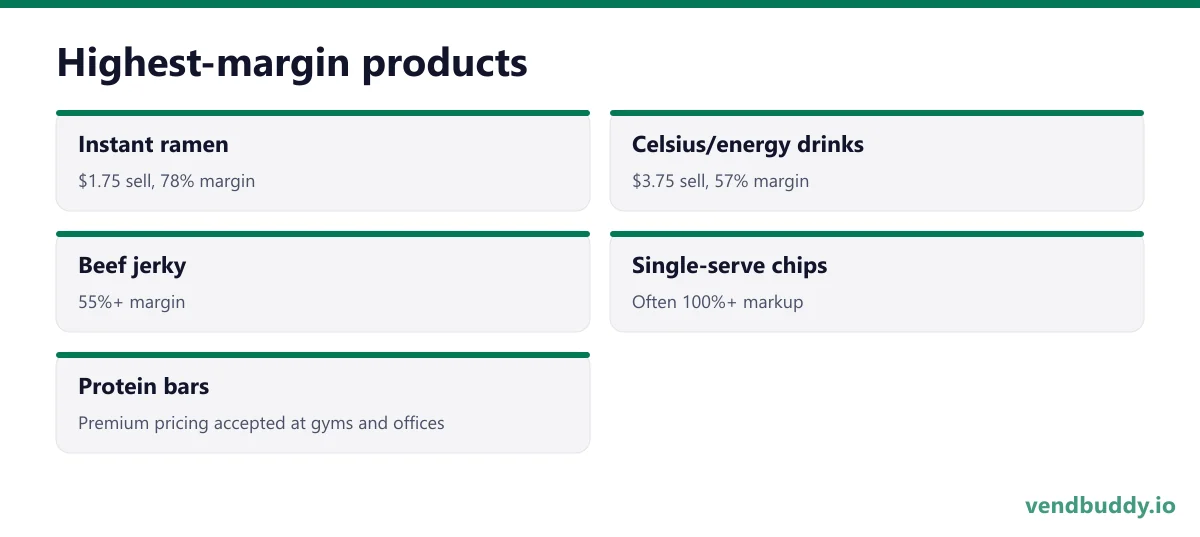
- Instant ramen: $1.75 sell, 78% margin.
- Celsius/energy drinks: $3.75 sell, 57% margin.
- Beef jerky: 55%+ margin.
- Single-serve chips: Often 100%+ markup.
- Protein bars: Premium pricing accepted at gyms and offices.
Avoid: candy bars at 43% margin — the shelf space earns more with alternatives. We ran the actual margin math across 664 real SKUs in VendBuddy's product catalog — see the full breakdown in our vending machine profit margin research (instant ramen tops out near 87%, incidental items like lip balm and ear plugs beat almost everything else).
Match products to the location
- Offices: Cold brew + breakfast bars AM, energy + salty snacks PM. Full breakdown: best AI vending machine for offices.
- Apartments: Large beverages, meal replacements (cup noodles, mac and cheese). Full breakdown: best AI vending machine for apartments.
- Dorms: Energy drinks, spicy chips, gummy candy, instant soup.
- Gyms: Protein bars, Celsius, electrolyte drinks, water. Full breakdown: best AI vending machine for gyms.
- Warehouses: Hearty snacks, energy drinks, water in quantity.
Seasonal adjustments that add $500–$1,000/month
Operators who don't adjust seasonally lose up to 40% of revenue during off-peak. Stock 30 days ahead:
- Winter: Hot cocoa, instant soup, oatmeal, spicy chips.
- Summer: Extra water, sports drinks, cold brew, electrolytes. Drop chocolate.
- Back-to-school: Energy drinks, protein bars, cup noodles.
Where to buy at scale
- Early (1–5 machines): Costco and Sam's Club.
- At scale (10+): Vistar — largest route-scale distributor.
- Bridge: Restaurant supply stores.
Use the VendBuddy Product Catalog for real margin calculations and swap recommendations. Upload your sales data to the Sales Data Dashboard to see exactly which products perform at each location.
Top 10 products to sell in a vending machine
If you want the whole page compressed into one shortlist, this is it — the ten SKUs that earn their slot in the widest range of buildings, drawn from the planogram, margin and location sections above. Stock these first, then let 30 days of sales data tell you which of them your specific building disagrees with.
- Bottled water — the baseline seller everywhere, and the item most often under-faced. It never stops moving and it costs almost nothing per unit.
- Coke 20oz, plus Coke Zero or Diet Coke 20oz — 20oz outperforms 16.9oz on both sell-through and gross margin because customers perceive more value at a similar price.
- Doritos Nacho Cheese and Cool Ranch 1.75oz — the two flavours behave like two different products and both hold their own slot.
- Celsius or another energy drink — roughly 57% margin at a $3.75 sell price, and the dominant seller at industrial, gym and night-shift sites.
- Gatorade Zero or an electrolyte drink — carries gyms, warehouses and any site where people are physically working.
- Instant ramen or cup noodles — the highest-margin mainstream item in vending at around 78%, and a genuine meal replacement in apartments and dorms.
- The four standard candy bars — Snickers, Kit Kat, Twix and Reese’s Peanut Butter Cups. Only about 43% margin, so treat them as traffic rather than profit and give them four slots, not eight.
- A protein or breakfast bar — premium pricing is accepted without complaint at gyms and offices, which makes it one of the better margin-per-slot decisions available.
- One gummy candy — Starburst Gummies, Trolli or Nerds. Consistently outsells the chocolate next to it in dorms and student housing, and survives summer heat when chocolate does not.
- Fairlife Protein Shake or Core Power — a high-ticket item that moves surprisingly well in gyms, hospitals and offices, and lifts average transaction value more than any snack will.
That is 12 to 16 slots once you account for facings, which is the right size for a first machine. Everything beyond it should earn its place from your own sales report rather than from a list, including this one.
Frequently Asked Questions
Top 10 products to sell in a vending machine
The ten that earn their slot in the widest range of buildings: bottled water, Coke 20oz plus a zero-sugar cola, Doritos in both Nacho Cheese and Cool Ranch, an energy drink such as Celsius, Gatorade Zero or another electrolyte drink, instant ramen or cup noodles, the four standard candy bars (Snickers, Kit Kat, Twix, Reese’s), a protein or breakfast bar, one gummy candy, and a Fairlife or Core Power protein shake. That is roughly 12 to 16 slots once facings are counted, split about 60/40 drinks to snacks. Instant ramen carries the best margin on the list at around 78%; candy bars carry the worst at about 43%, so give them fewer slots than instinct suggests. After 30 days, cut anything that has not sold through twice and double-face your top five.
What products should I offer in my first vending machine?
Start with 12–16 SKUs, not 40. The mix that works almost everywhere on a first machine: bottled water, Coke and either Diet Coke or Coke Zero in 20oz, one sports drink, one energy drink, Doritos in both flavors, one non-Dorito salty chip, Snickers, Kit Kat, Reese’s, one gummy candy, and one protein or breakfast bar. That is roughly a 60/40 split of drinks to snacks by slot count, because drinks turn faster and carry the transaction. Price for 40–50% COGS — if a unit costs you $0.55 in the case, sell it at $1.25–$1.50. Then let the machine tell you what to stock: after 30 days, cut anything that has not sold through twice and double-face your top five. Your first planogram only has to be good enough to launch. The sales data does the rest, and the location breakdowns above tell you which way to skew it.
Related reading: complete startup guide, cost and profit breakdown, placement guide for maximum revenue, and real vending machine income numbers. Also see: cans vs bottles data, regional bestsellers, where to source Celsius and Alani, and the price-adjustment framework. Build a combo meal deal to increase your average transaction value.
Where to source inventory (and when Amazon actually wins)
Be honest about the math: for commodity volume — full cases of the top-selling chips, sodas, and candy — a warehouse club like Sam's Club (or a vending distributor like Vistar) beats Amazon on per-unit cost almost every time. That's your bread-and-butter restocking, and a Sam's Club Plus membership pays for itself fast once you're buying for more than one machine.
Amazon earns its place for the four jobs the clubs are bad at:
- Testing a new SKU before you commit to a 24-case pallet — buy one multipack, run it two weeks, keep it only if it sells.
- Subscribe & Save on steady slow-movers so a low-volume machine never goes empty between club runs.
- Healthy and specialty items clubs rarely carry — the higher-margin SKUs that win you health-conscious offices and gyms.
- Topping up mid-week without burning a two-hour club trip for two boxes.
Bulk snacks & candy — all under one roof. Browse the categories:
What is selling, which buildings say yes, and the numbers before you buy a machine. Free, confirm from your inbox, unsubscribe in one click. Refer one friend and get 25 VendBuddy credits.
General information, not legal, tax or financial advice. Rules change, so check the official source. Revenue and income figures are examples, not promises. See our terms.