How to find vending machine locations fast: make a list, not a drive. Pick 20 businesses within 10 miles that have 50 or more people through the door every day (warehouses, manufacturing plants, apartment buildings with 200-plus units, gyms, hospitals), walk in during off-peak hours and ask for the manager. Expect one yes for every 15 to 20 pop-ins. Most beginners land their first paying location in 2 to 4 weeks, and the ones who fail are the ones who quit after five rejections. Everything else in vending, which machine to buy, what to stock, how to restock, gets easier once one placement is signed. This page is the full playbook, ranked by what each location type actually earns.
- Best sources: Drive your ZIP, search Google Maps for keywords, ask current customers for referrals.
- Highest-yield categories: Multifamily (200+ units), warehouses, manufacturing, hospitals, gyms.
- Walk-in beats cold call 3:1 — pop in during off-peak hours.
- Filter early: Under 50 daily visitors = walk away.
- VendBuddy Lead Finder generates pre-screened lists for any ZIP.
Want the list built for you? The free location finder pulls the businesses near your ZIP, scores them by headcount and type, and gives you five contact reveals with no card. How it scores locations by ZIP explains what it weighs.
How to get locations for vending machines
To get locations for vending machines, ask the person who runs a building with a steady crowd and nowhere close to grab a snack: warehouses, plants, apartment buildings with 200-plus units, gyms. Walk in at a slow hour, offer to install and stock the machine at no cost to them, and plan on 15 to 20 walk-ins for every yes.
Warehouses are a good first target because there are so many of them. The Bureau of Labor Statistics counted 23,848 private warehousing and storage establishments in the first quarter of 2026, and about 1.83 million people worked in the industry in September 2026 (BLS, Warehousing and Storage: NAICS 493, preliminary figures).
Getting your FIRST location: the 30-day beginner playbook
Here is the shortest path:
- Day 1–2: Make a list of 20 businesses within 10 miles of your home that have 50+ daily visitors. Good targets: offices with 30+ employees, gyms, apartment complexes with 100+ units, warehouses, medical offices. Use Google Maps — search “gym near me,” “office building near me,” “warehouse near me.”
- Day 3–5: Do your first 5 pop-ins. Dress professionally. Bring a simple one-page leave-behind. Say: “Hi, I run a local vending service. Who handles amenities here?” Leave a card. Do not try to close.
- Day 6–10: Follow up on your first 5 pop-ins with an email. Do 5 more new pop-ins.
- Day 11–20: Continue until you have done 20 pop-ins total. Someone will say yes. When they do, get a verbal commitment and move to the contract step.
- Day 21–30: Use the VendBuddy Contract Generator to create a placement agreement. Sign it. Order your machine.
One thing worth settling before Day 1: there is no zoning code anywhere that publishes a list of approved venues. Every placement comes down to who controls that floor and whether they will put a yes in writing. If that is still the open question for you, where can I put a vending machine works through the private, public and right-of-way cases and says which of them a first machine should actually target.
Find real locations near you — free
Skip the cold guessing. VendBuddy’s Lead Finder surfaces vending-ready businesses by ZIP and type, with contacts and a pitch script for each. Sign up free and get 5 credits to pull your first list.
Find my locations free →The biggest mistake new operators make
They rely on email and phone outreach. It doesn’t work as well as pop-ins, and they quit after 5–10 rejections.
The real data: consistent operators typically see their pipeline start to open up at month 5–6 of daily business development. Lead flow feels broken before that — that’s normal. The operators who quit in months 2–3 miss the moment when their work starts compounding. Our negotiation playbook covers the exact scripts and follow-up cadence that accelerate this timeline.
The location tier list (ranked by revenue)
Here’s the ranking based on real per-machine revenue data:
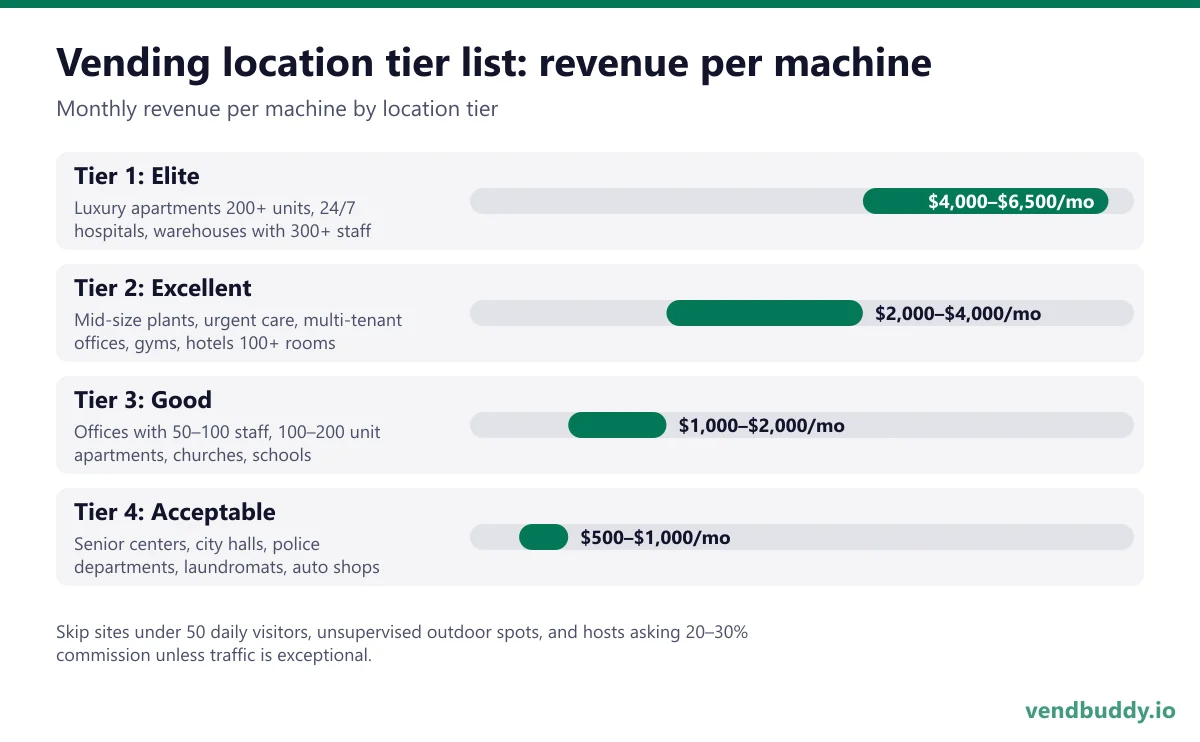
Tier 1: Elite ($4,000–$6,500/month per machine)
- Luxury apartment complexes and high-rise condos with 200+ units and $100,000+ median household income in the area. A single well-placed machine at an 800-unit luxury high-rise can do $5,000–$6,500/month on its own. If you’re a property manager looking for free vending amenities, we match you with local operators.
- Large hospitals and 24/7 medical facilities with 500–1,000+ daily foot traffic.
- Large warehouses and manufacturing facilities with 300+ daily employees.
Tier 2: Excellent ($2,000–$4,000/month per machine)
- Mid-size manufacturing facilities with 100–200 employees.
- 24/7 pet hospitals and urgent care clinics.
- Multi-company corporate office buildings with 200–250 on-site employees.
- Gyms and fitness centers with reliable membership bases.
- Hotels with 100+ rooms.
Tier 3: Good ($1,000–$2,000/month per machine)
- Smaller office buildings (50–100 employees).
- Mid-size apartment complexes (100–200 units).
- Churches with weekly recurring events or homeschool co-ops.
- Schools where vending is permitted.
Tier 4: Acceptable ($500–$1,000/month per machine)
- Senior centers, city halls, police departments — easy contracts, steady low volume.
- Laundromats and auto shops — supplemental only, not primary.
Avoid
- Locations with under 50 daily visitors.
- Outdoor or unsupervised locations (theft kills 3–8% of revenue).
- Locations demanding 20–30% commission unless traffic is exceptional.
Free vending machine location finder
Our free vending machine location finder turns a ZIP code into a list of nearby businesses worth a pop-in, ranked for vending, so the Top 20 list below takes minutes instead of an afternoon on maps. A plain map search for the business types in the tier list above works too, it is just slower. Paid vending locator services go further and pitch the location for you for a fee per placement, so read the review before you pay one. Whichever you use, the walk-in is still yours to do.
How to find leads
Free methods
- Google Maps searches: “warehouses near me,” “gyms near me,” “office buildings near me,” “manufacturing near me.” Filter by review count and rating.
- Data-Axle: Free access through most public library cards. Filters businesses by employee count, industry, and address. The single best free lead source for targeting by company size.
- Driving industrial parks and commercial zones. Physical scouting produces leads you’ll never find online. Note addresses, then research ownership and property management.
- Yelp and YellowBook for business type searches.
- VendBuddy Opportunity Map: Free, no account. Type any US ZIP and get population, employment, median income, an estimated business mix, and a 0–100 opportunity score. Use it to decide which ZIPs deserve your driving hours before you build the list — full walkthrough in best places to put a vending machine near you. Start at the Opportunity Map.
Paid/software methods
- VendBuddy Lead Finder: Search any U.S. ZIP code for businesses scored by vending fit, with contact enrichment built in. Start at vendbuddy.io/app once the Opportunity Map has told you which ZIP to work.
- VendBuddy Location Scout (free Chrome extension): Already looking at a business website or a Google Maps listing? Click the icon and it reads the name and ZIP, says whether that kind of venue tends to work for vending, and opens the matching Lead Finder search. How to scout vending locations with it.
- National property management opt-in programs that connect operators with multi-building portfolio companies.
- Location procurement services (paid locators): The companies that help find profitable vending machine locations for a fee vary a lot in quality. Our review of vending machine locator services covers who offers vending machine location procurement services, what they charge and what to check before you pay.
Build your Top 20 List before you start
Before your first pop-in, build a pipeline of at least 20 target locations. This keeps you from settling for a bad deal out of desperation. Use AI, Google Maps satellite/Street View, and online reviews to pre-qualify each building before you visit in person. Walk through every prospective location with a checklist: placement zones, power access, sight lines, and management accessibility. Spot red flags early — properties with unclear management, high turnover, or restrictive access often signal future headaches.
The in-person pop-in playbook
Pop-ins are the single highest-converting BD activity in vending. Cold calls have roughly a 1% hit rate. Emails are 2–5%. Pop-ins, done well, run 15–25%.
Before the pop-in
- Dress professionally. Not a suit — clean pants, a collared shirt, branded polo if you have one.
- Bring a one-page leave-behind: your company name, phone, email, a short bullet list of what you offer, and a QR code to your website. Use the VendBuddy Flyer Generator to create professional leave-behinds in seconds.
- Have business cards. People who hand out cards look more professional, even in 2026.
- Research the property: size, number of units or employees, who manages it.
The pop-in itself
Walk in with a clear, friendly opener: “Hi, I run a local vending service, and I noticed you have [X on-site employees / Y residents / Z buildings]. I’d love to talk to whoever handles amenities about upgrading the vending here. Is that person available, or is there a better time to catch them?”
Three things to remember:
- Never try to close on the first visit. The goal is to identify the decision-maker and get a follow-up meeting or a business card.
- Be easy to say no to. “Is that something you’d be open to hearing more about, or no?” — giving them a graceful exit makes them more likely to engage.
- Always leave a leave-behind. Even if they say no. People change jobs, priorities change, and your leave-behind might be found six months later when they suddenly need a new vendor.
Persistence
Real operators have landed locations on the third, fourth, even fifth pop-in. If you’re polite and add value every visit (dropping off a product sample, sharing a relevant industry update, letting them know you just installed at a similar property), persistence turns into relationship.
The follow-up cadence that actually works
Vending is at the bottom of a property manager’s to-do list. “No answer” does not mean “not interested.” Here’s the cadence that converts:
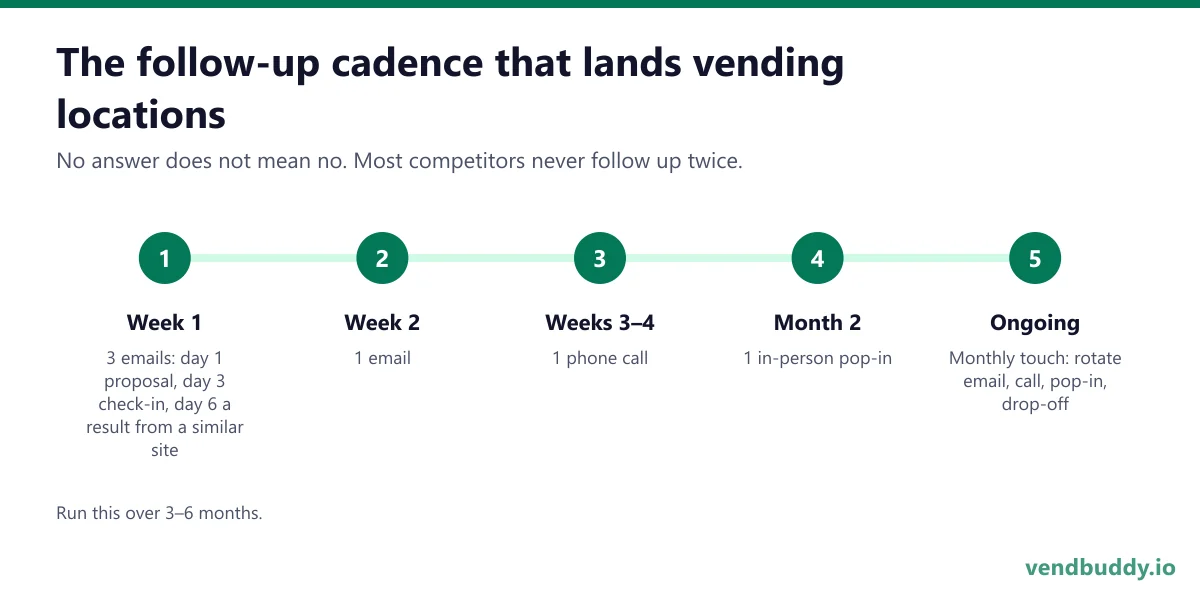
- Week 1 after first pop-in: 3 email touches. Day 1: “Great meeting you, here’s the proposal.” Day 3: “Quick follow-up — any questions?” Day 6: Value-add like “Here’s what our similar install at [comparable property] is generating.”
- Week 2: 1 email.
- Weeks 3–4: 1 phone call.
- Month 2: 1 in-person pop-in.
- Ongoing: Monthly touches — email, phone call, pop-in, or drop-off. Rotate.
The VendBuddy Lead Finder searches any ZIP code for pre-screened vending leads with the best contact on file — multifamily, offices, gyms, and warehouses, all filtered by daily traffic estimates.
How to talk to the decision-maker
Once you’re in front of the person who can sign, your job is to understand their problem, not pitch your machine. Questions to ask:
- How many people are on-site daily? What are the peak hours?
- Do you currently have vending? What’s working and what isn’t?
- What are residents/employees asking for that you can’t currently provide?
- Is there a specific space you’re considering for a machine?
- Who else would need to approve the contract?
Your pitch should then reference their specific answers: “You mentioned residents have been asking for healthier options — our smart cooler stocks 30+ protein and functional drinks, and we can customize the product mix to match what your survey is showing.”
Handling the most common objections
- “We already have a vendor.” Reply: “No problem — may I ask how they’re doing? I’d love to put a proposal in front of you for when their contract is up or if you’re ever open to a comparison.”
- “We don’t have the space.” Reply: “Most of my machines fit a standard 40-inch alcove. Can I measure and show you exactly where it would go?”
- “Who pays for electricity?” Reply: “Standard vending practice is the property covers electricity — it’s a few dollars a month per machine — in exchange for the zero-cost amenity. Happy to work around whatever your preference is.”
- “We’d need revenue share.” Reply: “Happy to. Industry standard is 5–10% of gross. Can I walk you through what that would actually pay out at your expected volume?”
- “We’ll think about it.” Reply: “Of course. Is it OK if I follow up in two weeks with an updated proposal? And what would be most helpful to include in that — case studies, product lists, a specific install timeline?”
Revenue share: what to actually agree to
Target 10–15% commission of gross revenue as the industry standard. Many luxury residential properties will accept 5% or no commission at all when you lead with upscale equipment and strong service. See our complete negotiation guide for the exact commission scripts and objection handling tactics. Walk away from any location demanding 20–30% unless the volume is exceptional (200+ daily visitors, captive audience).
Flat rent ($50–$200/month) is an alternative at high-volume locations — it can be more profitable than commission if you know the machine will do $2,000+/month, but it carries risk if the location underperforms.
Contracts: what must be in writing
Never operate on a handshake. Every placement needs a written agreement covering:
- Contract length and renewal terms.
- Commission structure or flat rent amount.
- Your restocking commitment (e.g., “weekly minimum”).
- Maintenance and repair responsibility (yours).
- Equipment ownership (yours).
- Access hours for restocking.
- Termination clause — usually 30–60 days written notice.
- Exclusivity — no competing machines on site. This is critical.
- Vandalism and theft liability.
The VendBuddy Contract Generator produces signing-ready placement agreements in under two minutes. You can also create a professional Scope of Work document to present during your pitch meeting.
When to pull a machine that isn’t performing
Give every new location at least 4–6 months before deciding to pull. Months 1–2 are too early — foot traffic patterns and buying habits haven’t stabilized. At month 6 of clear underperformance, have a professional conversation with the property manager: can we relocate the machine inside the building, change product mix, or move it entirely?
Bring numbers to that conversation instead of impressions: a cashless reader like Nayax timestamps every sale, so you can show the property manager exactly what the machine does at their site, on which days and at which hours — the evidence that keeps a marginal placement alive, or tells you honestly that it should move.
Affiliate link — VendBuddy may earn a commission at no extra cost to you.
Never burn the relationship. The same property manager often controls other buildings, and a graceful exit can become a warm lead six months later.
How many locations do you actually need in Year 1?
A commonly cited Year 1 goal is 10 placed locations in the first 12 months. That’s aggressive but achievable with daily business development. At average per-location performance, 10 locations generates $12,000–$20,000/month in gross revenue. With 2–3 premium placements mixed in, it can generate $30,000+/month.
But remember: placement quality beats placement quantity, especially early. A single well-placed machine at a luxury high-rise or 150-employee manufacturing facility can outperform five mediocre locations combined. Our placement guide explains exactly where inside a building to position your machine for maximum revenue.
Also helpful: our complete startup guide, real cost and profit numbers, and our scaling playbook for when you’re ready to grow past your first 5 locations. Also see: what to do when a property manager says no, 10 untapped non-apartment locations, how to take over a Coke or Canteen account, and how to respond to a rejection email.
Beyond machines: micro markets, smart markets, and modern amenities
The 2026 operator is not just placing vending machines. The highest-revenue locations in your market are increasingly looking for micro markets, smart markets, or modern-amenity grab-and-go — and you can win those with the same prospecting motion described above.
- 75+ employee sites: pitch a micro market instead of a machine.
- Class A multifamily and premium offices: pitch as a modern amenity, not a product.
- 500+ employee sites: evaluate a smart market.
- Warehouses and distribution centers: run the $5K/month warehouse playbook.
For the full 2026 location ranking by revenue, see best vending machine locations in 2026. And before paying a locator service, read the honest locator review.
The four steps this page compresses
Landing a location is a sequence, and each step has its own page. Qualifying comes first: the location scoring checklist is how you decide a spot is worth a pitch before you spend the trip. Then you have to reach the right human, which is rarely the person at the front desk — the decision-maker map lists who signs at each venue type.
For the pitch itself, use the cold pitch script that works in person and the cold email scripts for vending contracts when the building will not let you walk in. After the yes, prove the placement rather than assuming it: the 90-day location test gives you a defensible rule for keeping, retuning, or pulling the machine. If you want the whole conversation on paper instead of assembled from pages — the annotated script, twelve objections answered, and a signable placement agreement — that is the Vending Location Playbook.
Frequently Asked Questions
Is there a free vending machine location finder?
Yes. VendBuddy’s location finder is free to search by ZIP code and returns nearby businesses ranked for vending, and a map search for offices, gyms, warehouses and apartment buildings works too. Paid locator services also pitch the location for you.
Who offers vending machine location procurement services?
Three kinds of companies: paid locator services that pitch businesses on your behalf for a fee, route brokers who sell routes with locations already signed, and software like VendBuddy that scores the businesses near you so you can do the asking yourself. The first two cost money up front and the quality varies, and our locator services review covers what to check before you pay.
How do complete beginners find their first vending machine location?
The fastest path: make a list of 20 local businesses with 50+ daily visitors, do in-person pop-ins to each, and follow up weekly. Most beginners land their first location within 2–4 weeks of starting pop-ins. Use the VendBuddy Lead Finder to build your first target list in minutes.
How many locations do I need to pitch to land one?
Most operators pitch 15–20 locations for every one they land. Some get lucky at 5; some need 30. The key variable is follow-up — most operators give up after 1–2 attempts. A 6-touch follow-up cadence over 60 days significantly improves your close rate.
What do I say when I walk into a business to pitch my vending service?
Keep it simple: “Hi, I run a local vending service. I noticed you have [X employees / residents]. I’d love to connect with whoever handles amenities. Is that person available?” Leave a one-page leave-behind and a card. The goal of the first visit is to identify the decision-maker, not to close.
Do I need a contract for a vending machine placement?
Yes, always. A written placement agreement protects both parties and prevents misunderstandings about commission, access hours, termination, and exclusivity. Use the VendBuddy Contract Generator to create a signing-ready agreement in under 2 minutes.
Is it better to walk in or call to get a vending machine location?
Walk in. Cold calls hit roughly 1% of the time and emails 2 to 5%, while pop-ins done well run 15 to 25%. Go at an off-peak hour and ask for whoever handles amenities.
What kinds of places make the best vending machine locations?
Places with a captive crowd: apartment buildings with 200 or more units, warehouses, manufacturing plants, hospitals and gyms. If a site sees fewer than 50 people a day, walk away.
How long does it take to get your first vending machine location?
Most beginners land their first paying location within 2 to 4 weeks of starting pop-ins. Lead flow often feels slow until month 5 or 6 of steady outreach, so keep going past the first five rejections.
Everything above — the pop-in script, the follow-up cadence, the contract terms — is exactly what is packaged in the Operator Pack ($47): the word-for-word script, a signable placement agreement, and the 50-state distributor list, so you are not piecing it together from a blog post while standing in a parking lot.
Ready to negotiate your first deal? → Vending Machine Location Negotiation Playbook
Running 3+ machines? → How to Scale Your Vending Business
Use the Machine Finder to pick a property type — bar, laundromat, gym, mall, arcade, dealership — and see the specific machines that logically fit it, with prices and where to buy.
Open the Machine Finder →The Vending Location Playbook is the next step after this guide: the cold walk-in pitch script word for word and then annotated, variants for offices, gyms, apartments, warehouses and salons, twelve answered objections, and a plain-English placement agreement. $47 one-time.
See the Location Playbook →What is selling, which buildings say yes, and the numbers before you buy a machine. Free, confirm from your inbox, unsubscribe in one click. Refer one friend and get 25 VendBuddy credits.
Every operator we talk to wants fewer cold calls. The ones who get there have a Google Business Profile and a simple site a manager can check before replying. AI builders make that an evening job now. Wix is the mature site builder; Base44 also builds working tools like a quote form. Start with the AI website walkthrough or Wix vs Base44.
You are often one good location away from the route you want. Post the area and the kinds of places you are after on our public Wanted board. It is free, and property managers and people passing on tips can see what operators near them are looking for.
Post what you wantSee the Wanted board →Fresh data: what operators on VendBuddy actually search for, how quickly they get a first lead and how often a pipeline card becomes a placed machine is in our quarterly State of Vending Operators report (Q4 2026).
Original research: which location types vending operators actually look at, by state, rating, late hours and review counts, is in the 2026 Vending Location Index (36,069 listings).
General information, not legal, tax or financial advice. Rules change, so check the official source. Revenue and income figures are examples, not promises. See our terms.