🌐 También disponible en español
How much do vending machines make? $50 to $1,000 a month net, and which end you land on is decided almost entirely by the address. Same cabinet, same snacks, same operator: in a slow strip mall it grosses $200–$500 and nets $50–$150. In a 150-person office it grosses $1,500–$3,000 and nets $500–$1,000.
- 2026 revenue at a glance
- How much does a vending machine make a month?
- How much do vending machines make a week (and a day)?
- Per-machine income: the honest ranges
- What to expect as a brand-new operator
- Route-level income: what different sizes earn
- Real operator examples across the journey
- Income by machine type
So here is the honest answer the $10K-a-month videos skip: most vending machines make almost nothing. A machine in a quiet barbershop clears maybe $90 in a month. Subtract the gas to get there and the two hours you spent restocking it and you worked for free. Nothing is wrong with the machine. The building just never had enough people in it.
The machines that do pay are picked, not lucky. Somewhere around 100 to 200 people walking past per day is where the math flips, and you can check that number before you sign anything. What follows is the full tier table, per-machine income by machine type and by location type, route math at 5, 10, 20 and 40 machines, and P&L figures operators actually reported. Every range comes from the same operator dataset behind our sourced vending machine statistics reference.
2026 revenue at a glance
| Tier | Daily visitors | Gross / month | Net / month | Example placement |
|---|---|---|---|---|
| Poor | <30 | $200–$500 | $50–$150 | Slow strip mall, small barbershop |
| Average | 50–100 | $500–$1,500 | $150–$500 | Mid-size gym, small office |
| Good | 100–200 | $1,500–$3,000 | $500–$1,000 | Large office, busy apartment, hotel |
| Great | 200+ | $3,000–$6,500 | $1,000–$2,500 | Luxury high-rise, hospital, warehouse |
| Elite | 500+ multi-shift | $8,000–$30,000 | $2,800–$10,000 | 24/7 hospital, mega-warehouse, university |
Net assumes 25–35% margin after COGS, commission, card processing, and ops. Real operator-reported numbers, 2026.
These are national ranges — your ZIP decides where you land in them. The free Opportunity Map scores any US ZIP in two seconds using Census income, population, and business density. No account needed.
Check my ZIP free →How much does a vending machine make a month?
A vending machine makes $200 to $6,500 a month in gross revenue, and $50 to $2,500 a month in net profit, depending almost entirely on how many people walk past it every day. Those are not error bars on an average — they are five genuinely different businesses, and which one you get is decided by the location, not the machine:
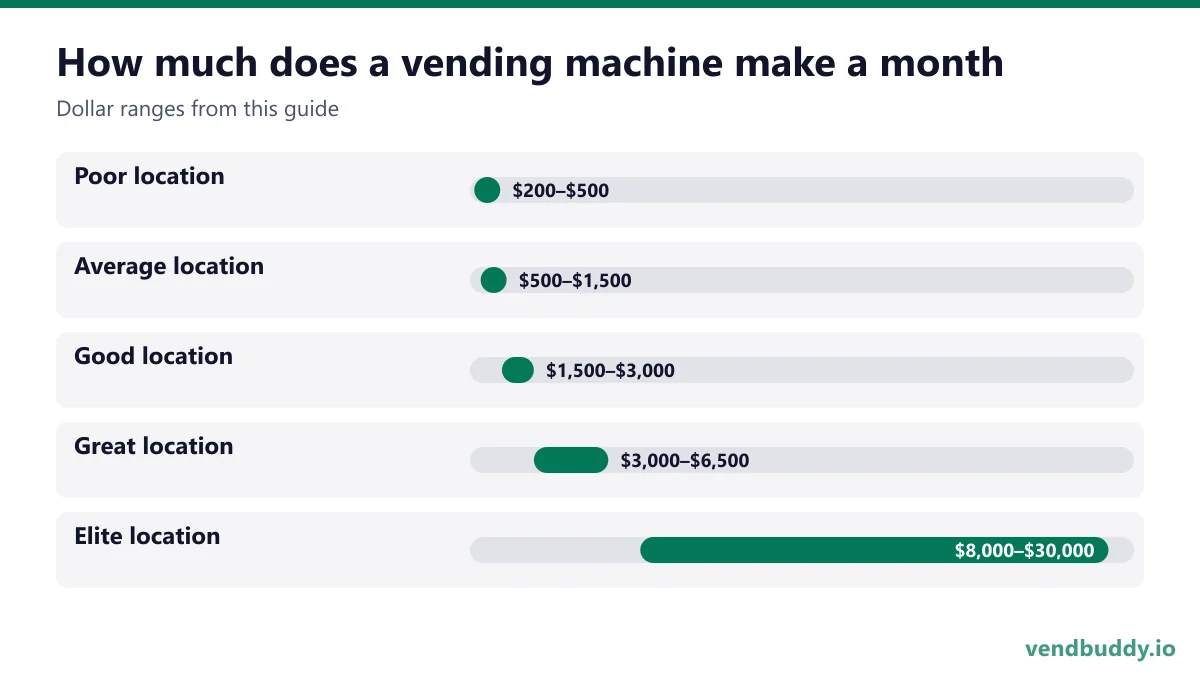
- Poor location (under 30 daily visitors): $200–$500 gross, $50–$150 net a month. Most machines in the wild live here. Relocate at six months.
- Average location (50–100 daily visitors): $500–$1,500 gross, $150–$500 net a month.
- Good location (100–200 daily visitors): $1,500–$3,000 gross, $500–$1,000 net a month. This is the tier worth chasing.
- Great location (200+ daily visitors): $3,000–$6,500 gross, $1,000–$2,500 net a month.
- Elite location (hospitals, universities, mega-warehouses): $8,000–$30,000 gross a month. Rare, and real.
The median new operator does not land in the middle of that list. They land near the top of it only if they qualified the building first, and near the bottom of it by default if they bought the machine first and went looking for somewhere to put it. If you are still setting expectations for month one, a first machine commonly runs $600–$1,200 gross for its first 60 days while the building learns it exists, then settles into its real tier by month four to six.
ROI Calculator — minutes📝 Real operator numbers
Anonymized P&Ls by route size💰 What it costs to start
Costs & profit breakdown
What would YOUR machines make?
You just read the averages. Now run your real numbers — VendBuddy’s free ROI calculator models payback and monthly profit for your exact machine cost, location, and pricing. Sign up free and get 5 credits.
Calculate my numbers free →How much do vending machines make a week (and a day)?
A vending machine makes $50 to $700 a week in gross revenue at a normal placement, and $7 to $100 a day. There is no separate weekly business — those are the monthly figures above divided by 4.33 weeks and 30 days. The same five tiers carry straight across:
| Tier | Gross / month | Gross / week | Gross / day | Net / week |
|---|---|---|---|---|
| Poor | $200–$500 | $50–$115 | $7–$17 | $12–$35 |
| Average | $500–$1,500 | $115–$350 | $17–$50 | $35–$115 |
| Good | $1,500–$3,000 | $350–$700 | $50–$100 | $115–$230 |
| Great | $3,000–$6,500 | $700–$1,500 | $100–$215 | $230–$500 |
| Elite | $8,000–$30,000 | $1,850–$6,900 | $265–$1,000 | $600–$2,400 |
Net / week assumes the same 25–35% margin used everywhere else on this page.
The daily column lies in one specific way, and it matters the first time you pull a sales report. Offices, warehouses, schools, and medical buildings earn almost all of it Monday through Friday. A $1,500/month office machine is not doing $50 a day; it is doing roughly $75 a day across 20 working days and close to nothing on Saturday and Sunday. Apartments, hotels, gyms, and laundromats run the other way. Their week is flatter, and it often tilts toward Friday through Sunday — a gym machine can take a third of its weekly total between Saturday morning and Sunday afternoon.
So judge a new placement on a full seven days, never on a Tuesday. And time the restock to the building: a weekday-only site wants to be full Monday morning, a weekend-heavy site wants to be full Thursday night. Operators who restock every location on the same rigid day tend to run out in the buildings that earn the most.
Per-machine income: the honest ranges
No two machines are alike because no two locations are alike. Here’s what operators actually report across the full spectrum — from brand-new operators to seasoned routes:
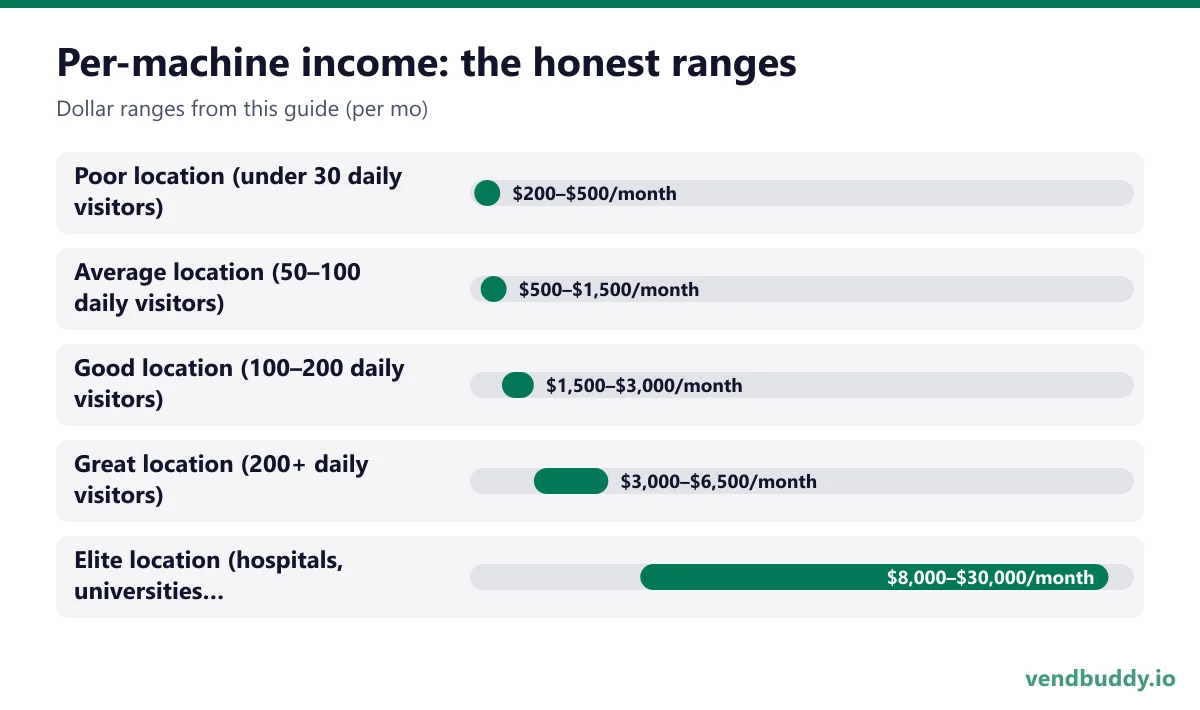
- Poor location (under 30 daily visitors): $200–$500/month gross, $50–$150 net profit. Think: small barbershop, low-traffic strip mall, slow laundromat. Relocate or remove at 6 months.
- Average location (50–100 daily visitors): $500–$1,500/month gross, $150–$500 net. Think: mid-size gym, church, small office building. Acceptable for beginners; upgrade over time.
- Good location (100–200 daily visitors): $1,500–$3,000/month gross, $500–$1,000 net. Think: large office, busy apartment complex, hotel. Target tier for most operators.
- Great location (200+ daily visitors): $3,000–$6,500/month gross, $1,000–$2,500 net. Think: luxury high-rise, hospital, large warehouse. Chase these aggressively.
- Elite location (hospitals, universities, mega-warehouses): $8,000–$30,000/month gross. These are rare but real — operators with smart machines in 24/7 hospitals report $12K–$30K/month.
What to expect as a brand-new operator
If you are starting your first machine today, here is an honest timeline:
- Month 1–2: $400–$900/month gross is normal. You are still learning the location’s patterns, adjusting product mix, and building customer awareness. Do not panic.
- Month 3–4: Revenue typically stabilizes as buying habits form. Target $800–$1,500/month gross if you have a decent location (50+ daily visitors).
- Month 5–6: Your machine has found its “steady state.” If you’re below $800/month gross at 6 months in a location with 50+ daily visitors, the product mix or placement spot needs a change — not the location necessarily.
- Year 1 with 3–5 machines: $3,000–$8,000/month gross, $1,000–$2,500/month net. Enough to replace a part-time income or fund machine #6.
The gap between machine one and machines two through five is usually cash rather than locations, and some operators close it with a 0% intro business credit line — worth doing only for a building whose foot traffic you have already counted, because an interest-free window doesn’t make a slow lobby busy.
Route-level income: what different sizes earn
Most operators don’t have one machine — they build routes. Here’s the route-level math:
- 5 machines (side hustle): $2,500–$7,500/month gross, $750–$2,500 net. 8–12 hours/week of work.
- 10 machines (serious side hustle): $5,000–$15,000/month gross, $1,500–$5,000 net. 15–20 hours/week.
- 20 machines (full-time income): $10,000–$30,000/month gross, $3,000–$10,000 net. 20–30 hours/week with a part-time helper.
- 40+ machines (business): $40,000–$100,000+/month gross, $12,000–$35,000 net. Small team, operations manager, warehouse.
- 100+ machines: $200,000–$600,000+/month gross. Full operations team. At this scale you’re running a company, not a route. See our scaling playbook.
Real operator examples across the journey
These numbers come from documented operator experiences across the vending community:
- Beginner, month 3: A first-time operator with one machine at a mid-size apartment complex earns $740/month gross, $220/month net. Normal — the location is ramping.
- First 3 machines: An operator placed one smart machine in a luxury high-rise: $4,200/month gross. Two other machines at offices average $1,100/month each. Total route: $6,400/month gross, ~$1,800/month net.
- 5 machines, 6 months in: A stay-at-home parent built to $5,000/month in gross revenue with 6 locations.
- 20-machine route: An operator scaled to $50,000/month gross revenue within his first year by targeting warehouses and hotels.
- Mature 15-machine route: A retiree with 15 locations earns $5,500/month net working 2 days a week.
- Mid-scale replacement income: A corporate professional replaced her $90K salary with 15 vending machines working 3 days a week.
Income by machine type
The same location earns differently depending on what you put in it. Here is what each common machine type pulls at a solid (100–200 daily-visitor) placement:
- Snack-only machine: $600–$1,500/month gross. Lowest ticket, but cheap to stock and dependable.
- Drink-only machine: $800–$2,000/month gross. Higher price per unit; cold drinks move fastest in warm months.
- Snack + drink combo: $1,200–$3,000/month gross. The workhorse — one footprint, two revenue streams.
- Smart / AI machine: $1,800–$5,000/month gross. Touchscreen, cashless-first, and real-time telemetry typically lift revenue 2–3x over an old combo in the same spot. See machine recommendations.
- Micro market (open shelving, self-checkout): $3,000–$12,000/month gross at 75+ employees on site. Much higher ceiling, more setup. Full math: micro markets vs vending machines.
- Specialty (coffee, claw, ice): Wildly variable — a busy claw machine or ice vending machine can clear $1,000–$4,000/month in the right venue.
The smart/AI row is the one operators argue about most, so we broke it out on its own page: smart vending machine net profit per machine per month, after the software fee and card processing come out of the gross.
Buy the SandStar direct from VendBuddy — $4,995 to $6,995
We are a direct SandStar dealer, so this is the one smart cooler on this page we sell ourselves instead of linking to. Five configurations, $4,995 to $6,995 for the cabinet, plus $65 per machine per month for the software licence. It isn’t the cheapest vision cooler on the internet, and we’d rather say that here than after you have paid.
- We inspect the cooler before it ships and own the freight claim if a carrier dents it.
- Remote training and planogram support cost nothing. An onsite technician is optional at $500 a day, two-day minimum.
- The $65 monthly licence covers the SIM and cellular data, telemetry, device management and remote support, so there’s no second connectivity bill.
- Warranty runs 3 years on the SRK series and 5 years on the VRK series.
Not ready to sign anything? Get pricing and availability first →
Machine type × location tier: monthly gross and net
Combining the two variables above — what you put in the machine, and where you put it — gives a clearer target than either axis alone. Net assumes the same 25–35% margin used throughout this guide (smart/AI and coffee run slightly leaner after software/consumable costs, noted below).
| Machine type | Poor location | Average location | Great location |
|---|---|---|---|
| Snack-only | $80–$250 gross / $20–$90 net | $200–$750 gross / $50–$260 net | $1,200–$3,200 gross / $300–$1,120 net |
| Drink / soda-only | $110–$330 gross / $30–$120 net | $270–$1,000 gross / $70–$350 net | $1,600–$4,300 gross / $400–$1,500 net |
| Snack + drink combo | $160–$500 gross / $40–$175 net | $400–$1,500 gross / $100–$525 net | $2,400–$6,500 gross / $600–$2,275 net |
| Smart / AI machine | $240–$835 gross / $55–$265 net | $600–$2,500 gross / $130–$800 net | $3,600–$10,800 gross / $790–$3,450 net |
| Coffee / specialty | $160–$585 gross / $30–$175 net | $400–$1,750 gross / $80–$525 net | $2,400–$7,600 gross / $480–$2,280 net |
Poor/Average/Great location multipliers derived from this guide’s own location-tier table above. Smart/AI and coffee net figures use a 22–32% and 20–30% margin respectively (software fees and perishable/consumable COGS run slightly higher than the 25–35% used for snack/drink/combo).
Income by location type
Location type is the single biggest driver of revenue. Typical gross per machine, per month, at a well-run placement:
| Location type | Typical gross / month | Why |
|---|---|---|
| Manufacturing / warehouse | $1,500–$4,000 | Captive multi-shift crews, few nearby alternatives |
| Hospital / healthcare | $2,000–$8,000 | 24/7 staff plus visitors, round-the-clock demand |
| Large office (100+) | $1,200–$3,000 | Steady weekday demand, predictable patterns |
| Apartment / high-rise | $800–$2,500 | Convenience premium, strong evening sales |
| Gym / fitness | $700–$2,000 | Drinks, protein, and recovery products |
| School / university | $1,000–$3,500 | High volume, with summer seasonal dips |
| Hotel / motel | $600–$1,800 | Guest impulse buys, 24/7 availability |
| Laundromat / small retail | $300–$1,200 | Dwell time helps, but traffic varies widely |
For a deeper per-venue breakdown, see vending machine profit by location type.
Two rows in that table hide a rule you cannot negotiate around. Schools and hospitals both look like volume plays, but a K-12 campus is governed by federal nutrition standards that decide what you are allowed to sell and when the machine can even be switched on, which is why the school range starts lower than the headcount suggests — the arithmetic is worked through in how much a vending machine makes a month in a school.
The profit formula
Gross revenue doesn’t equal take-home. Here’s the real breakdown:
- Start with monthly revenue (avg sales/day × days open)
- Subtract COGS: 40–50% of revenue (the products you sell)
- Subtract commission: 5–15% to location owner
- Subtract card processing: 5–6%
- Subtract misc: fuel, insurance, software, repairs
- Net profit: typically 25–35% of gross revenue
Example: $1,500/month gross machine → ~$450/month net profit after all expenses.
What separates high earners from low earners
The difference between $500/month and $5,000/month per machine comes down to: (1) Location quality — one elite placement equals 5–10 average ones. (2) Cashless payment — adds 25–35% revenue instantly. (3) Product mix optimization — matching products to demographics, not guessing. (4) Smart/AI machines — 2–3x revenue of traditional combos. (5) Seasonal rotation — adds $500–$1,000/month.
Use the VendBuddy platform to score locations, get product recommendations, and project revenue before you commit. The ROI Calculator models your exact scenario, and the Sales Data Dashboard tracks real performance once you’re operating.
Related: full cost and profit breakdown, location playbook, is vending a good business?, complete startup guide, best products to stock, and how to scale from 1 to 100+ machines. Browse our city-specific vending guides to see opportunity data for 600+ U.S. markets. Also see: the $0 to $1M operator timeline and cans vs bottles data.
2026 update: what's actually moved the numbers this year
The ranges above hold, but four shifts are quietly changing why a machine lands where it does in that range. None of them are hype — they're mechanical changes to the per-vend math.
- Cashless is now the default, not the upgrade. Industry surveys from processors and trade groups have put cashless share of vending transactions above 60–65% in most U.S. markets, up from roughly half a few years ago. The effect isn’t just convenience — card users consistently spend more per visit than cash users (no need for exact change, less price sensitivity on the last dollar), and machines with a broken or missing reader are increasingly treated as “out of order” by customers who simply walk past. Operators report that a working reader is now closer to a floor requirement than a revenue lever — the money is in which tap-to-pay option you offer, not whether you offer one.
- Shelf prices caught up to inflation, which is propping up gross more than volume is. A standard candy bar or bagged snack that priced at roughly $1.25–$1.50 a few years back is commonly $1.75–$2.25 today; a 20oz bottled drink that was $1.75–$2.00 is now more often $2.25–$2.75. That’s a rough 25–35% price increase layered on top of flat-to-modest vend counts at most locations — meaning a meaningful share of the gross-revenue growth operators report year over year is dollars-per-vend, not more people buying. Don’t mistake a rising top line for rising foot traffic; check your vend count, not just your deposit total.
- Micro-market cannibalization is a real risk in shared buildings. When a micro market (open shelving, self-checkout, wider SKU range) goes into the same building as an existing vending machine — whether you install it or a competitor does — anecdotal operator reports put the hit to nearby vending volume at roughly 30–50% within the first two to three months, because the market offers fresher food and more selection in the same footprint. If you operate a vending machine in a 75+ employee building, either be the one who upgrades it to a market, or make sure your machine covers a floor, shift, or entrance the market doesn’t reach. See micro markets vs vending machines for the full comparison.
- The smart-machine premium is real, but it's a net premium, not a gross one. The 2–3× revenue lift from touchscreen, cashless-first smart machines cited earlier in this guide is a gross-revenue comparison. Smart machines also carry a higher entry cost ($4,500–$9,000+ vs. $2,500–$4,000 for a traditional combo) and ongoing telemetry/software fees that traditional machines don’t have (commonly $25–$75/month per machine). Net the software fee out and the real take-home lift is closer to 40–70% more profit than a traditional combo in the same spot — still a clear win at 100+ daily visitors, but not the full multiple you see quoted on the gross line. Budget the subscription cost before you commit to hardware; see machine recommendations to compare all-in cost.
Figures in this section are directional, sourced from processor cashless-adoption surveys, published price-tracking data, and operator community reporting — not audited financials. Model your own location with the ROI Calculator.
Where the income question splits into smaller ones
“How much do they make” is really five questions wearing one coat. If you are asking how long your capital sits at risk, that is the payback period on a single machine. If you are asking how big the route has to get, that is how many machines it takes to make a living, and the real math behind a ten-machine route shows the numbers at the size most operators actually reach.
Two figures quietly move every projection on this page. The first is the cut the host takes off the top — vending machine commission rates explains what is normal by venue type and when you should refuse to pay one. The second is your own time: how many hours a week vending really takes converts the gross figures above into an honest hourly rate. And when a placement lands below the ranges here, work through why a vending machine is not making money before blaming the machine.
VendBuddy is a lead-generation platform that helps vending operators find businesses near any US ZIP that want a machine. The ranges on this page are operator-reported route numbers, last checked September 2026.
Do you have the time? Find out in 10 seconds
Time is the real question behind “is vending worth it?” Drag the slider to your honest weekly availability and see what your schedule actually supports.
Do you actually have time for vending?
Most people overestimate how much time a vending route takes. Drag the slider to your real weekly availability for an honest read.
Frequently Asked Questions
How much does a vending machine make a month?
Between $200 and $6,500 a month in gross revenue, and $50 to $2,500 a month in net profit — and where you land inside that range is set by the location, not the machine. A poor location (under 30 daily visitors) grosses $200–$500 and nets $50–$150. An average one (50–100 daily visitors) grosses $500–$1,500 and nets $150–$500. A good one (100–200 daily visitors) grosses $1,500–$3,000 and nets $500–$1,000. Most machines in the wild sit in the first tier, which is why the honest headline answer is that most vending machines make almost nothing.
How much does a vending machine make per day?
At a good location (100–200 daily visitors), expect $50–$100/day in gross sales. At an elite location (luxury high-rise, large warehouse), $130–$220/day is achievable. At a poor location, $7–$17/day — which is why location selection is the single most important decision you’ll make.
How much can you make from a vending machine weekly?
$50 to $700 a week gross at a normal placement, and $12 to $230 a week net after product, commission, and card fees. A good location (100–200 daily visitors) lands around $350–$700 gross a week; a poor one sits at $50–$120. Weekday-only buildings such as offices and warehouses earn nearly all of that between Monday and Friday, so compare weeks rather than days when you are deciding whether a placement is working.
How much profit does a vending machine make per month?
Net profit is typically 25–30% of gross revenue. A machine doing $1,200/month gross nets roughly $300–$360/month. A machine doing $3,000/month gross nets $750–$900/month. The biggest variables are COGS (40–50%), commission (0–15%), and card processing (5–6%).
How many vending machines do you need to make $100,000/year?
At average performance ($1,500/month gross, 27% net), you need about 21 machines. At premium performance with above-average placements ($2,500/month gross each), 13–15 machines can hit $100K/year net. The route quality matters far more than the count, and the machine-by-machine arithmetic at three different net figures is worked through in how many vending machines do you need to make $100k a year.
What is a realistic first-year income from vending?
A realistic first-year operator with 3–5 machines earns $12,000–$30,000 in gross revenue, or $3,500–$8,000 in net income. Operators who hustle business development and land 2–3 premium placements in year one frequently hit $40,000–$60,000 in gross revenue from just 5–8 machines.
How much do vending machines make a year?
A single average machine grossing $1,500/month makes about $18,000/year gross and $4,500–$5,400/year in net profit. A 10-machine route commonly grosses $60,000–$180,000/year, and a 20-machine route can clear $120,000–$360,000/year gross before expenses. Net runs 25–35% of those figures.
How much does a vending machine make a week?
At a good location (100–200 daily visitors), expect roughly $350–$700/week in gross sales. Elite placements — hospitals, mega-warehouses, luxury high-rises — can do $900–$1,500/week. Poor locations may only see $50–$120/week, which is the clearest signal to relocate the machine.
Are vending machines still profitable in 2026?
Yes. Cashless payment adoption and smart/AI machines have raised average per-machine revenue, while well-placed machines still net 25–35% of gross. Profitability hinges on location quality and product mix, not the calendar year — a great placement in 2026 outperforms a mediocre one from any year.
How many vending machines does it take to make $1,000 a month?
At average-tier locations ($150–$500 net per machine per month), it typically takes 3–6 well-placed machines to clear $1,000/month net. At Good-tier locations ($500–$1,000 net per machine), 1–2 machines can get you there. One Great-tier placement (luxury high-rise, hospital, large warehouse) can clear $1,000/month net on its own. Location quality, not machine count, is the fastest path to this number — see the location-type profit breakdown for specifics.
How much can you realistically make with just 2 vending machines?
Two average-tier machines ($150–$500 net each) generate roughly $300–$1,000/month net combined — a real but modest side income. Two Good-tier machines ($500–$1,000 net each) can clear $1,000–$2,000/month net, which is where most operators decide whether to reinvest in a third machine or hold at two. The gap between the two outcomes is almost entirely about where the machines are, not what's in them.
How much does a vending machine make in a mall or shopping center?
Mall and shopping-center common areas typically land in the $800–$2,500/month gross range per machine, depending on anchor-tenant foot traffic and whether the machine sits near food court or entrance/exit paths — closer to the Good-to-Great tier in this guide's table above. Machines tucked into low-traffic corridors or upper floors often underperform even a mid-size office. Mall property managers also frequently negotiate higher commission (10–20%) than standalone office or apartment placements, which compresses net more than the gross number suggests.
Want to understand the full cost picture? → Vending Machine Costs and Profit Breakdown
Ready to build your first route? → How to Find and Land Vending Machine Locations
Tracking these numbers by hand? → The vending machine software operators actually need
Want the paperwork done for you? → Every VendBuddy digital product, explained
The fastest revenue lift: add a card reader
Across operator surveys and our own route data, adding cashless lifts per-machine revenue 30–50% within 60 days — cash-only machines are functionally invisible to most customers under 30. Nayax is the reader most multi-machine operators standardize on: reliable hardware, strong telemetry, and wide machine compatibility — it is also the one live reader integration inside VendBuddy. Our full breakdown of what the monthly fee buys, and when to skip it, is in the Nayax review for operators.
What is selling, which buildings say yes, and the numbers before you buy a machine. Free, confirm from your inbox, unsubscribe in one click. Refer one friend and get 25 VendBuddy credits.
General information, not legal, tax or financial advice. Rules change, so check the official source. Revenue and income figures are examples, not promises. See our terms.