The cheapest way to finance a vending machine in 2026 is a credit-union equipment loan at 6–9% with 10–20% down. The fastest $0-down route is vendor financing at 6–12% or a 0% intro business card, and either one only makes sense when the machine will pay for itself in 12–14 months at a location you have already confirmed. That rule is the whole guide in one sentence. The rest is what each option costs, who actually gets approved, and which lenders to walk away from.
- Should you finance at all?
- Option 1: SBA Microloans
- Option 2: Equipment financing from machine vendors
- Option 3: Business credit lines
- Option 4: Credit union equipment loans
- Option 5: Business credit cards (and the 0% intro trick)
- Option 6: Reinvesting cash flow (the boring winner)
- Getting a loan to buy an existing vending machine business or route
Part of our complete guide: how to fund a first business.
- Finance when the machine pays for itself in 12–14 months at a confirmed location — otherwise keep saving. Why ↓
- The four real options: SBA Microloan (up to $50k, 8–13% APR) · vendor equipment financing (6–12%, often $0 down) · credit union loan (6–9%, lowest rates, 10–20% down) · 0% intro business card (12–18-month window).
- $0 down is realistic on smaller deals via the 0% card or vendor financing. How ↓
- Thin or empty business credit file? 7 Figures Funding works the 0% intro route across several issuers at once rather than one card at a time, which is usually the better sequence if you would otherwise spread four hard pulls across four applications yourself. Affiliate link — VendBuddy may earn a commission at no extra cost to you, we have no influence over any approval decision, and any credit line is debt you personally guarantee.
Should you finance at all?
A simple rule to start with: if the machine pays for itself in 12–14 months at a confirmed location, financing almost always makes sense. The point of financing is to preserve operating capital — inventory, repairs, the deposit on your next location — not to fund machines you can't afford.
The case for financing:
- You preserve cash for working capital, which is what actually kills new operators.
- Equipment financing is tax-deductible and often qualifies for bonus depreciation (more on this below).
- You can take advantage of confirmed locations instead of passing on them.
- The machine generates revenue that covers the payment, often with room to spare.
The case against:
- Over-leveraging in Year 1. If you haven't proven a location yet, financing 10 machines is not growth — it's risk concentration.
- Paying interest on machines that sit unplaced. The worst possible outcome.
- Personal guarantees on business loans. Most vending-specific lenders require one.
Rule of thumb: finance confirmed placements, pay cash for speculative ones, and never let financing outpace your ability to operate the machines. Use the VendBuddy ROI Calculator to model the payback timeline for any location before committing to a loan.
Option 1: SBA Microloans
The Small Business Administration's Microloan program offers up to $50,000 at favorable rates — typically 8–13% APR — specifically for small businesses. Terms run up to 6 years.
Best for: First-time operators who need to fund 2–5 machines and related startup costs. Also the best option if you have a thin credit history — SBA Microloan lenders often work with borrowers who couldn't qualify for traditional bank loans.
Pros: Low rates, long terms, flexible use of funds (can cover inventory, insurance, marketing — not just equipment).
Cons: Slower application process (2–4 weeks typical). Personal guarantee required. Requires a business plan and financial projections.
The part that surprises people is that the SBA does not lend this money itself — a nonprofit CDFI does, which is exactly why the route works for thin credit files. How to find the intermediary covering your county, what the ~$13,000 program average buys, and what the proceeds can legally fund are in the SBA Microloan route for a vending business.
Map your financing to real machines
Compare machine costs and model payback against your financing in VendBuddy’s ROI calculator and Machine Finder. Sign up free and get 5 credits.
Compare machines free →Option 2: Equipment financing from machine vendors
Most major vending machine manufacturers offer financing directly — often through a third-party lender, branded under the manufacturer's name. Terms typically run 12–36 months at 6–12% APR with the machine as collateral.
Best for: Operators who want fast, turnkey financing on a specific machine purchase. Decision in hours instead of weeks.
Pros: Fast approval, no business plan required, the machine secures the loan (often no personal guarantee on smaller deals). Some vendors offer 0% introductory rates to first-time buyers.
Cons: Higher total cost than SBA if you carry the loan to maturity. You can only use the funds for that specific machine — no working capital.
The instrument this most often competes with is a 0% intro card, and the two are close enough that people pick on the headline rate when payback period is what actually decides it. We costed the same $4,000 machine both ways in vending machine equipment financing versus a credit card — $183 a month and roughly $383 total interest financed over 24 months, against $267 a month and $0 on a 15-cycle card if you clear it in time.
There is a second thing sitting at the same dealer counter, advertised as instant approval with no credit check: buy-now-pay-later platforms such as Acima and PayTomorrow. They approve applicants a lender declines, but they are lease-purchase agreements rather than loans, so they quote a total of payments instead of a rate. What that total really costs against the sticker, and the one case where paying it is rational, is in vending machine financing with no credit check.
Buy the SandStar direct from VendBuddy — $4,995 to $6,995
We are a direct SandStar dealer, so this is the one smart cooler on this page we sell ourselves instead of linking to. Five configurations, $4,995 to $6,995 for the cabinet, plus $65 per machine per month for the software licence. It isn’t the cheapest vision cooler on the internet, and we’d rather say that here than after you have paid.
- We inspect the cooler before it ships and own the freight claim if a carrier dents it.
- Remote training and planogram support cost nothing. An onsite technician is optional at $500 a day, two-day minimum.
- The $65 monthly licence covers the SIM and cellular data, telemetry, device management and remote support, so there’s no second connectivity bill.
- Warranty runs 3 years on the SRK series and 5 years on the VRK series.
Not ready to sign anything? Get pricing and availability first →
Option 3: Business credit lines
A revolving line of credit from a bank, credit union, or online lender. You draw what you need, pay interest only on the drawn balance, and repay on a flexible schedule.
Best for: Operators who already have at least one operating machine generating revenue and want flexible access to capital for inventory, new locations, or seasonal spikes.
Pros: Maximum flexibility. Pay interest only on what you use. Good for working capital rather than equipment specifically.
Cons: Usually requires 6–12 months of business history. Personal guarantee typical. Rates vary widely (7–25% APR).
7Figures Credit specializes in business credit building and funding solutions for vending operators. Pre-qualify in minutes without impacting your personal credit — their process is designed specifically for operators who need equipment, working capital, or business credit cards.
Option 4: Credit union equipment loans
Local credit unions consistently offer the best rates on equipment financing — typically 6–9% APR — and are more flexible on underwriting than big banks.
Best for: Operators who already have a relationship with a credit union or are willing to open one. Works best for established operators or borrowers with strong personal credit.
Pros: Lowest rates available on secured equipment loans. Long terms. Often no prepayment penalty.
Cons: Requires membership. Slow process (1–3 weeks). May require a down payment of 10–20%.
Option 5: Business credit cards (and the 0% intro trick)
Many business credit cards offer 0% APR on purchases for 12–18 months. For operators buying a $3,000–$5,000 smart machine they can pay off within that window, this is effectively a free loan.
Concrete example: Put a HAHA Smart Combo US-360 (check current price on Amazon) on a card with 15 months of 0% APR. At a 100-traffic location, the machine pays itself off in 4–6 months — you keep the rest of the 0% window as a buffer for inventory and the next placement.
Best for: Operators who are confident the machine will generate enough revenue to pay off the card balance within the 0% introductory period.
Pros: 0% APR if repaid on time. Earns points or cash back. No loan application process.
Once the route is past the financing stage and you are simply buying product every month, the rewards side stops being a footnote. The larger line is not the product order though, it is the rent or mortgage payment going out on the first, and that is the arithmetic worked through in the Bilt card for vending operators.
Cons: If you miss the payoff window, APR jumps to 20–30%. Credit card financing reduces your available personal credit and can hurt your credit utilization score.
Because this is the route most first machines actually get bought on, it has its own page: 0% interest business credit for a vending machine covers who qualifies, the $3,000–$10,000 limits to expect on a first approval, and the payoff-before-the-cliff arithmetic — balance divided by billing cycles, checked against what the placement actually nets each month.
Option 6: Reinvesting cash flow (the boring winner)
Pay cash for machine 1. Use its revenue to fund machines 2 and 3. Use machines 2 and 3 to fund 4, 5, and 6. Slower than financing, but zero interest cost and zero leverage risk.
This is the most operator-friendly path on a tight budget: a HAHA Smart Combo US-360 (check current price on Amazon). Add about $300 of starter inventory and your first year of insurance ($400–$700) to the machine price, and that is your all-in cash number. Once it's producing revenue at a confirmed location, every dollar it earns above operating cost stacks toward machine 2.
Best for: Risk-averse operators, first-time operators learning the business, or anyone who wants to grow without debt.
Pros: No interest. No lender. No personal guarantees. You learn the business at a manageable pace.
Cons: Slower growth. You may lose locations you can't fund quickly enough.
One more path sits outside all six: if you already hold bitcoin, you can borrow dollars against it instead of selling it — roughly 5% APR at the time of writing, no credit check, and no maturity date, at the cost of liquidation risk if the collateral falls far enough. The mechanics, the LTV math, and the honest downside are in our guide to bitcoin-backed loans as an alternative financing path.
Getting a loan to buy an existing vending machine business or route
Buying a route is a different financing problem than buying a machine: you are paying for locations, contracts, and cash flow, not just equipment — typical asking price is 12–24 months of gross revenue. Three paths work at that price point:
- SBA loans. Under roughly $50,000, an SBA Microloan covers a small route purchase (8–13% APR, terms to 6 years). Above that, an SBA 7(a) loan is the standard vehicle for business acquisitions — lenders will want the seller's financials, so if the seller can't produce a clean P&L, walk or renegotiate.
- Seller financing. Extremely common in vending because so many sellers are retiring operators: 20–50% down and the rest paid monthly from the route's own cash flow. It also keeps the seller honest about the numbers — they only get paid if the route performs. Full structure and terms in our seller financing guide.
- Equipment financing on the machines within the deal. Lenders will finance the appraisable hardware portion; you cover the goodwill/location portion with cash or seller carry.
Whatever the financing, price the deal on verified numbers, not the listing: run every stop through our route due-diligence checklist and value the deal with the free route valuation calculator before you sign anything.
The approval side of this is a separate skill from choosing the product, and it is where most of these deals actually die. If you are at the point of applying, the step-by-step on how to get a loan to buy a vending machine business covers the order of operations, the document pack the seller has to produce, and the coverage ratio a lender will run before reading anything else.
Insurance: the coverage every property manager checks before they sign
Financing buys you the machine. Insurance is what unlocks the placement. Most commercial property managers — corporate offices, healthcare buildings, managed apartment complexes — require proof of general liability insurance before they sign a placement contract. Operators routinely lose locations to competitors who already have a Certificate of Insurance (COI) ready to send the same day.
Worth reading before you sign anything: the contract walkthrough covers which terms get pushed back on and which ones you can safely give away. Commission is rarely the clause that hurts you later.
What you actually need before machine 1:
- General liability — $1M per occurrence / $2M aggregate. The non-negotiable baseline. Covers injury or property damage caused by your machine or your activity on-site. Some healthcare and corporate clients require $2M/$4M.
- Product liability. Almost always bundled with general liability at no extra premium. Covers claims tied to a product that vended improperly.
- Additional insured endorsement. Free to add. The property manager wants their entity named on your policy. Carriers issue this in minutes.
- Commercial property / equipment floater. Optional for one machine, important once you have three or more. Covers theft, vandalism, fire, and flood damage to the machines themselves.
- Workers' comp. Only required the moment you hire your first part-time stocker or driver. Solo operators are typically exempt (varies by state).
Realistic cost: A solo operator without employees pays $400–$700/year for a complete general liability package. Add equipment coverage and you're at $650–$1,200/year total. That's cheaper than a single month of card processing fees on a healthy route.
Three carriers write vending operator policies online in under 20 minutes:
- Hiscox — strongest name recognition with property managers. A Hiscox COI is rarely questioned. General liability starts around $450/year for solo operators.
- Next Insurance — fastest online quote-to-bind experience. COI generates instantly. Prices are competitive with Hiscox, sometimes lower for operators with a clean claims history. Strong mobile app for COI management.
- Thimble — monthly payment flexibility, useful for operators not ready to commit to an annual policy. Higher per-month cost but no lump-sum requirement.
For the full breakdown — coverage requirements by location type, exactly how to file your first COI, and the common gaps that cost operators their first claim — read our complete vending machine insurance guide.
Bonus depreciation: the tax advantage that makes financing effectively free
Vending machines qualify for IRS bonus depreciation rules, which let you deduct a large portion of the equipment's cost in the year you place it in service — offsetting taxable income from the rest of your vending operation.
In strong years, this can effectively create near-tax-free income as the depreciation on new machines cancels out taxable gains from your existing route. This is one of the biggest reasons aggressive growth financed by equipment loans can be tax-efficient when timed correctly.
The exact percentages change year to year as the bonus depreciation rules phase down. Always run your financing and purchase plan past a CPA familiar with equipment-heavy small businesses before tax-year end. Our LLC and tax deductions guide covers Section 179, QBI deductions, and exactly when to hire a CPA.
How much money you actually need
Realistic budget ranges for starting a vending business:
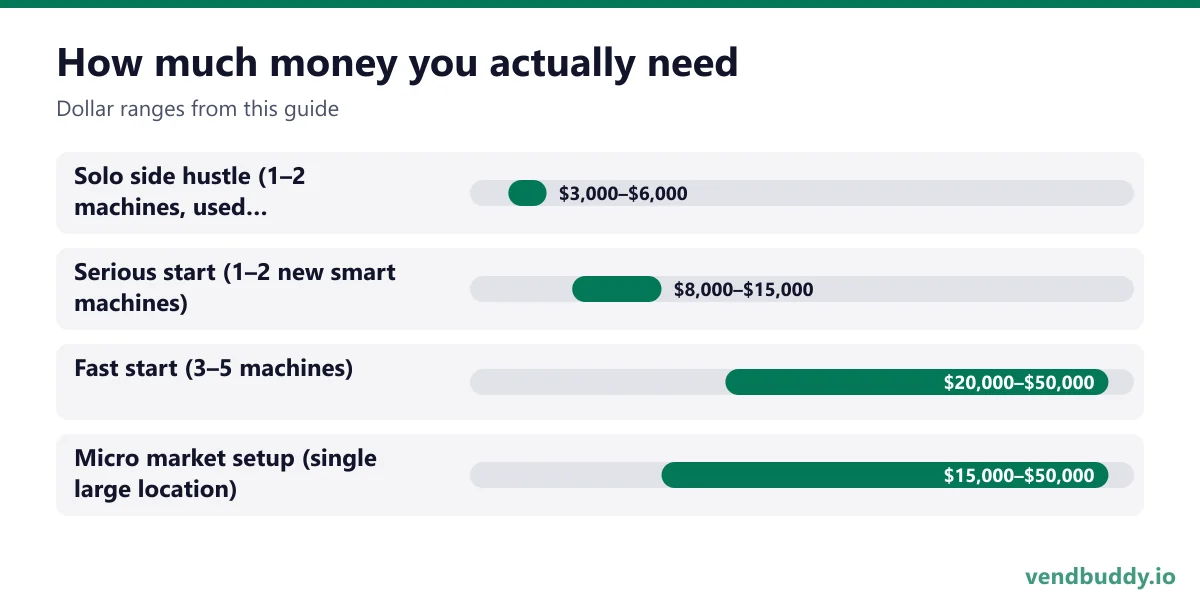
- Solo side hustle (1–2 machines, used equipment): $3,000–$6,000 total. Covers machine, inventory, licenses, insurance, and operating cash. Cheapest legitimate smart entry: a HAHA Smart Combo US-360 — refrigerated, cashless, AI grab-and-go, Prime shipping.
- Serious start (1–2 new smart machines): $8,000–$15,000 total. Better equipment, built-in cashless, higher revenue potential. The step up is the HAHA AI Plus (Plus 440) for multi-item combos, or the beverage-only HAHA DC-542D AI Pro for high-traffic offices and apartment lobbies.
- Fast start (3–5 machines): $20,000–$50,000 total. Mix of new and premium machines, broader location pipeline, working capital for rapid growth.
- Micro market setup (single large location): $15,000–$50,000 for one installation. Only viable at confirmed 100+ employee locations.
Match your funding to your plan, not the other way around. Don't finance $40,000 of equipment if your plan is to run 2 machines on the weekends. If you're starting lean, our $0-down startup guide covers BNPL, seller financing, and creative approaches that work on a shoestring.
What lenders actually look for
To maximize your approval odds:
- Personal credit score of 650+. Above 700 opens the best rates. SBA Microloan lenders work with lower scores but charge more.
- A real business structure. LLC, EIN, business bank account, and at least one month of separation between business and personal finances.
- A location letter of intent or signed agreement. This is the biggest unlock for vending-specific lenders — showing you have a real placement turns a speculative loan into a secured one.
- Basic financial projections. Expected monthly revenue, COGS, operating costs, and net profit. Use the VendBuddy ROI Calculator to generate these in minutes.
- Proof of industry research. Some lenders (especially SBA partners) want to see that you understand the business. A short business plan — even a 2-page version — signals you're serious.
Red flags: predatory lenders to avoid
The vending space attracts a predictable set of bad actors. Watch for:
- Upfront fees before a decision. Legitimate lenders don't charge hundreds of dollars just to review an application.
- APRs over 25% for equipment loans. Unless your credit is severely damaged, there are always better options.
- "No credit check" equipment deals with hidden terms. Often these are lease-to-own structures with effective APRs above 50%. Leasing is a legitimate instrument with an expensive default configuration — if one has been put in front of you, lease to own a vending machine walks the three buyout structures ($1, 10% PUT, and fair market value) and the six clauses that cost operators money, including the evergreen renewal that charges you after you thought you were finished.
- Pressure to sign same-day. Legitimate lenders will honor their quote for at least a few business days.
- Machine bundles with "guaranteed locations." Almost always a scam. Real vending operators source their own locations.
Next steps
If you're ready to fund your first or next machine:
- Use the VendBuddy ROI Calculator to model the exact economics of the location you're financing. Lenders love hard numbers.
- Apply for pre-qualification with at least two funding sources. Compare real offers, not advertised rates.
- If you need fast business credit and funding, 7Figures Credit specializes in vending operator funding — pre-qualify without impacting your personal credit.
- Never finance more than you can operate profitably in the first 12 months.
Related financing decisions
Two questions come up often enough on this page to have earned pages of their own, and both go a level deeper than the comparison above:
- How to get a loan to buy a vending machine business — the approval mechanics rather than the options: what an underwriter is actually looking at, why machines are collateral and locations are not, the document pack the seller has to produce, the debt-service-coverage test lenders run before they read anything else, and the five things that reliably kill an application.
- Leasing versus buying vending machines — the money math behind a monthly payment: a typical $60–$120 lease works out near 25% APR once you solve for the rate, plus the fair-market-value buyout trap, the tax treatment, and the four situations where leasing genuinely beats owning.
Related reading: our complete guide to starting a vending machine business, our location acquisition playbook, the real cost and profit breakdown, and our scaling guide for growing from 1 to 100+ machines. Need help choosing equipment? Check our machine buying guide and the Machine Finder tool. Want the pop-in pitch and a signable contract in your bag before your first visit? The word-for-word script is in our cold pitch script guide.
FAQ
How do I get a loan to buy a vending machine or vending business?
The three most common paths: an SBA Microloan (up to $50,000 at 8–13% APR, terms to 6 years, works with thin credit but takes 2–4 weeks), equipment financing from the machine vendor (6–12% APR, 12–36 months, decision in hours, machine is the collateral), or a credit union equipment loan (6–9% APR, the lowest rates, but expect a 10–20% down payment). For a full route or business acquisition rather than a single machine, SBA is usually the only fit at typical price points.
Can I finance a vending machine with no money down?
Yes, two ways: a 0% intro APR business credit card (12–18 month windows; a $3,000–$5,000 smart machine at a decent location pays itself off in 4–6 months, well inside the window) or vendor equipment financing, which on smaller deals often requires no down payment and no personal guarantee. Credit union loans have the best rates but usually want 10–20% down.
What insurance does a vending machine business need?
General liability at $1M per occurrence / $2M aggregate is the non-negotiable baseline — most commercial property managers require a Certificate of Insurance before they sign. Product liability is almost always bundled free. Add an additional-insured endorsement (free) naming the property. A solo operator pays $400–$700/year all-in; Hiscox, Next, and Thimble all write vending policies online in under 20 minutes.
Is financing a vending machine worth it?
Use the 12–14 month rule: if the machine pays for itself within 12–14 months at a confirmed location, financing almost always makes sense because it preserves working capital. Finance confirmed placements, pay cash for speculative ones, and never let debt outpace your ability to operate the machines.
Should I finance an AI or smart vending machine as my first machine?
Only against a confirmed location, and only if the payback still clears the 12–14 month rule at conservative revenue. A smart or AI cooler runs $5,000–$10,000+ against $1,200–$3,000 for a used combo, so the financed payment is two to four times larger while the location risk is identical. Run the number before you sign. A machine grossing $1,200 a month nets roughly $330 after 40–50% COGS and a 25–30% net margin on what is left. At that net, a $7,000 machine takes about 21 months to pay back before interest — outside the rule, and well outside any 0% intro window. Smart machines earn their premium only where the room supports the bigger basket: 150+ daily traffic, a large on-site population, and a host who actually wants the grab-and-go format. If this is your first placement and you are borrowing, the lower-risk sequence is a financed combo at a proven site, with the smart cooler as machine three or four.
The payment you are already making that earns nothing
Before the machine, before the pallet, before the card reader, there is rent. It goes out on the first of the month, it is usually the largest single payment an operator makes, and on most cards it either earns nothing or costs 2.5 to 3 percent through a third-party portal. That is the gap the Bilt card is built around. Per Bilt’s card page, every tier earns up to 1.25X points on rent or mortgage, with no transaction fee, paid through a payment portal, through Venmo, or by check via BillPay, and no minimum number of monthly transactions is required to earn on housing.
The arithmetic is not dramatic and it is not supposed to be. At $1,800 a month, a year of rent is 27,000 points on a payment that was earning zero. Route spend sits on top of that at the ordinary rate, which is 1X on Blue and 2X on Palladium. If your only question is which card pays most on product and freight, a flat 2X card still wins that contest. Bilt wins the household, which is a bigger number than the route for most people reading this.
The three tiers, as the page states them
Bilt Blue, $0 a year
Welcome offer as the page states it: $100 of Bilt Cash.
- up to 1.25X on rent or mortgage, with no transaction fee
- up to 4X at 20,000+ partner restaurants
- 3X on hotels and 2X on flights booked through the Bilt travel portal
- 3X on Lyft
- 1X on everything else
Bilt Obsidian, $95 a year
Welcome offer as the page states it: $200 of Bilt Cash.
- up to 1.25X on rent or mortgage, with no transaction fee
- up to 6X at partner restaurants
- 3X on dining or grocery, up to $25,000 a year
- 4X on hotels and 3X on flights booked through the Bilt travel portal
- 3X on Lyft
- 2X on other travel
- 1X on everything else
- a $100 Bilt Travel hotel credit twice a year
Bilt Palladium, $495 a year
Welcome offer as the page states it: $300 of Bilt Cash, plus 50,000 points and Gold status after $4,000 of spend in 90 days.
- up to 1.25X on rent or mortgage, with no transaction fee
- up to 5X at partner restaurants
- 4X on hotels and 3X on flights booked through the Bilt travel portal
- 4X on Lyft
- 2X on everything else
- $200 of Bilt Cash a year
- a $400 hotel credit twice yearly
- Priority Pass
Points transfer to 28 airline and hotel partners, or redeem for travel through the Bilt portal, for Lyft, for statement credits, or toward a home down payment. The down-payment route is the one most renters have never heard of, and it is the reason a few operators we talk to hold this card without caring about airline transfers at all.
Where this card is the wrong answer
- You carry a balance. Pay it in full or skip the whole idea. Interest erases a 1.25X earn rate inside the first statement and keeps going. Bilt’s page states a “10% intro APR on new eligible purchases for 12 billing cycles”, and the sensible way to read that is as a term on the page rather than as a plan.
- You need business-card reporting. Bilt is a personal card. It will not build a credit file for the business and it will not hand you a clean business statement at tax time.
- You own outright and have no mortgage. Strip the housing payment out and this is an ordinary rewards card, and not the strongest one.
That middle one has a workaround worth doing properly. Keep one card for business spend only and record it. A personal card used exclusively for the route is fine with an accountant. A personal card carrying the route’s product buys and your groceries is what turns tax time into archaeology. If you would rather have a business card or credit line for the LLC, 7Figures Funding (affiliate link) lets you pre-qualify for 0% intro business cards and lines of credit without a hard pull. If a simple everyday card fits better, Chase Freedom Unlimited is a personal card (referral link: we may earn a bonus if you are approved, at no cost to you), so keep one card used only for the business. Rent and personal spend on Bilt, the company’s spend on that business-only card or credit line.
Referral link: if you’re approved, we earn Bilt points at no cost to you. Bilt sets approval, rates and terms; this isn’t financial advice.
What is selling, which buildings say yes, and the numbers before you buy a machine. Free, confirm from your inbox, unsubscribe in one click. Refer one friend and get 25 VendBuddy credits.
General information, not legal, tax or financial advice. Rules change, so check the official source. Revenue and income figures are examples, not promises. See our terms.