Setting up your vending business legally isn't complicated — but doing it wrong costs time and money. Here's the step-by-step for LLC formation, the tax deductions you're probably missing, and when to bring in a CPA.
Part of our complete guide: how to start a vending machine business.
Do you need an LLC for a vending machine?
No law requires an LLC to own or operate a vending machine. You can start as a sole proprietor under your own name, and plenty of operators do. What you will need either way is the paperwork your state and city require for any business: usually a business license and a sales tax permit, and sometimes a vending or food permit for the machine itself.
Most people rebuild these documents from scratch and then lose them. The kits are the paperwork in fill-in-the-blank form, bought once, no subscription.
Most operators form an LLC anyway, for three practical reasons. It separates the business from your personal assets if someone is hurt by a machine or a property is damaged. Many locations, especially offices, schools and property managers, expect to sign a placement agreement with a business entity that carries liability insurance. And it keeps the bookkeeping clean, which matters once deductions like depreciation and mileage start adding up. State filing fees range from under $100 to about $500, plus any annual report fee.
Where the LLC actually earns its fee
The moment is the first placement contract.
Read one and you will find an indemnification clause. The wording varies but the substance does not: you agree to defend and hold the property harmless against claims arising from your machine or your presence on site. That is a reasonable thing for a property manager to ask for. It is also you personally guaranteeing an unbounded promise if there is no entity between you and it, and the scenarios are not exotic. A machine tips on someone. Somebody trips on a cord you ran. A refrigerated unit fails over a long weekend and a claim follows the product that was inside it.
As a sole proprietor there is no legal distinction between the business and you, so a claim against the business is a claim against your savings, your car and your equity. With a properly maintained LLC, the claim normally stops at the business. What the contract asks for stays the same either way, which is exactly why the entity is the cheaper half of the answer. The clauses worth reading twice before you sign anything are in vending machine contracts 101.
Two honest limits on that protection. It does not cover your own negligence, and it collapses if you run business money through a personal account. Courts set aside the separation when the operator never really maintained one, which is the whole reason the bank account step below is not optional.
And an LLC is not insurance. General liability at $1M per occurrence costs a small operator $500 to $1,500 a year, and most commercial property managers will ask for a certificate before they sign. The entity decides who is liable. The policy is what pays.
Picture the machines paying you while you sleep
That’s the real promise of vending — income that doesn’t cost you your time, and a life on your own terms. VendBuddy turns this guide into a step-by-step plan so you actually build it instead of just reading about it. Start free today.
Start building free →What it costs, by state band
Filing fees vary more than almost anything else in this business, and the sticker price is the part people compare when the recurring cost is what actually adds up:
- Roughly $40 to $100 to file: Kentucky, Colorado, New Mexico, Michigan, Arizona, Missouri, Ohio, Wyoming.
- Roughly $100 to $200: where most states land, including Florida, Georgia, Illinois and New York. New York also requires newspaper publication, which is a separate and sometimes larger cost.
- $300 and up: Texas at $300, Tennessee at a $300 minimum, Massachusetts at $500.
- The recurring line, which is the one to check: California charges an $800 minimum annual franchise tax regardless of profit, Delaware $300, and annual report fees elsewhere run from nothing to a few hundred dollars. Over five years that number dwarfs the filing fee.
File in the state where the machines actually are. The Wyoming and Nevada advice that circulates online is written for online businesses with no physical footprint; a vending route has machines sitting in buildings in one state, and registering elsewhere usually just means paying two states instead of one. Confirm your current fee on your Secretary of State site rather than trusting any article, this one included, because these numbers get revised.
When a sole proprietorship is genuinely fine
There is a real version of this where you skip the filing for now. You bought a used machine outright for cash, so no lender needed an entity. You placed it in a family business, a friend’s shop or your own storefront, with no signed indemnity in play. You are testing whether you like the work at all before spending another dollar on it.
The tripwire to watch for is the first real placement agreement, because that is when you stop testing and start promising. Form the entity before you sign it, not after.
The other tripwire is financing. Equipment lenders and 0% business cards want a business to lend to, and a thin file is easier to build with an entity and an EIN attached to it than without.
How to set up an LLC for your vending business
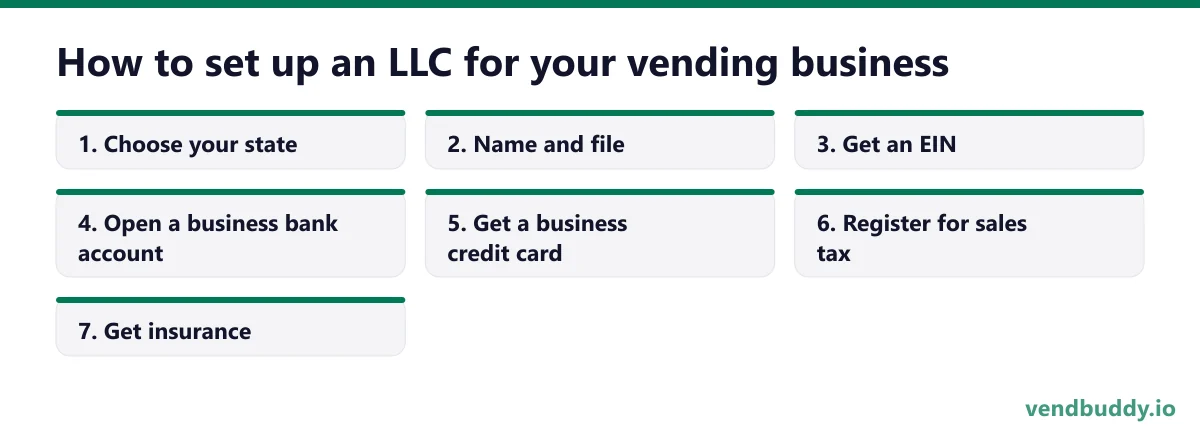
Step 1: Choose your state
File in the state where you operate machines. Costs vary: Wyoming ($100), New Mexico ($50), and Colorado ($50) are cheapest. California ($800/year franchise tax) and Massachusetts ($500) are most expensive.
Step 2: Name and file
Check name availability on your Secretary of State website. File Articles of Organization online — takes 15–30 minutes in most states. Processing: 1–5 business days for online filing.
Step 3: Get an EIN
Apply free at IRS.gov. Takes 5 minutes. You need this for a business bank account, hiring employees, and filing taxes.
Step 4: Open a business bank account
Separate personal and business finances completely. Most banks require: EIN, Articles of Organization, and a form of ID.
Step 5: Get a business credit card
Start building business credit immediately. Use it for machine purchases, inventory, fuel, and subscriptions. Pay it off monthly. Your business credit score will matter when you want equipment financing later.
If you want a business card or credit line, 7Figures Funding (affiliate link) lets you pre-qualify for 0% intro business cards and lines of credit without a hard pull. If you want one simple card that earns on everything with no annual fee, Chase Freedom Unlimited is a personal card (referral link: we may earn a bonus if you are approved, at no cost to you), so keep one card used only for the business. Chase Freedom Unlimited: 1.5% cash back on everything, 3% on dining and drugstores, 5% on Chase Travel, no annual fee (checked 2026-10-08).
Operators who want the rewards side of that spend organized rather than accidental usually end up running two or three cards against one points balance, which is the arrangement explained in the Chase Trifecta for vending operators.
Step 6: Register for sales tax (if applicable)
Most states require sales tax collection on vending machine sales. Some states exempt food items under certain price thresholds. Check your state's specific rules — requirements vary significantly.
Step 7: Get insurance
General liability insurance ($1M–$2M policy) costs $500–$1,500/year for small operators. Many locations require a Certificate of Insurance (COI) before signing a placement contract. Add Workers' Comp the moment you hire employees.
Tax deductions every vending operator should claim
- Section 179 depreciation: Deduct the full cost of machines in the year you place them in service (the 2026 limit is $2.56 million). A $4,000 machine = $4,000 off taxable income in year one.
- Bonus depreciation: Can create near-tax-free income in strong years — verify current rates with a CPA.
- Vehicle mileage: IRS standard mileage rate of 72.5¢/mile for January to June 2026 and 76¢/mile from July 1 (IRS) for every trip to service, restock, or pitch locations. At 500 miles/month, that's about $363 to $380/month in deductions. Log each trip the day you drive it, in an app or a glovebox Adams vehicle mileage journal.
- COGS: Every product purchased for resale is deductible.
- Card reader fees: Monthly subscriptions and processing fees.
- Insurance premiums: General liability, property, auto, workers' comp.
- Warehouse/storage rent: Fully deductible.
- Phone and internet: Business percentage.
- Marketing: Business cards, flyers, website, VendBuddy subscription.
- Home office deduction: If you run operations from home.
- Repairs and maintenance: Parts, service calls, cleaning supplies.
- Professional services: CPA, bookkeeper, attorney fees.
Most of these deductions get missed because the receipts get lost, not because the rules are hard. Keeper links to your business card and bank account and flags write-offs like product, parts and mileage as they post, and you can try it free before tax season. Affiliate link: VendBuddy may earn a commission at no extra cost to you.
The QBI deduction
If you operate as a pass-through entity (sole proprietorship, LLC, or S-Corp), you may qualify for a Qualified Business Income (QBI) deduction of up to 20% of net business income. On $60K net income, that's a $12K deduction — roughly $3,000 in tax savings.
When to hire a CPA
DIY with QuickBooks or Wave until you pass $5K/month revenue. At that point, a CPA ($200–$500/year for a small vending business) pays for themselves through deductions you'd miss and S-Corp election timing. The S-Corp election can save $5,000–$15,000/year in self-employment tax once you're earning $50K+ net — but the timing and structure matter, so get professional advice. VendBuddy may earn a commission if you sign up through the QuickBooks link.
Frequently Asked Questions
Do you need an LLC to own one vending machine?
No. Every state lets you own and run a vending machine as a sole proprietor under your own name and report the income on Schedule C. The LLC starts earning its fee when you sign a placement contract with an indemnity clause, because that promise otherwise sits on your personal assets.
Most first agreements are two pages, not twenty. The contracts walkthrough lays out the clauses that actually matter for the contract, including the termination language operators forget about until they need it.
How much does an LLC for a vending business cost?
Filing fees run roughly $40 to $500 depending on the state, and the recurring cost matters more: California charges an $800 minimum annual franchise tax, and annual report fees elsewhere range from nothing to a few hundred dollars. File in the state where the machines are.
Can you write off a vending machine on your taxes?
Yes. A vending machine is business equipment, so you deduct it — the only real question is how fast. Section 179 lets you expense the full purchase price in the year the machine is placed in service instead of spreading it over seven years, up to the annual cap ($2.56 million for 2026, far above anything a route operator will reach). A $4,000 machine bought and placed in the same tax year comes straight off your taxable income. Two conditions catch people out: the machine has to be placed in service, not sitting in your garage waiting for a location, and the deduction cannot exceed your business income for the year, though the excess carries forward. Bonus depreciation is the fallback when Section 179 is limited. Everything attached to the machine is deductible too — card reader, install, wrap, freight. Confirm current-year limits with a CPA before you file, because these numbers move.
Related: full cost and profit breakdown, financing guide, complete startup guide, real income numbers from real operators, and scaling your vending business. Check vending machine regulations in your state for licensing and tax requirements, and use the ROI Calculator to model how depreciation deductions improve your after-tax returns.
What is selling, which buildings say yes, and the numbers before you buy a machine. Free, confirm from your inbox, unsubscribe in one click. Refer one friend and get 25 VendBuddy credits.
Want the free 38-page Ultimate Vending Guide too? Get the guide
General information, not legal, tax or financial advice. Rules change, so check the official source. Revenue and income figures are examples, not promises. See our terms.