🌐 También disponible en español · Também disponível em português
Starting a vending machine business means one machine, one location you have already secured, and a few thousand dollars. A new compact combo machine lists for about $2,500 to $3,600 at dealers (Gumball.com, A&M Equipment), a card reader is about $400 (Nayax), and liability insurance runs a median $37 a month for vending operators (Insureon). You don’t need experience, connections, or a warehouse. Most operators started without the answers and ran their first machine around a day job. This page is the plan, in the order that works: the business setup, the first location, then the machine, then the numbers.
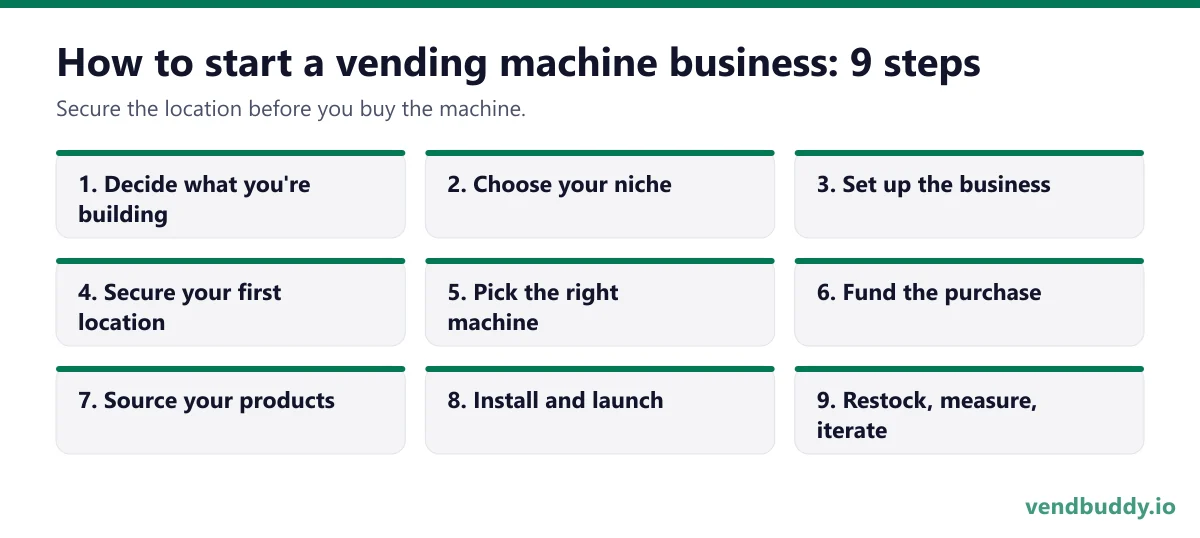
- Pick your path: side hustle, transition, or full-time.
- Choose a niche based on your local market and capital.
- Form an LLC and open a business bank account.
- Secure a location FIRST, then buy the machine that fits.
- Set up cashless payment: 78% of vending sales were cashless in 2025 (Cantaloupe).
- Track per-machine numbers weekly from day one.
Budget: about $2,500 to $5,300 for one machine, built line by line in the cost table. Full step-by-step below ↓
Where beginners actually stall: not the LLC, not the machine. Step 4. Nobody has a location, so nobody buys a machine, so nothing starts. Break that first: pull the ten businesses nearest you that fit a machine (free, no card), then read the rest with real names in front of you.
Step 1: Decide what you’re actually building
Vending supports three distinct business models and picking the right one shapes every decision that follows.
The three paths
- Side hustle (1–5 machines): Solo operation, handled on nights and weekends. Target: $500–$3,000/month in extra income. If you’re a beginner, this is your path.
- Transition business (5–15 machines): Part-time help or a delivery stocker. Target: $3,000–$10,000/month. The bridge between side hustle and full-time.
- Full-time business (15+ machines): Warehouse, team, operations manager, $10,000+/month. Usually requires 18–24 months of consistent growth to reach.
Pick your target before you buy a single machine. If your goal is $1,000/month of extra income, you do not need 25 machines. You need 3–5 excellent placements. If your goal is to replace a six-figure salary, side-hustle thinking will actively slow you down.
The path you pick does not decide how many machines you buy on day one. That is a separate decision with its own answer, and it is almost always one machine at a location you have already secured. one machine, three, or a small route walks through the first-purchase sizing decision, including when buying an existing route beats starting from scratch.
Step 2: Choose your niche
The common niches:
- Snacks and drinks (traditional combo machines): The default, highest-volume path. Best for mixed-use locations like offices, warehouses, and gyms. Best choice for beginners.
- Smart/AI machines and micro markets: Open-shelf mini-stores with computer-vision checkout. Bigger baskets: in 2025 the average micro market purchase was $3.02 and the average Smart Store purchase $4.49, against $2.01 at a vending machine (Cantaloupe 2026 report). The equipment costs more and needs a large, steady headcount to justify it.
- Healthy/specialty: Fitness centers, corporate wellness, medical offices. Higher margins, narrower product catalog, premium pricing.
- Coffee and beverage-only: Office buildings, co-working spaces. Lower margins on coffee itself, but repeat daily customers.
Turn this guide into a step-by-step plan
VendBuddy gives new operators the whole starter kit: find locations, model ROI, generate contracts, and get the scripts to land your first machine. Sign up free and get 5 credits.
Start my plan free →Step 3: Set up the business
Do this before your first machine, not after. It takes a few hours and costs under $500.
- Form an LLC in your state. State filing fees run from $35 in Montana to $500 in Massachusetts (state fee table). BEGINNER TIP: Use an online LLC service like ZenBusiness or LegalZoom if the state portal feels confusing; they handle the paperwork for $50–$150.
- Get an EIN from the IRS. It is free and takes a few minutes online. Required to open a business bank account.
- Open a business bank account. Never run vending revenue through your personal account. Bookkeeping at tax time will become a nightmare, and you lose liability protection if you mix funds.
- Get the required licenses. Varies by location, typically includes a general business license, a sales tax permit, and a health department permit if you sell perishables.
- Buy general liability insurance. Most property managers ask for a certificate of insurance before they sign. Vending operators who bought through Insureon paid a median of $37 a month ($442 a year) for general liability, or $58 a month for a business owner’s policy (Insureon).
Licensing and tax pointers (what to check, where)
- State sales tax. Vending sales are usually taxable, and some states have their own vending rules for how tax is figured. Register with your state revenue department before your first sale; the SBA tax ID guide links each state.
- Local business license. Your city or county clerk issues it. The SBA licenses and permits page explains federal, state and local layers.
- Health permit. Usually only if you sell perishable or fresh food. Packaged snacks and sealed drinks are often exempt, but check with the county health department.
- Calorie labeling. Operators with 20 or more machines must disclose calories for food sold from them (FDA vending labeling rule). Glass-front machines can rely on front-of-package labels.
- Schools. Machines students can reach during the school day must meet USDA Smart Snacks limits, such as 200 calories or less per snack (USDA Smart Snacks).
- Income tax. Keep every receipt from day one. Machines, mileage and product are business expenses; vending LLC and tax deductions covers what operators deduct.
Your state’s exact list is on the vending laws by state page, and vending machine permit requirements by state walks through the food-handling piece.
Step 4: Secure your FIRST location before buying a machine
This is the most common mistake new operators make: buying a machine first, then scrambling to find somewhere to put it. Do it the other way.
BEGINNER NOTE: You need one yes out of 15–20 pop-ins. Read our complete location guide for the exact script and follow-up cadence.
The other thing beginners get stuck on here is whether a given venue is even allowed to have a machine. Short version: can you put a vending machine anywhere is a permission question rather than a zoning one, so the constraint is whoever controls that floor, and public sites like parks and schools go through a bid instead of a conversation.
Why location-first beats machine-first
- Different locations have different space constraints (doorway widths, floor area, electrical access). The wrong machine for the wrong space is wasted capital.
- You’ll buy the right machine type for the actual customer base: a snack combo for a small office, a smart cooler for a residential high-rise.
For the software version of that list, how to find vending machine locations explains what our scorer weighs. The VendBuddy Lead Finder then pulls the businesses near your ZIP that fit a machine, with the job title to ask for at each one, so your 20 pop-ins start from real names instead of a blank map.
The free Opportunity Map scores any US ZIP on population, employment, and median income, with no account needed, so your first 20 pop-ins land in the strongest area near you instead of the closest one. The walkthrough is in best places to put a vending machine near you.
Step 5: Pick the right machine
Once you have a verbal commitment, match the machine to the location. A short decision tree:
- Low traffic (under 50 daily visitors) or tight budget: A used combo machine ($1,200–$3,500). Lower risk if the location doesn’t perform. Good beginner choice.
- Medium traffic (50–150 daily): A new combo machine with built-in cashless ($4,500–$6,500). Reliable, long lifespan, easy to maintain.
- High traffic (150+ daily) with 100+ on-site employees or residents: A smart/AI cooler ($6,000–$10,000) or micro market setup ($15,000+). Larger average purchases than a machine (see the Cantaloupe numbers in Step 2).
- Solo operator who wants to install alone: Prefer smart coolers that ship on wheels with built-in cellular. A single person can install in roughly 2.5 hours without negotiating WiFi access.
Use the VendBuddy Machine Finder to match a specific location type and traffic level to the exact machines that fit your budget and target ROI. For a deeper dive, read our complete machine buying guide.
Step 6: Fund the purchase
We broke down every option in our vending machine financing guide. The short version:
- Cash: simplest, highest opportunity cost, lowest risk.
- SBA Microloans: up to $50,000 through SBA intermediaries; the average microloan is about $13,000 (SBA).
- Equipment financing from the machine vendor: many dealers offer financing. Compare the APR and term against the payback math below before you sign.
- Business credit lines: useful for inventory and operating cash, not just equipment.
- Reinvested cash flow: buy machine 1 in cash, use its revenue to fund machines 2 and 3.
A simple rule: if the profit math below pays the machine back inside the loan term at a confirmed location, financing can make sense. Preserve your operating capital for inventory, repairs, and new location deposits. If cash is tight, our $0-down startup guide covers six creative ways to get your first machine placed without upfront capital.
The path most first-time operators actually take is the fourth one on that list: a 0% intro-APR business credit line, used to buy machine number one without draining the savings account that has to cover product, repairs and the first slow month. 7 Figures Funding specializes in helping new business owners qualify for 0% intro business credit lines. Borrow against a location you have already signed, never against a guess, and confirm the machine pays itself back inside the intro window before you draw.
Step 7: Source your products
Retail pricing at regular grocery stores will destroy your margins. You need wholesale pricing from the start. Options:
- Costco and Sam’s Club: Good for the first 1–5 machines. Decent wholesale pricing without a distributor account.
- Vistar: The largest route-scale vending distributor. Required at scale. Minimum order sizes apply.
- Restaurant supply stores: Good middle option with bulk pricing and no minimum.
- Direct from manufacturer: Available for larger routes. Best margins but requires volume.
What to stock in your first machine
Start with a proven base: Coke and Diet Coke 20oz, Sprite 20oz, bottled water, Celsius, Gatorade Zero, Doritos Nacho Cheese and Cool Ranch 1.75oz, Kit Kat, Snickers, Twix, Reese’s, Starburst gummies, and Trolli gummies. This mix moves in almost every location type. Our vending machine snacks guide breaks down chips, candy and pastries by cost and shelf life, the drink and soda machine guide covers the cold side, and the complete product stocking guide covers the full planogram, highest-margin items, and location-specific mixes. You can also use the VendBuddy Catalog & Margins tool for real-time margin calculations.
Stock broad for the first 30 days, track every sale, then aggressively prune to your top 10–15 SKUs.
Step 8: Install and launch
Before delivery day:
- Confirm the electrical outlet is working and at the right location.
- Measure the doorway and install path. Smart coolers on wheels usually fit; older combo machines may need the door frame removed.
- Confirm your cellular coverage or WiFi access for cashless payment.
- Pre-kit your inventory so you can stock the machine the same day as install.
After getting a verbal yes, send a brief written confirmation to the property manager with your timeline, equipment specs, and any facility needs (power outlet, placement spot, elevator access).
On install day, arrive with the machine, a dolly, your inventory, and a handful of signs (QR code for cashless, “new machine” announcement, your contact info). Test every coil or slot, confirm card reader connectivity, and take photos for your records. Most installs take 2–4 hours from arrival to fully stocked and live.
Most operators end up on Nayax for card readers because it is what the distributors already support. Their reader handles tap, chip and the telemetry feed in one box, and the monthly fee is the part to check against your per-machine volume before you commit the route to it. Affiliate link, so we may earn a commission at no extra cost to you.
Launch-day marketing matters: post in the building’s tenant app, Facebook group, or bulletin board to let residents know the machine is live.
For the physical side of install day (hand truck, locks, card reader, coin counter), the Route Starter Checklist has one pick per job and one cart link at the end.
Step 9: Restock, measure, and iterate
Your first 30 days at a new location are diagnostic, not revenue-maximizing. Use the DIAL method to optimize your mix over the first 90 days:
- Deploy your initial good-enough mix. Restock weekly at minimum during the first month.
- Investigate what sells and what sits. Track every sale by SKU using your machine’s telemetry or a simple spreadsheet.
- Adjust one thing at a time. After 30 days of data, swap one slow mover for a new test item.
- Learn from each change before making the next. After 60 days, review pricing against the nearest convenience store and the data from your card reader. Turn slow slots into intentional test slots rather than constantly restocking products that aren’t selling.
What it costs to start a vending machine business, line by line
Here is one machine priced from real listings and published figures, checked in October 2026. Prices move, so treat this as the shape of the budget and re-check before you buy.
| Line item | Cost | Source |
|---|---|---|
| New compact combo machine (Seaga SM2300, 16 snacks and 7 drinks) | $2,474 to $3,595 | Gumball.com, A&M Equipment |
| Or: refurbished drink machine (Dixie Narco 501E) | $1,519 to $1,800 | Vendo Fleet, Westway Vending |
| Card reader (Nayax VPOS Touch) | $399 | Nayax shop |
| LLC state filing fee | $35 (Montana) to $500 (Massachusetts) | FileForms state table |
| EIN | $0 | IRS |
| General liability insurance | Median $37/month ($442/year) | Insureon |
| Opening product (sample: 50 bags of chips, 48 candy bars, 24 sodas) | $104.89 | Sam’s Club: chips $18.48, Snickers $53.53, Coke 20 oz $32.88 |
Add it up and one machine lands around $2,500 to $5,300 all in for year one: the low end is a refurbished machine in a cheap-filing state, the high end a new combo machine in Massachusetts with a fuller first load. A full first load usually takes a few of those sample boxes, so price your own list the same way. For a deeper breakdown by machine type, see the itemized startup cost guide.
Profit math for one machine
Every sale splits the same way: what the customer pays, minus what the item cost you, minus the location’s commission, minus card fees. Here are the inputs we can source:
- Average sale: $2.01 per vending transaction in 2025, across Cantaloupe’s data set of about 581,000 food and beverage machines (Cantaloupe 2026 report).
- Product cost: $0.37 for a 1 oz bag of chips, $1.12 for a Snickers bar, $1.37 for a 20 oz Coke at Sam’s Club prices (chips, candy, soda). A mix of 40% chips, 30% candy and 30% soda averages about $0.90 per item.
- Commission: this one is yours to negotiate. The example below assumes the location takes 10% of sales; many small sites take nothing.
So each sale leaves about $2.01 minus $0.90 product minus $0.20 commission, roughly $0.91, before card fees, gas and your time. Volume is what changes the answer:
| Sales per month | Gross | Product | Commission (10%) | Left before card fees, gas, insurance |
|---|---|---|---|---|
| 150 (5 a day) | $301.50 | $135.00 | $30.15 | $136.35 |
| 300 (10 a day) | $603.00 | $270.00 | $60.30 | $272.70 |
| 600 (20 a day) | $1,206.00 | $540.00 | $120.60 | $545.40 |
This is an illustration built from the sourced inputs above, not a promise. At 300 sales a month, a $2,873 to $3,994 machine-plus-reader pays back in roughly 11 to 15 months. At 150 sales it takes twice as long, and in a building where five people walk past a day it may never pay back. That is the whole argument for securing the location before the machine.
The number that matters most is sales per day, and that comes from headcount and how far people are from the next option. If you want to stop guessing at it, the ROI model in VendBuddy runs this same math with your own prices. For what real routes report, read how much vending machines make and vending machine commission rates.
Why people do it anyway: ten machines like the middle row are about $2,700 a month before costs, earned on a schedule you set. That is time at your kid’s game instead of another meeting. It takes work to get there, one location at a time.
Walk me through it: zero to your first location in 30 days
Thirty days is enough to go from nothing to a signed location. It is usually not enough to also have the machine installed, because freight scheduling is not yours to control. So run the month as a location sprint, keep the equipment homework alongside it, and expect the install itself to land in week five or six.
Week 1: register the business, then build a list of 20 buildings. Form the LLC or file as a sole proprietor, get the EIN, open a separate bank account. That is one afternoon and $50 to $500. Everything else this week goes into the list: 20 buildings inside a 20-minute drive, each with more than 50 people through it on a normal weekday, each with either no machine or one that is obviously neglected. At the 10 to 15 percent close rate a beginner should expect, that is roughly what it takes to land one signature, and the people who pitch four buildings and stop are the ones who decide the business does not work.
Week 2: contact all 20, in two different ways. Walk into the owner-operated places without warning (gyms, auto shops, tire shops, small manufacturers, family-run clinics), because the person who can say yes is standing right there. Email the ones with a property management company behind them, since at those the decision-maker is never at the front desk. The wording for both is in cold email scripts for vending contracts. Send Tuesday through Thursday morning, follow up once after four business days, then leave it. Out of 20 buildings, 3 to 6 replies and 1 to 3 real conversations is a normal week, not a bad one.
Most first agreements are two pages, not twenty. The contracts walkthrough lays out the clauses that actually matter for the contract, including the termination language operators forget about until they need it.
Week 3: turn the verbal yes into paper. A manager saying “sure, sounds good” is not a location. Before you spend money, get five things written down: where exactly the machine sits, who supplies the outlet, what commission (if any) the property gets, how you get in after hours, and how either side ends the arrangement. One page is enough. vending machine contracts 101 has the clauses and why each one exists. Sign it even when the manager is friendly, because the friendly manager takes another job in March and the next one has never heard of you.
Week 4: buy the machine you now know you need. You have measured the doorway, you know whether the room wants snacks or drinks or both, and you know the headcount, so you are buying for a real building instead of guessing. Order the machine, book the freight, and put the card reader on before delivery rather than after. Freight runs three days to two weeks. First stock is $250 to $400. Then you are live.
The bottleneck in all of this is week 1, and it is the part people quietly skip: nobody wants to sit down and write out 20 real buildings with names and addresses. VendBuddy scores the buildings near you by category, headcount and traffic and gives you the job title to ask for at each one, which turns that week into an evening.
Mistakes to avoid in your first 90 days
- Buying a machine before securing a location. See all 10 vending machine mistakes to avoid for the full list.
- Stocking based on personal taste. Your preferences are irrelevant. Data is everything.
- Overstocking perishables. Fresh food in a location under 150 daily visitors will almost always lose money to spoilage.
- Quitting after 2–3 location rejections. Expect to pitch 15–20 locations for every one you land.
- Skipping cashless payment. Cashless was 78% of vending sales in 2025, and the average cashless purchase was $2.45 against $1.57 in cash (Cantaloupe). A cash-only machine leaves most of the money on the table.
- Underpricing to “compete.” You don’t compete on price. You compete on convenience, so price near the closest convenience store and protect your margins.
- Not tracking expiration dates. Selling expired product is a health risk and a contract-breaker.
Your first 90 days, summarized
- Days 60–90: Optimize product mix based on actual sales data. Start prospecting your second location while machine 1 matures. When you’re ready to grow, our scaling guide covers the four stages from solo to operations manager.
That 90-day view is deliberately generous. The launch itself, from decision to a machine taking money, runs closer to six to ten weeks for most people, and roughly 80% of that calendar sits in one step. How long it takes to start a vending machine business breaks the timeline down week by week and shows which step the outliers are always losing time in.
Want this whole page as a list you can work down instead of read? The complete startup checklist is every step above in operating order, one line each, grouped by phase, with the explanations stripped out and left here.
Ready to start? The VendBuddy platform gives you everything you need in one place: lead search, contact enrichment for property managers, machine recommendations, ROI modeling, and a contract generator.
Also explore: Is vending a good business? (the honest analysis), how much vending machines actually make (real numbers), and LLC setup and tax deductions for vending operators. Also see: the solo install day checklist and vending contracts 101.
Business models in 2026: machine, micro market, smart market
The three options in 2026:
- Vending machine. Under 75 employees on-site, smaller footprint, lowest capex. Still the default for most starter operators.
- Micro market. Mid-size workplaces; the average purchase was $3.02 in 2025 versus $2.01 at a machine (Cantaloupe). See micro markets vs vending machines.
- Smart market. 500+ employees, frictionless walk-out retail. Higher capex, highest ceiling. See the smart market operator guide.
If your target sites skew Class A multifamily or premium offices, read modern amenities before your first pitch. For the full 2026 location ranking, see best vending machine locations in 2026.
The admin layer nobody puts in the highlight reel
Three steps decide whether the launch above is legal and insurable, and all three are cheap if you do them in order. the itemized cost to start a vending machine business puts a real number on machine, stock, card reader and entity. Then check what your state and city actually require: vending machine licenses and permit requirements vary wildly by jurisdiction, and the food-handling piece in particular catches operators who assumed a business licence covered it. Finally, most property managers will ask for a certificate of insurance before they will sign anything, so read the vending machine insurance guide before your first pitch rather than after your first yes. If you want all three sequenced into one fill-in checklist with cost bands, alongside the all-50-states distributor list, that is the Vending Business Starter Kit.
Do you have the time? Find out in 10 seconds
Time is the real question behind “is vending worth it?” Drag the slider to your honest weekly availability and see what your schedule actually supports.
Do you actually have time for vending?
Most people overestimate how much time a vending route takes. Drag the slider to your real weekly availability for an honest read.
Frequently Asked Questions
How much does it cost to start a vending machine business?
About $2,500 to $5,300 for one machine in year one. A new compact combo machine lists for $2,474 to $3,595 and a refurbished drink machine for $1,519 to $1,800; a card reader is about $399; LLC filing runs $35 to $500 by state; liability insurance is a median $37 a month; and a sample opening load of chips, candy and soda costs about $105 at warehouse-club prices. The line-by-line sources are in the cost table. If cash is tight, see our $0-down guide.
Is a vending machine business profitable?
It can be, and location decides it. With the 2025 average vending sale of $2.01, about $0.90 in product per item and a 10% commission, each sale leaves roughly $0.91 before card fees, gas and time. At 300 sales a month that is about $273; at 150 it is about $136. A machine in a building with real headcount and nowhere else to buy is profitable; a machine in a quiet lobby often is not. The full worked example is in profit math for one machine.
How much does a vending machine make a month?
It depends on sales per day. Using the 2025 industry average sale of $2.01, a machine selling 10 items a day grosses about $603 a month and one selling 20 a day about $1,206, before product, commission and fees. Your own sales count is the number to measure from week one. Real route numbers are in how much vending machines make.
How long does it take to make money from a vending machine?
A machine takes money on day one, but paying back the purchase takes longer. At 300 sales a month, a $2,873 to $3,994 machine and card reader pay back in roughly 11 to 15 months in our worked example; at 150 sales it takes about twice as long, which is why location-first is the golden rule.
Do I need a license to put a vending machine in a business?
Usually you need a local business license, a state sales tax registration, and a health permit only if you sell perishable food. Operators with 20 or more machines must also post calorie information under the FDA vending labeling rule, and school machines must meet USDA Smart Snacks limits. Check your state on the vending laws by state page.
Do vending machine sales get taxed?
Generally yes. Vending sales are usually subject to state sales tax, and some states have special vending rules for how it is calculated, so register with your state revenue department before your first sale. Your profit is business income on your tax return, and machines, mileage and product are deductible expenses. See vending LLC and tax deductions.
Can I start a vending machine business with no experience?
Yes. The skills required (inventory management, light sales, basic bookkeeping) are all learnable. The steepest learning curve is business development: finding and pitching locations. Expect your first 2 to 3 months to feel slow. Month 5 to 6 is typically when lead flow starts to compound.
Do I need an LLC for a vending machine business?
Technically no, but practically yes. A sole proprietorship is legal in all 50 states, so the real trigger is the first placement contract. Those carry indemnity language, and without an entity that promise reaches your personal assets. State LLC filing fees run from $35 to $500. The full yes/no and the filing steps plus deductions are in do you need an LLC for a vending machine business.
How many vending machines do I need to make a full-time income?
Using the worked example on this page (about $273 a month left per machine at 300 sales, before card fees, gas and your time), $5,000 a month would take around 18 machines at that volume, and fewer at busier placements. Placement quality beats machine count at every stage.
Can you walk me through how to start a vending machine business and secure locations?
Register the business and build a list of 20 nearby buildings in week one, contact all 20 in week two by walking into the owner-operated ones and emailing the managed ones, convert a verbal yes into a one-page written agreement in week three, and buy the machine in week four now that you know the doorway, the headcount and the product mix. Budget four to eight weeks from first conversation to first sale, since freight and install add one to two weeks after the signature.
What is a lending machine? Did you mean vending machine?
Almost certainly yes. Lending machine is one of the most common typos for vending machine, and if that is what you searched, this is the guide you were looking for. There is a rarer thing called a lending machine: a self-service kiosk that lends items like library books, tools or laptops and takes them back, which is a different business with different economics.
Operator toolkit (the gear that pays for itself)
The vending machine is the big spend. The items below are the small-to-mid spends that consistently pay back fast — every experienced operator we've worked with has at least three of the day-1 items, and most operators past 5 machines have all of the warehouse-tier ones.
Day 1 — small spend, big leverage
- WYZE Cam OG security camera (2-pack). A camera pointed at every machine. Stops cash-box theft and settles "the machine ate my dollar" disputes in 30 seconds. Check the listing for mounting and storage details before you buy. Buy here →
- Scotch Thermal Laminator TL901X. Laminate your scope-of-work, location flyer, and contract before every property-manager pitch. Laminated proposals close visibly more often than printed paper — they look like you've done this before. Buy here →
- Nelko P21 Bluetooth Label Maker. Tiny Bluetooth labeler — print product price tags, machine ID stickers, restock-bin labels straight from your phone. The cheapest organization tool you'll ever own and the one stockers actually use. Buy here →
- DYMO LabelManager 160 (handheld, with 3 tape cassettes). Step up to this when you have 5+ machines and a warehouse. Standalone QWERTY keyboard, no phone needed — the warehouse manager and your stocker both grab it without setup. Faster than the Nelko once you're labeling 50+ items per restock cycle. Buy here →
Beyond machine #1 — warehouse, hauling, off-grid
- Strongway 1,200 lb Industrial Hand Truck. The dolly that actually moves a 280 lb HAHA combo by yourself. Convertible 2-wheel-to-4-wheel, stair-climbing rear wheels, auto-recoil ratchet strap built in. Operators who try to install with a cheap dolly damage cabinets and end up renting one — buy this once. Buy here →
- SIMPLI-Magic 800 lb Convertible Hand Truck. The cheaper alternative if you only ever move under-200-lb appliances or need a dolly for inventory totes. Folds flat for car trunk storage, 2-in-1 vertical / flat platform. Don't use this on a full-size machine — it's rated 800 lb but the leverage geometry favors the Strongway above for tall heavy cabinets. Buy here →
- REIBII 5-Tier Heavy-Duty Wire Shelving (3,200 lb). Warehouse-tier rack — 55" wide, 71" tall, holds 640 lb per shelf. Set two of these against opposite walls in a 200 sqft storage unit and you've got a real pick-pack workflow. Adjustable shelves, no tools required, ~10-min assembly. Buy here →
- EBL Portable Power Station 1000W (999 Wh). The unlock for outdoor / festival / construction-site / RV-park placements that don't have a 120V outlet. Runs an HAHA mini cooler for ~20 hours, recharges via solar panel, AC outlet, or car. Also doubles as your home backup during a hurricane week — operators in Houston/Florida/Carolinas have used these to keep route inventory cold during outages.
Need a category instead of a specific pick? Browse the current best sellers:
The full gear list, organized by category, lives in the Operator Resources guide.
This guide is the map. The Vending Business Starter Kit is the paperwork: the LLC, EIN, permit, sales-tax and insurance checklist in unblocking order, a vending machine distributor list covering all 50 states with a 15-point used-machine inspection, and a 96-term glossary. One-time, no subscription.
Get the vending machine starter kit →What is selling, which buildings say yes, and the numbers before you buy a machine. Free, confirm from your inbox, unsubscribe in one click. Refer one friend and get 25 VendBuddy credits.
Walk-ins and cold emails find locations. A small site with your own machine photos and a request-a-machine form lets the next one find you. Around machine three to five, an AI builder drafts it in an evening. Wix is the mature site builder; Base44 also builds working tools like a quote form. Start with the AI website walkthrough or Wix vs Base44.
Fresh data: what operators on VendBuddy actually search for, how quickly they get a first lead and how often a pipeline card becomes a placed machine is in our quarterly State of Vending Operators report (Q4 2026).
General information, not legal, tax or financial advice. Rules change, so check the official source. Revenue and income figures are examples, not promises. See our terms.