A micro market is not a bigger vending machine. It is a fundamentally different business model, with different unit economics, different placement criteria, and a completely different pitch. Here is when a micro market beats a vending machine, and when it does not.
Part of our complete guide: how much does a vending machine cost.
- Under 75 employees: vending machine. Revenue ceiling makes the market math fail.
- 75–250 employees with on-site lunch culture: compact micro market wins (3× revenue uplift).
- 250+ employees, multi-shift, or no nearby food: full micro market (5–6× revenue).
- Capex: $12K–$35K compact, $25K–$75K full. Shrink: typically 2–4% in closed employee populations.
Jump to: Revenue comparison · When to choose a market · Unit economics · Shrink reality · Pitch script
Quick comparison (same 150-employee site)
| Format | Setup cost | Monthly revenue | Best for |
|---|---|---|---|
| 1 combo vending machine | $3,000–$5,000 | $1,800–$2,400 | Under 75 employees, no on-site dining |
| 2 machines (snack + drink) | $5,000–$8,000 | $2,800–$3,800 | 50–100 employees, single break area |
| Compact micro market (100 SKUs) | $12,000–$35,000 | $5,500–$8,500 | 100–250 employees, dedicated break room |
| Full micro market (250+ SKUs, fresh) | $25,000–$75,000 | $9,000–$16,000 | 250+ employees, multi-shift or no nearby food |
Numbers from active 2026 operator-reported revenue at multi-shift manufacturing sites.
What a micro market actually is
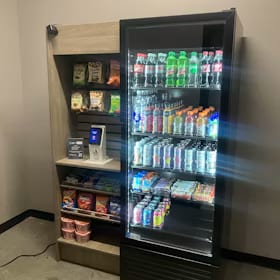
A micro market is an unattended self-checkout retail space, typically 100–400 square feet, with open shelving, coolers, a freezer, and a self-checkout kiosk. Think of it as a 7-Eleven with no cashier, staffed entirely by a remote operator who restocks a few times a week.
Picture the machines paying you while you sleep
That’s the real promise of vending — income that doesn’t cost you your time, and a life on your own terms. VendBuddy turns this guide into a step-by-step plan so you actually build it instead of just reading about it. Start free today.
Start building free →Revenue comparison
Same 150-employee manufacturing plant. Real operator-reported numbers:
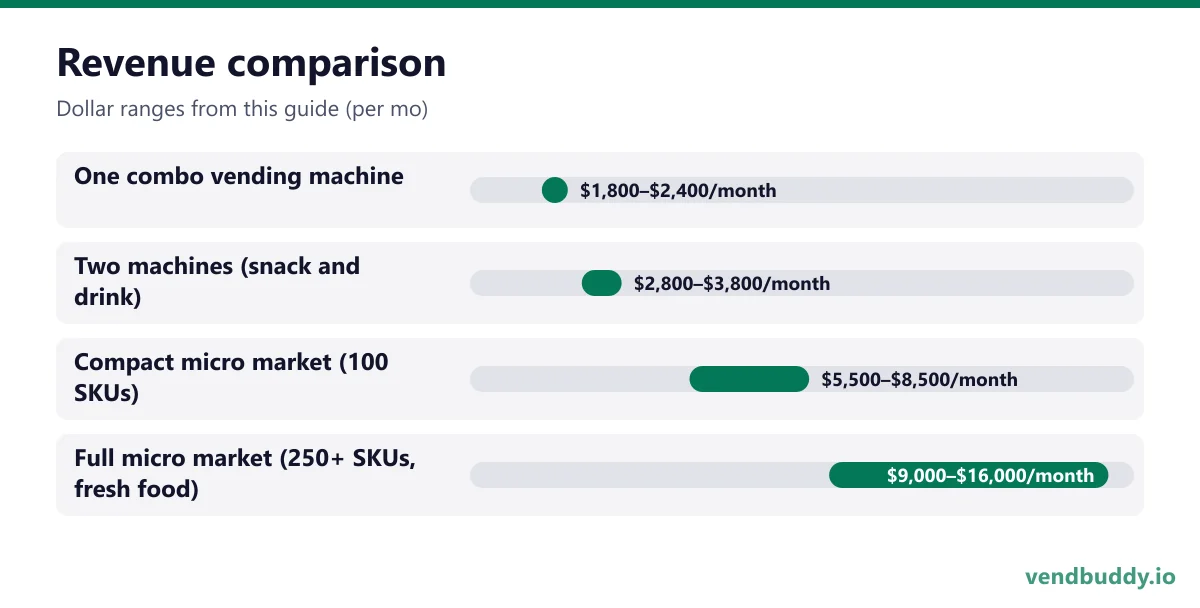
- One combo vending machine: $1,800–$2,400/month gross.
- Two machines (snack and drink): $2,800–$3,800/month.
- Compact micro market (100 SKUs): $5,500–$8,500/month.
- Full micro market (250+ SKUs, fresh food): $9,000–$16,000/month.
The uplift is 3 to 6x. Bigger basket sizes, higher unit prices, SKU variety machines cannot offer (fresh sandwiches, salads, yogurt, full-size entrees), and dwell time. Customers stay in a micro market for 2–5 minutes. They stand at a machine for 30 seconds.
When to choose a micro market
- Employee count. Under 75: machine. 75–250: hybrid or compact market. 250+: full micro market.
- Dwell time. On-site lunch (warehouse, hospital, manufacturing) = market wins at lower headcount.
- Space and buildout. 100+ sq ft enclosed space with power. Hallway corner = machine.
Unit economics
- Startup cost: $12,000–$35,000 compact; $25,000–$75,000 full.
- Cost of goods: 45–55%.
- Shrink: 2–5%; AI kiosks push under 2%.
- Labor: Similar to a vending route per revenue dollar, often lower.
- Commissions: 5–10% typical, occasionally zero for fresh-food amenities.
The shrink conversation
In professional environments with visible cameras and badge-integrated entry, shrink averages 2–4% — lower than most retail stores. Employees know each other, camera footage is reviewable, HR consequences are real.
Shrink gets worse in open-public locations (transportation hubs, tourist areas). Stick to closed employee populations.
How to pitch a micro market
- Lead with retention. "Your employees spend 45 minutes a day driving to a convenience store. A micro market gives them that time back."
- Show a real planogram. Photos of a live market. People do not know what a modern market looks like.
- Address theft head-on. "Shrink typically runs 2–4%, priced into our model, cameras deter over 90% of incidents."
- Offer a 90-day pilot. Close rate over 60%.
Smart markets and the upgrade path
Smart markets use cameras and weight sensors — no scanning, no kiosk. For most operators, standard self-checkout is the right starting point. Smart markets add $15,000–$40,000 capex and only pencil out at 500+ employees. Related: smart markets guide for operators.
Who it's best for
- One combo machine, $3,000–$5,000 setup. Best under 75 employees with no on-site dining, where $1,800–$2,400 a month is the honest ceiling. Not for a site with a lunch culture, because the basket size caps out long before demand does.
- Two machines, $5,000–$8,000 setup. Best at 50–100 employees around a single break area, at $2,800–$3,800 a month. Not for a multi-shift site, where night shift finds both machines empty.
- Compact micro market, $12,000–$35,000 setup. Best at 100–250 employees with a dedicated break room and 100+ square feet with power, at $5,500–$8,500 a month. Not for a hallway corner, and not for an open-public location, where shrink stops behaving.
- Full micro market, $25,000–$75,000 setup. Best at 250+ employees, multi-shift, or anywhere with no food nearby, at $9,000–$16,000 a month. Not for a site that cannot support fresh rotation, because the fresh SKUs are most of why it earns more.
- Smart markets. Best above 500 employees, where cameras and weight sensors remove the scan step and push shrink under 2%. Not below that, because they add $15,000–$40,000 of capex that the headcount cannot repay.
FAQ
Can I run a micro market alongside vending machines?
Yes. Mix both. Machines serve smaller sites; micro markets anchor the big ones.
How often do I restock?
2–3x/week compact; 3–5x/week full. Sensors flag stockouts in real time.
Do I need a license or permit?
Most states treat micro markets under retail food codes, especially with fresh food. Check local rules.
Kiosk problems?
Modern kiosks have live remote support. You are rarely the first line.
Model both scenarios in ROI calculator and pull a qualified list from the lead finder.
Use the Machine Finder to pick a property type — bar, laundromat, gym, mall, arcade, dealership — and see the specific machines that logically fit it, with prices and where to buy.
Open the Machine Finder →What is selling, which buildings say yes, and the numbers before you buy a machine. Free, confirm from your inbox, unsubscribe in one click. Refer one friend and get 25 VendBuddy credits.
Every operator we talk to wants fewer cold calls. The ones who get there have a Google Business Profile and a simple site a manager can check before replying. AI builders make that an evening job now. Wix is the mature site builder; Base44 also builds working tools like a quote form. Start with the AI website walkthrough or Wix vs Base44.
General information, not legal, tax or financial advice. Rules change, so check the official source. Revenue and income figures are examples, not promises. See our terms.