Smart markets are the next step beyond micro markets — frictionless, cashier-less retail spaces powered by computer vision and sensor fusion. Here is the operator-focused playbook on when they pencil and when they do not.
Part of our complete guide: how much does a vending machine cost.
Smart market vs micro market
A micro market uses a self-checkout kiosk. A smart market uses cameras and weight sensors; shoppers badge in, grab, and walk out while the system auto-charges. Think Amazon Just Walk Out at factory or office scale.
Capex and opex
- Compact smart market (100–150 SKUs, 200 sq ft): $35,000–$65,000.
- Full smart market (300+ SKUs, 400+ sq ft): $60,000–$150,000.
- Software and network fees: $200–$800/month.
- Shrink: Typically under 1.5% (vs 2–4% in self-checkout micro markets).
Picture the machines paying you while you sleep
That’s the real promise of vending — income that doesn’t cost you your time, and a life on your own terms. VendBuddy turns this guide into a step-by-step plan so you actually build it instead of just reading about it. Start free today.
Start building free →Revenue expectations
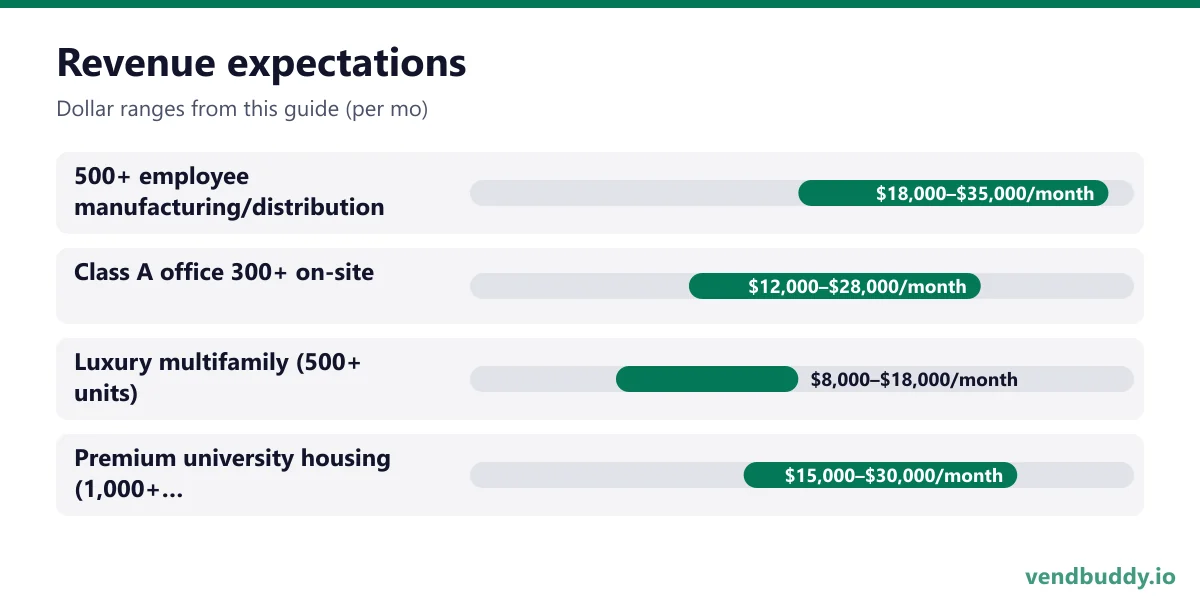
- 500+ employee manufacturing/distribution: $18,000–$35,000/month.
- Class A office 300+ on-site: $12,000–$28,000/month.
- Luxury multifamily (500+ units): $8,000–$18,000/month.
- Premium university housing (1,000+ residents): $15,000–$30,000/month seasonal peak.
The 300/3/3 rule
- 300+ captive audience on site.
- $3+ average transaction value.
- 3+ year expected tenure.
Any false → step down to full self-checkout micro market.
The tech stack
- Overhead cameras with computer vision tracking.
- Shelf weight sensors.
- Badge-in or app-based entry.
- Cloud inventory and transaction platform.
- Dispute resolution workflow for miscounts.
The dispute resolution flow matters more than vision accuracy. A 24-hour resolution window with clean refunds is table stakes.
Which hosts will say yes
- Manufacturing with 500+ on-site, 24/7 ops.
- Amazon, FedEx, 3PL distribution centers.
- Class A multifamily with 500+ units.
- Universities replacing legacy C-stores.
- Flagship tech campuses.
The smart market pitch
CFO or facilities VP pitch. Three angles:
- Employee retention impact. Quote 1–3% retention improvement.
- Space utilization. 200 sq ft smart market outperforms 600 sq ft staffed micro kitchen at 1/4 ongoing labor.
- Modern employer signal. Recruiting soundbite.
Operator risks
- Capex concentration. Single failed deployment ties up $50K+.
- Vendor lock-in. Most platforms are proprietary end-to-end.
- Connectivity dependency. Stable business internet with backup required.
- Tenant turnover. Anchor tenant leaves = revenue collapse 60% overnight.
FAQ
Is a smart market just a micro market with cameras?
No. Different operational model, shrink profile, customer experience, and usually SKU strategy.
Can I start with a micro market and upgrade?
Yes, often the right path. Run self-checkout 12 months, prove the location, then upgrade.
Who owns the transaction data?
Read the contract. Some platforms claim rights to anonymized data. Negotiable at scale.
Typical payback period?
18–36 months in a fitted location. Longer than micro markets (12–18) and vending machines (6–12) — but steady-state cash flow is 3–5x higher.
Related: micro markets vs vending machines, AI vending machines, the best AI vending machines on Amazon, 2026 location rankings.
What is selling, which buildings say yes, and the numbers before you buy a machine. Free, confirm from your inbox, unsubscribe in one click. Refer one friend and get 25 VendBuddy credits.
Walk-ins and cold emails find locations. A small site with your own machine photos and a request-a-machine form lets the next one find you. Around machine three to five, an AI builder drafts it in an evening. Wix is the mature site builder; Base44 also builds working tools like a quote form. Start with the AI website walkthrough or Wix vs Base44.
General information, not legal, tax or financial advice. Rules change, so check the official source. Revenue and income figures are examples, not promises. See our terms.