- Yes — IF you control three things: location quality, consistent business development, and running it like a real business, not a lottery ticket.
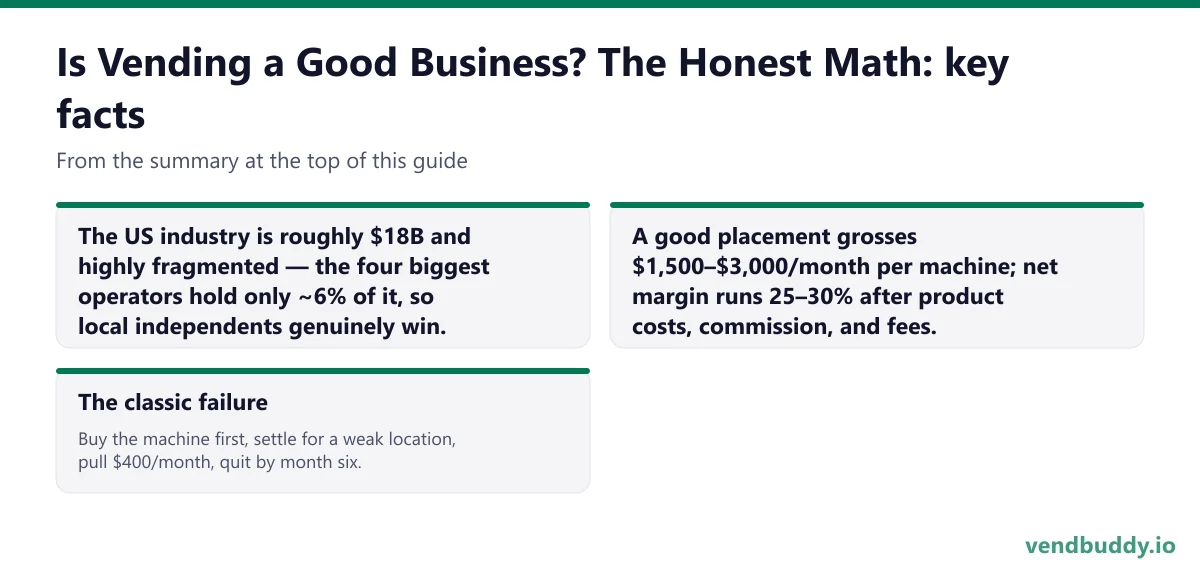
- The US industry is roughly $18B and highly fragmented — the four biggest operators hold only ~6% of it, so local independents genuinely win.
- A good placement grosses $1,500–$3,000/month per machine; net margin runs 25–30% after product costs, commission, and fees.
- The classic failure: buy the machine first, settle for a weak location, pull $400/month, quit by month six. The location was wrong — not the business.

If you are reading this, you probably heard vending machines make $300/day and are wondering if it is too good to be true. Short answer: it can be, but it depends entirely on three things you control.
- What the vending industry actually looks like in 2026
- Real income numbers from real operators
- The passive income myth (and the real answer)
- Who vending is a great fit for
- Who should NOT start a vending business
- The hidden costs and risks nobody mentions
- Vending vs other side hustles
- How to validate for yourself before spending a dollar
Part of our complete guide: how to start a vending machine business.
The honest math, up front, from real routes rather than course pitches: a good placement grosses $1,500–$3,000 a month per machine and nets 25–30% of that after product, commission and fees — call it $400–$900 in your pocket. A weak placement pulls about $400 a month gross and never recovers, no matter how good the machine is. Every number on this page sits between those two, and the rest of it is about which one you would actually end up with. If you want the wider evidence base rather than one guide’s ranges, our sourced vending machine statistics roundup compiles 68 figures with a named source attached to each.
Those three things are: (1) where you place your machine, (2) how hard you work the business development side, and (3) whether you treat it like a real business or a lottery ticket. Get all three right and vending is one of the most accessible paths to a meaningful second income available in 2026. Get them wrong and you’ll be selling a machine on Facebook Marketplace in six months wondering what went wrong.
This is what we wish every first-time operator read before they signed a placement, bought a machine, or wrote a check. Everything here comes from real operator data and the day-to-day reality of running a route. If you want the full walkthrough, our step-by-step guide to starting a vending machine business covers the entire process from LLC to first install.
What the vending industry actually looks like in 2026
The U.S. vending industry is valued at roughly $18 billion and continues to grow. Traditional machine installs grew about 7% from 2022 to 2023, and micro markets — the open-shelf, self-checkout setups replacing break-room cafeterias — grew 41% in the same period. The global vending market is projected to exceed $25 billion by 2027.
The most important structural fact: the industry is highly fragmented. The four largest operators combined control only about 6% of the market. Everything else is independent operators running anywhere from one machine to a few hundred. For someone starting today, that fragmentation is an advantage — there’s no dominant player to compete with, and local operators consistently outperform large corporates on service and responsiveness.
Cashless payments now account for roughly 75% of U.S. vending revenue, up sharply from pre-pandemic levels. Any new operator entering the business needs to plan for cashless from day one — it’s not optional anymore. Our smart vs traditional vending machine comparison breaks down how cashless-native machines impact revenue.
Real income numbers from real operators
The Instagram answer is “$1,000 per machine per month, scale to 50 machines, retire.” The real-operator answer is more nuanced. Here are the actual ranges documented across real routes:
Per-machine revenue tiers
- Poor location: under $1,000/month in gross revenue — not worth keeping.
- Underperforming: $1,000–$1,500/month — needs intervention or relocation.
- Good: $1,500–$3,000/month — a solid machine that pays its bills and generates profit.
- Excellent: $3,000+/month — premium placements like luxury apartment complexes, 100+ employee manufacturing facilities, and 24/7 medical facilities regularly hit this tier.
- Elite single placements: $4,000–$6,500/month — real numbers from 800+ unit luxury high-rises and large corporate buildings with 200+ on-site employees.
Net profit after cost of goods sold (40–50% of revenue), commissions (10–15%), card processing (5–6%), and operating costs (fuel, insurance, software) typically runs 25–30% of gross revenue. That means a machine doing $1,200/month in revenue nets around $300–$360/month in profit. We break down every line item in our vending machine costs and profit breakdown.
What this looks like at the route level
To earn $4,000/month in take-home income at average performance, you need roughly 25 machines. At premium performance with better-than-average placements, 8–15 machines can hit the same number. Operators with high-value placements — large offices, hospitals, luxury residential buildings — have reached $600K/year in gross revenue with just 18 strategically placed machines.
The pattern you see repeatedly in the most successful routes: placement quality dominates machine count. Three premium placements can outperform fifteen average ones. See our complete breakdown of how much vending machines actually make for detailed route-level income data.
If the number you are actually testing this business against is your salary, work the count backwards from it rather than forwards from a machine. How many vending machines it takes to make a living runs that arithmetic at three different per-machine net figures and shows where the hours stop fitting around a job.
See if vending works for your situation
Model the real numbers for your budget and time: VendBuddy’s ROI calculator and Lead Finder turn “is it worth it?” into a clear answer. Sign up free and get 5 credits.
Run my numbers free →The passive income myth (and the real answer)
Vending is best described as semi-passive, not passive. The work comes in three phases:
- Early phase (months 1–6): Very active. You’re finding locations, pitching decision-makers, installing machines, learning what sells, and making stocking runs yourself. Expect 10–20 hours per week of real work per 5 machines.
- Growth phase (10–20 machines): Still active, but leverageable. You can hire part-time help for restocking runs and focus your own time on business development. A 20-machine route with smart software and dynamic routing takes roughly 10–15 hours per week to service.
- Mature phase (40+ machines): This is where it becomes close to passive — but only because you’ve built systems, hired a full-time stocker, and likely added an operations manager. You’re now running a business, not tending machines.
The machines earn while you sleep — that part is true. But “the machine earns while you sleep” and “I don’t have to do any work” are different statements. The difference is what separates operators who make it past 18 months from the ones who quit.
If that is the question you actually came here to settle, it has its own page with the hour-by-hour arithmetic: how many hours a week a vending machine business really takes covers what a dialed-in 1–3 machine route costs you weekly, why driving is 40–60% of it, and the three levers operators use to get closer to genuinely hands-off.
Who vending is a great fit for
- You have $5,000–$50,000 of working capital (or access to vending machine financing) and can tolerate 12–14 months before machines pay themselves back.
- You’re willing to do cold business development. Pop-ins, emails, phone follow-ups — this is 80% of the battle. Our negotiation playbook and sales scripts can help, but you still have to show up. If you can’t handle talking to strangers about your service, vending will be painful.
- You want a business you can run alongside a day job in the first year. Vending is one of the most side-hustle-friendly businesses that still has real scaling potential.
- You’re operationally minded. The operators who scale fastest know their numbers cold — revenue per location, COGS per machine, unit velocity, gross margin. The VendBuddy sales data dashboard tracks all of this for you. If that sounds like detail-work you’d enjoy, vending rewards it.
If you want that fit question answered about you specifically rather than in general, the ten-sign self-assessment is the page to read next — it includes the three anti-signs that should talk you out of it, which is the half most qualification checklists leave out.
Who should NOT start a vending business
- You’re looking for truly passive income with zero daily effort. Vending is not that. Real estate might be closer — but also requires more capital.
- You can’t tolerate rejection. Most operators need to pitch 15–20 locations to land one. Lead flow typically doesn’t feel like it’s working until month 5 or 6. If you’ll quit in month 2 or 3, vending isn’t the move. Read our guide to finding vending machine locations for tactics that improve your hit rate.
- You’re starting with less than $3,000 and can’t get financing. You can technically start with a single used machine for $2,000, but without inventory reserves and operating cash, one bad month will end the business.
- You can’t commit regular hours. Machines that run out of inventory lose money and burn location relationships.
That third one is usually a capital problem rather than a character problem, and it is the one on this list with an actual workaround. Most first-time operators finance the first machine rather than paying cash for it — specifically so the working-capital reserve stays intact for product and the first slow month — so if the only thing standing between you and a first machine plus a stocking reserve is the money, 7 Figures Funding helps new business owners qualify for 0% intro business credit lines — borrow against a location you have already agreed, never against a guess.
Affiliate link — VendBuddy may earn a commission at no extra cost to you. Any credit product depends on your personal qualification.
The hidden costs and risks nobody mentions
Spoilage and inventory write-offs
The #1 profit killer for new operators. Stocking fresh sandwiches, yogurt, or salads in a location with under 100 daily visitors is how you learn to budget for waste. If more than 5% of your inventory expires before selling, you’re overstocking or in the wrong location. Stick with shelf-stable items (chips, candy, bottled drinks) until you understand a location’s velocity. Our best vending machine products guide covers the proven starter planogram and seasonal rotation strategy.
Location churn
Even great operators lose locations. Property managers leave. Buildings get sold. A site-wide ban on vending suddenly appears. Plan for 5–10% of your locations to churn per year and budget accordingly.
Theft and vandalism
Outdoor and unsupervised machines lose 3–8% of revenue to theft. Always place machines indoors in supervised areas. Get a vandalism clause in every contract — our contract generator includes one by default.
The machine-broke-at-midnight tax
A jammed coil, a bill acceptor failure, or a refrigeration issue can kill a machine’s revenue for days. At 5–10 machines you handle this yourself. At 20+ you need either a repair tech on call or enough knowledge to fix common issues.
The cost that pays for itself
Card readers are the one line on this list that returns more than it takes: about $300 up front plus $7 to $10 a month, against the 30–50% revenue lift operators report once a cash-only machine stops being invisible to anyone under 30. The Nayax review covers what the monthly fee buys and when to skip it, and you can get pricing for your own route from there.
Vending vs other side hustles
Compared to common alternatives, vending has a distinct profile:
- vs Airbnb: Lower capital requirement (you don’t buy real estate), but lower cash yield per unit. Higher labor intensity early, lower later.
- vs e-commerce / Amazon FBA: More physical, less marketing-dependent. You’re not competing on ads or algorithms. The biggest moat is your location contract, which is harder to disrupt than a product listing.
- vs traditional brick-and-mortar retail: Dramatically lower overhead. No rent, no employees early, no inventory stored at your own storefront.
- vs drop-shipping: Real, defensible income. Drop-shipping margins compress the moment a market saturates; a signed 2-year placement contract doesn’t.
How to validate for yourself before spending a dollar
Before you buy a machine, do two things:
- Land a verbal commitment from one location. Pop in to five nearby properties — a gym, a small office building, a laundromat, a manufacturing facility, an urgent care. Use the VendBuddy Lead Finder to identify the best prospects in your area, or check our opportunity map for high-density ZIP codes. If you can’t get one verbal yes after five tries, that’s useful information. Don’t buy a machine first.
- Run your financial model. At $1,200/month gross revenue, factoring in COGS, commission, and operating costs, does the net number justify your time and capital? Use the VendBuddy ROI Calculator to model your exact scenario before committing.
Neither step costs anything, which is the point: real money leaves your account only after a location has said yes.
Buy the SandStar direct from VendBuddy — $4,995 to $6,995
We are a direct SandStar dealer, so this is the one smart cooler on this page we sell ourselves instead of linking to. Five configurations, $4,995 to $6,995 for the cabinet, plus $65 per machine per month for the software licence. It isn’t the cheapest vision cooler on the internet, and we’d rather say that here than after you have paid.
- We inspect the cooler before it ships and own the freight claim if a carrier dents it.
- Remote training and planogram support cost nothing. An onsite technician is optional at $500 a day, two-day minimum.
- The $65 monthly licence covers the SIM and cellular data, telemetry, device management and remote support, so there’s no second connectivity bill.
- Warranty runs 3 years on the SRK series and 5 years on the VRK series.
Not ready to sign anything? Get pricing and availability first →
The mindset that separates operators who make it
Feeling unsure at the beginning is completely normal — it’s not a sign you’re behind. The operators who build real businesses share a few consistent traits:
- They prioritize consistency over talent. Showing up repeatedly, even imperfectly, beats waiting for the perfect plan every time.
- They build simple systems early. Set things up once to support consistent action instead of constant second-guessing. Your business is a machine — design it to run without you having a perfect day.
- They let the first 90 days be about stability, not speed. Early momentum comes from staying calm and showing up, not sprinting. The data-collection phase matters more than the revenue phase early on.
- They focus on clarity, not optimization. Most early stress comes from adding pressure that doesn’t need to be there. Get clear on what matters, do that thing, repeat.
The VendBuddy philosophy: calm, disciplined, systems-driven action beats hustle and heroics at every stage. Whether you’re picking your first location or scaling to 20 machines, the question is always the same — “Do I have a system for this, or am I just working harder?”
There is one number underneath all of that, and it is the number that decides who is still here in year two. A placement costs roughly 65 building contacts, so the operator who stops at thirty has not tested the market — they have quit before the sample was large enough to mean anything. That arithmetic, and what it says about the difference between an average operator and a good one, is outwork the average.
The honest answer
Yes, vending is a good business in 2026 — for operators who approach it as a business, not a lottery ticket. The best operators in the country are earning six-figure incomes from routes of 18–40 machines, not from scaling to 500 units. That’s more achievable than most side hustles, and more defensible than most online businesses.
But it’s real work. It rewards operational discipline, business development persistence, and the kind of person who gets satisfaction from knowing their numbers and optimizing systems. If that sounds like you, vending is one of the best small-business opportunities available to someone with modest starting capital.
The answer on this page is the average. Ten questions about your hours, your budget and your city gets you the version for you — a four-week starting plan and an honest read on the fit, including when the answer is that there is not one.
Start by reading our complete guide to starting a vending machine business, then use the VendBuddy platform to find your first location and model the economics. If budget is a concern, our $0-down startup guide covers six proven ways to launch without cash. And before you buy equipment, check our machine buying guide to match the right machine to your location type. Don’t forget to check vending machine laws in your state before getting started.
Frequently Asked Questions
Is vending a good business for someone with no experience?
Yes — vending is one of the more beginner-friendly small businesses because the learning curve is operational, not technical. You do not need industry contacts, a business degree, or prior retail experience. The two skills that matter most are persistence in finding locations and discipline in tracking your numbers. Both are learnable.
How much money can you make with one vending machine?
A single machine at a good location (100–200 daily visitors) generates $1,500–$3,000/month in gross revenue and $400–$900/month in net profit. At an elite location (200+ visitors, luxury building or warehouse), a single machine can net $1,000–$2,500/month. At a poor location, under $150/month net. Location is everything.
What are the three things vending success depends on?
First, placement quality — your highest-traffic, most captive-audience locations will always outperform no matter what else you do. Second, business development consistency — the operators who land locations are the ones who show up every week regardless of how many rejections they get. Third, treating it as a real business with real tracking, contracts, and systems, not a side bet you check on occasionally.
Most first agreements are two pages, not twenty. The contracts walkthrough lays out the clauses that actually matter for the contract, including the termination language operators forget about until they need it.
Ready to see the real numbers? → How Much Do Vending Machines Actually Make?
Ready to start? → How to Start a Vending Machine Business (complete guide)
Not sure vending is the right fit for YOU specifically? → Take the free Vending Niche Finder quiz
What is selling, which buildings say yes, and the numbers before you buy a machine. Free, confirm from your inbox, unsubscribe in one click. Refer one friend and get 25 VendBuddy credits.
General information, not legal, tax or financial advice. Rules change, so check the official source. Revenue and income figures are examples, not promises. See our terms.