The fastest path to a signed location: walk in (don't call) → frame the machine as a free amenity → ask for 5% commission → return 3 times in week one → always leave a one-pager. Operators who do all five sign 2–3 placements a month from scratch. Below: the exact pop-in script, commission rules, and a 5-objection response sheet you can use today.
Part of our complete guide: how to find vending machine locations.
- Pop in, don't call. Walk-ins close 3× more often than cold calls.
- Lead with "free amenity," not "vending machine." You're offering them something, not asking for space.
- Start commission at 5%. Walk from 20%+ unless the location does $8K/month.
- 3 visits in week 1, then weekly for a month. Most deals close on visit 3-5, not visit 1.
- Always leave a one-pager. Doubles callback rate vs. a business card.
Jump to: Cold approach script · Commission rules · Discovery questions · Top 5 objections · Follow-up cadence
Want every script + template ready to use? Open VendBuddy Scripts & Templates →
The exact 60-second pop-in🎯 Auto-fill it for your area
Personalized script + flyer🩹 Already got rejected?
The PM-recovery playbook
The negotiation mindset: The No-Cost Amenity Framework
You're not asking for a favor. You're offering a free amenity that makes their building more attractive to tenants, employees, or customers. This is the No-Cost Amenity Framework — you provide the machine, stock it, service it, and maintain it at zero cost to the property. Frame every conversation from this position: you're solving a problem, not creating one. Property managers aren't buying a vending machine — they're buying a happier resident base and a stronger renewal story.
The proven cold approach script
Walk in (pop-ins beat calls 3:1 in close rate), ask for the decision-maker, and deliver:
"Hi, I run a local vending service in [area]. I noticed your [building/facility] doesn't have convenient access to snacks and drinks for your [tenants/employees/visitors]. I'd love to provide a modern, fully-stocked machine at absolutely zero cost to you — I handle all restocking, maintenance, and service. Most of my locations receive a monthly commission check as a thank-you. Do you have 60 seconds to hear how it works?"
Key elements: (1) Local — you're a neighbor, not a corporation. (2) Specific — you noticed something about their space. (3) Zero cost — repeated and emphasized. (4) Commission as benefit — they earn money from your presence.
Picture the machines paying you while you sleep
That’s the real promise of vending — income that doesn’t cost you your time, and a life on your own terms. VendBuddy turns this guide into a step-by-step plan so you actually build it instead of just reading about it. Start free today.
Start building free →How to handle commission negotiations
The golden rules:
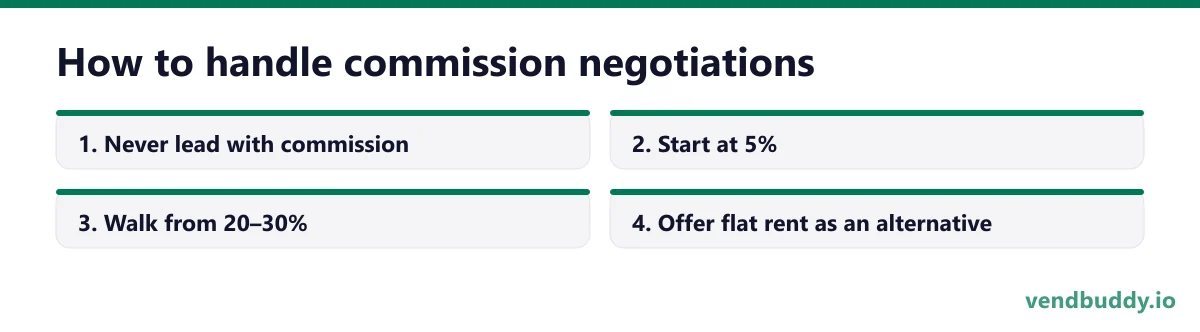
- Never lead with commission. Lead with the free amenity, convenience, and zero-effort value. Let them ask about money.
- Start at 5%. This is standard. Go up to 10–15% only for high-volume locations.
- Walk from 20–30%. Unless the location does $8K+/month, it's not worth it. Many premium locations (luxury condos, corporate offices) require zero commission when you present professionally.
- Offer flat rent as an alternative: "$50/month flat instead of commission" can be more attractive to smaller businesses who prefer predictability.
The 4 Core Discovery Questions
Before you pitch, discover what the property manager actually cares about. These four questions let you tailor your close:
- "Have you had vending here before? What was the experience like?" — Reveals pain points with current or former vendors.
- "What do your residents/employees typically ask for?" — Shows you're listening, not selling.
- "Is there a common area or break room where a machine would make sense?" — Moves toward logistics and placement.
- "What would make this a win for you?" — Lets them define success on their terms.
Listen more than you talk. Discovery beats pitching every time — the answers to these questions give you everything you need for a tailored close.
Handling the 5 most common objections
Remember: objections are a good sign — they mean the prospect is engaged. Use the 3-Step Objection Method: (1) Acknowledge the concern, (2) Reframe toward the benefit, (3) Ask a follow-up question that moves the conversation forward.
"We already have a vending machine/vendor."
"Great — are they responsive? Do they offer cashless payment? When does your current contract expire? I'd love to earn your business when that comes up. Can I leave my card?" 40% of locations switch vendors due to poor service.
"We don't have space."
"I have compact machines that fit in a 2x3 foot area — about the size of a file cabinet. Can I take a quick look? I've fit machines in spots most people wouldn't think of."
"Not interested."
"Totally understand. Would it be okay if I checked back in a few months? Things change, and I'd hate for your team to miss out." Some deals close on the 3rd pop-in after being ignored twice.
"Who pays for the electricity?"
"The machine uses about the same power as a mini fridge — roughly $10–$15/month. Most of my partners consider it a fair trade for the free amenity and commission check."
"Let me think about it."
"Absolutely — here's my one-pager with everything we discussed. I only have two machines available this month and I'm prioritizing this area, so I'll follow up next week. What day works best?"
Whatever commission you settle on, write the same rate and the same definition of net sales into the agreement; the Placement Agreement + Proposal Kit has those clauses ready to fill in.
Creating urgency without being pushy
- "I only have [X] machines available this month and I'm prioritizing properties in this ZIP code."
- "I just placed a machine at [nearby business] and they're already seeing great results — I'm trying to serve this whole corridor."
- "Would a 30-day no-commitment trial make this easier? If it's not working for you, I remove everything at no cost."
The follow-up cadence that wins
Most operators give up after one visit. The data says otherwise:
- Week 1: Pop in 3 times (different days/times).
- Week 2–4: Pop in once per week.
- Monthly: Phone call or email check-in.
- Quarterly: Drop by with a product sample or updated one-pager.
Lead flow typically peaks at month 5–6 of consistent BD, not month 1. Push through the quiet early months.
What to leave behind
Always leave a written one-pager: your name, photo, business name, phone, email, what you offer, key benefits, commission structure, and 1–2 references from existing locations. Professional leave-behinds double your callback rate vs. a business card alone.
Use VendBuddy's Scripts and Templates for ready-to-use pitch scripts, email templates, and professional flyers. Generate a professional leave-behind flyer in seconds, and create a Scope of Work for formal meetings.
| Approach | Pop in — never cold-call first |
| Opening frame | “Free amenity at zero cost to you” |
| Commission | Start at 5% — walk from 20%+ |
| Cadence | 3 visits week 1, weekly for month, then monthly |
| Leave-behind | Professional one-pager (doubles callbacks) |
| Urgency | “I only have X machines this month” |
Frequently Asked Questions
What is the best way to approach a business about placing a vending machine?
Walk in during off-peak hours and ask for the decision-maker. Pop-ins close 3x more often than cold calls because they demonstrate professionalism and seriousness. Lead with “free amenity” framing: you provide the machine, stocking, and maintenance at zero cost, and the location earns a monthly commission.
How much commission should I offer a vending machine location?
Start at 5% of gross revenue. Standard range is 5–10% for most locations. Walk away from any deal above 15–20% unless the location generates $8,000+ per month. Many premium properties (luxury condos, corporate offices) accept zero commission when you present professionally and frame the machine as a free amenity.
How many times should I follow up with a potential vending location?
Pop in 3 times in week one, then once per week for the next 3 weeks, then monthly phone or email check-ins. Most deals close on visit 3–5, not visit 1. Lead flow typically peaks at month 5–6 of consistent business development, so persistence pays.
What do you say when a location says they already have a vending machine?
Ask three questions: “Are they responsive? Do they offer cashless payment? When does your current contract expire?” Then leave your card. 40% of locations switch vendors due to poor service, so being the professional alternative ready when the contract expires is a winning long-term strategy.
Ready to start pitching? → Open VendBuddy Scripts to get your personalized pitch
Need locations to pitch? → Search any ZIP code for vending leads
Operator toolkit (the gear that pays for itself)
The vending machine is the big spend. The items below are the small-to-mid spends that consistently pay back fast — every experienced operator we've worked with has at least three of the day-1 items, and most operators past 5 machines have all of the warehouse-tier ones.
Day 1 — small spend, big leverage
- WYZE Cam OG security camera (2-pack). A camera pointed at every machine. Stops cash-box theft and settles "the machine ate my dollar" disputes in 30 seconds. Check the listing for mounting and storage details before you buy. Buy here →
- Scotch Thermal Laminator TL901X. Laminate your scope-of-work, location flyer, and contract before every property-manager pitch. Laminated proposals close visibly more often than printed paper — they look like you've done this before. Buy here →
- Nelko P21 Bluetooth Label Maker. Tiny Bluetooth labeler — print product price tags, machine ID stickers, restock-bin labels straight from your phone. The cheapest organization tool you'll ever own and the one stockers actually use. Buy here →
- DYMO LabelManager 160 (handheld, with 3 tape cassettes). Step up to this when you have 5+ machines and a warehouse. Standalone QWERTY keyboard, no phone needed — the warehouse manager and your stocker both grab it without setup. Faster than the Nelko once you're labeling 50+ items per restock cycle. Buy here →
Beyond machine #1 — warehouse, hauling, off-grid
- Strongway 1,200 lb Industrial Hand Truck. The dolly that actually moves a 280 lb HAHA combo by yourself. Convertible 2-wheel-to-4-wheel, stair-climbing rear wheels, auto-recoil ratchet strap built in. Operators who try to install with a cheap dolly damage cabinets and end up renting one — buy this once. Buy here →
- SIMPLI-Magic 800 lb Convertible Hand Truck. The cheaper alternative if you only ever move under-200-lb appliances or need a dolly for inventory totes. Folds flat for car trunk storage, 2-in-1 vertical / flat platform. Don't use this on a full-size machine — it's rated 800 lb but the leverage geometry favors the Strongway above for tall heavy cabinets. Buy here →
- REIBII 5-Tier Heavy-Duty Wire Shelving (3,200 lb). Warehouse-tier rack — 55" wide, 71" tall, holds 640 lb per shelf. Set two of these against opposite walls in a 200 sqft storage unit and you've got a real pick-pack workflow. Adjustable shelves, no tools required, ~10-min assembly. Buy here →
- EBL Portable Power Station 1000W (999 Wh). The unlock for outdoor / festival / construction-site / RV-park placements that don't have a 120V outlet. Runs an HAHA mini cooler for ~20 hours, recharges via solar panel, AC outlet, or car. Also doubles as your home backup during a hurricane week — operators in Houston/Florida/Carolinas have used these to keep route inventory cold during outages.
Need a category instead of a specific pick? Browse the current best sellers:
The full gear list, organized by category, lives in the Operator Resources guide.
Related: location finding playbook, complete startup guide, 10 mistakes to avoid, where to place machines for maximum revenue, and scaling from 1 to 100+ machines. Also see: how to respond to a rejection email, vending contracts 101, tiered revenue-share structures, and what to do when a property manager says no. Use the Pipeline CRM to track every prospect through your follow-up cadence, and the Contract Creator to generate a signing-ready agreement the moment you close.
The Vending Location Playbook carries a plain-English placement agreement in seven annotated sections, a commission ladder, and a filled-in worked example — plus the twelve objections that come up before anyone reads a contract. $47 one-time, no subscription.
See the placement agreement kit →What is selling, which buildings say yes, and the numbers before you buy a machine. Free, confirm from your inbox, unsubscribe in one click. Refer one friend and get 25 VendBuddy credits.
Walk-ins and cold emails find locations. A small site with your own machine photos and a request-a-machine form lets the next one find you. Around machine three to five, an AI builder drafts it in an evening. Wix is the mature site builder; Base44 also builds working tools like a quote form. Start with the AI website walkthrough or Wix vs Base44.
You are often one good location away from the route you want. Post the area and the kinds of places you are after on our public Wanted board. It is free, and property managers and people passing on tips can see what operators near them are looking for.
Post what you wantSee the Wanted board →Original research: we read 28 public vending RFPs, agreements and awards and recorded the commission, term, insurance, card-reader and healthy-vending terms each one states. See Vending Commission Rates and Contract Terms 2026: what public contracts show.
General information, not legal, tax or financial advice. Rules change, so check the official source. Revenue and income figures are examples, not promises. See our terms.