The #1 objection to starting a vending business is money. But thousands of operators have launched with little or no cash upfront. Here's every proven $0-down strategy, ranked by risk and accessibility.
- How to start a vending machine business with no money
- Can you really start a vending machine business with no money?
- Why $0 down works in vending
- Strategy 1: Buy Now, Pay Later (BNPL)
- Strategy 2: 0% Intro APR business credit cards
- Strategy 3: SBA Microloans
- Strategy 4: Seller financing
- Strategy 5: The partner model
Part of our complete guide: how to start a vending machine business.
How to start a vending machine business with no money
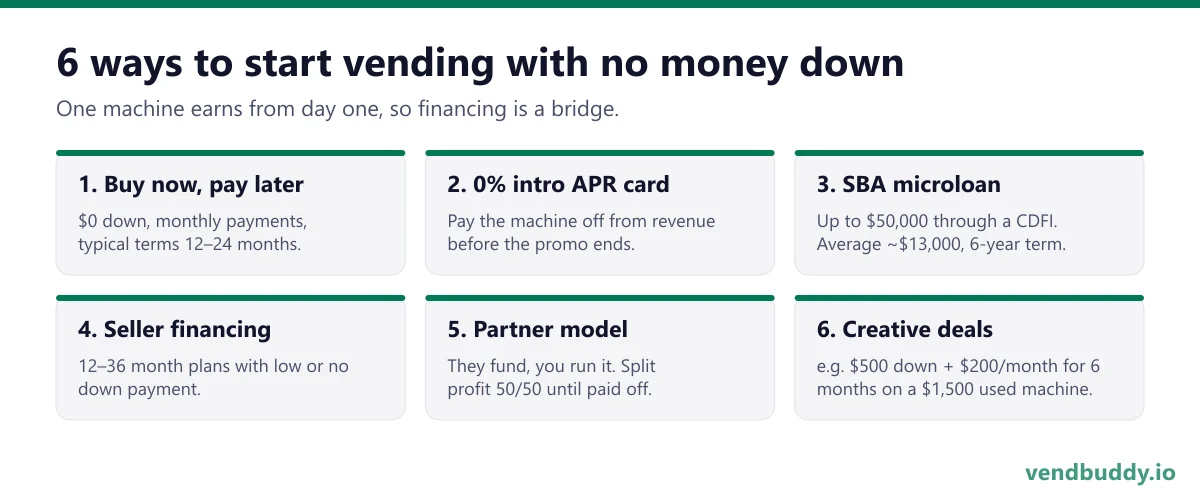
You do not start with no money — you start with none of your own money. Get a verbal yes from a location first, then finance a used combo machine at $1,500–$3,000 and let it clear its own note out of the $500–$2,000 a month that machine grosses. Six routes reliably do that: buy-now-pay-later equipment financing, a 0% intro-APR business card or credit line, an SBA Microloan through a local CDFI, seller financing from the machine or route seller, a capital partner who funds machines while you do the work, and negotiated private-seller payment plans. Financing the equipment before you have a location is how $0 down turns into $0 revenue with a payment attached.
Of those six, the 0% intro window is the one most first-timers actually reach, and if your business credit file is thin it is usually better to have someone run the applications across several issuers at once than to apply card by card yourself — 7 Figures Funding specializes in getting new business owners approved for 0% intro business credit lines. All six routes are broken down in full below.
Affiliate link — VendBuddy may earn a commission at no extra cost to you, and we have no influence over any approval decision. Approval depends on your personal qualification, and any credit line is debt you personally guarantee.
Can you really start a vending machine business with no money?
Yes, if "no money" means none of your own savings: you get a yes from a location first, then borrow against the machine and let it pay its own note. You still need a few hundred dollars for the first product fill and small fees, so plan for that even on a $0-down deal.
The cheapest borrowed money on the list below is often an SBA microloan. The SBA's microloan page (last updated August 28, 2026) says the program lends up to $50,000, the average microloan is about $13,000, rates generally run 8% to 13%, and the longest repayment term is seven years. Machinery and equipment are named uses. Source: SBA.gov, Microloans.
Picture the machines paying you while you sleep
That’s the real promise of vending — income that doesn’t cost you your time, and a life on your own terms. VendBuddy turns this guide into a step-by-step plan so you actually build it instead of just reading about it. Start free today.
Start building free →Why $0 down works in vending
If you place a machine in a location with 50+ daily visitors, it can realistically generate $500–$2,000/month gross. That means the machine pays for itself — financing is just a bridge to get it in place.
Strategy 1: Buy Now, Pay Later (BNPL)
Services like Acima and PayTomorrow let you finance used and new vending machines with $0 down. You make monthly payments from your machine's revenue. Typical terms: 12–24 months. Some vending machine dealers partner with these platforms directly, so ask before paying cash.
Strategy 2: 0% Intro APR business credit cards
The no-annual-fee business cards operators reach for most are the Chase Ink Business Unlimited, the Amex Blue Business Plus, and the Capital One Spark line. To compare 0% intro offers without a hard pull, 7Figures Funding (affiliate link) lets you pre-qualify for 0% intro business cards and lines of credit without a hard pull. Several of these carry an intro-APR window on purchases, but which ones, and for how long, changes constantly — read the current offer page rather than any article, this one included. The play is the same regardless: buy your first machine on the card, pay it off from machine revenue before the promo period ends, and build a business credit file while you do it. Key rule: never carry the balance past the intro period — the go-to APR will eat your margins. Full operator walkthrough in the business card guide.
A 0% card and a rewards card are two different jobs, and the second one only starts to matter once the route is buying product every month rather than one machine once. When you get there, the cards operators actually compare are laid out in Bilt versus Chase Ink versus Chase Freedom for a vending operator.
Affiliate links — VendBuddy may earn a commission at no extra cost to you, and we have no influence over any approval decision. Approval depends on your personal qualification, and any credit line is debt you personally guarantee.
Strategy 3: SBA Microloans
Good credit is helpful but not required — CDFIs are designed for underserved entrepreneurs. Apply through your local CDFI (find yours at SBA.gov).
Strategy 4: Seller financing
Many vending route sellers and machine dealers offer 12–36 month payment plans with low or no down payment.
Buying an existing route with no money down
The same logic scales up to a whole route. A route that already earns can be bought out of its own cash flow when the seller carries the note, which is the only realistic way to buy a vending machine business with no money of your own. Sellers agree more often than people expect, usually because they want out of the servicing rather than out of the income, and a note paid from proven revenue is safer for them than a stranger with a bank loan. Two conditions protect you: verify the revenue against processor and card-reader statements rather than the seller's spreadsheet, and write the note so that losing a location adjusts the payment instead of leaving you paying for revenue that walked.
Strategy 5: The partner model
Find someone with capital but no time. You do all the work — finding locations, stocking, servicing. They fund the machines. Split profits 50/50 until the machines are paid off, then renegotiate or buy them out. This works especially well with family members, friends, or local investors who want passive income.
Strategy 6: Creative approaches
- Used machine negotiation: Offer $500 down + $200/month for 6 months on a $1,500 used machine. Many private sellers on Craigslist and Facebook Marketplace will accept this.
- Machine trade/barter: Some operators trade services (web design, marketing, manual labor) for their first machine.
- Employer financing: If you're still working, some employers will invest in your side business through internal programs.
No money and bad credit: what still works
If your credit is damaged rather than simply thin, four of the six routes above stop being reliable and the honest short list narrows to lease-to-own equipment programs, seller financing, the partner model, and a CDFI microloan. None of those is free money, and what each one really costs is worth spelling out:
- Lease-to-own equipment programs. Acima and PayTomorrow style approvals lean on income and bank-account history, and some run a soft inquiry rather than a hard pull, so a low score does not end the application on its own. The trade is price: a $2,000 machine on a 12-month lease-to-own can total $2,800–$3,400 by the time you own it outright. Worth taking only when the location is already agreed and grossing more than the payment.
- Seller financing. The person selling the machine becomes your lender. No bureau is pulled because no bureau is involved, and the terms are whatever the two of you put in writing. Ask on every private-seller machine. A surprising number of people who inherited a machine want it out of the garage more than they want cash today.
- The partner model. Your credit never comes up. Write down the split, the buyout price, and who legally owns the machine before the first purchase, because this is the route that ends friendships when it is done on a handshake.
- CDFI microloans. Community Development Financial Institutions lend the SBA Microloan money, and their mandate is borrowers conventional banks decline. Credit still matters, but a 580 with steady income and a written plan is a conversation rather than an automatic no. Expect them to ask where the machine is going.
What does not work, whatever the reels claim: there is no vending grant that buys a first machine for someone with bad credit, and no lender that hands over equipment money with no down payment, no credit, and no location. When an offer sounds like that, look at who gets paid up front. The longer version, including how to rebuild the file while the first machine runs, is in starting with no money and bad credit.
The math that makes it work
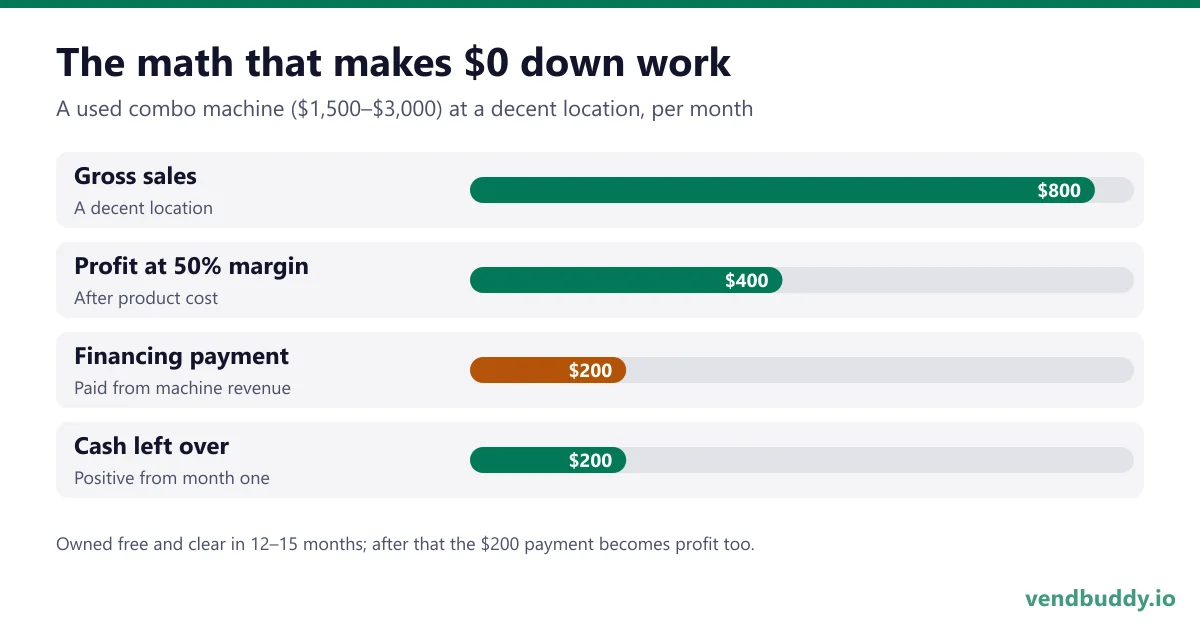
A used combo machine costs $1,500–$3,000. At a decent location generating $800/month gross with 50% margins, you net $400/month profit. At $200/month financing payment, you're cash-flow positive from month one and own the machine free and clear in 12–15 months. Then every dollar is pure profit going forward.
Related: all 6 financing options compared, real cost breakdown, complete startup guide, how to find vending machine locations, machine buying guide, and LLC setup and tax deductions. Use the ROI Calculator to model whether your financing payment is covered by machine revenue, and the Machine Finder to compare machines within your budget.
The payment you are already making that earns nothing
Before the machine, before the pallet, before the card reader, there is rent. It goes out on the first of the month, it is usually the largest single payment an operator makes, and on most cards it either earns nothing or costs 2.5 to 3 percent through a third-party portal. That is the gap the Bilt card is built around. Per Bilt’s card page, every tier earns up to 1.25X points on rent or mortgage, with no transaction fee, paid through a payment portal, through Venmo, or by check via BillPay, and no minimum number of monthly transactions is required to earn on housing.
The arithmetic is not dramatic and it is not supposed to be. At $1,800 a month, a year of rent is 27,000 points on a payment that was earning zero. Route spend sits on top of that at the ordinary rate, which is 1X on Blue and 2X on Palladium. If your only question is which card pays most on product and freight, a flat 2X card still wins that contest. Bilt wins the household, which is a bigger number than the route for most people reading this.
The three tiers, as the page states them
Bilt Blue, $0 a year
Welcome offer as the page states it: $100 of Bilt Cash.
- up to 1.25X on rent or mortgage, with no transaction fee
- up to 4X at 20,000+ partner restaurants
- 3X on hotels and 2X on flights booked through the Bilt travel portal
- 3X on Lyft
- 1X on everything else
Bilt Obsidian, $95 a year
Welcome offer as the page states it: $200 of Bilt Cash.
- up to 1.25X on rent or mortgage, with no transaction fee
- up to 6X at partner restaurants
- 3X on dining or grocery, up to $25,000 a year
- 4X on hotels and 3X on flights booked through the Bilt travel portal
- 3X on Lyft
- 2X on other travel
- 1X on everything else
- a $100 Bilt Travel hotel credit twice a year
Bilt Palladium, $495 a year
Welcome offer as the page states it: $300 of Bilt Cash, plus 50,000 points and Gold status after $4,000 of spend in 90 days.
- up to 1.25X on rent or mortgage, with no transaction fee
- up to 5X at partner restaurants
- 4X on hotels and 3X on flights booked through the Bilt travel portal
- 4X on Lyft
- 2X on everything else
- $200 of Bilt Cash a year
- a $400 hotel credit twice yearly
- Priority Pass
Points transfer to 28 airline and hotel partners, or redeem for travel through the Bilt portal, for Lyft, for statement credits, or toward a home down payment. The down-payment route is the one most renters have never heard of, and it is the reason a few operators we talk to hold this card without caring about airline transfers at all.
Where this card is the wrong answer
- You carry a balance. Pay it in full or skip the whole idea. Interest erases a 1.25X earn rate inside the first statement and keeps going. Bilt’s page states a “10% intro APR on new eligible purchases for 12 billing cycles”, and the sensible way to read that is as a term on the page rather than as a plan.
- You need business-card reporting. Bilt is a personal card. It will not build a credit file for the business and it will not hand you a clean business statement at tax time.
- You own outright and have no mortgage. Strip the housing payment out and this is an ordinary rewards card, and not the strongest one.
That middle one has a workaround worth doing properly. Keep one card for business spend only and record it. A personal card used exclusively for the route is fine with an accountant. A personal card carrying the route’s product buys and your groceries is what turns tax time into archaeology. If you would rather have a business card or credit line for the LLC, 7Figures Funding (affiliate link) lets you pre-qualify for 0% intro business cards and lines of credit without a hard pull. If a simple everyday card fits better, Chase Freedom Unlimited is a personal card (referral link: we may earn a bonus if you are approved, at no cost to you), so keep one card used only for the business. Rent and personal spend on Bilt, the company’s spend on that business-only card or credit line.
Referral link: if you’re approved, we earn Bilt points at no cost to you. Bilt sets approval, rates and terms; this isn’t financial advice.
Short on startup capital?
Most new operators do not pay cash for their first machines. The two most common paths are equipment financing through the machine seller and 0% intro-APR business credit — the second is what lets operators start a route without touching savings. 7 Figures Funding specializes in helping new business owners qualify for 0% intro business credit lines.
Frequently Asked Questions
How to start a vending machine business with no money?
You do not start with no money - you start with none of your own money. Secure the location first, then finance the machine so it pays for itself from day one. In practice that means one of six routes: buy-now-pay-later equipment financing (Acima, PayTomorrow), a 0% intro-APR business card or credit line, an SBA Microloan through a local CDFI, seller financing from the machine or route seller, a partner who supplies the capital while you supply the labor, or a negotiated payment plan with a private seller. A used combo machine runs $1,500 to $3,000 and a decent location grosses $500 to $2,000 per month, so a $200 per month payment is covered from month one. What does not work is financing the equipment before you have a signed or verbally agreed location - that is a payment with no revenue behind it.
How do I start a vending machine business with no money and bad credit?
Four routes still work when the credit file is damaged: lease-to-own equipment programs that underwrite on income and bank-account history rather than a FICO pull, seller financing where the seller carries the note and no bureau is involved, a partner model where the capital sits with someone whose credit is fine, and a CDFI microloan, which exists to lend to borrowers conventional banks decline. Expect to pay for the access - a $2,000 machine on a 12-month lease-to-own can total $2,800 to $3,400 by the time you own it. What does not exist is a grant or a lender that funds a first machine with no down payment, no credit, and no location agreed. Full detail in starting with no money and bad credit.
Can I start a vending business with $5,000?
Comfortably, and with money left over. $5,000 covers one well-bought used combination machine at $1,500 to $3,000, the freight or moving crew at $150 to $500, a first product fill at $200 to $400, a card reader, and a licence and basic liability insurance - with roughly $1,000 left as a buffer for the second restock and the first surprise repair. That buffer is the part beginners skip and the part that matters, because an under-stocked machine sells out its three best rows and then idles for a week.
Can I start a vending business with $20,000?
Yes, and at that level you have a genuine strategic choice rather than just a bigger machine. $20,000 buys roughly six to eight placed used machines built up one at a time, or two to three smart or new machines, or an existing route with proven locations and existing revenue. The route purchase is the fastest path to cash flow and also the easiest way to overpay, because the seller knows which of those locations is about to churn and you do not. Read the due-diligence checklist in buying a vending route without getting burned before you look at a single listing.
Can I start a vending business with financing?
Yes, and financing behaves better in vending than in most businesses because the equipment is its own collateral and it starts producing revenue within days of placement rather than months. The rule that keeps it safe is sequencing: get a verbal yes from a location first, then finance a machine sized to that building, so the payment lands against real revenue. The six routes above cover BNPL equipment financing, 0% intro-APR business credit, SBA Microloans through a CDFI, seller financing, a capital partner, and private payment plans. Every route compared side by side is in the financing guide.
Can I start a vending business with no money down?
No money down is realistic; no money at all is not. Several of the routes above genuinely require zero down payment on the machine itself, but you still need a few hundred dollars for the first product fill, and freight has to be paid by somebody. Budget $400 to $900 of actual cash even on a fully financed machine. The genuine version of the $0-down claim is that none of your own money buys the equipment, which is a real and useful thing - it is just not the same sentence as starting with nothing.
Can you buy a vending route with no money?
Sometimes, through seller financing: the seller carries part of the price and you pay it from the route's cash flow. Expect to negotiate a down payment, and verify the route's sales before you sign.
Can I get an SBA loan to start a vending machine business?
Yes, usually through the SBA Microloan program. Per SBA.gov (page updated August 28, 2026), microloans go up to $50,000 through approved nonprofit intermediary lenders, the average is about $13,000, rates generally run 8% to 13%, and machinery and equipment are allowed uses. The intermediary makes the credit decision and sets the terms, so call a microlender near you before you buy anything.
Should I finance a vending machine before I have a location?
No. Get a yes from the location first, then finance the machine. Financing the equipment before you have a location is how $0 down turns into $0 revenue with a payment attached.
How long does it take a financed vending machine to pay for itself?
In our example math, a used combo machine costs $1,500 to $3,000. At a location grossing $800 a month with 50% margins you net about $400, so a $200 monthly payment leaves you cash-flow positive from month one and the machine is paid off in 12 to 15 months. These are example figures, not promises; a weaker location stretches every number.
What is selling, which buildings say yes, and the numbers before you buy a machine. Free, confirm from your inbox, unsubscribe in one click. Refer one friend and get 25 VendBuddy credits.
Every operator we talk to wants fewer cold calls. The ones who get there have a Google Business Profile and a simple site a manager can check before replying. AI builders make that an evening job now. Wix is the mature site builder; Base44 also builds working tools like a quote form. Start with the AI website walkthrough or Wix vs Base44.
General information, not legal, tax or financial advice. Rules change, so check the official source. Revenue and income figures are examples, not promises. See our terms.