A well-placed claw machine can quietly pull in $800 or more every month — without you being there. That kind of passive income from a single machine has drawn a lot of vending operators toward the crane game niche. But dead spots exist too, and an underfilled machine in a slow strip mall might barely cover the cost of the prizes it gives away. This guide breaks down real numbers, honest startup costs, and the specific venue types where claw machines consistently earn.
Part of our complete guide: best cash flow businesses.
How much does a claw machine make?
Revenue comes from plays, typically priced at $0.50 to $2.00 each depending on the machine and market. Here is what operators report across different placement types:
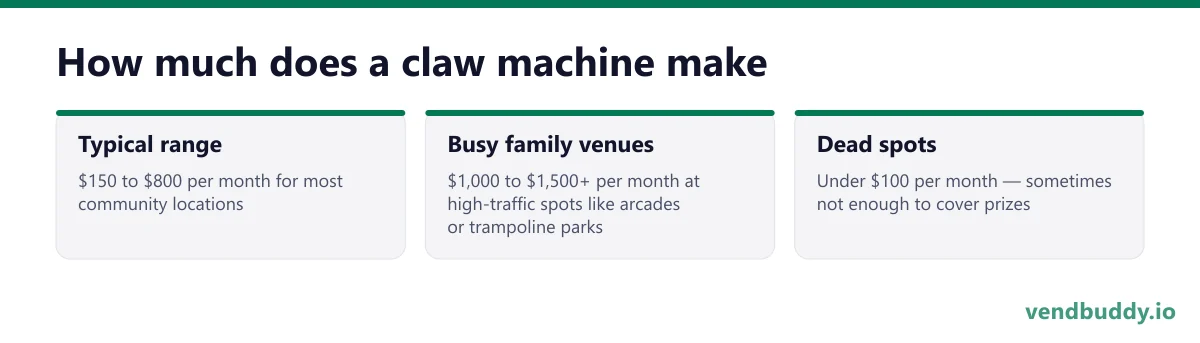
- Typical range: $150 to $800 per month for most community locations
- Busy family venues: $1,000 to $1,500+ per month at high-traffic spots like arcades or trampoline parks
- Dead spots: Under $100 per month — sometimes not enough to cover prizes
Your actual take-home depends heavily on the revenue split with the location. Most host venues take 20% to 40% of gross revenue. A machine pulling $600 per month at a 30% split leaves you $420 before factoring in prize restocking and occasional maintenance. The math works — but only at the right locations.
What separates a $200-a-month machine from an $800-a-month machine is almost always foot traffic quality, not quantity. A laundromat sees a lot of visits, but those customers are waiting — not in entertainment mode. A trampoline park sees fewer daily visitors but nearly every kid in the building will beg for a few plays. Placement context matters as much as raw traffic.
Startup costs
Getting into the claw machine business is more accessible than many vending categories. Here is a realistic breakdown:
- New claw machine: $1,000 to $3,000 depending on size, crane strength, and features
- Used/refurbished machine: $500 to $1,200 — viable but inspect crane mechanism carefully
- Initial prize fill (plush, toys): $200 to $500
- Ongoing prize restocking: $75 to $200 per month depending on payout settings and volume
Total entry cost for one machine lands around $1,500 to $3,500. At a conservative $400/month net after location split and restocking, you are looking at payback in roughly 4 to 9 months. That is a reasonable timeline for a low-overhead side business.
Picture the machines paying you while you sleep
That’s the real promise of vending — income that doesn’t cost you your time, and a life on your own terms. VendBuddy turns this guide into a step-by-step plan so you actually build it instead of just reading about it. Start free today.
Start building free →Best locations to place a claw machine
Not every business wants a claw machine, and not every business that wants one will actually produce revenue. These venue types have the best track record:
- Bowling alleys — long dwell time, mixed ages, built-in entertainment mindset
- Arcades and family fun centers — the natural home; customers already spending on games
- Trampoline parks — high energy, kids in the mood to spend, parents watching
- Skating rinks — captive audience during skate sessions, strong weekend traffic
- Movie theaters — pre-show dwell time is underutilized; lobby placement earns
- Pizzerias and casual restaurants — families with kids waiting for food are ideal customers
- Laundromats — lower ceiling than entertainment venues, but consistent low-competition placements
- Buffet restaurants — long table waits, kids present, high repeat visit rate
- Malls — high traffic but often managed by mall ownership; expect revenue splits or flat rental fees
- Ice cream shops — seasonal but excellent conversion; customers are already treating themselves
Finding these venues by hand — cold-calling bowling alleys and pizzerias one by one — is the slowest part of this business. VendBuddy pulls venue leads directly from Google Maps so you can filter by business type in any city, see contact info for owners and managers, and approach locations before a competitor does. The Lead Map and Lead Finder tools were built specifically for this workflow.
For more on finding placement opportunities across vending categories, see How to Find Vending Locations.
Dialing in payout and prizes
Claw machines have adjustable crane strength settings that determine how often a player wins. Most modern machines let you set a "skill stop" or "claw strength cycle" — meaning the claw grips at full strength every N plays regardless of player skill. This controls your prize payout cost as a percentage of revenue.
A common target is 25% to 35% prize cost as a share of gross revenue. Example: if your machine earns $500 in a month and you give away prizes worth $150, your prize cost ratio is 30%. That is sustainable. If you let the machine run too easy and give away $250 in prizes on $500 in plays, your margin collapses fast.
Prize selection matters too. Licensed characters (Pokemon, Disney) attract more plays but cost more per unit. Generic plush at $2 wholesale with an 8-play cycle lands your prize cost around $0.25 per play — very manageable at $0.75 to $1.00 per play pricing.
Pros, cons, and who it is for
Pros: Low maintenance compared to food or beverage vending; no expiration or temperature concerns; strong emotional engagement drives repeat plays; scalable once you have venue relationships.
Cons: Placement-dependent — a bad location is genuinely a money loser; prize theft and vandalism occur in some venues; crane mechanism repairs require a technician or DIY skills; kids-only appeal limits your venue universe.
Claw machines work best for operators who already have relationships with family-oriented venues, or who are willing to build those relationships systematically. If you are comparing options, see Alternative Vending Machine Businesses Ranked for a side-by-side look at how claw compares to bulk candy, card vending, and other categories. You might also consider bulk candy and gumball routes as a lower-cost entry point, or Pokemon TCG card vending machines if you want higher-margin novelty machines.
Lowest-cost way to test the claw format. Light-up marquee and adjustable difficulty — best for home, parties, and low-stakes placements (not heavy commercial duty).
Full-size commercial crane: tempered glass, dual bill acceptors, neon marquee, 3-year warranty. Built for daily revenue in public venues.
FAQ
Do you need a license to operate a claw machine?
In most U.S. states, claw machines are classified as amusement devices rather than games of chance, which means standard business licensing applies. A handful of states require an amusement device permit. Check your state gaming commission website for specifics before placing machines.
This is where your website starts to compound. A Google Business Profile comes first, then around machine three to five a site that catches inbound requests. AI builders like Wix and Base44 make that an evening job, and the Wix vs Base44 comparison helps you pick. Affiliate link, so we may earn a commission at no extra cost to you.
How often do you need to restock prizes?
At moderate traffic levels, plan on restocking every 2 to 4 weeks. Busy placements may need weekly visits. Many operators bundle claw restocking with their regular vending route stops to minimize drive time.
What is a realistic return on a single machine?
A machine placed in a good family venue, priced at $1.00 per play with a 30% location split and reasonable prize costs, can net $250 to $500 per month. That pays off a $2,000 machine in 4 to 8 months. Results at poor placements will be much lower.
How do I approach a bowling alley or pizzeria about placing a machine?
Lead with the value to them: a revenue share with zero upfront cost, added entertainment for their customers, and no obligation to manage the machine. Bring a one-page summary of how the split works and a photo of the machine. Finding the right contact — general manager or owner — before you walk in matters. VendBuddy surfaces the best contact on file (owner or manager when available) for venues in your area so you can reach the right person directly instead of leaving a card with a host stand.
What is selling, which buildings say yes, and the numbers before you buy a machine. Free, confirm from your inbox, unsubscribe in one click. Refer one friend and get 25 VendBuddy credits.
General information, not legal, tax or financial advice. Rules change, so check the official source. Revenue and income figures are examples, not promises. See our terms.