Pokemon card vending machines are showing up in malls, arcades, and hobby shops across the country — and most markets still have zero competition. If you are a vending operator looking for a niche with genuine collector demand and margins that beat candy by a wide margin, TCG vending deserves a serious look in 2026.
Part of our complete guide: best cash flow businesses.
TCG vending machine basics: what it sells and what it nets
A TCG vending machine is a locked, glass-front machine that sells sealed trading card packs and boxes, mostly Pokemon, in place of snacks. On one well-placed machine, Pokemon card vending machine profit runs about $200 to $700 a month after product, the host’s commission and the machine payment, on $300 to $1,500 a month in gross sales.
Operators searching for the best card vending solutions usually mean one of two things: a purpose-built card machine with adjustable coils and a glass front, or a standard snack machine retrofitted for packs. The purpose-built unit wins on reliability, and the FAQ below covers what to look for.
Collectors already buy packs from machines. On May 21, 2025, PokéBeach counted 1,473 official Pokemon TCG vending machines listed by The Pokemon Company International in 25 states, up from fewer than 200 machines in six states in March 2024 (PokéBeach, May 2025). Those official machines are the ones shoppers hunt for, and they are often sold out.
Why TCG vending is booming
Pokemon TCG alone generated over $15 billion in cumulative retail sales through 2024. What fuels vending specifically is the impulse nature of pack buying. A collector walking past a machine loaded with sealed Pokemon booster packs does not need a sales pitch. The pull of a mystery pack, priced at a point that feels accessible, does most of the selling for you.
Most people working on the pitch start by pulling the list rather than driving the map. The ranks the businesses around your ZIP by type and headcount, and the first five contact reveals are free.
How TikTok turned this into a national trend
The demand did not build quietly. Through 2025 and into 2026 the Pokemon card vending machine became a genuine TikTok phenomenon — the Pokemon vending machine topic and the broader #pokemoncards hashtag (north of 9 billion views) filled feeds with restock lineups, pack openings filmed in front of the machine, and clips of collectors camping out for a new set drop. When a machine sells a $10 pack that pulls a chase card worth hundreds, that moment gets filmed and shared — and every share sends more foot traffic to the next machine.
The trend got hot enough to make mainstream coverage. Crowds at restocks grew large enough that some retailers pulled back: one widely reported altercation over Elite Trainer Boxes ended with a shopper pepper-sprayed at a machine. That is the double edge of a viral niche: attention drives sales, but a machine in an unsupervised hallway during a hyped set release is a target. Place inside supervised venues, keep high-value SKUs behind a locking display, and let the hype work for you instead of against you.
The same demand shows up in search: a large share of the people typing "Pokemon vending machine" every month are shoppers hunting for the official Pokemon Company machines rather than operators, and they are usually finding them sold out. If that is you, start with how to find an official Pokemon vending machine near you — and if you are an operator, read that same demand as the size of the gap you would be filling.
For the wider picture of which social-driven niches are worth chasing right now — and how to time your entry before a trend saturates — see TikTok vending trends for 2026 and the viral-product-to-vending-income playbook.
How much does a Pokemon card machine make?
Revenue depends almost entirely on foot traffic quality and your ability to keep the machine stocked with product people actually want.
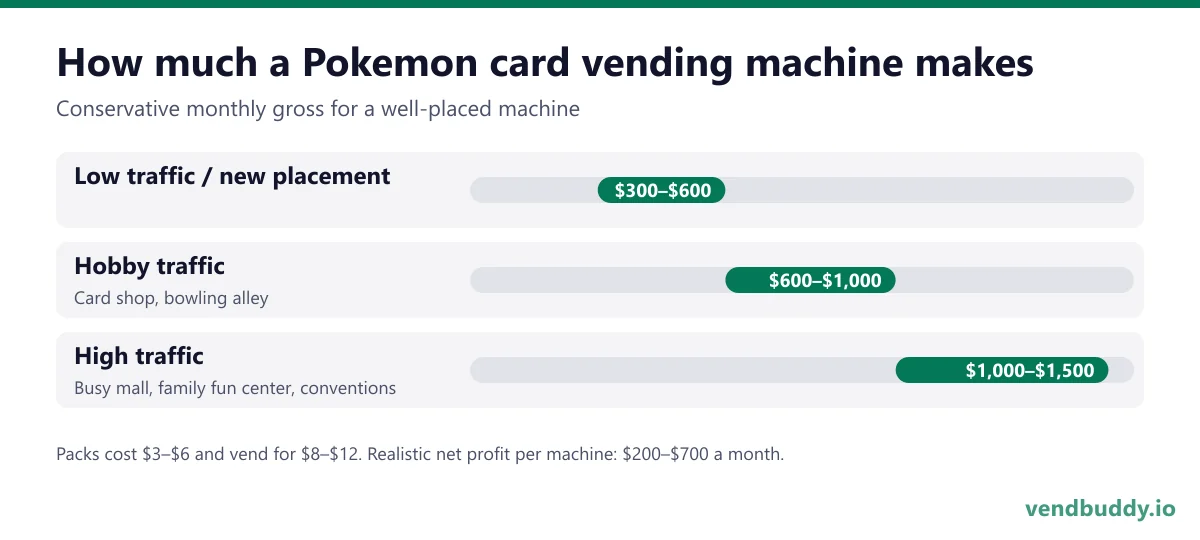
Conservative baseline estimates for a well-placed machine:
- Low foot traffic / new placement: $300 to $600/month gross
- Moderate hobby-traffic location (card shop, bowling alley): $600 to $1,000/month gross
- High-traffic (busy mall, family fun center, convention rotation): $1,000 to $1,500/month gross, with hype-spike potential well above that
Margins are the real story. Sealed Pokemon booster packs bought in bulk from authorized distributors can cost you $3 to $6 per pack. Vend them at $8 to $12 and your gross margin per transaction is meaningful. Mystery pack bundles (3 packs for $15, for example) can push average transaction value higher while keeping the price-per-pack perception favorable.
Be honest with yourself about costs: your margin is sell price minus sealed-product cost, minus machine payment, minus location commission if the host takes a cut, minus restock labor.
Scaled up to a whole route, that per-machine number decides everything — and the honest answer for how many machines it takes to replace a salary is roughly three times what most content on this topic implies. The full model, with three costed scenarios and the ramp timeline, is in how to quit your job with Pokemon vending machines.
Startup costs and sourcing inventory
A purpose-built card or collectible vending machine runs $1,500 to $4,000 new. Standard snack/drink machines are not well-suited — card packs need smaller coils, accurate dispensing, and ideally a locking display front. Vendors like Selectivend and several eBay-sourced refurb suppliers offer collectible-format machines.
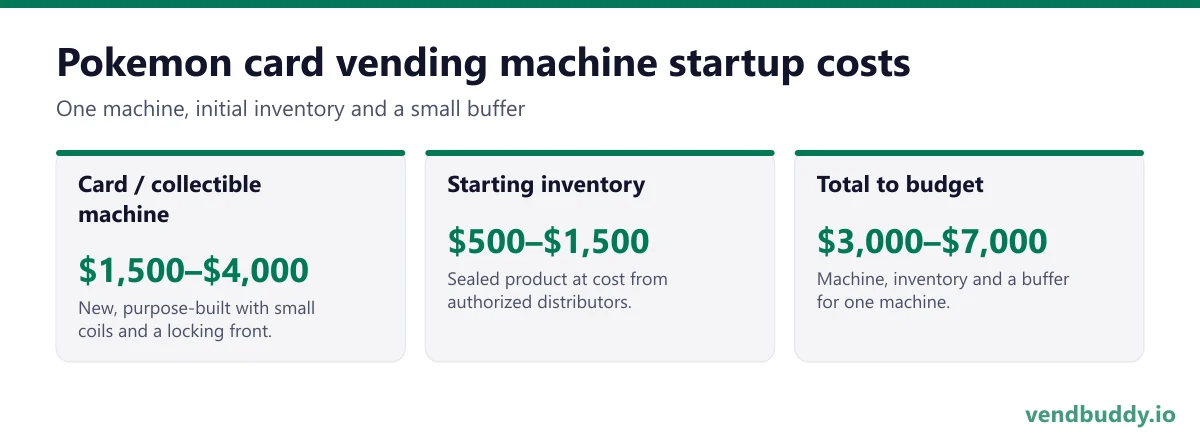
Inventory is your real working capital requirement. A fully stocked machine may hold $500 to $1,500 in product at cost. Sourcing sealed Pokemon product at good margins means buying from authorized distributors (not retail stores, where you will lose money). Establish accounts with hobby distributors early. Check authenticity carefully — the market has counterfeit product, and selling a fake pack will end your reputation with the collector community in that area before you build it.
Sourcing is where most card-vending plans quietly fall apart, and it deserves more than a paragraph: where to buy Pokemon cards for a vending machine covers the four supply channels with real landed costs, exactly what a hobby distributor account requires, how to spot resealed packs before they reach an unattended machine, and how to stay stocked through a set-release allocation squeeze.
Total startup budget to take seriously: $3,000 to $7,000 for one machine, initial inventory, and a small buffer.
If you would rather not pull that $3,000 to $7,000 out of savings, the usual move is 0% intro business credit: you buy the machine and the first load of packs on the card and pay it down from sales before the intro window ends. 7 Figures Funding helps new business owners apply for 0% intro business credit lines. Affiliate link — VendBuddy may earn a commission at no extra cost to you, and we have no influence over any approval decision. Any credit line is debt you personally guarantee.
The line-by-line version of that budget — machine price tiers, why inventory rather than equipment dominates the total, what zero spoilage is genuinely worth, the insurance wrinkle sealed collectibles create, and an honest payback comparison against a snack machine — is in what a Pokemon card vending machine actually costs.
What Amazon can and cannot sell you for this
Worth saying plainly: Amazon doesn’t list a purpose-built trading-card machine. What it lists is the general vending category, plus the few support buys this niche actually needs. The card-specific cabinets come from specialist builders or from a coil machine converted to tighter columns, which is covered above.
- Vending machines on Amazon. The general category browse. Mostly snack, drink and combo cabinets, which is useful for pricing the floor before you pay a specialist builder a premium. View on Amazon →
- Card readers and payment hardware. A cash-only card machine loses the exact buyer it was built for. Up-front and monthly costs are in our card reader comparison; most operators start with Nayax (affiliate link). View on Amazon →
- WYZE Cam OG, 2-pack. A machine holding several hundred dollars of sealed product through a release week is worth a camera pointed at it. View on Amazon →
- A 0.01 g pocket scale. Packs from the same print run weigh almost the same. Weigh a few from every case before they go in the machine and a resealed lot shows up fast. View on Amazon →
For a broader view of how TCG vending compares to other alternative vending categories, see Alternative Vending Machine Businesses Ranked.
Best locations for Pokemon card vending machines
The locations that produce results share one trait: they attract people who already have a collector mindset or are comfortable with impulse entertainment spending. Target these first:
- Mall common areas and food courts (especially near GameStop or hobby anchor tenants)
- Hobby shops, comic shops, and card game stores (complementary, not competitive — most shop owners will take a rev-share arrangement)
- Arcades and family fun centers
- Bowling alleys
- Barbershops (youth-focused locations see strong impulse buys)
- Game stores and tabletop gaming cafes
- Convention floors and pop-culture event venues
- Mall kiosk-adjacent placement
Finding the right contacts at these venues — the owner, the manager, whoever can actually say yes to a placement — is where most operators stall. VendBuddy pulls venue leads from Google Maps and surfaces the best contact on file (owner or manager when available), so you can spend time pitching instead of searching. The Lead Finder and Lead Map tools let you target by location type and geography, which is exactly the workflow this niche demands.
That list is the starting point rather than the answer. Which of those venues actually performs, the qualified-traffic rule that replaces raw footfall in this niche, how to structure the commission split, and the reason a host will accept a card machine when they would decline a snack machine in the same corner, are all in where Pokemon vending machines actually work.
If you are also evaluating entertainment vending options, claw machine placements often overlap with the same venue types.
Pros, cons, and risks
Pros: High margin per transaction relative to snack vending, strong collector demand, low competition in most markets, repeat buyers in the right locations, easy to expand once you have sourcing and placement dialed in.
Cons: Inventory management is more complex than snacks (product variety, set rotations, authenticity), hype cycles mean demand for specific sets spikes and fades, restocking requires more active attention.
Risks to take seriously:
- Theft and tampering. High-value product in a public machine is a target. Choose machines with solid locks and consider placement in supervised locations (inside a store vs. an unsupervised hallway).
- Hype volatility. A set release or viral moment can spike demand — but slow periods exist. Do not over-invest in inventory for a single set before it proves out.
If you are ready to plan one, the Pokemon Vending Machine Business Kit puts the product mix, sourcing checks, anti-theft habits and a margin calculator in one place.
See also: Candy and Gumball Bulk Vending for a lower-variance entry point if you want to test vending fundamentals before committing to collectibles inventory management.
Touchscreen card vending stocked with Pokemon, Yu-Gi-Oh, Magic: The Gathering, One Piece, sports cards, and accessories. A trending, low-competition niche.
FAQ
Do I need a special machine for card vending?
Yes. Standard snack coil machines are not reliable for card packs. Look for machines with adjustable coil spacing, glass-front display capability, and remote monitoring. Expect to pay $1,500 to $4,000 for a suitable unit.
Can I place a machine inside an existing card shop?
Many shop owners are open to rev-share arrangements, especially if you handle restocking. Frame it as incremental revenue for them with no work required. Have a simple agreement ready.
How much does a Pokemon card vending machine make per month?
A well-placed machine in a hobby-traffic location typically generates $300 to $1,500 per month in gross revenue. Net profit after product cost, machine payments, and location commissions typically runs $200 to $700 per machine. Results depend heavily on foot traffic quality, restock consistency, and sourcing margins.
Worth noting on product spend: the route spend is the smaller half of this. The bigger line is the rent or mortgage payment, which normally earns nothing. Per its card page the Bilt card earns up to 1.25X on that payment with no transaction fee, and the no-fee Blue tier earns 1X on everything else. Referral link, and it only works if you clear the balance every month. Affiliate link, so we may earn a commission at no extra cost to you.
Where do I find venues to pitch?
VendBuddy pulls venue leads — malls, arcades, hobby shops, family fun centers — with the best contact on file (owner or manager when available) directly from Google Maps data. It is the fastest way to build a target list without manual searching.
Is Pokemon TCG vending legal everywhere?
Generally yes, but check your city or county for vending permits and any specific requirements for commercial placement in public spaces. When operating inside a private business, a placement agreement with the host covers you on their end.
How many official Pokemon vending machines are there in the US?
On May 21, 2025, PokéBeach counted 1,473 official Pokemon TCG vending machines listed by The Pokemon Company International in 25 states, up from fewer than 200 in six states in March 2024. Those are the company’s own machines, separate from independent operators.
How much does it cost to start a Pokemon card vending machine?
Plan on $3,000 to $7,000 for one machine, the first load of sealed product and a small buffer. The machine runs $1,500 to $4,000 new, and a full machine can hold $500 to $1,500 of product at cost.
What is selling, which buildings say yes, and the numbers before you buy a machine. Free, confirm from your inbox, unsubscribe in one click. Refer one friend and get 25 VendBuddy credits.
General information, not legal, tax or financial advice. Rules change, so check the official source. Revenue and income figures are examples, not promises. See our terms.