Bulk vending — candy, gumball, and capsule machines — is the lowest-cost entry point in the entire vending industry. A single gumball head can be purchased for under $50, placed at a local pizzeria, and earn a quiet $10–$25 per month with almost no maintenance. That does not sound impressive until you have 40 of them.
Part of our complete guide: best cash flow businesses.
How much does bulk/candy vending make?
Expectations matter here. A single bulk head at an average location earns roughly $5–$50 per month. High-traffic spots — busy barbershops, bowling alleys, family fun centers — can push toward the upper end. Quiet waiting rooms or low-foot-traffic retail entries sit closer to the floor.
The math becomes interesting at scale. Fifty heads averaging $15/month each generates $750/month in gross revenue. Your main costs are product refills (typically 10–25% of gross), occasional repairs, and your time driving the route. Net margins on a mature bulk route can run 60–75%, which is genuinely difficult to match in any other vending category at this capital level.
What bulk vending is not: a fast path to full-time income from a handful of machines. Operators who treat it as a get-rich scheme burn out early. Operators who treat it as a systematic volume game — adding heads steadily, cutting underperformers, compounding — build durable side income over 12–24 months.
Startup costs (start under $100)
This is where bulk vending separates itself from every other vending format. You can enter the business for less than the cost of a restaurant meal for two.
- Single-head gumball/candy machine: $30–$80 new, often under $30 used
- Double-head machine: $80–$150
- Triple rack or 4-head tower: $150–$300
- Initial product fill (gumballs, M&Ms, Skittles, bouncy balls, capsule toys): $15–$40.
For that first fill, a bag of Dubble Bubble refill gumballs is the usual pick for a gumball head.
A starter kit — one double-head machine plus first fill — can run under $120 all-in. If the spot has no counter or ledge, a metal gumball machine stand puts the head at kid height. Capsule/toy machines (vending small plastic toys or stickers) command a slightly higher price point per vend ($0.50–$1.00 vs. $0.25 for gumballs) and can meaningfully lift per-head revenue at the right location.
Picture the machines paying you while you sleep
That’s the real promise of vending — income that doesn’t cost you your time, and a life on your own terms. VendBuddy turns this guide into a step-by-step plan so you actually build it instead of just reading about it. Start free today.
Start building free →Best locations for bulk vending
Bulk machines need foot traffic, dwell time, and ideally impulse-friendly demographics (families with children, customers waiting). The highest-performing location categories are:
- Pizzerias and family restaurants (waiting areas near the exit)
- Barbershops and hair salons
- Auto repair shops and tire shops (long dwell times)
- Laundromats
- Bowling alleys and family fun centers
- Nail salons
- Ethnic grocery markets and international food stores
- Retail store entryways (small gift shops, dollar stores, convenience stores)
- Pediatric and family medical waiting rooms (confirm policy first)
Avoid locations with heavy foot traffic but no dwell time — commuter transit stops, for example, rarely convert well for bulk. You want customers who are standing still for at least two to five minutes.
Finding and pitching these locations at scale is the hardest part of building a bulk route. VendBuddy pulls verified venue data from Google Maps and surfaces the best contact on file (owner or manager when available) so you can identify and approach dozens of qualifying spots in a single session instead of driving around blind.
How to scale a bulk route
Bulk vending scales by adding heads and cutting dead weight, not by upgrading individual machines. A practical growth sequence:
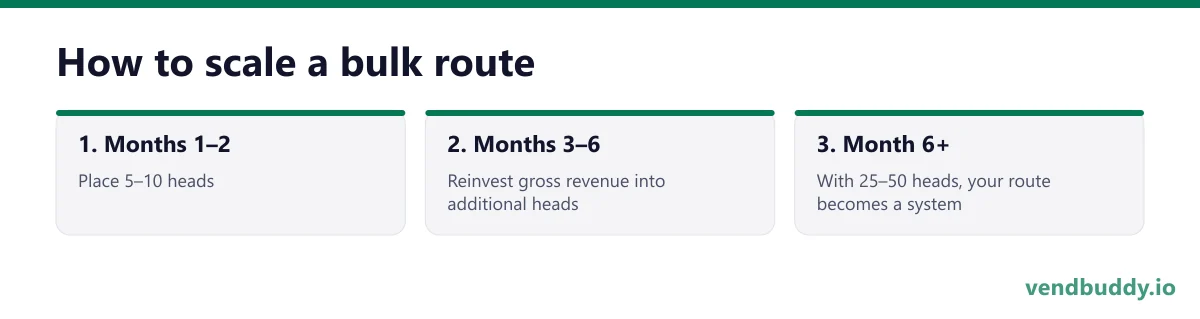
- Months 1–2: Place 5–10 heads. Learn which location categories actually perform in your market. Collect real data, not assumptions.
- Months 3–6: Reinvest gross revenue into additional heads. Pull any machine earning under $8/month after 60 days — those hours and miles are better spent on a new placement.
- Month 6+: With 25–50 heads, your route becomes a system. Document service intervals (most bulk machines need a refill every 4–8 weeks depending on traffic). Batch your stops geographically to minimize drive time.
Route efficiency matters more than most new operators expect. Two operators can both have 50 heads; the one with a tight geographic cluster spends half the time and fuel of the one with machines scattered across a metro area. Use a lead-finding tool like VendBuddy Lead Finder to prospect within defined zip codes so you build density from the start.
For context on how bulk stacks up against other low-cost formats, see alternative vending machine businesses ranked and claw machine business profit and locations.
Pros, cons, and who it is for
Pros:
- Lowest capital barrier in vending — real entry under $100
- No power, no refrigeration, no connectivity required
- High margin on product
- Easy placement conversations (low-stakes ask for the business owner)
- Scalable with compounded reinvestment
Cons:
- Revenue per head is genuinely low — volume is not optional
- Cash-only collections require regular physical visits
- Vandalism and theft are higher risks than with larger machines
- Not viable as a primary income with fewer than 60–80 heads
Who it is for: First-time operators testing vending with minimal downside. Part-time side hustlers willing to do route work on weekends. Existing operators looking for a complementary low-overhead revenue layer. It is not ideal for anyone expecting five figures per month from a dozen machines.
Ready to find your first batch of qualifying locations? Open VendBuddy and run a Lead Map search in your zip code — filter by restaurant, salon, or auto shop to start. Also see our guide on how to find vending locations for a full placement strategy.
Classic glass-globe gumball machine on a stand — a low-cost impulse earner that fits a waiting-room corner anywhere.
Holds ~230 toy capsules with an adjustable turntable for bouncy balls, capsule toys, or gum. A staple earner near arcade and retail exits.
Three adjustable canisters (gumballs, candy, capsules), all-metal coin mechanism, anti-theft locks. The cheapest real route you can start.
FAQ
Do I need a license to operate bulk vending machines?
Requirements vary by state and city. Many jurisdictions require a general business license and, in some cases, a vendor or solicitation permit. A handful of cities charge a per-machine fee. Check with your city clerk and state business licensing office before placing machines. The charity-sticker route may trigger additional charitable solicitation registration requirements.
How often do bulk machines need to be serviced?
At a typical location, a standard gumball or candy head needs a refill every four to eight weeks. High-traffic spots (busy pizzerias, bowling alleys) may need monthly visits. Build your route map so you can service multiple machines in a single trip.
What product sells best in bulk machines?
Classic gumballs and branded candy (M&Ms, Skittles, Reese's Pieces) consistently outperform generic product. Capsule toys and bouncy balls perform well in family-oriented locations. Avoid gourmet or novelty fills until you have baseline data from a location — defaults earn more reliably than experiments.
How do I approach a business owner about placing a machine?
Keep it brief and low-pressure. Explain that the machine costs them nothing, takes up roughly one square foot, and gives their customers something to do while they wait. Offer a small commission (10–20% of collections) if they push back on a free placement. Most bulk operators lead with the low-ask angle before offering commission.
What is selling, which buildings say yes, and the numbers before you buy a machine. Free, confirm from your inbox, unsubscribe in one click. Refer one friend and get 25 VendBuddy credits.
Walk-ins and cold emails find locations. A small site with your own machine photos and a request-a-machine form lets the next one find you. Around machine three to five, an AI builder drafts it in an evening. Wix is the mature site builder; Base44 also builds working tools like a quote form. Start with the AI website walkthrough or Wix vs Base44.
General information, not legal, tax or financial advice. Rules change, so check the official source. Revenue and income figures are examples, not promises. See our terms.