Vending machine commission rates land between 5% and 20% of gross sales, and on a small or mid-size account the number you will actually sign is 8–12%. Open every negotiation at 5%. A surprising share of buildings take 0% when you pitch the machine as an amenity for their people instead of a revenue share.
Part of our complete guide: vending machine income.
Commission is what it costs to sit inside somebody else’s building, so model it like COGS, not like a favor you are doing. On a machine grossing $1,200 a month, 10% is $120 — out of a net that might only be $400. That is close to a third of your take-home leaving before you have driven anywhere.
The rest of this page is the working framework: what each location type expects, when 0% is the right offer, how a product credit cuts an effective 10% down to under 3%, the affordability check to run before you sign, and the point where you walk. If a building is asking 20% and does under $8,000 a month gross, that point is right now.
- Standard range: 5–10% of gross revenue.
- Start low: Open every negotiation at 5%.
- Walk from 20%+: Unless the location does $8K+/month gross.
- Premium properties: Often accept 0% when framed as a free amenity.
- Alternative: Flat rent ($50–$200/mo) when volume is unpredictable.
What Vending Commission Actually Is
A vending commission is a percentage of gross sales paid to the property owner or manager in exchange for exclusive placement rights. It is not a rent payment, it is not a profit-share — it is a cost-of-goods analog for the location itself. Treat it that way in your unit economics from day one.
The standard range in 2026 is 5–20% of gross revenue, with the wide spread explained almost entirely by location type and negotiating leverage. Most operators working small-to-mid-size accounts land between 8–12%. Anything above 15% needs a very deliberate justification in your model before you sign.
When 0% Commission Works (and When to Offer It)
Zero-commission placements are more common than beginners expect, and targeting them is a legitimate strategy — not a pipe dream.
- Small offices (under 30 employees): The operator is providing a genuine service. Property managers at this scale are grateful for the convenience, not angling for revenue share. Start at 0% and offer product credit instead (see below).
- Churches, civic buildings, community centers: Non-profits and civic properties often cannot legally or philosophically accept commissions. A $25–$50/month product credit for their events fund is welcomed and costs you far less than 10% of gross.
- Storage facilities and self-storage: Low-traffic, low-maintenance, and the manager genuinely appreciates having snacks available for customers on move-in days. Commission expectations are minimal.
- New machines in underserved rural areas: If you are the first operator to approach a location, 0% is a completely reasonable opening. You can always renegotiate upward at renewal if the account grows.
The rule: if the location needs you as much as you need them, open at 0% and let them ask for commission. Many never will.
Negotiate commissions like a pro
VendBuddy gives you the commission benchmarks, a contract generator, and the exact scripts operators use to keep more of every sale. Sign up free and get 5 credits.
Get the tools free →The Product Credit Alternative
Product credit is an underused negotiating tool. Instead of paying 10% of $1,200/month ($120 cash), you offer $60–$80 in free product per month from the machine. The location manager gets snacks for the break room or staff meetings. Your actual cost is your COGS on that product — typically 40–45 cents on the dollar — so a $75 product credit costs you roughly $30–$34 out of pocket.
That is a 70–75% reduction in effective commission cost compared to a 10% cash commission, for a location that is just as happy. Offer it as: "Rather than a percentage commission, I can stock your break room with $75 in complimentary product every month. Most location managers prefer it." A meaningful number say yes.
Sliding Scale by Location Type
Here is the honest benchmark table operators use when assessing whether a commission ask is reasonable:
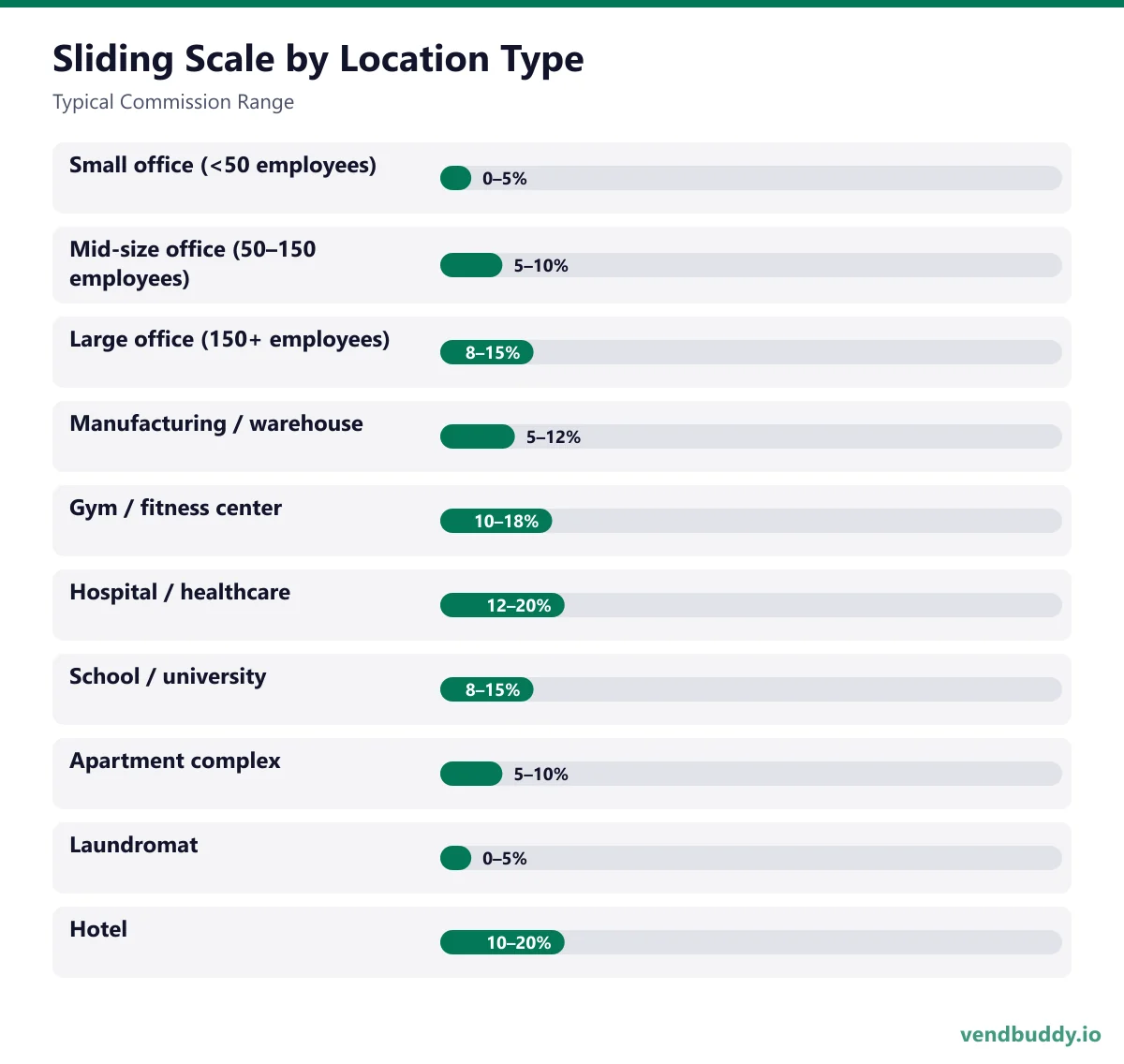
| Location Type | Typical Commission Range | Notes |
|---|---|---|
| Small office (<50 employees) | 0–5% | Often waived; product credit effective |
| Mid-size office (50–150 employees) | 5–10% | Standard ask from facility managers |
| Large office (150+ employees) | 8–15% | Procurement may require competitive bids |
| Manufacturing / warehouse | 5–12% | High volume, lower per-transaction; negotiate hard |
| Gym / fitness center | 10–18% | Owners know vending margins; expect higher ask |
| Hospital / healthcare | 12–20% | Premium traffic, procurement-heavy; budget accordingly |
| School / university | 8–15% | Often structured; may require bid process |
| Apartment complex | 5–10% | Property managers vary widely; start at 5% |
| Laundromat | 0–5% | Operator is adding value; 0% often accepted |
| Hotel | 10–20% | Highest expectations; model carefully |
VendBuddy gives you the proven cold-approach script that opens at 5%, the objection responses for “why so low?”, and the contract generator that locks in whatever rate you negotiate.
What public contracts pay
Government and campus contracts sit at the top of the range because they are big, multi-site and competitively bid. We read 28 public vending RFPs, agreements and awards: across the 7 that state one rate for every machine, the median was 25% of sales (10% to 52%), with drinks often carrying a higher rate than snacks. Those are large public accounts, not a single office break room, so use them as a ceiling when you price a bid. The full table, with a link to every source document, is in Vending Commission Rates and Contract Terms 2026: what public contracts show.
The Affordability Check: Can Your Profit Model Handle It?
Commission is only as meaningful as the gross revenue it is applied to. Before agreeing to any rate, run the math. A simple check:
- Estimate monthly gross from the location (use traffic count, employee headcount, or comparable benchmarks from your existing machines).
- Subtract COGS (typically 38–45% for a well-priced machine).
- Subtract commission at the proposed rate.
- Subtract your pro-rated share of machine costs: card reader fee (~$9/month), telemetry (~$5/month), insurance allocation (~$6/month), and vehicle cost allocation.
- What remains is your net contribution from that location. If it is under $80–$100/month, the machine is occupying a slot on your truck route that a better location could fill.
Use the VendBuddy ROI Calculator to run this check in under two minutes. Plug in the location’s estimated gross, your COGS, and the proposed commission rate and the calculator outputs net monthly contribution and payback period. Run it before every negotiation, not after. To see how one specific ask compares with public contracts and the bands below, the free commission rate checker does it in a minute.
A useful rule of thumb: commission + COGS should not exceed 55% of gross if you want a machine that meaningfully contributes to your operation. At 60%+ combined, you are working for the location, not yourself.
That ratio has one lever most operators forget to pull before they walk: a card reader lifts gross 15–35% on the same machine in the same spot, which is often the whole difference between a 10% commission you can carry and one you cannot.
Practical Negotiating Tactics
Anchor low and justify it. Come in with your number first. "Based on the traffic here I am planning for $900–$1,100/month gross. At a 5% commission that is $45–$55/month to you. Does that work?" Most location managers have not done this math themselves and your confident number anchors the conversation.
Offer a performance ramp. "I will start at 5% and if the machine hits $1,500/month consistently I will move you to 8%." This gives the location manager upside without costing you anything until the machine earns it, and it signals confidence in the placement.
Bundle value, not just cash. Propose quarterly restocks of locally preferred products, bilingual pricing stickers for mixed-language workforces, or a dedicated contact number for issues. These cost you almost nothing but differentiate you from a competitor who leads with percentage points.
Get it in writing every time. A commission rate agreed verbally today is a source of conflict in 18 months when the location manager changes. Your placement contract should specify the commission rate, the calculation basis (gross sales before tax), payment frequency, and the notice period for rate renegotiation.
Worth reading before you sign anything: the contract walkthrough covers which terms get pushed back on and which ones you can safely give away. Commission is rarely the clause that hurts you later.
See the full negotiation playbook for contract language and objection scripts.
When to Walk Away
Some locations are not worth the commission being asked, regardless of the traffic. Walk away when:
- The ask exceeds 20% and there is no room to negotiate. Healthcare is the one category where 20% can pencil — and only at high-traffic hospitals with $2,000+/month gross per machine.
- The location wants commission on gross before returns and refunds. Negotiate commission on net-of-refund gross, always.
- They want a monthly minimum guarantee regardless of machine performance. This is a lease, not a commission, and it destroys your downside protection.
- The commission plus your estimated COGS exceeds 58% of projected gross. The math does not work regardless of how good the traffic looks.
There are more locations than machines in any market. Discipline on commission acceptance is what separates operators with 40% net margins from those running at 15% and wondering why the business does not feel profitable. Walking away is only easy when you have somewhere else to go — the free Opportunity Map scores any US ZIP on population, employment, and income in about two seconds, so you always have a next market queued before a negotiation goes sideways.
FAQ
What is the average vending machine commission rate?
The national average is approximately 8–12% of gross sales for mid-size commercial accounts. Small offices and low-traffic sites often pay 0–5%. High-traffic healthcare and hospitality locations can run 15–20%.
Is commission paid on cash or on net revenue after COGS?
Always on gross sales (before COGS). The location owner does not share your product cost — they get a percentage of what the machine collects. Negotiate the rate accordingly.
Can I negotiate commission down after the contract is signed?
Only at renewal unless your contract includes a performance-renegotiation clause. This is why getting favorable rates at signing matters — and why every placement contract should include a 12-month review clause.
Should I always include commission in my ROI model before accepting a location?
Yes, without exception. Model three scenarios: 0%, the asked rate, and a midpoint. If the location does not pencil at the asked rate even under optimistic revenue assumptions, offer the midpoint or decline.
What is a typical vending machine commission percentage by location type?
Small offices and laundromats: 0–5% (often waived entirely). Mid-size offices and apartment complexes: 5–10%. Large offices, warehouses, and schools: 5–15%. Gyms: 10–18%. Hospitals and hotels: 12–20%. The full sliding-scale table above breaks down all ten location types.
How do I negotiate a vending machine commission?
Open at 5% (or 0% where you are the one adding value — small offices, laundromats, storage facilities). Offer a $50–$100/month product credit instead of cash — it costs you 40–45 cents on the dollar and most managers prefer it. Never go above 20% unless the location grosses $8K+/month, and put a 12-month review clause in every contract.
Do vending machine owners pay rent?
Normally no. The standard deal is that you supply, stock, and service the machine at zero cost to the location, and the location supplies the floor space and the electricity. What a host can legitimately ask for is commission — a percentage of gross sales, typically 0–10% for small and mid-size sites and up to 20% for hospitals and hotels. Flat monthly rent is rare, and it is a bad structure for you because it does not flex with revenue: $150 a month is nothing on a $2,500 machine and fatal on a $400 one. If a location insists on a fixed fee, convert it to a percentage, or offer a $50–$100 monthly product credit instead, which costs you only 40–50 cents on the dollar. The deal to walk away from is rent and commission together. That is a landlord relationship rather than a vending placement, and the margin does not survive it.
Related: how to negotiate vending machine locations, how to find vending locations, vending machine business costs and profit breakdown, how to place vending machines for maximum revenue, and how much do vending machines actually make. Also see: tiered revenue-share structures and vending contracts 101. Model your specific location with the ROI Calculator before signing any placement agreement.
Use the Machine Finder to pick a property type — bar, laundromat, gym, mall, arcade, dealership — and see the specific machines that logically fit it, with prices and where to buy.
Open the Machine Finder →What is selling, which buildings say yes, and the numbers before you buy a machine. Free, confirm from your inbox, unsubscribe in one click. Refer one friend and get 25 VendBuddy credits.
General information, not legal, tax or financial advice. Rules change, so check the official source. Revenue and income figures are examples, not promises. See our terms.