Part of our complete guide: how to find vending machine locations.
A handshake vending deal lasts until the property manager changes, the building sells, or a competitor shows up with a better offer. A well-drafted contract gives you 3 years of protected revenue, automatic renewal, and a termination clause that doesn't leave you dragging a 280-lb machine out at 30 days' notice. Here is what to include and what to watch for.
If you are still short of buildings to sign, how to get vending machine contracts covers the step before this one: the lead list, the decision-maker, and the Contract Creator that drafts the agreement below in about two minutes.
Most new operators use a template from a legal website or skip a contract entirely. Experienced operators with 10+ placements have usually learned from one specific contract failure — a missing termination clause, an uncapped commission escalator, or an indemnification paragraph that exposed them to a slip-and-fall claim. This post covers the real elements that matter. If you would rather start from a document than a blank page, a ready-to-sign plain-English placement agreement ships in the operator kits, annotated clause by clause.
Core terms every vending contract needs
Term length and renewal. Standard is 3 years with automatic annual renewal after the initial term. The automatic renewal clause requires either party to provide written notice (typically 60–90 days) before each anniversary to terminate. Without this, your contract expires and you're month-to-month with no protection against summary removal.
Exclusivity carve-out. If you're signing an exclusivity clause (you're the only vending operator at the property), be very specific about the scope. "Snacks and beverages" is different from "all food and beverage vending services." If your exclusivity is broad, another operator can't add a coffee machine or a micro-market without violating the contract. If it's narrow, they can. Define the scope explicitly in the contract language. Whether to ask for exclusivity at all, what to trade for it, and which carve-outs keep it signable is worked through in the exclusive vending agreement guide.
Commission structure. State the commission percentage, the gross revenue calculation method (gross sales minus tax is the standard base), and the payment timing (monthly, quarterly). Avoid open-ended escalator clauses that allow the location to demand a higher commission rate after Year 1 without renegotiation.
Damage and theft. The location's property insurance covers the machine if it's inside a secured property and damage results from a third party. Your operator's liability policy covers you if someone trips on the machine's power cord. Neither should be ambiguous. State explicitly: "Damage to the machine caused by third parties while on property is covered by the location's property insurance. Damage caused by operator negligence is covered by operator's liability policy."
Service-level commitments. Be specific about what you're committing to: "Operator will restock within 48 hours of notification of an empty machine. Operator will respond to service calls within 4 hours during business hours, 24 hours on weekends." Don't commit to standards you can't meet — this clause can be used to justify early termination if you breach it.
Termination and relocation clauses
Standard termination notice is 90 days for both parties. Without a termination clause, either party can exit with whatever notice is "reasonable" under state law — which can be as little as 30 days in some jurisdictions, not enough time to find a replacement placement. Also include a relocation clause: if the location moves, is renovated, or is sold, the agreement transfers to the successor property manager or requires 90 days' notice to you before the machine must be removed. The full version of this section, including cure periods, the removal window, prepaid commission and the auto-renewal terms worth catching, is in the vending contract termination clause guide.
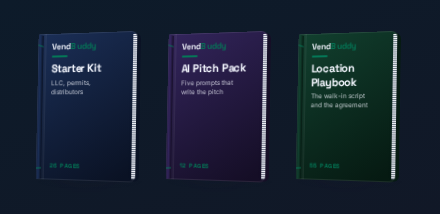
Everything above is free to read and free to do. The operator packs are the same material in fill-in-the-blank form — the 50-state distributor list, the LLC and permit checklist in unblocking order, the word-for-word walk-in script, and the placement agreement you hand a property manager. One-time purchase from $27, nothing renews.
See what is inside →Picture the machines paying you while you sleep
That’s the real promise of vending — income that doesn’t cost you your time, and a life on your own terms. VendBuddy turns this guide into a step-by-step plan so you actually build it instead of just reading about it. Start free today.
Start building free →The watch-outs experienced operators have learned
Non-compete clauses. Some property management companies slip in language preventing you from placing machines at any property within a 1-mile or 2-mile radius during the contract term. This can effectively block your growth in a dense urban area. Push back on geographic non-competes or cap them at the specific property.
Indemnification language. Watch for clauses that require you to indemnify the property for all claims arising from the machine, including those caused by the property's own negligence. Standard language should be mutual — each party indemnifies for their own negligence. Unilateral indemnification exposes you to claims from events you had no role in causing.
A laminated copy of the signed agreement left with the PM signals professionalism. The Scotch TL901X ($46 →) handles this in under 5 minutes.
Most placement agreements need two signatures and a Certificate of Insurance, not a notary. But corporate or multi-site landlords sometimes require a notarized signature or a verified e-sign trail before they will execute. Proof (formerly Notarize) does remote online notarization and identity-verified e-signatures, so you can get an agreement executed without coordinating an in-person notary. Affiliate link — we may earn a commission at no extra cost to you.
VendBuddy's Contract Creator generates a customized placement agreement with the right terms, exclusivity scope, and service-level commitments for your specific placement type.
Generate your contract →FAQ
Do vending machine operators need a written contract?
Yes, for any placement you're investing real capital in. A machine worth $3,000+ in a location you want to run for 3 years is not a handshake situation. Even a one-page letter of agreement covering term, commission, and termination notice is dramatically better than nothing.
What is a standard vending machine contract length?
Three years with automatic annual renewal after the initial term. 60–90 days written notice from either party to terminate at each anniversary. This gives you meaningful location protection while giving the property a reasonable exit if performance is genuinely bad.
Should vending machine contracts include exclusivity?
Yes, but narrowly defined. Exclusivity for your specific machine categories (snacks and beverages) prevents a competing operator from stepping in. But define the scope carefully — overly broad exclusivity clauses create unexpected obligations and can be challenged if they prevent the location from adding unrelated amenities like coffee service.
Who is liable if someone is injured near a vending machine?
Depends on the cause. Operator negligence (defective product, machine malfunction) falls on the operator's liability policy. Third-party vandalism or property conditions (wet floor near the machine) are typically covered by the location's property insurance. Your contract should state this explicitly. Never sign a unilateral indemnification clause that assigns all claims to you regardless of cause.
The location asked me for a contract. What do I actually send them?
Send a one-page placement agreement, not a twelve-page legal document — the long version stalls deals. It needs six things: the parties and the site address; the term (three years with automatic annual renewal is standard); what you provide (machine, stocking, service response time) and what they provide (floor space and electricity); the commission rate and exactly how it is calculated (percentage of gross sales, paid quarterly); who carries damage, theft, and vandalism; and a termination clause with 60–90 days written notice on both sides. Attach your Certificate of Insurance naming the property as additional insured — that attachment is usually what actually ends the conversation. Send it as a PDF the same day they ask, while the yes is still warm. The VendBuddy Operator Pack includes a plain-English placement agreement you can sign on the spot, and the sections above explain every clause you are agreeing to.
Is there a free vending machine contract template I can copy?
Yes. A full one-page placement agreement is printed on the site, clause by clause, with a plain-English note under each section explaining what you are agreeing to: the free vending machine contract template. Fill the bracketed fields, send it as a PDF, and have a lawyer in your state read it before you use the same document across twenty properties.
Related: the free contract template, clause by clause, the termination clause explained, exclusive vending agreements, vending machine commission rates, negotiating vending placements, vending machine insurance guide, tiered revenue share agreements, vending business plan template.