Most people walk past massage chairs in malls and airports without a second thought. Vending operators who pay attention see something different: a machine that collects $1–$3 every few minutes, needs no restocking, and sits in a spot where people are already killing time. Massage chair vending is one of the most overlooked high-ticket niches in the industry, and in 2026 it remains genuinely underserved in most mid-size markets.
Part of our complete guide: best cash flow businesses.
Are massage chair vending machines profitable?
They can be, when the chair sits where people already wait: our estimate for a mid-traffic venue is $400 to $700 a month with no product to buy, and most operators break even in 6 to 18 months. Put the same chair where nobody sits still and it earns close to nothing, so the location decides the answer.
Every figure here is an average, and averages hide the building. The revenue calculator lets you plug in the property you are actually looking at and see the range for that type.
For a price check, Daiwa's vending page (viewed October 5, 2026) lists a massage at "$5 for 15 minutes" and offers host venues a 50% profit share with free installation and maintenance. Some venues will have heard that pitch, so expect them to compare it with the 10% to 25% commission most operators offer. Source: Daiwa Massage, 50/50 profit share.
How much does a massage chair make?
Revenue depends almost entirely on foot traffic and dwell time at your location. Here are honest, conservative estimates based on operator reports and industry data:
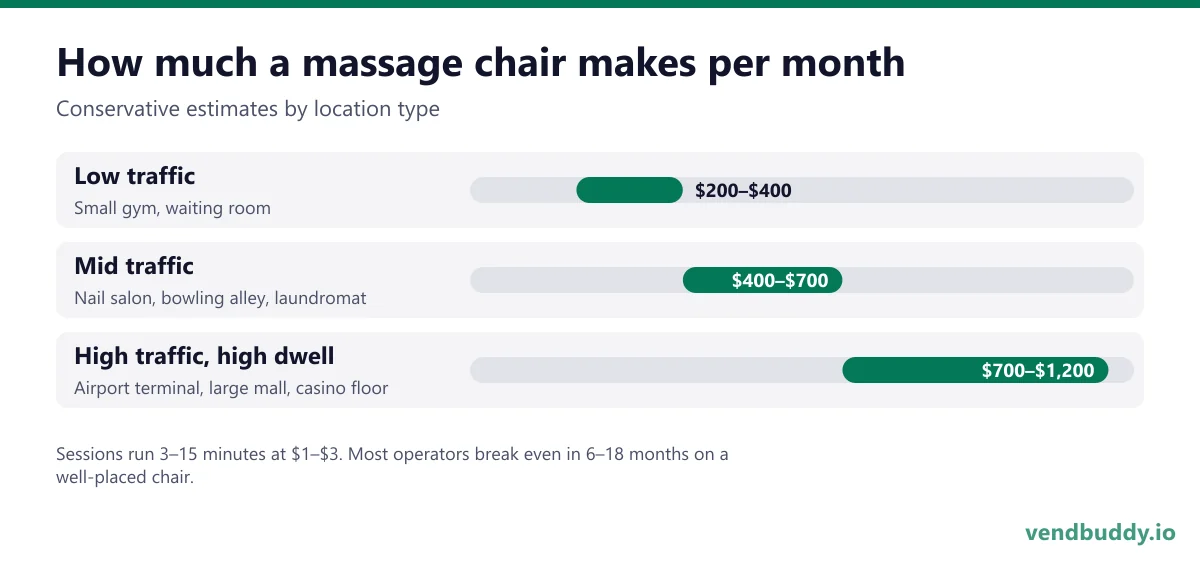
- Low-traffic location (small gym, waiting room): $200–$400/month
- Mid-traffic location (nail salon, bowling alley, laundromat): $400–$700/month
- High-traffic, high-dwell location (airport terminal, large mall, casino floor): $700–$1,200/month
A typical session runs 3–15 minutes at $1–$3 per session. Some operators use tiered pricing — $1 for 3 minutes, $2 for 8 minutes — to increase per-visit revenue without deterring casual users. Modern coin-and-card units accept contactless payment, which meaningfully increases use rates compared to coin-only machines.
Picture the machines paying you while you sleep
That’s the real promise of vending — income that doesn’t cost you your time, and a life on your own terms. VendBuddy turns this guide into a step-by-step plan so you actually build it instead of just reading about it. Start free today.
Start building free →Massage chair business startup costs
Massage chair vending has a higher upfront cost than a snack machine but a dramatically simpler ongoing operation. There is no inventory to buy, no product to rotate, and no spoilage risk.
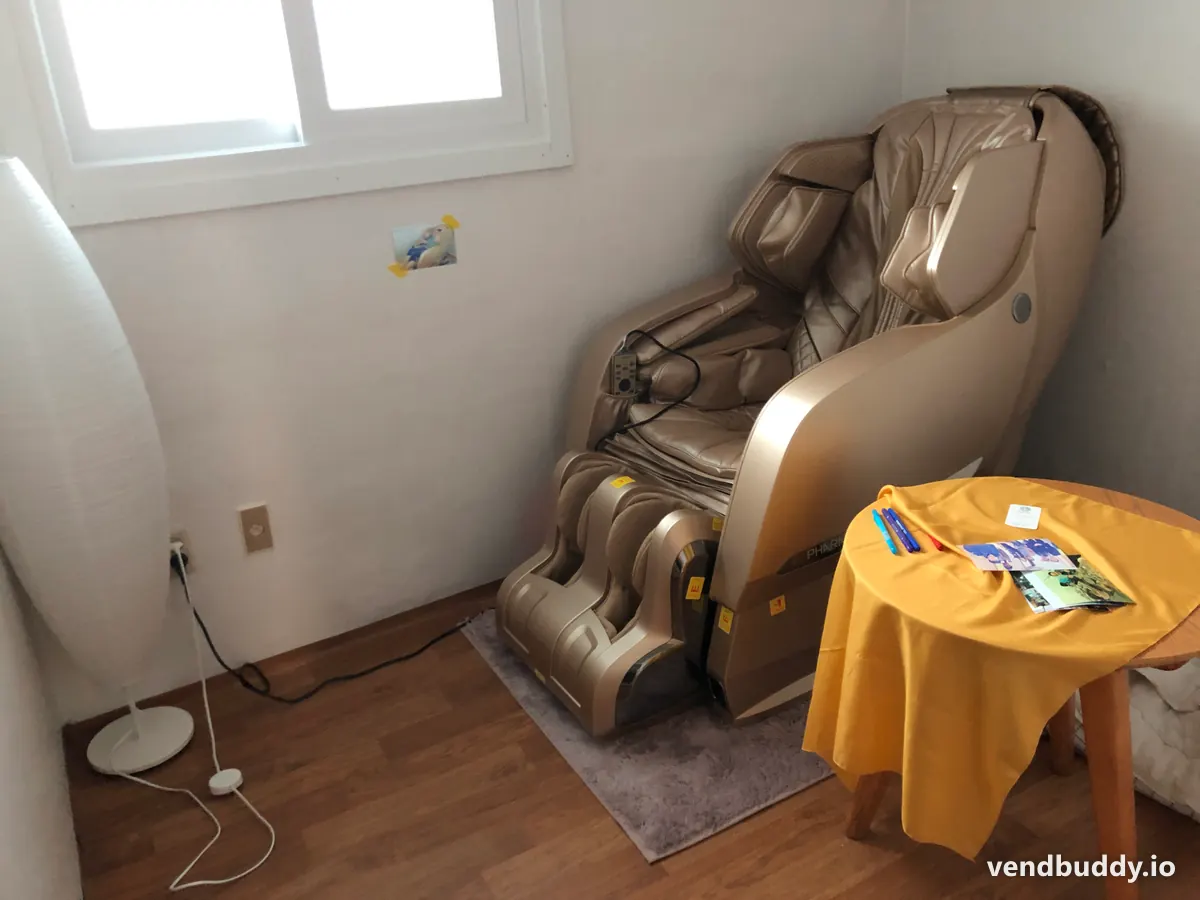
- Commercial coin/card massage chair: $1,500–$4,000 per unit (brands like Ogawa, Synca, and specialty commercial units)
- Delivery and installation: $100–$300 depending on distance and building access
- Card reader, if the chair is coin-only: budget $200–$400 up front and roughly $7–$13 a month, per our card reader comparison. Tap-to-pay is what gets the passer-by with no quarters to sit down. Nayax is a common retrofit pick. Affiliate link — VendBuddy may earn a commission if you buy through Nayax, at no extra cost to you.
- Location commission or flat rent: typically 10–25% of revenue, or a negotiated flat monthly fee
- Maintenance fund: budget $50–$100/month per chair for wear items (upholstery, rollers, remote panels)
The main operational task is collecting revenue, wiping down the chair, and doing periodic mechanical checks.
Funding the chairs without draining savings
At $2,000 to $4,000 per commercial chair, most first-time operators do not write a check — 0% intro business credit can carry the first chair or two while the location proves itself, so your cash reserve stays intact for placement fees and repairs. The full menu of options is in how to finance vending machines.
Best locations for a massage chair business: why dwell time is everything
People use a massage chair when they have time to kill and nowhere urgent to be. A busy grocery store with 4-minute average visits is a worse location than a laundromat with a 45-minute average visit.
Best location categories, ranked by typical dwell time and use rate:
- Airports and transit terminals — passengers waiting 1–3 hours are ideal customers; high-volume, high-revenue ceiling
- Casinos — long dwell times, discretionary spending mindset, strong fit
- Shopping malls — anchor-end placement near food courts or theaters performs best
- Movie theaters — lobby placement catches people waiting for showings
- Nail and hair salons — customers already sitting and waiting; high repeat-visit potential
- Hotel lobbies — especially extended-stay and business-travel properties
- Gyms and fitness centers — post-workout recovery use; members appreciate the amenity
- Bowling alleys — long visit duration, casual atmosphere, good fit
- Laundromats — captive audience with 30–60 minutes to fill
- Medical and dental waiting areas — high anxiety, long waits; check with management on appropriateness
Finding these locations efficiently is where most operators waste the most time. VendBuddy's Lead Finder and Lead Map pull venue data directly from Google Maps, filtered by category and location, so you can identify nail salons, gyms, bowling alleys, and hotel lobbies in your target market — along with the best contact on file (owner or manager when available) — without spending hours on manual research.
Pros, cons and who it is for
Pros:
- No inventory, no restocking runs, no spoilage
- High margin once placed — ongoing costs are low relative to revenue
- Scalable: each additional chair adds revenue with minimal added time
Cons:
- Higher upfront cost per unit than traditional vending
- Mechanical failures do happen — chair downtime means zero revenue
- Premium locations (airports, large malls) may require revenue sharing with a property management company rather than a direct negotiation
- Placement is harder to secure than snack machine placement — venues are less familiar with the concept
Who it is for: Operators who want a low-maintenance, high-margin add-on to an existing route, or solo operators building a focused niche business. It is not ideal for someone who wants to start with zero capital or who is unwilling to do active location prospecting.
Most people working on prospecting start by pulling the list rather than driving the map. The ranks the businesses around your ZIP by type and headcount, and the first five contact reveals are free.
If you are evaluating this alongside other non-traditional options, the full ranking of alternative vending machine businesses covers massage chairs, phone charging vending, and other niches side by side. For the fundamentals of landing placements, how to find vending locations covers the outreach process from first contact to signed agreement.
Pay-per-session SL-track massage chair bundled with a Nayax cashless reader. No inventory, high margin, and it earns wherever people wait.
FAQ
Do I need a business license to operate massage chair vending?
Requirements vary by state and municipality. Most operators run under a general business license and do not need a massage therapy license, since the machine is automated. Check your local requirements before placing your first chair.
How often do the chairs need maintenance?
Commercial units are built for heavy use and typically need a thorough inspection every 3–6 months. Upholstery wear and remote panel issues are the most common problems. Budgeting $50–$100/month per chair as a maintenance reserve is a reasonable starting point.
Can I negotiate a flat monthly fee instead of a revenue split?
Yes, and many operators prefer it. A flat fee (often $50–$150/month depending on venue size and traffic) gives you predictable costs. Revenue splits are more common at higher-volume venues where the location holder wants upside. Negotiate what works for both parties.
How do I find venues that are open to this?
Cold outreach to venue managers is the standard approach. The fastest way to build a prospect list is to use VendBuddy to pull filtered venue data — nail salons, gyms, bowling alleys, hotel lobbies — in your target area, with contact details included. It cuts the research phase from days to minutes.
How long does it take a massage chair to pay for itself?
Most operators break even within 6 to 18 months on a well-placed chair. A commercial chair costs $1,500 to $4,000, and with no inventory the main running costs are the location fee and a $50 to $100 a month maintenance reserve. A chair in a low-dwell spot may never pay back.
How much should I charge for a massage chair session?
A typical session runs 3 to 15 minutes at $1 to $3. Some operators use tiers, such as $1 for 3 minutes and $2 for 8 minutes. Daiwa lists $5 for 15 minutes on its own vending chairs (viewed October 5, 2026), so test a longer, higher-priced option where people wait a long time.
Do coin-only massage chairs need a card reader?
It helps. Contactless payment gets the passer-by with no quarters to sit down. Budget $200 to $400 up front for a retrofit reader and roughly $7 to $13 a month.
Do vending massage chairs work as an income generator for hotel rooms or Airbnb homes?
Not in the pay-per-use sense. A hotel room or an Airbnb home has one guest party at a time, so a chair there is an amenity the host buys, not a vending placement that earns from foot traffic. The vending version of this business lives in the hotel lobby, the airport gate and the mall corridor, where hundreds of people pass with time to kill.
What is selling, which buildings say yes, and the numbers before you buy a machine. Free, confirm from your inbox, unsubscribe in one click. Refer one friend and get 25 VendBuddy credits.
General information, not legal, tax or financial advice. Rules change, so check the official source. Revenue and income figures are examples, not promises. See our terms.