If you have ever driven through a dense neighborhood and seen a standalone blue kiosk with a coin slot and a fill-your-own-jug sign, you already know what a water vending machine business looks like. What you might not know is that those machines quietly generate some of the highest per-gallon margins in the entire vending industry — with almost no product cost after the initial setup. This guide breaks down the real numbers, the right locations, and what it takes to run a reverse-osmosis refill operation in 2026.
Part of our complete guide: best cash flow businesses.
How much does a water vending machine make?
Revenue depends almost entirely on location and community fit. A machine placed outside a busy Hispanic grocery market in a city with notoriously hard tap water can move 500 to 1,000 gallons per week — sometimes more. At $0.25 to $0.50 per gallon, that translates to roughly $125 to $500 per week from a single unit.
Conservative monthly estimates for a well-placed machine run $500 to $1,500. Operators in high-density communities with poor tap quality regularly report $2,000 to $3,000 per month from a single kiosk. Machines in mediocre locations — suburban strip malls where most residents are satisfied with tap water — may settle closer to $300 to $600 per month.
The honest takeaway: water vending is a volume-and-location game. The machine itself does not create demand. You are placing yourself inside existing demand, which is why scouting the right neighborhood is the single most important decision you will make.
Startup costs
Water vending machines carry higher upfront costs than most other vending formats because they require plumbing, power, and sometimes a permanent concrete pad.
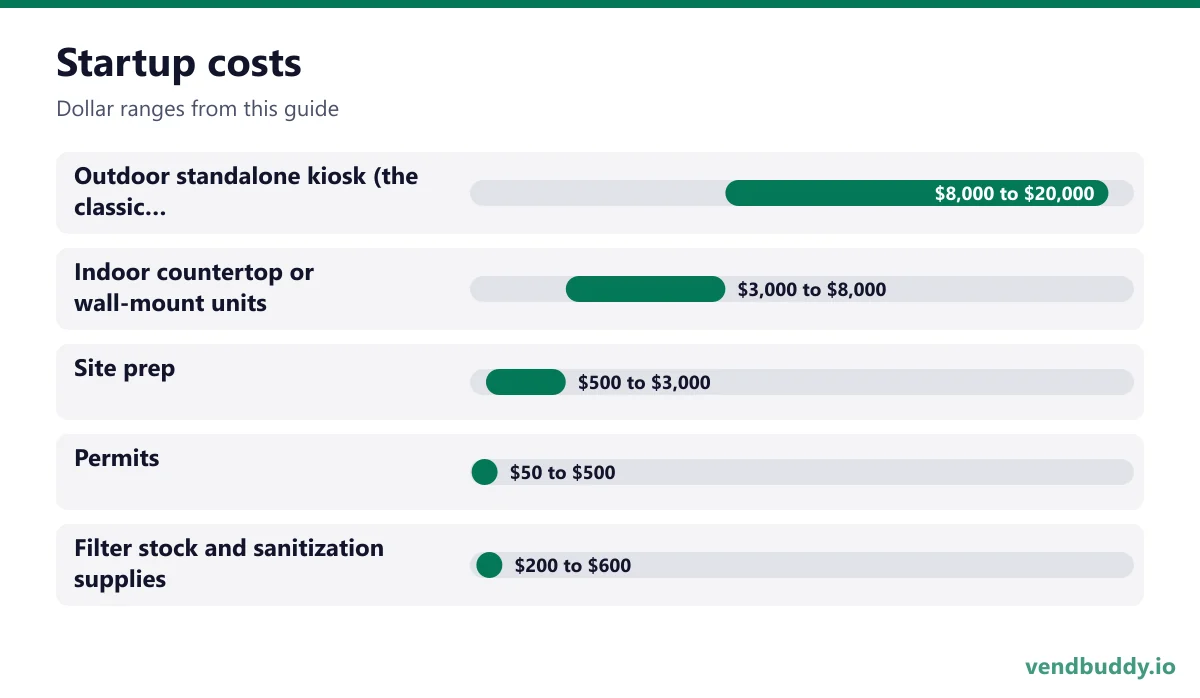
- Outdoor standalone kiosk (the classic blue unit): $8,000 to $20,000 depending on capacity, filtration stages, and payment system. Units with card readers, UV sterilization, and real-time monitoring sit at the higher end.
- Indoor countertop or wall-mount units: $3,000 to $8,000. Lower throughput, but also lower installation complexity.
- Site prep: Water line tap, drain line, 20-amp dedicated circuit, and (for outdoor units) a concrete or asphalt pad. Budget $500 to $3,000 depending on how far the water line runs.
- Permits: Most municipalities require a health department permit for water dispensing equipment. Expect $50 to $500 and a waiting period of 2 to 8 weeks.
- Filter stock and sanitization supplies: Keep 6 months of sediment, carbon, and RO membrane stock on hand. Initial supply: $200 to $600.
All-in, plan for $10,000 to $25,000 for your first outdoor machine ready to earn revenue. The break-even window for a strong location runs 12 to 24 months.
Funding the first machine without draining savings
A $10,000–$25,000 buy-in is exactly where 0% intro business credit earns its keep: the intro window can cover most of a strong location’s break-even runway before interest ever starts. The full menu — equipment loans, credit, and the alternatives — is in how to finance vending machines.
Picture the machines paying you while you sleep
That’s the real promise of vending — income that doesn’t cost you your time, and a life on your own terms. VendBuddy turns this guide into a step-by-step plan so you actually build it instead of just reading about it. Start free today.
Start building free →Best locations (community fit matters)
Water vending is one of the most community-sensitive formats in vending. The same machine that earns $2,500 a month in one zip code earns $400 in a zip code three miles away. Here is what separates winners from laggards:
- Hispanic and ethnic grocery markets: This is the single strongest placement category. Jug-refill culture is deeply embedded in many Latin American communities where distrust of tap water is the norm, not the exception. A machine outside a carneceria or mercado in a dense urban area can be your highest earner.
- Laundromats: High foot traffic, customers already waiting, and a demographic that responds well to value-priced clean water. Many laundromat operators welcome the additional service as a draw.
- Convenience stores and gas stations: Strong impulse purchase environment, though the site owner may want a revenue share. Negotiate carefully.
- Strip-mall storefronts with parking: A visible standalone unit in a parking lot next to a busy anchor tenant (dollar store, discount grocery) performs well if the surrounding neighborhood has hard or chlorinated tap water.
- Apartment-dense corridors: Renters in older buildings often have aging pipes and no water filtration. A kiosk within walking distance fills a real need.
- Standalone lots: Some operators lease a small patch of parking lot or a corner lot outright, eliminating the site owner from the revenue equation entirely.
Margins and maintenance
Water vending has among the best margin profiles in the vending industry. The consumable cost — filtered water — runs roughly $0.01 to $0.03 per gallon including the amortized cost of filter replacements. Selling at $0.25 to $0.50 per gallon means gross margins of 90% or higher on every gallon after filters are accounted for.
Maintenance is real but manageable:
- RO membranes: replace every 2 to 3 years, roughly $80 to $200 each.
- Carbon and sediment pre-filters: replace every 3 to 6 months, roughly $20 to $60 per service.
- UV lamp (if equipped): annual replacement, roughly $30 to $80.
- Sanitization flush: quarterly, usually done in under an hour.
- Payment system upkeep: most modern units use cellular-connected readers; budget $15 to $30 per month in connectivity fees.
Total monthly operating costs for a single machine in normal operation: roughly $80 to $200. That leaves substantial net income on a well-placed unit even at the conservative revenue end.
Pros, cons, and who it is for
Pros: Extremely high margin per unit of product. Recession-resistant demand — clean water is non-discretionary. Low ongoing labor. Scales cleanly (add machines, do not add staff). Strong community loyalty once customers develop a refill habit.
Cons: Higher upfront cost than snack or drink vending. Requires plumbing and permitting, which adds lead time. Location dependency is severe — a bad placement is expensive to move. Health department oversight adds compliance overhead. Community fit requirement means your market research must be thorough before you commit.
Who it is for: Operators willing to do real location research, comfortable with a longer payback window, and ideally already embedded in or knowledgeable about the communities where demand is strongest. It is not a passive install-and-forget business — but for operators who treat it like a real business, the margins reward the work.
If you are still comparing formats, the full alternative vending business rankings walk through ice, air, laundry, and other formats side by side. You can also read the dedicated breakdowns for ice vending machines and air and tire inflation vending to see how water stacks up.
5-stage RO refill station with real-time TDS display and coin/mobile payment. Some of the highest per-gallon margins in vending.
FAQ
- Do I need a license to sell vending water?
- In most U.S. states, yes. Water dispensing equipment is regulated by the state or local health department as a retail water facility. Requirements vary widely — some jurisdictions require only a one-time inspection, others require annual permits and water quality testing logs. Check with your county health department before purchasing equipment.
- How often do I need to service the machine?
- A typical maintenance visit takes 30 to 60 minutes and covers filter checks, sanitization, and payment system review. Most operators service their machines monthly and do a deeper filter swap every 3 to 6 months. Remote monitoring units alert you to low flow or error conditions so you are not driving to check manually.
- Can I place a water vending machine at a grocery store?
- Yes, and grocery stores — especially ethnic and discount grocers — are among the most productive placements. You will typically negotiate a flat monthly rent ($100 to $400) or a small revenue share with the store owner. Use VendBuddy to find and contact grocery store owners and managers in your target area before approaching them cold.
- Is water vending still growing in 2026?
- Demand has remained steady. Concerns about PFAS contamination, aging municipal infrastructure, and general tap water trust deficits continue to push consumers toward filtered alternatives. The refill segment specifically benefits from cost-conscious consumers who want better water without paying $1.50 per bottle at retail.
Ready to find your next water vending location? VendBuddy maps storefronts, laundromats, grocery markets, and convenience stores in any neighborhood and surfaces the best contact on file to start a placement conversation — without hours of manual searching.
What is selling, which buildings say yes, and the numbers before you buy a machine. Free, confirm from your inbox, unsubscribe in one click. Refer one friend and get 25 VendBuddy credits.
General information, not legal, tax or financial advice. Rules change, so check the official source. Revenue and income figures are examples, not promises. See our terms.