Ice vending machines occupy a unique niche in the automated retail world: high startup cost, weather-dependent revenue, and a product people genuinely need. Before you commit $20,000 to $100,000 to a standalone ice kiosk, here is what the numbers actually look like — and how to find the right property for one.
Part of our complete guide: best cash flow businesses.
How much does an ice vending machine make?
A well-placed ice vending machine typically generates between $1,000 and $4,000 per month in gross revenue. At $1.50 to $3.00 per bag or fill, you need somewhere between 350 and 2,700 transactions a month to hit that range — which sounds broad because it is. Revenue swings dramatically based on climate, foot traffic, and the time of year.
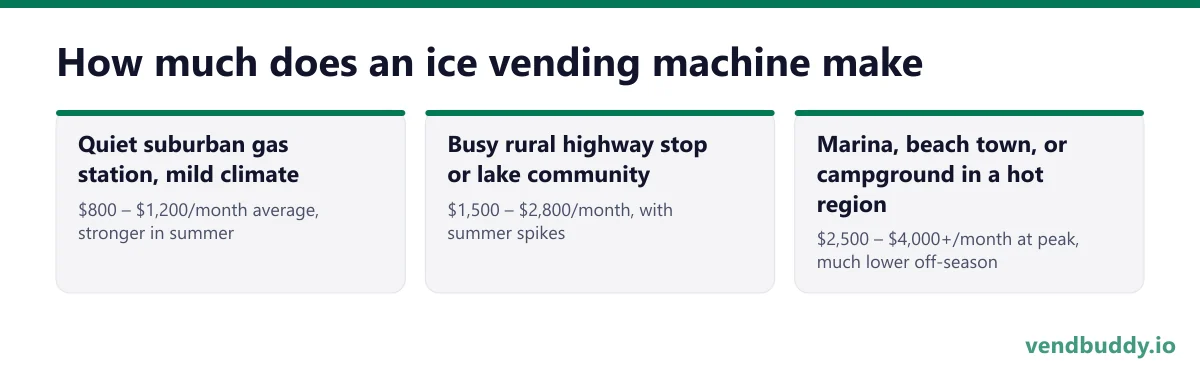
Realistic breakdowns by scenario:
- Quiet suburban gas station, mild climate: $800 – $1,200/month average, stronger in summer
- Busy rural highway stop or lake community: $1,500 – $2,800/month, with summer spikes
- Marina, beach town, or campground in a hot region: $2,500 – $4,000+/month at peak, much lower off-season
After electricity, water, supplies, and the property owner's cut (usually 10–20% of gross or a flat monthly fee), net margins typically run 50–65% of gross on a healthy machine. The margin looks good on paper; the challenge is volume consistency.
Startup costs (this one is high-ticket)
Ice vending is not a low-barrier entry point. Unlike a $3,000 snack machine you can move with a dolly, ice machines are semi-permanent infrastructure that require a concrete pad, water line, power hookup, and in many jurisdictions a health or food-handling permit.
- Small countertop or compact bagged-ice unit: $4,000 – $10,000
- Mid-size standalone unit (Ice House-style): $20,000 – $40,000
- Large self-serve ice-and-water kiosk (Twice the Ice, Ice House America, etc.): $50,000 – $100,000+
Beyond equipment, budget for:
- Concrete pad or site prep: $1,000 – $5,000
- Plumbing hookup: $500 – $3,000 depending on distance to supply
- Electrical (dedicated 240V circuit): $500 – $2,000
- Permits and health certificates: $200 – $800/year, varies by state
- Installation and freight: $500 – $2,500
All-in, plan for $25,000 – $110,000 to get a standalone kiosk operational. This is closer to a small business investment than a side hustle, and financing terms from manufacturers often run 60–72 months.
Funding a high-ticket machine without draining savings
Ice vending is the most capital-heavy niche on this blog — and the niche where financing strategy matters most. Equipment loans, SBA routes, and 0% intro business credit for the site-prep costs all have a place; the full comparison is in how to finance vending machines.
Picture the machines paying you while you sleep
That’s the real promise of vending — income that doesn’t cost you your time, and a life on your own terms. VendBuddy turns this guide into a step-by-step plan so you actually build it instead of just reading about it. Start free today.
Start building free →Best locations for ice vending machines
Ice vending lives or dies by location more than almost any other vending format. The ideal property combines high-heat demand, outdoor or semi-outdoor access, and enough dwell time for someone to stop and make a purchase.
Top-performing location types:
- Gas stations and convenience stores — the classic pairing; customers already stopping for drinks and snacks
- Marinas and boat ramps — extremely high ice demand per customer; cooler packing is standard behavior
- Campgrounds and RV parks — captive audience, long stays, no nearby alternatives
- Grocery store and hardware store parking lots — high daily traffic, customers already thinking about home supplies
- Beach towns and lake communities — seasonal spikes are enormous; off-season you may be nearly idle
- Rural highway stops — lower competition from commercial bag ice, strong commuter/traveler demand
- Standalone lots in suburban/exurban corridors — visible from the road, easy pull-in access
The property owner relationship matters as much as the location itself. You need a landowner who will cooperate on permitting, allow a utility hookup, and not abruptly terminate your lease once the machine is generating income. Finding and vetting those owners is where most operators waste time.
For a site-by-site scorecard, demand signals and lease terms, read ice vending machine locations: where ice kiosks actually sell.
VendBuddy's Lead Finder and Lead Map pull real property data from Google Maps and surface the best contact on file (owner or manager when available) so you can pitch locations directly — without cold-calling a phone tree or guessing who controls the lot.
The overlooked play: public-sector and outdoor-recreation sites
Most ice operators chase gas stations and fight over the same commercial corners. The quieter, stickier opportunities sit with municipalities and outdoor-recreation spots — places with real ice demand and almost no competing kiosk.
- River fish camps, kayak launches, and public boat ramps — anglers and boaters pack coolers every trip, and many of these sites have zero on-site ice today. Demand per visitor is high and the nearest bag ice can be 15+ minutes away.
- Parks & recreation facilities, public beaches, and fairgrounds — steady civic foot traffic plus event spikes (tournaments, festivals, holiday weekends) that no convenience store nearby can absorb.
- Fire, police, and EMS stations and public-works yards — crews need ice for coolers and for cooling during long outdoor operations, and station ice machines are small and run dry fast during big events.
The resilience angle. Ice becomes critical infrastructure during heat waves and after storms — exactly when power-dependent retail freezers are down. An ice kiosk sited near civic services or a recreation area, ideally with generator or battery backup, can keep serving when nothing else is open. Local emergency-management and CERT (Community Emergency Response Team) units routinely scramble for bulk ice during exercises and real events because the nearest fire station’s machine can’t scale to a large incident. Positioning your machine as community-resilient infrastructure — not just a vending box — is a genuinely different pitch.
The fastest way to test this in your own ZIP is the . Search once, see which businesses sit within a few miles, and reveal five contacts for nothing. It will not tell you who says yes, but it saves the afternoon you would spend building the list by hand.
The trade-off: public-sector placement runs through procurement and permitting, so it is slower to land than a private lot. But once you are in, municipal agreements tend to be stickier and less price-sensitive than a gas-station handshake. Frame it as a no-cost amenity and a community benefit, lead with the resilience story, and be patient with the paperwork.
Seasonality and payback reality
Ice vending is one of the most seasonal businesses in vending. In the Sun Belt and Southeast, you may see 60–70% of your annual revenue arrive between May and September. In northern climates, machines can sit nearly idle from November through March.
At $2,500/month average gross and 60% net margin, a $50,000 machine generates roughly $18,000/year net — a payback period of roughly 2.8 years under optimistic assumptions. At $1,500/month gross on a slower site, that stretches past five years.
Operators who finance equipment and then land mediocre locations routinely discover the machine cannot cover its own loan payment in the off-season. Model your worst-case month, not your best, before signing anything.
Pros, cons, and who it is for
Pros: high average transaction value, consumable product with repeat demand, minimal inventory management, remote monitoring available on most commercial units, strong margin on a per-unit basis.
Cons: high entry cost, site-dependent infrastructure requirements, significant seasonality, health permitting complexity in some states, vulnerable to power outages and equipment failures that spoil trust quickly.
Who it is for: operators with capital to deploy, patience for a 2–5 year payback, and access to high-heat or recreational markets. It is not a good first vending machine. Operators already running routes with steady cash flow are better positioned to absorb the upfront commitment.
If you want to compare ice vending against other formats before committing, see alternative vending machine businesses ranked. For a lower-cost water-focused complement, water vending machines (reverse osmosis) can co-locate with ice units on the same pad. For another outdoor utility play with lower entry cost, air vending and tire inflation machines are worth reviewing.
Self-service bagged + bulk ice with LCD screen and mobile/card/coin payment. Compact enough to drop on a pad outside a store.
High-volume kiosk: holds up to 200 x 10 lb bags, integrated card reader, cellular remote monitoring, and theft-proof magnetic lock.
FAQ
Do I need a permit to run an ice vending machine?
In most states, yes. Ice sold for human consumption is classified as a food product, which means health department registration, periodic inspections, and sometimes a food handler certification. Requirements vary significantly by state and county — check with your local health department before purchasing equipment.
Can I place an ice vending machine on rented property?
Yes, and most operators do. You will negotiate a site lease with the property owner — either a flat monthly fee or a revenue share (typically 10–20% of gross). Make sure the lease term is long enough to justify your buildout costs; five years minimum is a reasonable floor for a large kiosk.
How do I find property owners willing to host an ice machine?
Most operators start by approaching gas stations and convenience store managers directly. For broader prospecting — standalone lots, marinas, campgrounds, hardware stores — VendBuddy surfaces location data and the best contact on file from Google Maps so you can identify and reach the right person with less guesswork.
What is the difference between a bagged ice machine and a bulk ice-and-water kiosk?
Bagged ice machines produce pre-packaged bags; bulk kiosks dispense directly into the customer's container and often include filtered water fills as a second revenue stream. Kiosks cost significantly more but generate higher per-transaction value and can serve both ice and water buyers from one location.
What is selling, which buildings say yes, and the numbers before you buy a machine. Free, confirm from your inbox, unsubscribe in one click. Refer one friend and get 25 VendBuddy credits.
General information, not legal, tax or financial advice. Rules change, so check the official source. Revenue and income figures are examples, not promises. See our terms.