If you drive past a gas station and notice a standalone machine near the air pump, you might be looking at one of the simplest recurring-revenue assets in the vending business. Air vending machines charge $1.00–$2.00 per use, require almost no consumables, and operate around the clock with minimal intervention. For operators who want low overhead and predictable cash flow, the air machine is worth a serious look.
Part of our complete guide: best cash flow businesses.
How much does an air machine make?
Revenue depends almost entirely on location traffic. A machine at a quiet rural gas station might see 3–5 uses per day; one at a busy urban convenience store or truck stop could see 20–40. Doing conservative math:
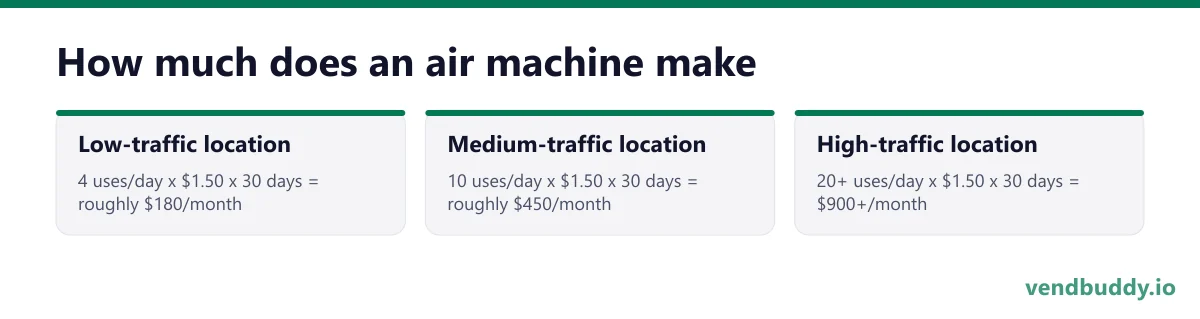
- Low-traffic location: 4 uses/day x $1.50 x 30 days = roughly $180/month
- Medium-traffic location: 10 uses/day x $1.50 x 30 days = roughly $450/month
- High-traffic location: 20+ uses/day x $1.50 x 30 days = $900+/month
A realistic working range for most operators is $100–$700 per month per machine, with the top end requiring genuinely high-traffic real estate. Combo air-and-vacuum units can add another revenue stream from the same footprint, though they cost more upfront and need slightly more maintenance on the vacuum side.
Revenue-share arrangements with the property owner are common. Expect to give up 10–25% of gross revenue, depending on how desirable the lot is. Factor that in before projecting profit.
Startup costs
Air-only machines typically run $1,500–$2,500 new. Combo air-and-vacuum units range from $3,000–$4,500 or more depending on brand and features. Used machines are available but require careful inspection — compressor condition and coin/card mechanism reliability are the two failure points that matter most.
Prices move around more than any guide keeps up with. The machine finder is where we keep the current line-up, sorted by what a location that size can realistically support rather than by what looks impressive.
Beyond the machine itself, you will need:
- Power: A standard 110V or 220V outlet nearby. Some lots require a licensed electrician to run a new circuit — budget $200–$600 if the infrastructure is not already there.
- Installation pad or mounting: Minimal; most machines anchor to a concrete pad. The lot owner typically handles or approves this.
- Location agreement: A written revenue-share or flat-fee lease. Keep it simple and get it signed.
- Card reader (optional): Cashless acceptance is increasingly expected. Card kits add $300–$800 and require a payment processor account.
Total startup for a single air machine at a ready-to-go location: roughly $1,800–$3,500. Combo units with card readers at a location needing electrical work can push toward $5,000.
Picture the machines paying you while you sleep
That’s the real promise of vending — income that doesn’t cost you your time, and a life on your own terms. VendBuddy turns this guide into a step-by-step plan so you actually build it instead of just reading about it. Start free today.
Start building free →Best locations
The machine needs to be where cars are — specifically, where drivers are already thinking about their tires or vehicle condition. Ranked roughly by reliability of demand:
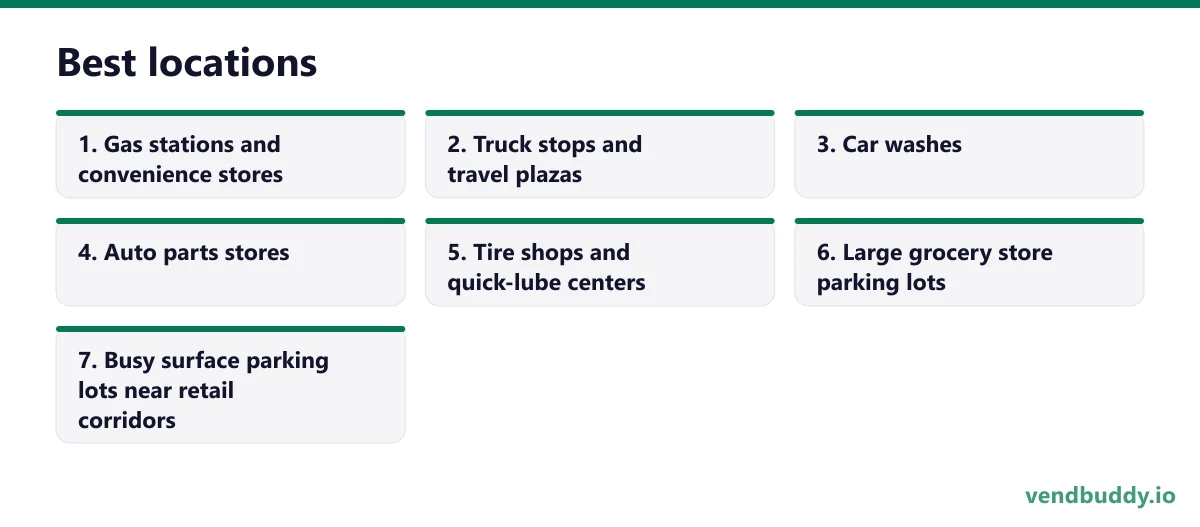
- Gas stations and convenience stores
- Truck stops and travel plazas (high daily volume)
- Car washes (drivers already in maintenance mode)
- Auto parts stores (AutoZone, O'Reilly lots often welcome them)
- Tire shops and quick-lube centers
- Large grocery store parking lots
- Busy surface parking lots near retail corridors
Visibility from the road and proximity to the entrance or pump island matter more than most operators expect. A machine tucked behind a dumpster will underperform an identical machine placed at the lot entrance by a wide margin.
Finding the right locations — and more importantly, getting a contact name so you can make a pitch — is where most operators stall. The VendBuddy Lead Finder and Lead Map pull gas stations, convenience stores, auto shops, and similar venues from Google Maps and surface the owner or manager contact where available, so you can skip the cold-walk cold-start problem.
Why operators love the margins (low restock)
Traditional vending machines live and die on restocking. Snacks and drinks require weekly (sometimes twice-weekly) visits, spoilage management, and supply chain coordination. Air machines have none of that. The "product" is compressed air, which is generated on-site by the machine's own compressor. There is nothing to restock.
Maintenance visits are typically once a month or less: check the compressor, clean filters, collect cash, test card reader functionality. Operators running 10–15 air machines often handle the entire route in a single day.
This is the core reason the margin profile is so different from food vending. Even after revenue share, a well-placed air machine can return 60–80% gross margin on the revenue it generates. Compare that to snack vending at 25–40% after product cost, and the appeal is clear — especially for operators who want a low-touch side business rather than a full logistics operation.
If the spend is going on plastic anyway, the card choice is worth ten minutes. Most operators we talk to land on the Bilt card, not for what it pays on pallets but because the rent payment earns too. Referral link, and the honest caveat is that a carried balance beats what any of these points are worth. Affiliate link, so we may earn a commission at no extra cost to you.
For a broader comparison of low-restock vending categories, see our breakdown of alternative vending machine businesses ranked by effort and return.
Pros, cons, and who it is for
Pros:
- Near-zero consumable cost
- Very low maintenance time per machine
- Scales well — adding machines adds revenue without proportional labor
- 24/7 operation with no staffing
- Clear, simple value proposition to location owners
Cons:
- Revenue ceiling per machine is lower than some categories (no upsell)
- Compressor failure is a real risk — a broken machine earns nothing and can frustrate the location owner
- Good locations require negotiation; the best spots already have a machine or a vendor relationship
- Card reader integration adds complexity and a processing fee cut
Best fit for: Operators who want a low-overhead, low-time-commitment route business; people already running a snack/beverage route who want to add machines without adding restock burden; first-time vending operators who want to learn the business without spoilage risk. If you are interested in other low-consumable categories, the ice vending machine business and the water vending machine business follow a similar high-margin, low-restock model and are worth comparing side by side.
FAQ
Do I need a special license to operate an air vending machine?
In most U.S. states, no special vending license is required for air machines. Standard business registration and a sales tax permit (if your state taxes vending revenue) are typically sufficient. Check your specific state and county requirements before placing machines.
How often does the compressor need service?
Most commercial air machine compressors are designed for 2,000–5,000 hours of operation between service intervals. Under normal use, a monthly check of filters and connections is adequate, with a more thorough service once or twice a year. Compressor replacement, when eventually needed, typically runs $300–$700.
Can I place an air machine if the gas station already has a free air pump?
Sometimes. Free air pumps are less common than they were a decade ago — California mandates them at stations selling fuel, but most other states do not. Even where free air exists, a paid machine is often placed nearby because the free pump is broken, slow, or inconveniently located. Assess the specific lot before assuming competition is disqualifying.
How do I find gas stations and auto shops open to placing a machine?
Start with locations where the existing air pump is broken, missing, or coin-operated but old. A VendBuddy Lead Map search filtered to gas stations and auto shops in your target area will surface venues with contact information, so you can reach out directly rather than walking in cold.
What is selling, which buildings say yes, and the numbers before you buy a machine. Free, confirm from your inbox, unsubscribe in one click. Refer one friend and get 25 VendBuddy credits.
General information, not legal, tax or financial advice. Rules change, so check the official source. Revenue and income figures are examples, not promises. See our terms.