Part of our complete guide: how much does a vending machine cost.
Unattended retail is a three-rung ladder: the traditional vending machine, the AI smart cooler, and the full micro market — rising in capital, revenue, and complexity as you climb. Most comparison articles pit the machine against the market and stop there. This one covers the two upper rungs, where a lot of operators actually get stuck: a locked, camera-driven smart cooler versus an open-shelf micro market. They look similar in a brochure and behave nothing alike in the real world.
What each one actually is
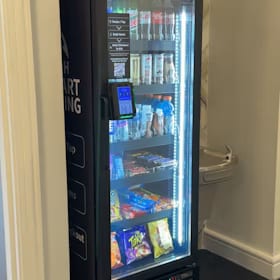
A smart cooler is a glass-front refrigerated cabinet with a locked door. The customer taps a card or app to unlock it, takes what they want, closes it, and computer vision plus weight sensors charge them for exactly what left the shelf. It holds roughly 20 to 60 SKUs — drinks, snacks, and a few fresh items — in a footprint barely larger than a normal cooler.
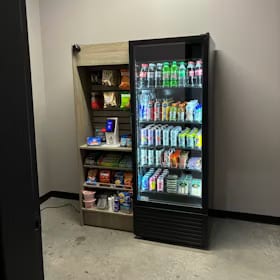
A micro market is an unattended self-checkout store, usually 100 to 400 square feet, with open shelving, coolers, a freezer, and a standalone checkout kiosk. Customers browse freely, scan their own items, and pay. It carries 100 to 400+ SKUs including fresh sandwiches, salads, and full meals — a genuine convenience store with no cashier. For how the market stacks up against plain vending machines, see micro markets vs vending machines.
Cost: a wide gap in capital at risk
| Format | Setup cost | Footprint | SKUs |
|---|---|---|---|
| AI smart cooler | $4,000 to $13,000 | A single cooler | 20 to 60 |
| Compact micro market | $12,000 to $35,000 | 100 to 200 sq ft | 100 to 200 |
| Full micro market | $25,000 to $75,000 | 200 to 400 sq ft | 250 to 400+ |
The cooler is a few thousand dollars and installs in an afternoon; the market is a buildout. That difference decides which one a given location can even justify.
Picture the machines paying you while you sleep
That’s the real promise of vending — income that doesn’t cost you your time, and a life on your own terms. VendBuddy turns this guide into a step-by-step plan so you actually build it instead of just reading about it. Start free today.
Start building free →Theft and shrinkage — the single biggest real difference
This is where the two formats truly diverge. A smart cooler is closed by default. The door will not open without a verified payment method attached, and the vision system charges for whatever leaves — so theft is close to zero by design. That makes a cooler safe to place in semi-public or lightly-supervised spots where an open market would get picked clean.
A micro market is open shelving. In a closed employee population with badge entry and visible cameras, shrink typically runs a very manageable 2 to 4 percent — people know each other and consequences are real. But put that same open market in a public or high-turnover environment and shrink climbs fast. The rule of thumb: micro markets need a trusted, semi-private population; smart coolers do not. If you cannot vouch for the crowd, the cooler's locked door is worth its higher per-SKU cost.
Space and venue fit
- Smart cooler wins where space is tight or the population is mid-sized: gyms, apartment lobbies and amenity rooms, 50 to 150-person offices, medical buildings, hotels, and anywhere you need grab-and-go without dedicating a room to it.
- Micro market wins where there is both room and volume: 150 to 250+ employee sites, manufacturing plants and warehouses with on-site lunch culture, big offices, and hospitals — places where variety and fresh food drive far bigger baskets than a cooler can hold.
Dwell time matters too. People linger in a market for two to five minutes and buy a lunch; they open a cooler for thirty seconds and grab a drink. Match the format to how long people actually stay.
Staffing and restock
Both are unattended, but the labor differs. A smart cooler is a single stocking point — open, refill, close, done. A micro market has shelves, multiple coolers, and a freezer to face and rotate, and if it carries fresh food you are managing date codes and spoilage. Compact markets get restocked two to three times a week, full markets three to five; a cooler often needs it less. Neither is passive, but the cooler is meaningfully lighter to run.
The honest middle path: a smart cooler as the step before a market
Here is the practical reality most operators land on. If a location is not clearly big enough or private enough to justify a full micro market, a smart cooler gives you most of the grab-and-go upside — higher ticket than a coil machine, fresh items, an app-based, cashless experience — without the buildout cost or the open-shelf shrink risk. It is the natural middle rung, and it is often the right first move at a location you might grow into a market later.
This is the tier VendBuddy supports directly: the SandStar smart-cooler lineup is a locked, AI-vision grab-and-go cabinet built for exactly these mid-sized, mixed-supervision placements — the apartment amenity room or the 100-person office where an open market would either not fit or not be safe. It lets you offer a modern grab-and-go experience while the door does the theft prevention for you.
Which one to choose
- Choose a smart cooler if space is limited, the population is mid-sized or not fully closed, you want low daily labor, or you are testing a location before committing real capital.
- Choose a micro market if you have a 150+ employee closed site with room to build, on-site lunch demand, and a population you trust — the revenue uplift from fresh food and variety is real when those conditions are met.
For deeper reads, see whether AI vending machines are worth it, the smart markets guide for operators, smart vs traditional machines, and the honest SandStar smart cooler review. To place either one, model the location in the ROI Calculator and pull qualified sites from the Lead Finder.
FAQ
What is the difference between a smart cooler and a micro market?
A smart cooler is a single locked, AI-vision refrigerated cabinet holding 20 to 60 items that charges you for whatever you remove. A micro market is an open, unattended self-checkout store of 100 to 400+ SKUs including fresh food, spanning 100 to 400 square feet. The cooler is cheaper, smaller, and near theft-proof; the market earns more where space and a trusted population allow.
Is a smart cooler cheaper than a micro market?
Yes, by a wide margin. A smart cooler runs roughly $4,000 to $13,000, while a micro market runs $12,000 to $75,000 depending on size and fresh-food capability. The cooler also installs in hours versus a market's full buildout.
Which has less theft, a smart cooler or a micro market?
A smart cooler. Its door will not open without a verified payment method and the vision system charges for exactly what leaves, so theft is close to zero. A micro market uses open shelving and relies on a trusted, camera-monitored population to keep shrink in the 2 to 4 percent range.
Should I put in a smart cooler or a micro market?
Use a smart cooler for tight spaces, mid-sized or semi-public populations, and locations you want to test cheaply. Use a micro market for 150+ employee closed sites with room to build and on-site lunch demand. The cooler is frequently the right middle step before a location is proven big enough for a market.