- Passive is not a thing you buy. It is a structure you build. No machine, course or route arrives hands-off, and the operators selling you that are selling the expectation that makes people quit in year one.
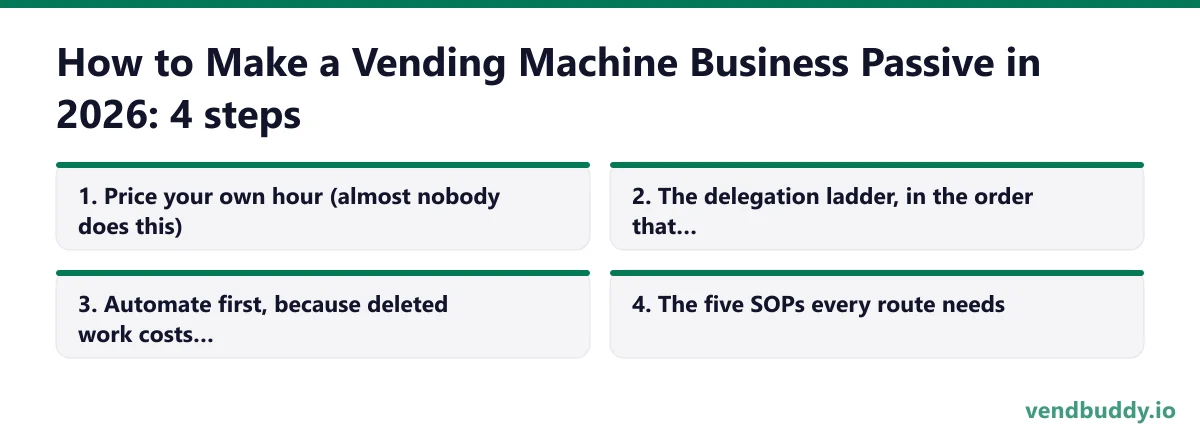
- Price your own hour before you delegate anything. Monthly net profit divided by hours actually worked. Every task below that number is a task you are overpaying yourself to do.
- The ladder has an order: restock runs first, machine moves second, repairs third, and location outreach last — because outreach is the function that decides what the business is worth.
- Automate before you delegate. Paying a person to perform a task you could have deleted is the most expensive mistake in this whole sequence.
- The bar is not surviving your absence. If you left for a month, would the business fail, stall, or grow? Grow is the only answer that means you built something.
Vending is not passive income. It is low-effort income, which is a genuinely better thing to own and a completely different thing to promise, and the distance between those two phrases is where most first-year operators lose their enthusiasm. The honest hours page is here and it has not changed: two to four hours a week on a dialed-in small route, front-loaded heavily into the build.
This page is the other half of that answer. Not is it passive, but how do you make it passive — because passivity in this business is engineered, one deleted task at a time, and the reason so few routes ever get there is not that it is hard. It is that almost nobody sits down and does the engineering.

Nothing you buy is passive. Ever.
Here is the sentence that would save a lot of people a lot of money: passive is a property of the system around an asset, not a property of the asset.
A rental property is not passive. A rental property with a property manager, a written maintenance threshold, a lease template and a bookkeeper is close to passive, and the difference between those two sentences is about four hundred dollars a month and a weekend of setup. Nobody thinks they are buying passive income when they buy a duplex. Somehow, in vending, people think the machine comes with it.
A machine arrives with tasks attached. Somebody has to decide what goes in it, notice when that stops selling, drive there, fill it, count the money, chase the one that jammed, answer the property manager who emailed about a refund, and work out at the end of the month whether the whole exercise made money. The machine does none of that. The machine dispenses.
So the useful way to think about this is as three states rather than a binary:
- Hands-on. You do every task, on a calendar, from memory. Every new machine adds its full hours. This is where every operator starts and where most stay.
- Low-effort. The route is dense, the product mix is settled, and the hours per machine have fallen because you got better. Still you, still weekly, but efficient. This is the honest 2–4 hours a week.
- Structurally passive. The checking is automated, the physical work is delegated, the procedures are written down, and your remaining job is a monthly review and the decision about the next location. Hours no longer scale with machines.
The third state is real and reachable. It is also a minority outcome, and the four sections below are the entire difference.
Step 1: price your own hour (almost nobody does this)
You cannot make a single sensible outsourcing decision without this number, and the overwhelming majority of operators have never worked it out. It takes four minutes.
Operator hourly rate = monthly net profit ÷ hours you actually worked that month.
Net, not gross. After product cost, commission, card fees, fuel, repairs and software. If you do not have that figure to hand, that is its own finding, and the margin breakdown will get you there in an evening.
Worked through as a planning scenario on illustrative figures rather than a projection: say six machines netting a combined $1,650 a month, and you spent 22 hours on the route. That is about $75 an hour. Now hold that number against the tasks that produced it:
| What you spent the hour on | What that hour is actually worth | Who should be doing it |
|---|---|---|
| Driving to a machine that turned out to be three-quarters full | $0 — the trip produced nothing | Nobody. Delete it with telemetry. |
| Restocking, counting, cleaning | Roughly what a stocker costs: $16–$25/hr | A part-time stocker or contractor |
| Fixing a jammed bill acceptor you have fixed nine times | $85–$150/hr — what a tech charges | You, until you can price a quote. Then a tech. |
| Walking into a building and signing a location | The entire future value of that machine | You. This is the job. |
| Renegotiating a commission rate down two points | Hundreds a year, in ten minutes | You, and it is criminally under-done |
That table is the whole strategy on one screen. Every hour you spend on a task worth less than your operator rate is an hour you are paying yourself below market to avoid a decision.
One honest caveat, and it is the same one the first-hire post makes at length: the arbitrage is only real if the freed hour goes somewhere. If you hand off eight hours of restocking a month and those eight hours dissolve into ordinary life, you have not bought leverage, you have bought leisure at $20 an hour and made your business less profitable. Decide what the hour is for before you buy it back.
Picture the machines paying you while you sleep
That’s the real promise of vending — income that doesn’t cost you your time, and a life on your own terms. VendBuddy turns this guide into a step-by-step plan so you actually build it instead of just reading about it. Start free today.
Start building free →Step 2: the delegation ladder, in the order that actually works
The order matters more than the timing. Operators who delegate out of sequence — usually because they hate one specific task — end up paying a locator to build a route they then discover they do not want.
There is a fifth rung people forget: bookkeeping. It is cheap, it is objectively better done by somebody else, and it is the one delegation that makes every other decision on this page possible, because you cannot price your hour without clean numbers. The profit-first setup is here.
Step 3: automate first, because deleted work costs nothing
This is the step people skip, and it is the expensive one to skip. Paying a person to perform a task you could have deleted is the worst trade in this entire sequence — you have converted a fixable inefficiency into a permanent line item.
Cashless and telemetry: killing the drive-by check
The largest single source of wasted hours on a small route is the stop that did not need to happen. On a calendar route you drive to every machine every week, and a meaningful share of those machines are three-quarters full when you open them. That is fuel, time, and the specific kind of tedium that makes people quit.
A telemetry-grade cashless reader reports sales remotely, which means you stop guessing. You know what sold, in which slot, on which day, at which hour, without going anywhere. Cash-only machines cannot tell you any of that, and in 2026 they also cannot take money from a large share of customers under thirty, which is a separate and equally expensive problem — the 2026 reader comparison covers the revenue side of that.
On the hardware itself: Nayax is the reader most multi-machine operators standardise on, largely because the telemetry and the payments arrive as one bill rather than two, and it is also the one live reader integration inside VendBuddy — a bias worth knowing about when you read that sentence. Pricing is quoted per route rather than published, so ask for hardware cost per machine, monthly fee per device and the transaction rate including the fixed per-transaction component, and hold the answer against your actual machine volume. (Affiliate link — VendBuddy may earn a commission at no extra cost to you. Cantaloupe and 365Pay are not affiliates of ours and we earn nothing if you pick them. What the monthly fee buys, and when to skip it, is in our Nayax review.)
Inventory-triggered restocking: the switch that removes a quarter of your stops
Telemetry on its own is just a dashboard. The value arrives when you change the rule. Instead of service every machine every Tuesday, the rule becomes service a machine when a defined share of its fast movers drop below par. Operators making that switch commonly cut twenty to thirty percent of stops without a single additional stockout, because the stops they cut were the ones that were not needed.
Three things make it work: set par levels per slot rather than per machine, define one trigger threshold and write it into the SOP so a stocker can apply it without you, and review the thresholds monthly against actual stockouts. If you are stocking out, the threshold is too low. If you are arriving to three-quarters-full machines, it is too high.
Route software: one system of record instead of your memory
The last automation layer is unglamorous and it is the one that makes the business sellable. Stops, par levels, product costs, commission terms, service history and per-machine profit have to live somewhere that is not your head and not a spreadsheet only you can read. That is the difference between a route somebody could take over and a route that evaporates when you stop paying attention to it. The software comparison is here, and if you already have a system you dislike, switching platforms covers what the migration actually costs.
Step 4: the five SOPs every route needs
An SOP is not documentation. It is the mechanism by which a decision you currently make from memory becomes a procedure a competent stranger can execute identically. That is the actual machinery of a business that does not depend on you, and it is five pages of work.
Keep each one to a single page. A procedure nobody can read in ninety seconds does not get followed, and an unfollowed SOP is worse than none because it creates the illusion of a system. Steal these directly.
1. The restock run
- Before leaving: pull the telemetry list, pick only machines past the trigger threshold, prekit each machine’s order into a labelled tote so nothing is decided in the van.
- At the machine: photograph the front before touching it, fill to par by slot, rotate stock so the oldest date is at the front, wipe the glass and the keypad.
- Before leaving the site: record collected cash, note any slot that was empty (that is a par-level correction, not a coincidence), and log anything mechanical you noticed even if it still works.
- Escalate, never improvise: if the machine is down, the fix is the machine-down SOP, not a judgment call in a hallway.
2. Machine down
- Within one hour of learning: tell the location contact before they tell you. A property manager who hears it from you has a vendor; one who hears it from a tenant has a problem.
- Triage against the known-faults list: bill acceptor, coin mech, cooling, control board, power. Five minutes of the troubleshooting guide resolves a large share of it.
- Set a hard clock: if it is not fixed within 48 hours, a tech is called or the machine is swapped. Undefined downtime is how locations get lost.
- Close the loop in writing: one message to the contact confirming it is back, and a line in the service log with the fault and the cost.
3. New-location onboarding
- Paper before placement: signed agreement, commission terms, insurance certificate if requested, and the access and service-window arrangement written down rather than agreed verbally. Contracts 101 is here.
- Install day: confirm the delivery path and the outlet in advance, photograph the placement, and test one cashless transaction end to end before you leave the building.
- First 30 days is a data-gathering exercise, not a routine: service on a shorter cycle, watch which slots actually move, and reset par levels off real sales rather than off your guess.
- The 90-day decision: keep, re-mix, or move. Put the review date in the calendar on install day — the 90-day test is the framework.
4. Refund and complaint
- Default to refunding. A disputed $2 is never worth a location relationship, and the person complaining is usually talking to your host next.
- One channel, published on the machine: a sticker with a number or a QR link so complaints reach you rather than the property manager.
- Respond within 24 hours, always. Speed matters more than outcome to almost everyone who complains about a vending machine.
- Log the cause, not just the refund. Three refunds from the same slot is a mechanical fault reporting itself, and that is the only reason this SOP exists.
The number on that sticker should be a business line a helper can answer too, so refunds still get handled on the days you are not there. A free Google Voice number works for one person. Quo lets several people share one business number with saved replies. VendBuddy may earn a commission if you sign up through that link. Refund reply templates are in business phone setup for vending operators.
5. Monthly P&L review
- Same date every month, in the calendar, non-negotiable. Ninety minutes.
- Per machine, not in aggregate: revenue, cost of goods, commission, fees, service cost, net. Aggregate numbers hide the machine that is quietly losing money.
- Three questions: which machine is the worst, what is the one change that would fix it, and which location is closest to its 90-day decision date.
- One action, written down, with a date. A review that produces no action is a hobby — the diagnostic for an underperforming machine is here.
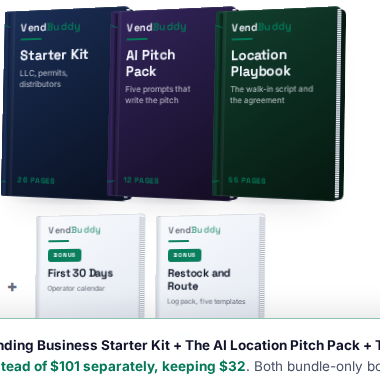
If you get to the end of this and the answer is yes, the kits are the shortcut past the blank page: a 26-page starter kit for the paperwork, a 55-page Location Playbook for the walk-in script and the agreement, and a 12-page AI Pitch Pack. Bought once, from $27, and you keep the files.
Look inside the kits →The million-dollar question: if you left for a month, would your business fail, stall, or grow?
Everything above is machinery. This is the test, and it is the only honest way to find out whether you own a business or a job with better hours. Answer it as it is, not as you would like it to be.
It would fail
Machines stock out, a location cancels, a repair goes unmade for three weeks and the host finds another vendor. If that is the honest answer, you do not own a business, you own a job that pays in machines. That is not a moral failing and it is where every operator starts — but it does mean the asset has no value independent of your attendance, which is also exactly what a buyer would conclude if you ever tried to sell it. Start at step one of this page: price your hour, then automate the checking.
It would stall
Nothing breaks. Nothing grows either. The machines keep dispensing because machines do that, the revenue is roughly flat, and you come back to a month of accumulated small decisions. This is where most competent operators actually sit, and it is a real achievement over failing — but a stall means the operating layer is built and the growth layer is entirely you. Nobody was finding locations while you were gone because finding locations was never written down as anybody’s job.
It would grow
You come back to more machines, or better-performing ones, than you left. Somebody serviced the route to a written procedure. Somebody escalated the one fault that mattered. A location that was on its 90-day review got moved because the review date was in a shared calendar, not in your head. This is the bar, and it is rarer than it should be given how little the machinery costs to build.
And the bar is not one month. One month is survivable on inertia alone — product on hand, no scheduled decisions, nothing that had to be renegotiated. The real test is three months, because at three months something has to be decided by someone who is not you: a commission renewal, an underperforming machine, a host who wants the unit moved, a price change. A business that grows through a quarter of your absence is doing it because the structure is doing the work.
If you left for a month, would your business fail, stall, or grow? Fail means you own a job. Stall means you built an operation but no growth engine. Only grow means you built a business.
Most operators cannot answer this question because they have never been away long enough to find out. You do not have to leave to run the test. Take the next two weeks, write down every single thing you did for the route, and mark each line with who else could have done it if there had been a procedure. The list of things only you can do is your actual job. Everything else is a task waiting for a decision you have not made.
Delegation only pays if the freed time goes into the one function you should never hand over: finding better buildings. VendBuddy scores real venues near you by traffic, headcount and category, hands you the best contact on file for each, and models the monthly net before you spend anything on equipment. Five free credits, no card required.
The bottom line
The passive vending business exists. It is just that nobody sells it, because what is for sale is a machine, and a machine is the least important component of the thing people are actually trying to buy.
What is for sale, if you are willing to build it: a priced hour so you know which tasks to stop doing, telemetry so you stop making trips that produce nothing, a stocker so the physical work is not yours, five one-page procedures so the route survives contact with somebody else, and a monthly review that turns numbers into one decision. That stack takes a few months to assemble and it is the entire difference between two operators with identical machines, one of whom is free and one of whom is not.
Start with the hour. It is four minutes of arithmetic and it changes what every other decision on this page looks like.
Related reading: how to run a vending machine business (the weekly and monthly operating rhythm this page assumes), the honest hours per week, what breaks between 5 and 50 machines, the scaling playbook, hiring a route driver, and where the margin actually goes.
Frequently Asked Questions
Can a vending machine business be passive?
Not on delivery, and anyone selling it that way is selling you the wrong expectation. A vending route is low-effort rather than no-effort: a dialed-in one to three machine route runs on roughly two to four hours a week, and that is genuinely excellent for a business you can start for a few thousand dollars, but it is not zero. What is true is that vending is one of the few small businesses where the remaining hours can be engineered out deliberately - by automating the checking, delegating the restocking and writing down the procedures - until the owner work is a monthly review rather than a weekly route. That end state is real, it is reached by a minority of operators, and it is built rather than bought.
How do I automate a vending machine business?
In three layers, in this order. First, telemetry: a cashless reader that reports sales remotely removes the drive-by check entirely, which is the single largest source of wasted hours on a small route because most stops made on a calendar were not needed. Second, sales-triggered restocking: once you can see per-slot movement you service machines because they are empty rather than because it is Tuesday, and operators commonly cut twenty to thirty percent of stops making that switch. Third, route software as one system of record for stops, par levels, costs and per-machine profit, so the business is not living in your head or in a spreadsheet only you can read. Automation before delegation is the correct order, because paying a person to perform a task you could have deleted is the most expensive mistake in this sequence.
Should I hire someone to restock my vending machines?
Yes, and it should be the first thing you delegate - but only after two conditions are true. The first is that you know your own operator hourly rate, which is monthly net profit divided by hours actually worked, because without that number you cannot tell whether the hire is arbitrage or just cost. The second is that the freed hours have somewhere to go: a hire only pays for itself if the time you buy back is spent on locations, pricing or acquisition rather than absorbed by the rest of your life. Restocking is the right first delegation because it is the highest-hour, lowest-judgment task on the route, it is easy to write down as a procedure, and the worst case of a mistake is a stockout rather than a damaged location relationship.
How much does it cost to hire someone to restock vending machines?
Two structures are common and they suit different route sizes. Hourly, a part-time stocker generally lands somewhere around sixteen to twenty-five dollars an hour depending on your market, plus payroll taxes and mileage if they use their own vehicle, which realistically adds twenty to thirty percent on top of the raw wage. Per-stop or revenue-share contracts, where a contractor services machines for a fixed fee per visit or a percentage of collected revenue, are the more common structure on small routes because the cost scales with the route instead of with the calendar. Whichever you use, get the classification right: a person you schedule, train and supervise closely usually looks like an employee rather than a contractor to a state labor agency, and that is not a question to answer optimistically.
What SOPs does a vending business need?
Five cover almost everything a route does: the restock run, the machine-down response, new-location onboarding, the refund and complaint response, and the monthly profit-and-loss review. Each one exists to convert a decision you currently make from memory into a procedure somebody else can follow identically, which is the actual mechanism by which a business stops depending on you. They do not need to be long - a single page each is enough, and a procedure nobody can read in ninety seconds will not get followed. The test of a good SOP is not how complete it is but whether a competent stranger could execute it without calling you.
How many machines do you need before vending becomes hands-off?
It is a structure question rather than a count question, but the counts do cluster. Below roughly five machines the economics rarely support paying anyone, so hands-off means automation rather than delegation. Somewhere between eight and fifteen machines most operators hit the point where their own hours become the binding constraint and a part-time stocker starts to make arithmetic sense. Past roughly twenty machines the business either has written procedures and a second pair of hands or it stops growing, because one person servicing twenty machines has no hours left to find the twenty-first location. The operators who plateau at twelve machines almost always plateaued on hours rather than on demand.
Is passive income from vending realistic or a myth?
The myth is the timeline, not the outcome. Passive on delivery is a myth: no machine, course or route is hands-off the day it arrives, and marketing that says otherwise is the main reason first-year operators quit. Structurally passive after deliberate work is not a myth - it is what a route looks like once the checking is automated, the restocking is delegated, the procedures are written and the owner work has collapsed into a monthly review. The honest framing is that vending buys you an unusually short path to that state compared with most businesses, not that it hands you the state for free.
What is selling, which buildings say yes, and the numbers before you buy a machine. Free, confirm from your inbox, unsubscribe in one click. Refer one friend and get 25 VendBuddy credits.
General information, not legal, tax or financial advice. Rules change, so check the official source. Revenue and income figures are examples, not promises. See our terms.