- 80% of “breakdowns” are operator-fixable in 10 minutes — jams, mis-loaded coils, dirty sensors, tripped breakers.
- Check in this order: power → payment → vend mechanism → cooling.
- Call a tech ($75–$125/visit) for: compressor work, control-board faults, and anything refrigerant-related.
- Prevention beats repair: a 5-minute clean-and-check at every restock eliminates most callbacks.
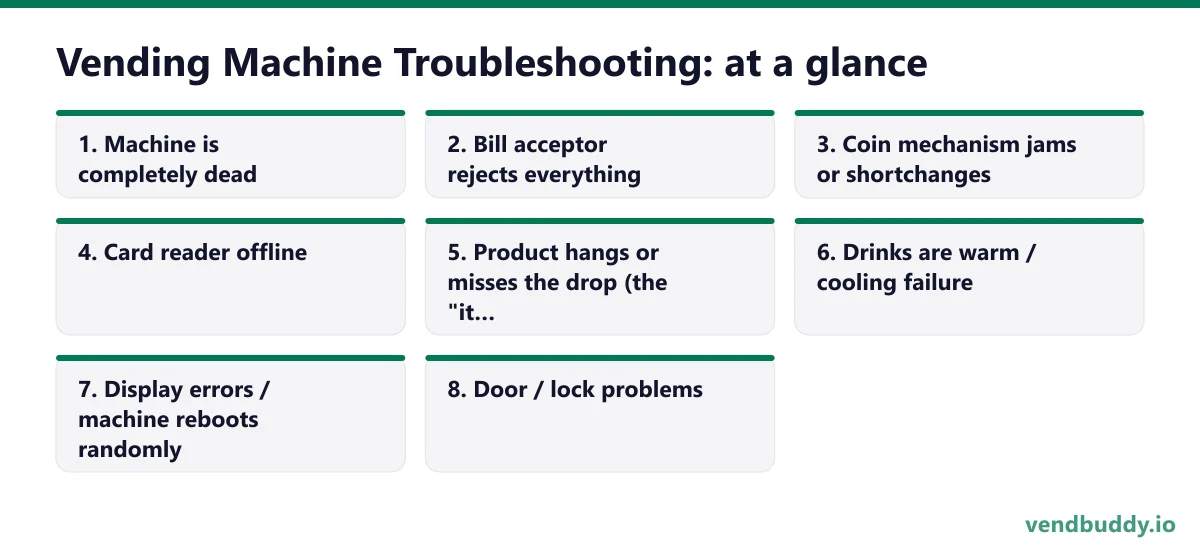
A “broken” vending machine is rarely broken. It is usually jammed, dirty, tripped, or mis-loaded — four conditions you can fix on the spot with zero parts. Knowing the difference between a 10-minute fix and a real repair is worth thousands a year in avoided service calls and dead-machine days. Here are the eight problems that cover nearly every service call, in the order a tech would check them.
Part of our complete guide: how much does a vending machine cost.

1. Machine is completely dead
Check: the outlet (plug something else in, or test it with an AstroAI digital multimeter), the building breaker, then the machine’s own power switch and internal fuse (usually near the power cord entry). Machines share circuits with floor polishers and space heaters more often than you would think.
Fix: reset breaker / replace fuse (a $2 part — keep spares in the van). If it trips repeatedly, stop and call a tech: something downstream is shorting.
2. Bill acceptor rejects everything
Check: open the acceptor path (it hinges or slides out) and look for a crumpled bill, coin, or straw wrapper. Then look at the sensor window — dust and soda film blind it.
Fix: clear the path, wipe the sensor with isopropyl alcohol on a lint-free cloth, reseat the unit. Running a KICTeam bill acceptor cleaning card through it on restock visits keeps the sensors clear between deep cleans. If it still rejects crisp bills, reflash/recalibrate per the acceptor manual (5 minutes) before replacing anything.
Picture the machines paying you while you sleep
That’s the real promise of vending — income that doesn’t cost you your time, and a life on your own terms. VendBuddy turns this guide into a step-by-step plan so you actually build it instead of just reading about it. Start free today.
Start building free →3. Coin mechanism jams or shortchanges
Check: foreign objects (arcade tokens, foreign coins, gum) in the coin path; empty change tubes making the machine “exact change only”.
Fix: clear the path, refill the change tubes on every restock. A machine flashing exact-change-only quietly loses 10–20% of cash sales.
4. Card reader offline
Check: the reader’s status light. No light = power/cable; colored error light = usually lost cellular signal or a hung modem.
Fix: reboot the reader (power cycle at the harness). If signal is chronically weak, ask your reader provider for an antenna extension — basement breakrooms are notorious. Card sales are typically 60%+ of revenue now; a dead reader is a half-dead machine (see the card reader comparison).
When it is not a reboot: a reader that drops offline weekly, or one that has aged out of support, is a repair you keep paying for in missed sales rather than in parts. At that point price the replacement — a current Nayax reader reports per-vend sales and stock-outs remotely, which also tells you whether the machine was really down or just empty. (Affiliate link — VendBuddy may earn a commission at no extra cost to you. Nayax is also the one live reader integration in our own product.)
5. Product hangs or misses the drop (the “it ate my dollar” classic)
Check: product loaded wrong for the coil pitch — bags too wide, boxes leaning, items double-stacked. Watch one vend cycle with the door open.
Fix: reload so items sit fully IN the spiral with labels facing out, match product size to coil size (wide chips in wide coils), and give stubborn slots a coil swap — coils cost $10–$20. Persistent hangs at a slot are a product-to-coil mismatch, not bad luck.
6. Drinks are warm / cooling failure
Check: the condenser coil (behind the lower grille) — if it is furred with dust, that is your problem 8 times in 10. Confirm the fan spins and the machine has 4+ inches of rear clearance.
Fix: vacuum/brush the condenser coil every quarter. If the coil is clean, the fan runs, and it still will not hold temperature — that is compressor or refrigerant territory: call a tech. Never open the sealed refrigeration system yourself.
7. Display errors / machine reboots randomly
Check: error codes against the machine manual (searchable online by model number — also see our repair-cost guide); loose harness connectors after a recent move.
Fix: power cycle first (30 seconds unplugged). Reseat visible connectors. Recurring board faults are a tech call — control boards run $150–$400 and mis-wiring one costs more.
8. Door / lock problems
Check: alignment — slammed doors sag on hinges and stop latching, which can disable vending entirely on machines with door switches.
Fix: tighten hinge bolts, adjust the strike plate. Replace worn lock cylinders promptly ($15–$30) — a machine that will not lock is an inventory donation program.
The call-a-tech line
DIY: everything above except sealed refrigeration and control boards. Tech ($75–$125/visit): compressor/refrigerant, repeated breaker trips, board faults, and anything you have already attempted twice. Between DIY and the tech there is a third option most new operators miss: your distributor and machine seller both know the good local techs — ask before you need one, not after.
A machine that is down for a week strains the placement relationship. VendBuddy’s route tools log restocks, revenue dips, and service notes per machine — so you catch the failing bill acceptor from the sales data before the location manager calls you.
Frequently Asked Questions
Why is my vending machine not taking bills?
Nine times in ten: a jammed bill path or a dirty sensor window. Open the acceptor, clear any debris, wipe the sensor with isopropyl alcohol, and reseat the unit. Recalibrate per the manual before replacing anything.
Why is my vending machine not cooling?
Check the condenser coil behind the lower grille first — dust buildup causes most cooling failures. Vacuum it, confirm the fan spins and the machine has rear clearance. If cooling still fails with a clean coil, it is compressor or refrigerant work: call a technician.
How much does vending machine repair cost?
Mobile vending techs charge $75–$125 per visit plus parts. Common parts: fuses $2, coils $10–$20, lock cylinders $15–$30, bill acceptor rebuilds $80–$150, control boards $150–$400. Most calls are avoidable with a 5-minute clean-and-check at each restock.
Related: repair costs in detail, how long machines last, buying used without inheriting problems, efficient restocking routines, and when to outsource servicing.
What is selling, which buildings say yes, and the numbers before you buy a machine. Free, confirm from your inbox, unsubscribe in one click. Refer one friend and get 25 VendBuddy credits.
General information, not legal, tax or financial advice. Rules change, so check the official source. Revenue and income figures are examples, not promises. See our terms.