For a vending machine card reader past five machines, the pick is Nayax, at $200–$400 for the reader, $7–$13 a month, and roughly 5.95% plus a nickel or a dime per swipe. Under five machines, and wanting the fewest moving parts to babysit, take Cantaloupe (Seed) instead; the money lands close enough that you will never feel the gap.
Part of our complete guide: how much does a vending machine cost.
Price is not what decides this. All three readers here land within $5 to $15 a month of each other on a small route, so what you are really picking is a telemetry ecosystem and a support desk you will live with for years. Nayax has the deeper per-vend data and the wider machine compatibility, older cabinets included. Cantaloupe has the smoother onboarding, US-first support, and the micro market story if that is anywhere in your next twelve months.
Worth naming before you read further: Nayax is an affiliate of ours and the one card reader that runs live inside VendBuddy, so we have a stake in that pick. Cantaloupe and 365Pay pay us nothing. On a machine grossing $1,000 a month the fees come to about $70, while cashless adds 30–50% to revenue on the same foot traffic. That is why nearly every operator ends up putting a reader on every machine eventually.
Pull current Nayax hardware pricing and transaction rates for your route size, then read the rest of this page with your own numbers in front of you.
Get Nayax pricing →Disclosure: affiliate link. VendBuddy may earn a commission if you buy through Nayax, at no extra cost to you.
What it actually costs
Budget $150–$400 per machine for the reader hardware depending on vendor and whether you buy new or refurbished. On top of that, plan for $8–$12 per machine per month in telemetry and SaaS fees — this covers connectivity (typically cellular via a built-in SIM), software access, and in some cases basic technical support.
Processing fees are where operators get surprised. Unattended retail is classified as "card-not-present" by the card brands, which means interchange rates are higher than a staffed retail counter. Effective processing rates in vending typically land between 5% and 6% of transaction value, plus a per-transaction flat fee of $0.05–$0.15. On a $2.00 item, you're giving up roughly $0.12–$0.13 in processing costs. That stings on low-ticket items but is fully absorbed by the incremental volume cashless brings.
Total annual cost per machine at moderate usage: $120–$144 in SaaS fees plus processing costs that scale with revenue. Most operators see net-positive ROI within 60–90 days at any location doing more than $150/month in sales. For placement guidance on finding high-volume sites, the vending machine earnings breakdown is a useful benchmark.
- 1–5 machines, want simplicity: Cantaloupe (Seed).
- 5+ machines, want data & reliability: Nayax.
- Adding micro markets in 12 months: 365Pay or Cantaloupe.
- International or unusual markets: Nayax.
All three: $7–$13/mo + ~5.95% per transaction. Full comparison table ↓ · what those fees cost per machine →
Telemetry: the hidden benefit
Card readers get the headline, but telemetry is where serious operators build competitive advantage. DEX-enabled readers pull machine-side data including individual product sales counts, motor errors, temperature alerts (refrigerated machines), and bill/coin acceptor status. That data flows into your back-office dashboard in near-real time.
Practical wins from telemetry: you stop driving to machines that don't need a fill. You catch a jammed coil on a top-selling item before it sits broken for a week. You push a price increase to 40 machines from your laptop in five minutes instead of visiting every location.
More strategically, telemetry shows you which locations actually perform. A site that looks promising during a walkthrough sometimes underdelivers — and telemetry gives you the data to make a cold, honest decision about whether to replace the machine with something higher-margin or walk the contract. That same data discipline is why pairing telemetry with a prospecting tool matters: use VendBuddy to find and pitch better locations, then let your telemetry data confirm which ones are worth keeping.
High-traffic venues near ATMs, arcades, and bars are particularly data-rich environments — customers make impulse purchases late at night when convenience trumps price. The ATM placement guide covers the co-location logic in detail.
Picture the machines paying you while you sleep
That’s the real promise of vending — income that doesn’t cost you your time, and a life on your own terms. VendBuddy turns this guide into a step-by-step plan so you actually build it instead of just reading about it. Start free today.
Start building free →How to choose by fleet size
1–10 machines: Start with PayRange if budget is tight or your machines lack MDB ports. If they do have MDB, Nayax gives you full telemetry at a fair price with no volume commitment. Avoid 365 at this scale — the onboarding overhead isn't worth it.
11–50 machines: Nayax or Cantaloupe. If you're acquiring an existing route with Cantaloupe hardware already installed, keep it. Starting fresh, Nayax's unified portal and responsive U.S. support edge out Cantaloupe for most operators in this range.
50+ machines or micro-markets: 365 Retail Markets earns consideration, especially if you're mixing traditional vending with open micro-market setups. Negotiate processing rates — at volume, 365 will deal. Cantaloupe also scales well at this tier and offers route optimization software.
Quick comparison (2026)
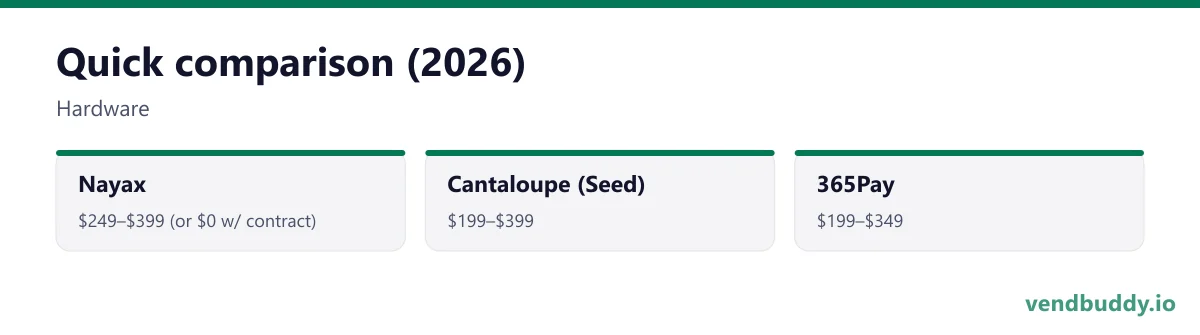
| Reader | Hardware | Monthly fee | Transaction fee | Best for |
|---|---|---|---|---|
| Nayax | $249–$399 (or $0 w/ contract) | $7.95–$12.95 | 5.95% + $0.05–$0.15 | 5+ machines, data & reliability |
| Cantaloupe (Seed) | $199–$399 | $7.95–$10.95 | 5.95% + $0.10 | 1–5 machines, simplicity, Seed ecosystem |
| 365Pay | $199–$349 | $6.95–$11.95 | 5.9% + $0.10 | Operators running or planning micro markets |
Pricing pulled from active 2026 operator quotes. All three negotiate at 25+ machines.
Why cashless matters in 2026
Adding a card reader lifts machine revenue 30–50% within 60 days. In gyms, offices, and student housing the lift is often over 60%. Cash-only machines are functionally abandoned by most customers under 30.
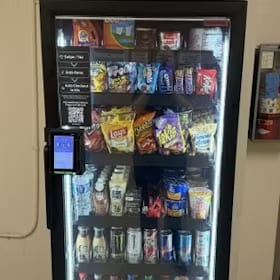
Nayax
Pricing (2026): Hardware $249–$399 upfront or $0 with multi-year contract. Monthly $7.95–$12.95. Transaction fees 5.95% + $0.05–$0.15.
Strengths: Strongest international reach, excellent hardware reliability, robust telemetry, transparent dashboard, wide integration.
Weaknesses: US support response has slipped in the last 18 months. Contract terms can be sticky.
Best for: Operators with 5+ machines who value data and reliability.
Cantaloupe (Seed)
Pricing (2026): Hardware $199–$399. Monthly $7.95–$10.95. Transaction fees 5.95% + $0.10.
Strengths: US-dominant, tight integration with Seed Markets and Seed Pro, strong loyalty support, clean reporting UI.
Weaknesses: Pricier mid-tier with software. Inconsistent support during ownership transitions.
Best for: Operators in the Seed ecosystem or running micro markets.
365Retail Markets (365Pay)
Pricing (2026): Hardware $199–$349. Monthly $6.95–$11.95. Transaction fees 5.9% + $0.10.
Strengths: Strongest micro market ecosystem, excellent consumer app (loyalty, rewards, payroll deduction), widely used by big fleet operators.
Weaknesses: Smaller footprint on standalone vending.
Best for: Operators running or planning micro markets.
Head-to-head decision matrix
- 1–5 machines, want simplicity: Cantaloupe.
- 5+ machines, want data: Nayax.
- Adding micro markets in 12 months: 365Pay or Cantaloupe.
- International or unusual markets: Nayax.
- Premium residential or office: Nayax or Cantaloupe.
A card reader pays for itself in weeks once the per-transaction lift kicks in. The VendBuddy ROI Calculator models cashless adoption against your current cash-only revenue so you can see the actual payback.
Nayax vs Cantaloupe: the head-to-head most operators are actually deciding
Almost nobody is genuinely weighing all three at once. In practice the decision comes down to Nayax vs Cantaloupe, and the honest answer is that they are strong in different places rather than one being better.
Nayax is a hardware and telemetry ecosystem. The VPOS Touch is the reader you see most on routes that intend to grow: the widest machine compatibility (including older and non-standard equipment), international coverage, and per-vend data granular enough to drive restock routing rather than just settle transactions. It is also the one card reader integration that runs live inside VendBuddy, so a Nayax route can push sales data straight into your P&L and restock planning with no spreadsheet in the middle — a bias worth naming out loud.
Cantaloupe is a platform business that also sells readers. ePort Engage plus the Seed back end is the smoother experience for a small route: simpler onboarding, US-first support, and one console covering cashless, prekitting and warehouse inventory. If micro markets are anywhere in your next twelve months, Cantaloupe (and 365Pay) own that category in the US in a way Nayax does not.
Who should pick which. Under five machines, no micro market planned, and you want the fewest moving parts — Cantaloupe. Five or more machines, mixed or older equipment, international units, or telemetry you actually intend to act on — Nayax. A micro market inside a year — Cantaloupe or 365Pay, decided by your market vendor rather than by the reader. At small route sizes the two land within $5–$15/month of each other, so price is not the deciding variable: data depth and ecosystem fit are.
Get a Nayax quote for your machine count → (Affiliate link — VendBuddy may earn a commission at no extra cost to you. Nayax is also the one live reader integration in our own product, which is a bias worth knowing about. Cantaloupe is not an affiliate of ours, and we earn nothing if you pick them.)
Mistakes operators make
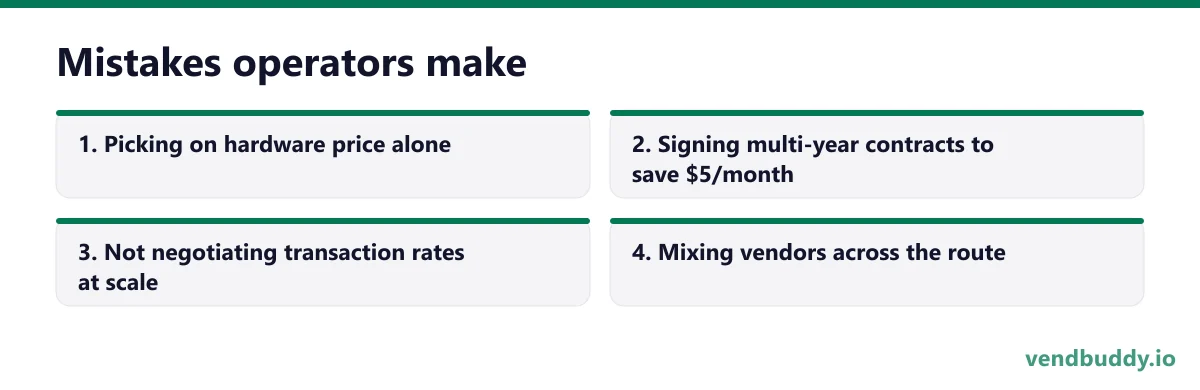
- Picking on hardware price alone. TCO is dominated by transaction and monthly fees.
- Signing multi-year contracts to save $5/month.
- Not negotiating transaction rates at scale. Over 25 machines, negotiate 10–25 bps off.
- Mixing vendors across the route.
FAQ
Can I get a vending card reader with no upfront cost?
Yes. Nayax, Cantaloupe, and 365Pay all offer $0-down hardware in exchange for multi-year contracts. Upfront purchase typically pays back within 18 months versus the contract option.
Do vending card readers work without internet?
Yes. All three major readers cache transactions offline and sync via cellular modem when the connection returns.
How long does it take to install a vending card reader?
15 to 30 minutes per machine for standard MDB integration. Older machines without MDB support may need an adapter board.
Which vending card reader is cheapest in 2026?
For 1 to 10 machines, all three are within $5 to $15/month of each other. Cantaloupe and 365Pay edge out Nayax slightly on hardware. The real difference is data quality, US support response, and ecosystem fit, not monthly cost.
Nayax vs Cantaloupe: which is better for a vending route?
Neither is better outright — they win in different places. Nayax is the hardware and telemetry ecosystem: the widest machine compatibility, the strongest per-vend data, international coverage, and the one card reader that integrates live with VendBuddy. Cantaloupe is the platform play: simpler onboarding for a small route, US-first support, and a far stronger micro market and prekitting story. Pick Cantaloupe under about five machines when you want the fewest moving parts, or when a micro market is on the roadmap. Pick Nayax at five or more machines, on mixed or older equipment, or when you intend to act on telemetry rather than just read it. Monthly cost lands within $5–$15 of the other at small route sizes, so price should not decide it.
Is a cash-only vending machine worth it, or do card reader fees eat the lift?
The fees do not come close to eating the lift. A reader costs about $300 up front plus $7–$13 a month and roughly 5.95% per transaction. On a machine grossing $1,000 a month that is about $60 in processing plus $10 in service — call it $70. Cashless adds 30–50% to revenue on the same foot traffic, so the same machine moves to $1,300–$1,500 and the extra $300–$500 in sales pays those fees five to seven times over. The hardware clears its own cost inside the first two to three months. There is no realistic 2026 scenario where cash-only wins on the math: a large share of customers under 30 carry no cash at all, and a machine they cannot pay at is a machine they walk past. The only cash-only case left is bulk candy at under $1 a vend, where the per-transaction fee is a meaningful share of the sale.
The card reader is the machine half of your stack — for the business half (finding locations, ROI, pipeline, contracts), see the vending management software guide.
Factor into your model in the profit breakdown, and see telemetry in the placement guide.
The fastest revenue lift: add a card reader
Across operator surveys and our own route data, adding cashless lifts per-machine revenue 30–50% within 60 days — cash-only machines are functionally invisible to most customers under 30. Nayax is the reader most multi-machine operators standardize on: reliable hardware, strong telemetry, and wide machine compatibility — it is also the one live reader integration inside VendBuddy. Our full breakdown of what the monthly fee buys, and when to skip it, is in the Nayax review for operators.
What is selling, which buildings say yes, and the numbers before you buy a machine. Free, confirm from your inbox, unsubscribe in one click. Refer one friend and get 25 VendBuddy credits.
General information, not legal, tax or financial advice. Rules change, so check the official source. Revenue and income figures are examples, not promises. See our terms.