- Vending software splits into two jobs: machine software (telemetry + cashless payments) and operator software (find locations, model ROI, manage deals and contracts).
- Most operators cover payments with a card-reader platform, then have a gap on the growth and operations side — which is where deals are actually won.
- VendBuddy is the operator command center for that second job: lead finding, ROI, pipeline CRM, contracts, and coaching in one place.
“Vending machine software” means two very different things, and conflating them is why operators feel like they have ten tools and still no system. Here is how to think about the stack — what each layer does, and where the real gap usually is.
Part of our complete guide: scaling a vending machine business.
Looking for vending management software specifically? The platform-by-platform version of this page lives at vending management software: what a VMS actually does, a capability table for VendSoft, Cantaloupe Seed, Parlevel, Vagabond, Gimme, Nayax, 365, Vendon and VendSys, and which one is worth paying for at your machine count.
The two jobs vending software does
Layer one is the machine: telemetry and cashless payments. Layer two is the business: finding locations, closing them, and running the operation. Most beginners obsess over layer one and ignore layer two — but layer two is where revenue is actually made or lost.
Machine software: telemetry and payments
On the machine itself, a card-reader and telemetry platform handles cashless payments and reports sales by SKU so you know what is selling and what to restock. These are essential and largely solved — pick a reliable card reader and read the data it gives you. See card readers, reading your sales reports, and managing multiple platforms as you grow.
Nayax is the platform most multi-machine operators standardise this layer on — wide machine compatibility, per-vend reporting granular enough to drive restock routing, and the one reader integration that runs live inside VendBuddy, so its sales data lands in your P&L without a spreadsheet in the middle. (Affiliate link — VendBuddy may earn a commission at no extra cost to you, and Nayax being our one live integration is a bias worth naming.)
Picture the machines paying you while you sleep
That’s the real promise of vending — income that doesn’t cost you your time, and a life on your own terms. VendBuddy turns this guide into a step-by-step plan so you actually build it instead of just reading about it. Start free today.
Start building free →Operator software: where deals are won
The bigger, under-served job is running the business: finding good locations, modeling whether a placement pays, tracking deals from pop-in to signed contract, generating the paperwork, and knowing your next move. This is the layer most “vending software” ignores — and the one that actually determines how fast you grow.
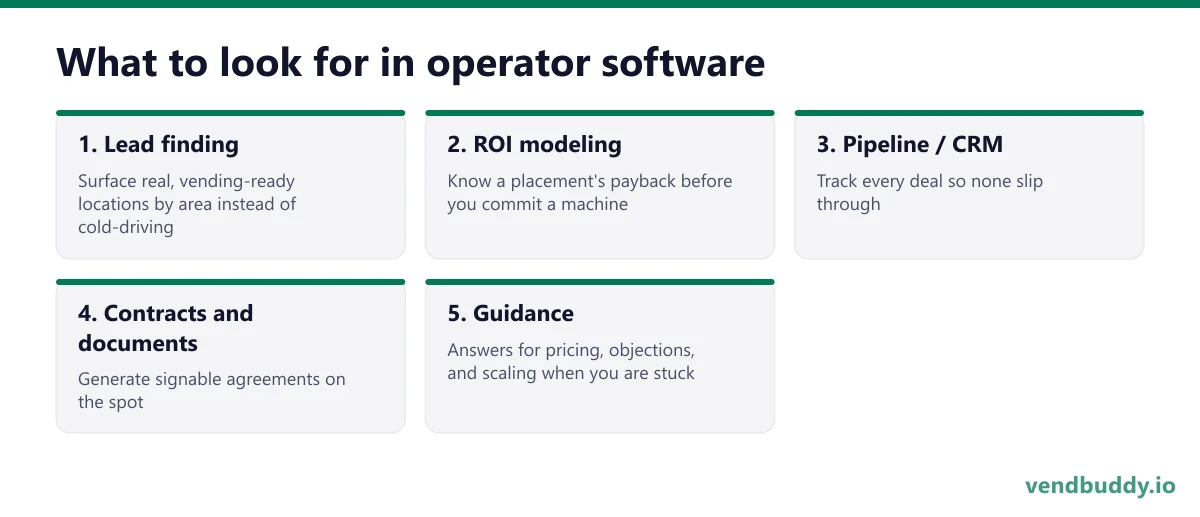
What to look for in operator software
- Lead finding — surface real, vending-ready locations by area instead of cold-driving.
- ROI modeling — know a placement’s payback before you commit a machine.
- Pipeline / CRM — track every deal so none slip through.
- Contracts and documents — generate signable agreements on the spot.
- Guidance — answers for pricing, objections, and scaling when you are stuck.
That is exactly the stack VendBuddy puts in one place — the Lead Finder, ROI Calculator, Pipeline CRM, Contract Creator, and Growth Coach — so the business side is a system, not ten browser tabs. Start free with 5 credits.
Head-to-head: spreadsheets vs telemetry platforms vs VendBuddy
| Capability | Spreadsheets + notes | Telemetry / card-reader platforms | VendBuddy |
|---|---|---|---|
| Find new locations | Manual research, hours per lead | — | Ranked leads by ZIP with the best contact on file |
| Model placement ROI | DIY formulas, easy to get wrong | — | Built-in ROI calculator |
| Track deals / pipeline | Rows go stale, follow-ups slip | — | Pipeline CRM with follow-up nudges |
| Contracts | Template hunting | — | Contract Creator, signable on the spot |
| Sales by SKU / restock data | Manual counts | Yes — this is their job | Restock log + revenue tracking |
| Cashless payments | — | Yes (Nayax, Cantaloupe, 365Pay) | — (pairs with any card reader) |
| Cost to start | Free, but hours weekly | Hardware + monthly fees per machine | Free (5 credits, no card) |
The takeaway: telemetry platforms and operator software are not competitors — you need one of each. The card reader runs the machine; VendBuddy grows the route.
VendSoft: where it fits
VendSoft comes up constantly in operator forums, so it is worth naming plainly. It is classic route-management software: machine and inventory tracking, route scheduling and manifests, driver restock logging, and DEX-style machine data feeding sales reporting. That is the back half of the business — running the machines you already have, efficiently, with fewer out-of-stocks and less guessing at par levels. It suits an operator past the first handful of machines, especially one with a driver or two and a service schedule that has outgrown a spreadsheet. VendSoft publishes its own documentation and resource pages on its site, which is the right place to check current pricing and feature detail rather than trusting any comparison article, ours included.
Where VendBuddy differs is the half that comes before any of that exists: finding and landing locations. Ranked property leads by ZIP, the best contact on file, placement ROI modelling, a pipeline to keep follow-ups from slipping, and contracts you can sign on the spot. Route software assumes the machine is already placed; we are the part that gets it placed. That makes the two complementary rather than competing — plenty of operators end up running one of each, and the honest sequencing is growth software early, route software once the route is big enough to be a logistics problem. The longer side-by-side is in VendSoft vs VendBuddy.
When you actually need it
From your very first machine, the operator-software job exists — you just may be doing it in a spreadsheet and your head. The point of dedicated software is to make finding and closing locations repeatable, which is what turns one machine into a route. See how to scale.
Who it's best for
- A card reader and telemetry platform, Nayax being the one we run. Best from machine one, because per-vend reporting is what turns restocking from a guess into a schedule, and it is the one reader integration that runs live inside VendBuddy. Not a substitute for route software once you have a driver and a warehouse.
- Route-management software such as VendSoft. Best for an operator past the first handful of machines with a driver or two, where machine and inventory tracking and route scheduling save more than they cost. Not worth buying at three machines, where a spreadsheet does the same job for nothing.
- Operator software, which is what we make. Best when the constraint is finding and closing the next location rather than running the ones you have, and it starts free with 5 credits and no card. Not for anyone who needs DEX, hardware or payment processing, because we ship none of the three.
Above about fifty machines the calculus changes and the route layer becomes the expensive decision. That version of this page is best vending management software for large routes, and the operational companion is running 100-plus vending machines.
Frequently Asked Questions
What software do vending machine operators use?
Two kinds: a card-reader and telemetry platform on the machine for payments and sales data, and operator software for the business side — finding locations, modeling ROI, and managing deals and contracts. VendBuddy handles the second.
Is there an app to manage vending machines?
Yes. Telemetry apps track machine sales and inventory, while operator platforms like VendBuddy manage the growth side — leads, ROI, pipeline, contracts, and coaching — in one place. Most vending machine applications fall into one of those two groups, so decide which job you need done before you compare them.
If you would rather not draft the contract from scratch, we keep a plain-English walkthrough at get vending machine contracts. It covers term, commission, exclusivity and how either side gets out.
Do I need software for a single vending machine?
You need a card reader from day one. For the business side, even one machine benefits from a system to find and close your next location — that is how a single machine becomes a route.
What is the best vending machine management software?
The best choice depends on the job: a reliable card-reader/telemetry platform for the machine, and an operator command center like VendBuddy for finding locations, modeling ROI, and closing deals.
What is selling, which buildings say yes, and the numbers before you buy a machine. Free, confirm from your inbox, unsubscribe in one click. Refer one friend and get 25 VendBuddy credits.
General information, not legal, tax or financial advice. Rules change, so check the official source. Revenue and income figures are examples, not promises. See our terms.