A single ATM in the right bar or nightclub can quietly pocket you $300–$600 a month in pure surcharge revenue — and the machine basically runs itself after setup. That math is why thousands of small operators have quietly built five- and six-figure portfolios one ATM at a time. But the model only works if you understand the real costs, pick the right locations, and go in with honest expectations about low-traffic spots. Here is exactly what you need to know.
Part of our complete guide: best cash flow businesses.
How much does an ATM make?
Your revenue is simple: every time someone withdraws cash, you collect the surcharge fee — typically $2.50 to $3.50 per transaction. Multiply that by monthly withdrawals and you have your gross revenue.
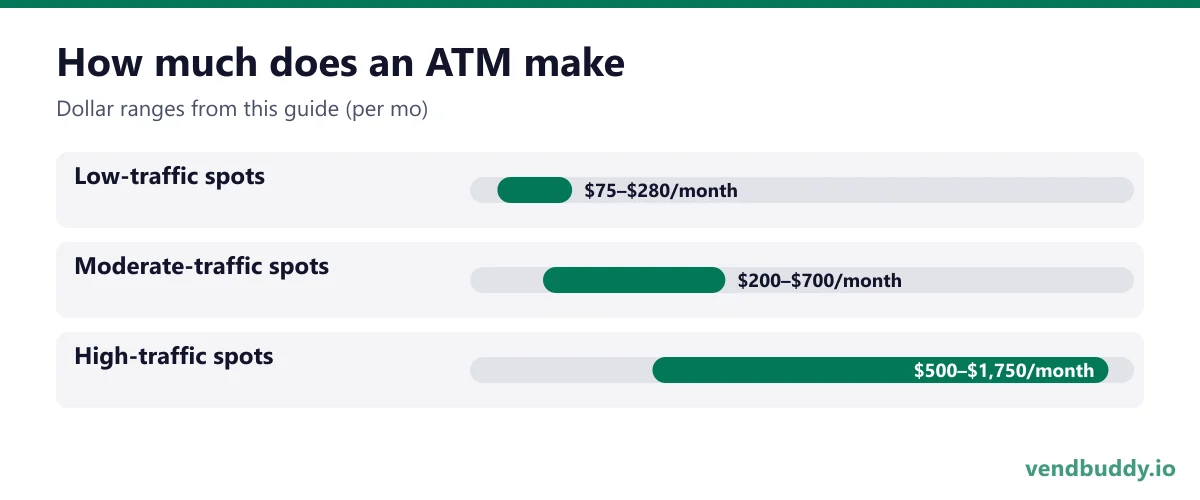
Monthly withdrawals vary enormously by location type:
- Low-traffic spots (quiet laundromats, slow strip malls): 30–80 withdrawals/month → roughly $75–$280/month
- Moderate-traffic spots (convenience stores, liquor stores, casual restaurants): 80–200 withdrawals/month → roughly $200–$700/month
- High-traffic spots (bars, nightclubs, festivals): 200–500+ withdrawals/month → roughly $500–$1,750/month or more
The honest truth: a poorly placed ATM in a low-foot-traffic location might net you $50–$80 a month after costs — not worth your time. Location is everything. An ATM in a cash-heavy nightclub or a busy smoke shop in the right neighborhood is a genuinely different business than one sitting in a half-empty strip mall.
Most operators target $125–$900/month per machine as a realistic working range across a mixed portfolio. A few busy units will carry the portfolio; some quiet units will barely break even.
Startup costs (including the cash float)
This is where most first-timers get surprised. You have two distinct capital requirements: the machine itself, and the cash you load into it.
The machine
- Used ATM (refurbished): $1,500–$2,500. Viable option if you buy from a reputable distributor who certifies it and provides documentation. Avoid unknown sources — compliance issues and repair bills can quickly erase the savings.
- New ATM: $2,300–$3,500. Lower maintenance risk, full warranty, cleaner compliance paper trail. Recommended if you are building a multi-unit operation.
The cash float — the cost most guides skip
You also need to vault the machine — meaning you load it with your own cash. The ATM dispenses your money; the surcharge fees are how you get paid and replenish the vault. Typical vault requirements:
- Minimum practical float: $1,500–$2,000 (for lower-traffic machines with weekly service)
- Comfortable working float for a busy location: $3,000–$5,000
That cash is not spent — it is sitting in the machine cycling through transactions — but it is real capital you cannot use for anything else. Budget $2,000–$5,000 per machine in float capital on top of the purchase price.
Used machine: ~$2,000 + Float: ~$3,000 = ~$5,000 all-in
New machine: ~$3,000 + Float: ~$4,000 = ~$7,000 all-in
That is the real number to plan around before your first surcharge dollar hits your account.
Other costs to budget: processing/network fees ($15–$35/month), cellular connectivity ($10–$20/month if using 4G modem), liability insurance, and any location commission (some venues want 10–25% of surcharge revenue as a placement fee).
Picture the machines paying you while you sleep
That’s the real promise of vending — income that doesn’t cost you your time, and a life on your own terms. VendBuddy turns this guide into a step-by-step plan so you actually build it instead of just reading about it. Start free today.
Start building free →Best locations to place an ATM
The best ATM locations share a few traits: heavy cash usage, limited nearby ATM access, and customers who want convenience more than they mind the surcharge fee. The top venue categories:
- Bars, nightclubs, and lounges — highest per-unit earnings potential; customers pay surcharges without hesitation at 1 AM
- Convenience stores — steady daytime and overnight traffic, cash-friendly customer base
- Liquor stores — reliable cash transactions, especially in areas where many customers prefer cash purchases
- Smoke shops and vape shops — strong fit; many customers in these shops prefer cash for privacy reasons (see also: nicotine and vape vending machine opportunities)
- Laundromats — change machines have declined; ATMs fill the gap, especially in coin-op laundromats
- Festivals and events — temporary placement opportunities with extremely high transaction volume over short periods
- Strip malls and neighborhood retail clusters — solid if anchored by a cash-friendly business and no bank ATM within a short walk
- Cash-friendly restaurants — especially those that do not accept cards or add card fees
The challenge: getting in front of the right owner or manager to pitch a placement deal. Cold-walking locations is slow and inefficient. VendBuddy is built for exactly this — the Lead Finder and Lead Map pull real venue listings from Google Maps, filtered by business category and location, with the best contact on file (owner or manager when available) so you can reach out directly without burning hours driving around. It is the same workflow vending operators use for machines, applied to ATM placement. Here is a full breakdown of how to find vending and ATM locations systematically.
Pros, cons and is it worth it?
Pros
- True passive income once placed — no products to restock, no perishables, no inventory complexity
- Low ongoing time commitment (vault replenishment every 1–3 weeks depending on volume)
- Scalable: each additional machine is incremental capital, not a new business
- Cash business with same-day settlement to your account
Cons
- Capital-intensive upfront — the float requirement catches many operators off guard
- Location-dependent income — a bad placement can earn almost nothing
- Machine downtime (connectivity issues, jammed cassettes, empty vault) means zero revenue; you need responsive maintenance habits
- Competition from mobile payments is a real long-term headwind — cash usage is declining in some demographics, though bars and cash-oriented retail have proven more resilient
- Some venues demand revenue sharing that shrinks your margins significantly
Is it worth it? Yes, for operators who are disciplined about location selection and realistic about the capital requirements. A portfolio of 5–10 well-placed ATMs generating an average of $300/month each is a $1,500–$3,000/month cash flow stream that requires only a few hours of maintenance per week. Getting there takes 12–24 months of reinvestment and methodical placement work. Compare this and other operator income streams in our ranked guide to alternative vending business models.
For operators who already run vending routes, ATMs are a natural add-on — the location relationships are already in place. If you are weighing payment infrastructure across your operation, see also: cashless vending and card reader options for how payment trends affect vending and ATM revenue together.
Most operators end up on Nayax for card readers because it is what the distributors already support. Their reader handles tap, chip and the telemetry feed in one box, and the monthly fee is the part to check against your per-machine volume before you commit the route to it.
Retail-grade ATM: 1,000-note cassette, EMV reader, electronic lock, 8" color screen. A single one in the right bar quietly earns surcharge income.
FAQ
Do I need a license to own an ATM?
In most U.S. states, independent ATM deployers (IADs) do not need a specific ATM license to own and operate machines. FinCEN guidance (FIN-2007-G006) says an owner-operator of ATMs who offers no other money services is not a Money Services Business, so there is no federal MSB registration for that alone; your sponsor bank and processor will still verify where your vault cash comes from. Requirements vary by state, so verify your state's rules before you start. Consult a compliance attorney or your ATM processor for guidance.
How do I get paid?
You set up a processing agreement with an ATM network (e.g., Nautilus Hyosung, Cardtronics, or an independent processor). Each surcharge transaction is settled to your bank account — typically daily or next-business-day. The cash in the machine is always yours; the surcharge is your revenue on top of it.
How often do I need to service the machine?
That depends entirely on transaction volume. A busy bar ATM dispensing $20s might need cash replenishment every 3–5 days. A low-traffic location might go 3 weeks between visits. Most operators start with weekly checks until they have a feel for each location's burn rate.
Can I negotiate a commission-free placement?
Yes, particularly in independent businesses where the owner values the customer convenience aspect. Bars and liquor stores are often receptive to a no-commission deal because the ATM keeps customers on-premise longer. Larger chains or franchises will typically require revenue sharing. Reaching out directly to the owner — rather than a manager — gives you the best shot at a favorable deal.
Ready to find ATM placement venues in your target area? VendBuddy lets you search by category, map the density of cash-friendly businesses near you, and pull the best contact on file — so you can move from research to pitched conversation in the same afternoon.
What is selling, which buildings say yes, and the numbers before you buy a machine. Free, confirm from your inbox, unsubscribe in one click. Refer one friend and get 25 VendBuddy credits.
General information, not legal, tax or financial advice. Rules change, so check the official source. Revenue and income figures are examples, not promises. See our terms.