Nicotine and vape vending machines are one of the most quietly profitable niches in the industry — but they come with a compliance burden that can sink an unprepared operator fast. This guide covers everything: the legal requirements you cannot skip, realistic revenue figures, startup costs, and the only venue types worth approaching in 2026.
Part of our complete guide: best cash flow businesses.
The rules first: age verification & compliance
Before you price a single machine, understand that nicotine vending is federally regulated. The FDA classifies e-cigarettes and tobacco products under the Family Smoking Prevention and Tobacco Control Act, which means any vending machine dispensing these products must comply with federal age-verification requirements — and most states layer additional rules on top.
What compliance actually requires:
- Age-verified machines only. Every nicotine or vape vending machine must use an ID-scan or electronic age-gate system that confirms the purchaser is 21 or older before dispensing. No exceptions. Manual placement in "adult areas" is not sufficient on its own.
- 21+ venues only. Federal law restricts tobacco vending machines to facilities where the operator ensures no one under 18 is present. Most compliant operators go further and restrict to 21+ venues exclusively to eliminate gray areas.
- Retail tobacco permit. Nearly every state requires a tobacco retail license to sell these products, even via machine. Fees range from $25 to several hundred dollars annually depending on jurisdiction. Some counties and cities stack their own permits on top.
- State and local variation. California, New York, Massachusetts, and several other states have banned vape vending machines entirely or imposed additional restrictions. Check your state tobacco authority before purchasing equipment.
- Signage requirements. Most jurisdictions require visible "No Sales to Minors" or "21+" signage on or adjacent to the machine.
Avoid these venues entirely: shopping malls, grocery stores, laundromats, gyms, family restaurants, convenience stores with mixed-age traffic, apartment lobbies, or anywhere minors are regularly present. If there is any doubt about foot traffic age, the answer is no.
How much does a nicotine vending machine make?
Revenue is highly location-dependent. A machine sitting in a quiet dive bar on a slow street will not perform like one in a high-volume nightclub. That said, realistic monthly revenue ranges for compliant 21+ venues look like this:
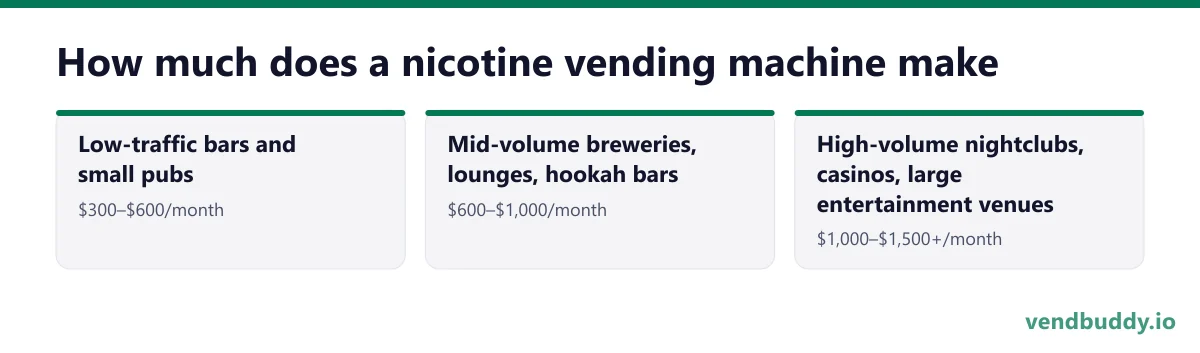
- Low-traffic bars and small pubs: $300–$600/month
- Mid-volume breweries, lounges, hookah bars: $600–$1,000/month
- High-volume nightclubs, casinos, large entertainment venues: $1,000–$1,500+/month
Margins on vape and nicotine products are typically 40–60% above wholesale cost, which is favorable compared to snack vending. Pod systems, disposables, and nicotine pouches are your highest-velocity SKUs. Premium disposables in the $15–$25 range drive the best revenue-per-transaction numbers.
Be conservative in your projections. New machines in untested locations often underperform for the first 60–90 days while customers discover them. Build your business case on the lower end of the range and treat upside as a bonus.
Picture the machines paying you while you sleep
That’s the real promise of vending — income that doesn’t cost you your time, and a life on your own terms. VendBuddy turns this guide into a step-by-step plan so you actually build it instead of just reading about it. Start free today.
Start building free →Startup costs & licensing
Nicotine vending has higher startup costs than traditional snack routes because the machines require built-in age-verification hardware.
- Age-verified vending machine: $2,000–$6,000 depending on brand, screen size, ID-scan quality, and remote-monitoring features. Brands like VerifID-equipped units and Cantaloupe-integrated machines are common in this space.
- Initial product inventory: $500–$1,500 per machine to stock a full planogram of pods, disposables, and pouches.
- State tobacco retail license: $25–$300+ depending on your state, plus renewal fees.
- Local permits: Varies widely. Some cities require a separate vending operator permit on top of the tobacco license.
- Insurance: A general liability policy covering your machines runs $400–$800/year for a small route.
All-in, a single compliant machine placed in a solid location costs roughly $3,000–$8,000 to launch. Payback period at average revenue is 6–18 months.
Best 21+ locations for nicotine vending machines
The only venues worth targeting are those that legally restrict entry to adults and where nicotine consumption is already normalized. These include:
- Bars and pubs — steady nightly traffic, customers already in a purchase mindset, staff willing to oversee the machine area
- Nightclubs and dance venues — highest transaction volume; customers may have left their cigarettes at home or run out
- Breweries and taprooms — growing 21+ category with loyal weekend crowds
- Casinos and gaming floors — extended dwell time drives repeat purchases; some of the strongest per-machine numbers in the industry
- Hookah lounges — nicotine-adjacent customer base; natural product fit
- Smoke shops and vape shops — counterintuitive but works as an after-hours or overflow option
- Adult entertainment venues — verified 21+ entry, extended hours, captive audience
- Hotel bars and resort lounges — high-spend guests, limited nearby alternatives
Finding these venues and getting in front of the right decision-maker is the hardest part of building a nicotine route. VendBuddy pulls 21+ venue leads from Google Maps and surfaces the best contact on file (owner or manager when available) so you can pitch directly — without cold-driving neighborhoods. Use the Lead Finder and Lead Map to filter by venue type and ZIP code before you make a single call.
Lead Finder cannot see a venue's door policy, so you still confirm each one is 21+ at every hour. Our guide to vape vending machine locations walks through that screen step by step, with Oklahoma City and Oklahoma's vending statute as the worked example.
For broader context on niche machine categories, see Alternative Vending Machine Businesses Ranked.
Pros, cons & risk
Pros: High margins, low product weight, customers are motivated buyers, strong repeat purchase behavior, limited vending competition in many markets.
Cons: Regulatory complexity is real and evolving; some states are moving toward bans; age-verified machines cost more and require more maintenance; venue owners may be hesitant without proof of compliance; product trends shift fast (today's top disposable may be discontinued in 12 months).
Risk factors to weigh: FDA enforcement has ramped up significantly since 2023. Any operator caught with a non-compliant machine or placement faces steep penalties. This is not a business where you "figure out compliance later." It must be built in from day one.
Looking at related placement strategies? The ATM placement guide covers similar 21+ venue outreach tactics, and how to find vending locations walks through the full prospecting process.
Age-gated touchscreen vending for 21+ venues only. High margin where compliance is handled correctly — read the rules before you place one.
FAQ
Are nicotine vending machines legal?
Yes, in most U.S. states, with conditions. Federal law and most state laws permit them in 21+ venues with age-verification hardware and a valid tobacco retail license. A handful of states — including California — have significantly restricted or banned them. Always verify your state and local laws before purchasing equipment.
What age-verification technology do I need?
At minimum, your machine must include an electronic ID scanner or digital age-gate that prevents dispensing to anyone under 21. Manual age checks by venue staff are not a compliant substitute for built-in hardware.
Do I need a separate license for each machine or each location?
It depends on your state. Some states issue a single operator license covering all machines; others require a permit tied to each physical location. Check with your state tobacco authority and any applicable city or county agencies before you place a machine.
How do I find bars and clubs open to hosting a vending machine?
Cold outreach works, but it is slow. VendBuddy surfaces 21+ venue leads by type and location, with contact details for owners and managers, so you can spend your time pitching rather than searching. Start with the Lead Map to identify high-density bar corridors in your target market.
What is selling, which buildings say yes, and the numbers before you buy a machine. Free, confirm from your inbox, unsubscribe in one click. Refer one friend and get 25 VendBuddy credits.
General information, not legal, tax or financial advice. Rules change, so check the official source. Revenue and income figures are examples, not promises. See our terms.