- Motor or spiral: $15–$80 parts + 20 min DIY. Most common, cheapest fix.
- Bill validator: $200–$400 to replace. Justify against machine value first.
- Coin mechanism: $150–$300. Often fixable with a compressed-air clean.
- Compressor: $300–$800 parts + $150–$250 labor. Trigger the 50% rule.
- Control board: $400–$1,200. At the high end, replace the machine.
The average vending operator spends $50–$150 per machine per month on repairs when you average it across a route over a full year. But that number hides a huge spread — a motor swap costs $15 and takes twenty minutes, while a compressor replacement can exceed $1,000 all-in. Knowing what each failure actually costs lets you make the repair-vs.-replace call in 30 seconds instead of calling a technician just to hear a number that surprises you.
Part of our complete guide: how much does a vending machine cost.
How much does vending machine repair cost?
Most vending machine repairs cost $15 to $400: a motor or spiral is $15 to $80 in parts, and a bill validator or coin mech runs $150 to $400. The big bills are a compressor at $450 to $1,050 all-in and a control board at $400 to $1,200, and those are the jobs where the 50% rule below decides whether you fix the machine or replace it.
Labor is where a small fix turns into a big invoice. The US Bureau of Labor Statistics counted 36,100 coin, vending and amusement machine servicers and repairers in May 2023, with a mean wage of $22.04 an hour (BLS Occupational Employment and Wage Statistics, May 2023). A shop that bills $95 to $150 an hour plus a $75 trip charge is paying for the van, the drive and the overhead on top of that wage, so a 20-minute motor swap is worth learning yourself.
Repair cost overview by machine type
Repair exposure varies sharply by machine type. A used combo machine bought for $1,500–$3,000 hits the 50% rule much faster than a $12,000 smart cooler. Here are the realistic annual repair budgets operators report in 2026:
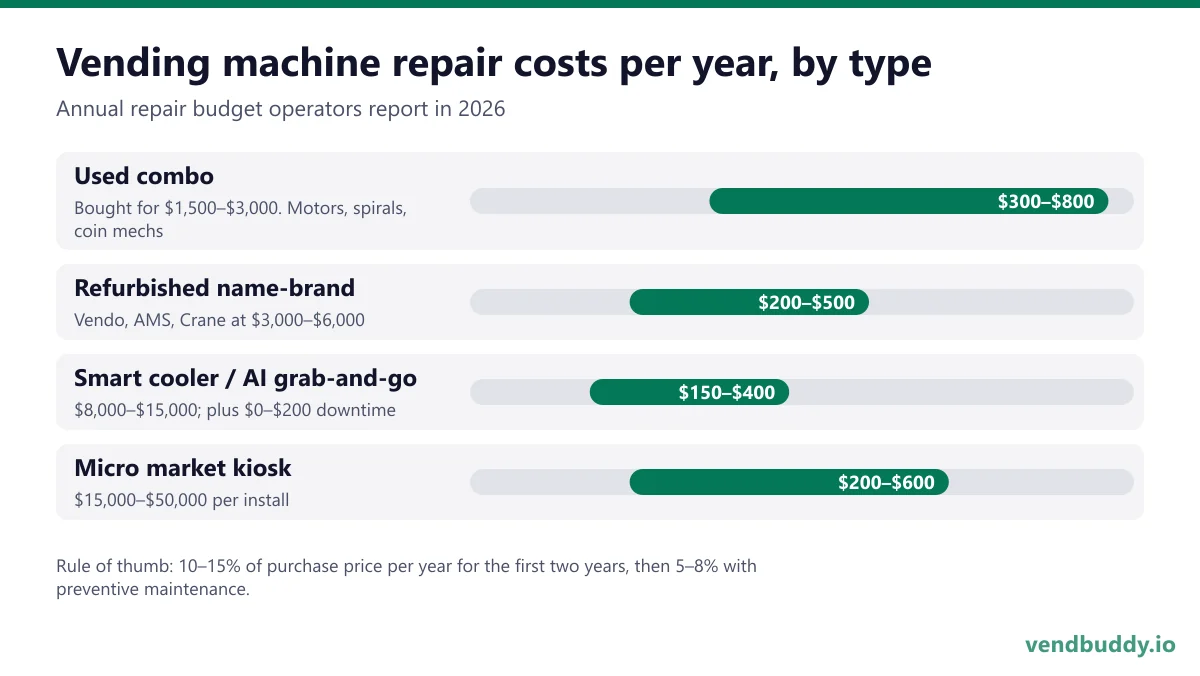
- Used combo (snack + drink, $1,500–$3,000 purchase price): $300–$800/year. Motors, spirals, and coin mechs dominate.
- Refurbished name-brand (Vendo, AMS, Crane, $3,000–$6,000): $200–$500/year if properly refurbished. Bill validators and boards are the main risk.
- Smart cooler / AI grab-and-go ($8,000–$15,000): $150–$400/year on hardware, but cellular and software failures add $0–$200 in downtime costs.
- Micro market kiosk ($15,000–$50,000 per install): $200–$600/year in kiosk repairs; the bigger risk is scale-down losses from connectivity outages.
Rule of thumb: budget 10–15% of machine purchase price per year for repairs in the first two years, dropping to 5–8% after that if you follow the preventive schedule below.
Picture the machines paying you while you sleep
That’s the real promise of vending — income that doesn’t cost you your time, and a life on your own terms. VendBuddy turns this guide into a step-by-step plan so you actually build it instead of just reading about it. Start free today.
Start building free →Motors and spirals
The most common vending repair by far. Motors (the small DC gear motors that drive the spiral coil) fail from overuse, product jams, and moisture. Spirals bend or break from stuck products or rough restocking.
- Replacement motor: $15–$40 per motor (OEM compatible). Buy a 5-pack if your machine has more than 8 selections — you'll use them.
- Replacement spiral/coil: $25–$80 per spiral, depending on pitch and diameter. Standard snack spirals run $25–$35; specialty wide-pitch drink spirals run $50–$80.
- Labor if DIY: 15–25 minutes per motor, no special tools.
- Labor if technician: $95–$150/hr + $75 service call. A single motor replacement could cost $170–$225 total.
A motor pulling 20% more current than normal will show up in smart machine telemetry before it fails.
Payment system failures
Payment failures are high-impact because they don't just cost a repair — they cost every sale from the moment they break until you fix them. A broken bill validator on a $2,000/month machine costs you roughly $67/day in lost revenue.
Bill validator
- DIY clean (compressed air + cleaning card): $0–$15. Fixes 30–40% of validator issues. Always try this first.
- Replacement bill validator: $200–$400 (Coinco, Mars/CPI, JCM). The brand matters for compatibility — check your machine's harness connector before ordering.
- Refurbished validator: $100–$180. Viable if sourced from a reputable parts supplier with a 90-day warranty.
- Technician swap: Add $75–$150 labor on top of parts.
Coin mechanism
- DIY clean: $0. Compressed air and a cotton swab clear most coin jams and sensor faults.
- Replacement coin mech: $150–$300 (Coinco, Conlux, NRI). Match the mech to your validator manufacturer for best results.
- Repair (sorter/hopper only): $50–$120 for just the failed subcomponent if your mech is otherwise solid.
Cashless reader (credit card / tap-to-pay)
- Nayax VPOS: $300–$400 to replace if the unit fails (rare — most Nayax issues are SIM or connectivity, not hardware).
- Cantaloupe Seed reader: $280–$380 to replace.
- 365Pay reader: Often covered under the 365 service agreement — check your contract before ordering a replacement.
- SIM/connectivity fault: $0 to resolve (reboot, SIM re-provision via support). Don't order a new reader until you've confirmed hardware failure.
Sometimes the fix genuinely is replacing a dying reader — a unit that drops offline weekly, misses taps, or has been out of support for years costs you more in silent lost sales than the swap does. If you are replacing rather than repairing, price a current Nayax reader at your actual machine count before you buy a like-for-like used one; the per-device economics change sharply between one machine and ten. (Affiliate link — VendBuddy may earn a commission at no extra cost to you. Nayax is also the one live reader integration in our own product.)
Before you approve a $450–$1,050 compressor job on a $1,500 machine, price the replacement. The Machine Finder lists current units by property type with prices, warranty terms, and which ones ship with cashless and telemetry already built in — so you are not paying to keep the same failure profile alive.
Refrigeration repairs
Refrigeration failures are the scariest for operators — spoiled product, customer complaints, and potential location loss.
Thermostat / temperature controller
- Replacement thermostat: $30–$80. Straightforward swap; most operators do it themselves in 20 minutes.
- Diagnosis cost: If you call a tech to confirm it's the thermostat, that's $75 service call + $50–$100/hr. Buy the part first; if the machine still won't cool after the swap, then call.
Condenser cleaning
- DIY condenser coil cleaning: $0 (compressed air, vacuum). Required every 3–6 months. A dirty condenser is the #1 cause of compressor failure — this is a $0 fix that prevents a $1,000 repair.
- Professional cleaning: $60–$120. Worth it annually in dusty environments (warehouses, factories).
Compressor
- Replacement compressor (parts only): $300–$800 depending on BTU rating and brand.
- Labor: $150–$250. Requires refrigerant recovery/recharge, which requires an EPA 608 certification — this is not a DIY job.
- All-in total: $450–$1,050. On a machine worth $1,500, this almost always triggers the 50% rule.
- Note: If your compressor runs constantly but doesn't cool, check the condenser and door seals first. A $40 door seal fix can masquerade as a compressor problem.
This is the one repair with no DIY version and the one most likely to end a machine, so it has its own page: the full compressor replacement cost breakdown covers the two symptom patterns that really mean compressor, the three cheaper faults that imitate it, and the machine values where repairing stops making sense.
VendBuddy's Spoilage & Risk Manager flags machines that are overdue for condenser cleaning and models the spoilage cost of a refrigeration failure at your specific location. The ROI Calculator shows you how a compressor replacement affects your payback timeline.
Control boards, display screens, and keypads
Electronic failures are the hardest to diagnose and the most expensive to fix. They're also the most likely to trigger a replace-vs.-repair decision on older machines.
Main control board (MDB / DEX controller)
- Replacement board (aftermarket): $400–$800 for most snack/combo machines.
- OEM control board: $600–$1,200. Often backordered on older machines.
- Diagnosis: Control board faults can mimic other failures. Before ordering a board, rule out power supply issues ($30–$80 capacitor replacement) and a reset/firmware update (free).
- Labor: $75–$150 if a tech handles the swap.
Display screen / LCD
- Replacement display: $100–$300 depending on size and machine brand. Generic LCD replacements exist for most common machines.
- Repair vs. ignore: A dead display usually doesn't stop sales on older machines (the machine still vends). Prioritize payment hardware over cosmetic screen repairs.
Keypad / selection panel
- Replacement keypad overlay: $30–$75 (cosmetic). Swaps onto the existing membrane frame.
- Full keypad/PCB assembly: $75–$200 for the full electrical assembly, including membrane and contact PCB.
Cabinet and glass damage
Cabinet repairs are usually aesthetic, but broken glass is a safety and liability issue that requires same-day action.
- Front glass panel replacement: $150–$350 cut to size. Tempered glass is required — don't substitute standard plate glass. Most glass shops can cut to spec from your measurements.
- Door gasket / seal: $40–$100. A leaking door seal spikes energy costs and causes compressor overwork. Replace it proactively every 3–4 years.
- Lock cylinder and key set: $50–$150. T-handle locks are a common vandalism target. Consider keyed-alike ordering so one key opens your whole route.
- Dent / cabinet bodywork: Usually cosmetic; $0 if you accept it, $200–$600 if you hire a body shop (not worth it on machines under $5,000).
Smart cooler–specific repairs
Smart coolers (Sandstar, Lightspeed Autonomous, HAHA, Stockwell) have additional failure modes that traditional machines don't. Most are warranty or software issues, not hardware repairs — but downtime still costs you.
- AI camera module: $150–$400 to replace (if out of warranty). Camera misidentification is usually a firmware or lighting calibration issue, not hardware — contact support before ordering parts.
- Weight sensor / shelf sensor: $80–$200 per shelf assembly. Sensor drift causes mischarges and inventory errors. Recalibrate via software before assuming hardware failure.
- Cellular modem / SIM: $60–$150 for modem replacement; SIM issues are usually $0 (carrier re-provision). A cellular outage takes the machine to manual-open mode, which loses cashless sales.
- Door magnetic lock: $40–$120. Fails from power surges. A UPS ($80–$150) prevents this and is the best insurance for smart cooler electronics.
- Full unit replacement (out-of-warranty catastrophic failure): Negotiate with the manufacturer — refurbished units are often available at 40–60% of new price.
See our smart cooler connectivity troubleshooting guide for the step-by-step diagnosis workflow before you file a repair ticket.
When to DIY vs. call a vending technician
Vending technicians in 2026 charge $95–$150/hr plus a $75 service call just to show up. That's $170–$225 before they touch the machine. The math on DIY is compelling for any part under $150. For everything else, vending machine maintenance and repair services are a local market rather than a national one, so vet the technician before the truck rolls.
Finding one is its own problem, because there is no national directory and the job title barely exists — how to find a vending machine repair technician covers the four places they actually work, the four questions to ask before booking, and the route size where a service contract starts paying.
Most first agreements are two pages, not twenty. The contracts walkthrough lays out the clauses that actually matter for the contract, including the termination language operators forget about until they need it.
| Repair type | DIY? | Reason |
|---|---|---|
| Motor / spiral swap | Yes | No tools, no risk, $15 part |
| Bill validator clean/swap | Yes | Plug-and-play harness connectors |
| Coin mech replacement | Yes | Snap-in mount on most machines |
| Thermostat replacement | Yes | 2-wire swap, 20 minutes |
| Door seal replacement | Yes | Peel-and-stick or clip mount |
| Condenser cleaning | Yes | Compressed air + vacuum, no disassembly |
| Glass replacement | Maybe | Heavy; two-person job; tempered glass only |
| Control board swap | Maybe | Only if you can confirm board is the fault |
| Compressor replacement | No | Requires EPA 608 cert for refrigerant |
| Refrigerant recharge | No | Illegal without EPA 608 cert |
To find a vetted vending technician: ask your local NAMA chapter, post in operator Facebook groups (Vending Business Owners, Vending Machine Talk), or contact your machine manufacturer's service network. Always get a written quote before authorizing work.
The 50% rule: repair vs. replace decision matrix
The industry standard is simple: if the repair exceeds 50% of the machine's current replacement value, replace the machine. A machine worth $2,000 on the used market has a $1,000 repair ceiling. Anything above that, you're better off selling it for parts and buying a better unit.
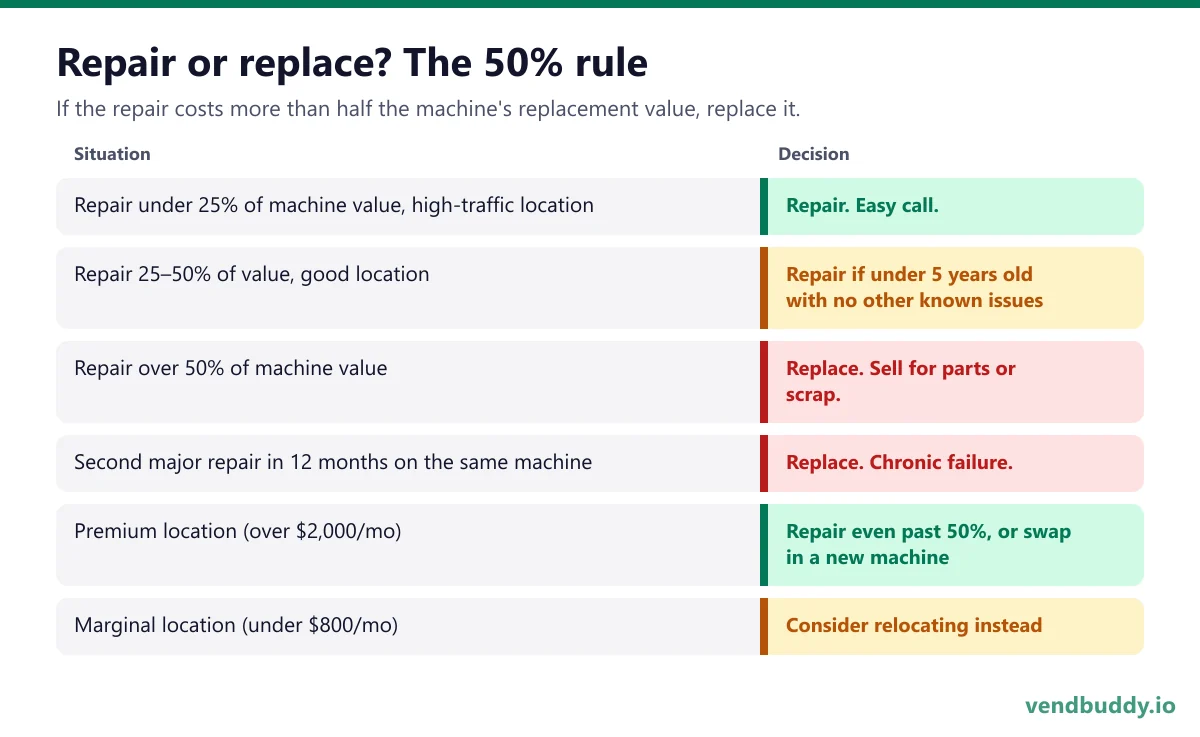
But the 50% rule is just the starting point. Use this matrix:
| Situation | Decision |
|---|---|
| Repair < 25% of machine value, high-traffic location | Repair. Easy call. |
| Repair 25–50% of machine value, good location | Repair if machine is < 5 years old and has no other known issues. |
| Repair > 50% of machine value | Replace. Sell for parts or scrap. |
| Second major repair in 12 months on same machine | Replace. Chronic failure pattern. |
| Machine is at a premium location (> $2,000/mo) | Repair even if > 50% rule — or install a new machine and don't risk the location going dark. |
| Machine is at a marginal location (< $800/mo) | Consider relocating the machine entirely instead of repairing it. |
Before buying a used machine, price out the most likely repairs for that model. A $1,200 combo machine with a known compressor issue is a $0 machine. Read our used vending machine buying guide for the pre-purchase inspection checklist.
Preventive maintenance schedule that cuts repair costs 40%
Operators who follow a structured PM schedule report 30–40% lower annual repair costs versus reactive-only maintenance. Here is the schedule used by operators running 20+ machine routes:
Every restock visit (weekly or bi-weekly)
- Run each spiral empty — check for drag or skipping.
- Test bill validator with 1, 5, 10, 20 dollar bills.
- Wipe the coin mech sensor slots with a dry cloth.
- Check cabinet temperature against the thermostat setpoint.
- Inspect door seal for cracking or gaps.
Monthly
- Blow out condenser coils with compressed air (2 minutes per machine).
- Test cashless reader — run a $0.25 test transaction.
- Inspect all spirals for bends; replace any that are visibly deformed.
- Check all cabinet locks and hinges.
Quarterly
- Deep-clean bill validator with manufacturer cleaning cards.
- Check and re-torque all electrical harness connections.
- Inspect compressor mounts and vibration dampeners.
- Update firmware on cashless readers and telemetry units.
Annually
- Replace door seals if showing wear (proactive, before they fail).
- Have a technician check refrigerant levels on cooling machines (EPA 608 required).
- Inspect and lubricate all moving parts in the delivery mechanism.
- Test all safety and grounding connections.
A PM checklist takes less than 5 minutes per machine per visit. The payoff is avoiding the $200–$1,000 repairs that result from deferred maintenance. The expanded version of the four tiers above, including what to do when an inspection turns up something, is in the vending machine maintenance checklist. See our restocking efficiency guide for how to build PM into your route workflow without adding time.
Frequently asked questions
- What vending machines actually cost in 2026 — the replacement side of the 50% rule.
- Machine Finder — match a unit to the property before you buy the replacement.
- Best vending card readers in 2026 — the hardware behind most payment-system repair bills.
Related reading: how to inspect and buy a used vending machine (includes a pre-purchase repair-risk checklist), the full vending machine cost and profit breakdown, how to restock efficiently and build PM into your route, and how to choose the right vending machine for your next location.
What is selling, which buildings say yes, and the numbers before you buy a machine. Free, confirm from your inbox, unsubscribe in one click. Refer one friend and get 25 VendBuddy credits.
General information, not legal, tax or financial advice. Rules change, so check the official source. Revenue and income figures are examples, not promises. See our terms.