- Hire to unlock work only you can do — never merely to escape work you dislike. Those feel identical from the inside and produce opposite outcomes.
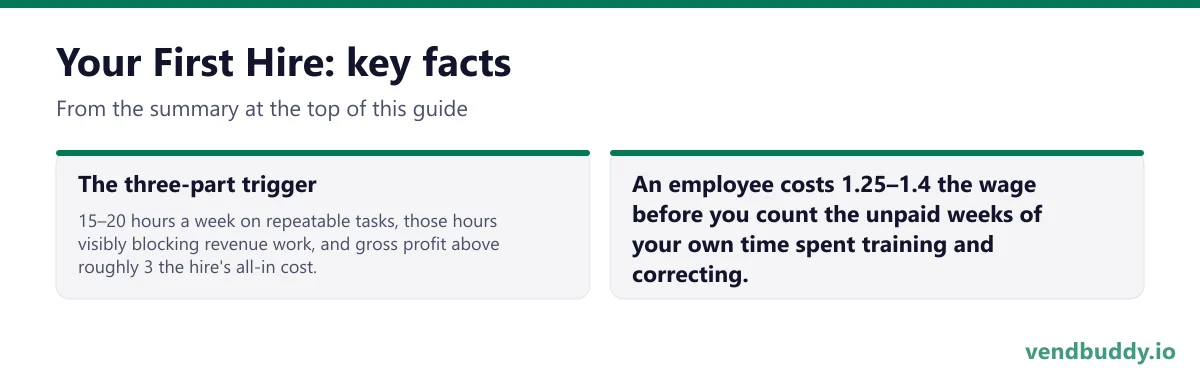
- The three-part trigger: 15–20 hours a week on repeatable tasks, those hours visibly blocking revenue work, and gross profit above roughly 3× the hire’s all-in cost.
- An employee costs 1.25–1.4× the wage before you count the unpaid weeks of your own time spent training and correcting.
- Do three things first: tighten the route, write the process down, raise prices. They routinely buy six to twelve months and cost nothing.
- The red flags are behavioural and early. Late to the interview, vague about the last job, no questions about the work. None of them improve with employment.
The first hire is the point where a lot of small businesses quietly stop being profitable. Not because hiring is wrong, but because the decision gets made on exhaustion rather than on arithmetic, and exhaustion is a terrible accountant.
This page is the arithmetic, the timing, and the warning signs on both sides of the desk — the ones in the candidate and the ones in your own business that mean you are not ready regardless of who applies. The examples are vending, because that is the business we know in detail, but the framework is the same for any small operation where one person has run out of hours.
The trigger: three conditions, all of them
Most advice on this reduces to "hire when you are busy," which is how people end up paying somebody to do work that should not exist. The honest test has three parts and you need all three.
| Condition | The test | If it fails |
|---|---|---|
| 1. Volume | More than 15–20 hours a week on repeatable tasks anyone could learn in a fortnight | You have a scheduling problem, not a staffing one |
| 2. Opportunity cost | Those hours are demonstrably blocking work that grows revenue | You are buying relief, not capacity — and paying for it monthly |
| 3. Margin | Gross profit exceeds roughly 3× the hire’s fully loaded cost | You have a pricing problem wearing a staffing costume |
Condition 2 is the one people fake. Be specific: if the twelve hours a week you free up will actually go into finding locations, signing contracts or selling, the hire pays for itself. If they will go into being less tired, that is a legitimate thing to want and it is not a business case, and you should price it honestly as a lifestyle purchase rather than an investment.
In vending terms, the usual first hire lands between 15 and 20 machines — but machine count is a weak proxy because route density decides everything. Eight machines spread across a metro can be more work than twenty in a tight cluster, which is the whole argument in route density versus machine count. The realistic one-person ceiling is covered here, and the answer is usually higher than people assume.
What the hire actually costs
Not the wage. The wage is roughly two-thirds of it.
| Line | Part-timer at $20/hr, 20 hrs/wk |
|---|---|
| Base wage | $1,730/mo |
| Payroll taxes | +$150–$180 |
| Workers comp | +$60–$140 |
| Hired & non-owned auto cover | +$40–$100 |
| Phone, equipment, keys, uniform | +$40–$80 |
| Fully loaded | $2,020–$2,230/mo |
| Your training time, first 6–8 weeks | 5–10 hrs/wk, unpaid, and the real cost |
That last row is the one that catches people. For the first month or two a new hire is negative capacity: you do your work, plus their work, plus the correction of their work. Anybody promising immediate relief has not done this. Budget two months before you get any hours back and the decision looks very different from the version where relief starts on day one.
Once staff are driving for you, workers compensation and hired and non-owned auto liability stop being optional. This is not a place to be creative; an uninsured employee in a vehicle accident on your business can end the business. The insurance guide covers what is actually required.
Picture the machines paying you while you sleep
That’s the real promise of vending — income that doesn’t cost you your time, and a life on your own terms. VendBuddy turns this guide into a step-by-step plan so you actually build it instead of just reading about it. Start free today.
Start building free →Three things to do before hiring anybody
These routinely buy six to twelve months of runway and cost nothing but a weekend.
1. Tighten the route before you staff the route. Most operators are driving to machines that did not need them. Moving from a calendar cadence to a sales-triggered one typically removes 20 to 30 percent of stops immediately, which is often the entire deficit that prompted the hiring conversation. Par levels and visit cadence are here, and multi-route sequencing is here once you have more than one loop.
2. Write the process down first. Delegating an undocumented job does not produce a helper, it produces a second person doing it wrong while you supervise permanently. Write the actual steps — par levels per machine, the order of the loop, what to do about a jam, how cash is counted and handed over, who to call about a fault. If you cannot write it down, you cannot delegate it yet, and discovering that on paper is much cheaper than discovering it in a payroll cycle.
Most people rebuild these documents from scratch and then lose them. The kits are the written version in fill-in-the-blank form, bought once, no subscription.
3. Raise prices. A business that cannot afford help at current prices very often has a pricing problem rather than a capacity problem. Twenty-five cents on your fastest movers across a fifteen-machine route is real money and takes an afternoon — the fifteen revenue levers covers the whole list, most of which are free.

Everything above is free to read and free to do. The operator packs are the same material in fill-in-the-blank form — the 50-state distributor list, the LLC and permit checklist in unblocking order, the word-for-word walk-in script, and the placement agreement you hand a property manager. One-time purchase from $27, nothing renews.
See what is inside →Red flags in the candidate
Small operations cannot absorb a bad hire the way a company with a HR department can. There is no bench, no reassignment and no probationary process — there is you, covering their route on a Saturday. So the screening bar has to be higher, not lower.
Before they start
- Late to the interview with an elaborate explanation. The lateness is minor; the elaborate explanation is the flag. It is a preview of every future conversation about a missed stop.
- Vague about why the last job ended. Not the reason itself — layoffs and bad managers are real and common. The vagueness.
- Every previous employer was the problem. One difficult workplace is bad luck. Four is a pattern, and you are about to be the fifth.
- Will not state a wage expectation. Someone who cannot advocate for themselves in a low-stakes conversation will not tell you when something is wrong on the route.
- No questions about the actual work. Good candidates ask about the hours, the driving, the lifting, the vehicle. Someone who asks nothing has not pictured doing the job.
- Cannot commit to a specific start date. Reliability starts before employment does.
- The reference check is difficult to arrange. Do it anyway, on the phone, every time. Ten minutes here is worth more than the entire interview.
In the first thirty days
- They do not tell you about a mistake. The single strongest predictor of how this ends. Everyone breaks something; the question is whether you hear about it from them or from the property manager.
- Quiet changes to the agreed process. Skipping a step because it seemed unnecessary is fine if they raise it. Skipping it silently means you now have two versions of the job and only one of them is written down.
- You have to ask twice for the same thing. Twice is a pattern. Address it in week two, not month three, and address it as a standard rather than as a mood.
- Cash variance that is always small and always in the same direction. Small consistent shortfalls are not rounding. Count with them present for the first month so this never becomes a suspicion you sit on.
- Locations start mentioning them. Property managers do not usually complain about a driver until it is well past the first incident.
The mechanics of writing the ad, screening and setting pay bands for a route driver specifically are in the route driver hiring playbook, and part-time versus full-time stocker covers the structure decision with real numbers.
Red flags in you
Less comfortable and considerably more predictive. If any of these are true, the next hire will fail regardless of who you pick.
- You cannot write down what the job is. Covered above, and it is the number one cause of failed first hires by a distance.
- You cannot name what good looks like in numbers. Stockouts found, stops completed on schedule, cash variance. Without countable standards you will manage on feel, which is unfair to a good hire and useless against a bad one.
- You are hiring to escape rather than to unlock. Ask what the freed hours are for. If the answer is not a specific revenue activity, this is a purchase and not an investment.
- Your margins only work because your labour is free. If the business is profitable at $0 an hour for you and unprofitable at $20, it was never profitable. Better to find that out on a spreadsheet.
- You will not actually let go. Some owners hire and then re-check every machine. That is a $2,200 a month tax on your own anxiety. If you know this about yourself, delay the hire and fix the systems instead, because systems are what make letting go possible.
The first ninety days, structured
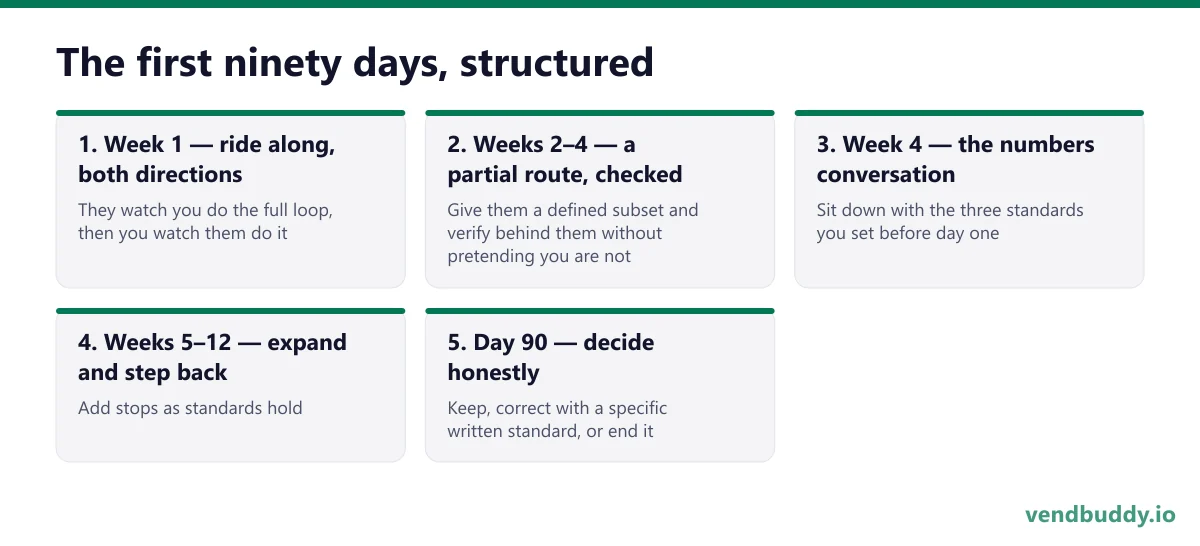
- Week 1 — ride along, both directions. They watch you do the full loop, then you watch them do it. Correct in the moment rather than afterwards.
- Weeks 2–4 — a partial route, checked. Give them a defined subset and verify behind them without pretending you are not. Transparency here builds trust faster than surprise inspections destroy it.
- Week 4 — the numbers conversation. Sit down with the three standards you set before day one. Good hires are relieved by this. Bad hires argue with the definition.
- Weeks 5–12 — expand and step back. Add stops as standards hold. Your job now is the work that was blocked, not shadowing the route you just handed over.
- Day 90 — decide honestly. Keep, correct with a specific written standard, or end it. Small businesses that carry a wrong hire past ninety days almost always carry them for a year.
The bottom line
The first hire is not a reward for being busy. It is a purchase of capacity, and it only pays if you can name what the freed hours are for, write down the job being handed over, and afford the fully loaded cost with margin rather than hope.
Do the three cheap things first — tighten the route, document the process, raise prices. If you still hit all three trigger conditions after that, hire part time, set countable standards before day one, and decide honestly at ninety days. The full scaling sequence from five to fifty machines puts this decision in the context of the stages either side of it.
A first hire only pays if the freed time goes into growth. VendBuddy scores real buildings near you by traffic, headcount and category, hands you the best contact on file for each, and models net profit per location, so the hours you buy back have somewhere to go. Start free with 5 credits.
Related reading: hiring a route driver, how many machines one person can service, scaling from 5 to 50 machines, part-time versus full-time stocker, the insurance guide, and restocking efficiently.
Frequently Asked Questions
When should I hire my first employee?
When the work that only you can do is being crowded out by work anybody could do, and the revenue covers the fully loaded cost with margin. The practical test has three parts: you are spending more than 15 to 20 hours a week on repeatable tasks, those hours are demonstrably blocking revenue-generating work, and gross profit exceeds roughly three times the hire’s all-in cost. If any of the three is missing, you have a systems problem or a pricing problem rather than a staffing problem.
How much does a first employee actually cost?
Roughly 1.25 to 1.4 times the wage once you include payroll taxes, workers compensation, any hired and non-owned auto cover, equipment, phone, and the unpaid weeks of your own time spent training and correcting. A $20 an hour part-timer at 20 hours a week is not $1,730 a month, it is closer to $2,200 to $2,400 in the first quarter. Budget the training drag explicitly, because it is the line that surprises people.
What are the red flags when hiring your first employee?
The reliable ones are behavioural and appear before the interview ends: lateness with an elaborate explanation, vagueness about why the last job ended, blaming every previous employer, unwillingness to state a wage expectation, and no questions about the actual work. In the first month, the strongest signals are not telling you about a mistake, quiet changes to the agreed process, and needing to be asked twice for the same thing. All of them get worse, never better.
Should my first hire be part time or full time?
Part time first, almost always. It halves the cost of being wrong, it lets you find out whether the work is genuinely delegable before committing to a salary, and it matches how most small operations actually grow. The exception is where the role only works as a full route or a full shift, in which case part time creates handover overhead that eats the savings. Convert to full time when you are turning down work because your part-timer has no hours left.
How many vending machines before I need help?
One person comfortably services 15 to 25 machines part time, and the usual first hire lands somewhere between 15 and 20. Machine count is a weak signal on its own, though, because route density decides everything - eight machines spread across a metro can be more work than twenty in a tight cluster. The better trigger is hours: when restocking passes about 20 hours a week and location acquisition has stopped happening, you are past due.
What should I do before hiring instead of hiring?
Three things, in order, and they routinely buy six to twelve months of runway. Tighten the route so you stop driving to machines that do not need you, which sales-triggered restocking usually cuts by 20 to 30 percent. Write down the process, because delegating an undocumented job produces a second person doing it wrong. And raise prices, because a business that cannot afford help at current prices frequently has a pricing problem wearing a staffing costume.
How do I know if my first hire is working out?
Set two or three countable standards before day one and check them weekly: stockouts found on their route, service visits completed on schedule, cash variance. Countable standards turn a vague sense that something is off into a conversation with evidence, and they let a good hire prove themselves rather than rely on your mood. If you cannot name what good looks like in numbers, the role is not ready to be delegated yet.
What is the biggest mistake people make with their first hire?
Hiring to escape work they hate rather than to unlock work only they can do. It feels identical from the inside and produces opposite results: the first buys you relief and the same revenue with a new cost line, the second buys you capacity. The second most common mistake is hiring somebody to do an undocumented job, which guarantees you supervise them permanently instead of ever getting the hours back.
What is selling, which buildings say yes, and the numbers before you buy a machine. Free, confirm from your inbox, unsubscribe in one click. Refer one friend and get 25 VendBuddy credits.
General information, not legal, tax or financial advice. Rules change, so check the official source. Revenue and income figures are examples, not promises. See our terms.