- Machine count sets revenue. Density sets profit per hour. Eight machines in one cluster routinely beat twenty spread across a metro on net per service hour.
- Reinvestment compounds fast. One machine funds the next in about 8 months; four machines fund the next in under 2. Roughly 20–24 months from one machine to ten with no outside capital.
- The side-hustle-to-business switch happens between machine 6 and 10, and it is operational: restock log, par levels, and a P&L per machine rather than one for the route.
- Add the next machine inside the radius, not outside it. A second machine at an address you already service is the cheapest capacity you will ever buy.
- Working out how many machines you can physically handle? That is the route capacity math.
Most operators plan growth as a number of machines. That is the wrong unit. Two routes with identical machine counts and identical revenue can differ by a factor of two in profit per hour worked, and the variable is not the machines — it is how far apart they are. Here is the allocation rule, the reinvestment math underneath it, and the point where a side hustle turns into something that needs systems.
Two routes, same money, different lives
Take the site canon figure of roughly $330 a month net per solid machine and build two routes on it. Assume 25 minutes on site per machine.
| Route A: 20 machines, metro-wide | Route B: 8 machines, two clusters | |
|---|---|---|
| Average drive between stops | 22 minutes | 8 minutes |
| Time per machine per visit | 47 minutes | 33 minutes |
| Service hours per month | 67 hours | 19 hours |
| Net per month | $6,600 | $2,640 |
| Net per service hour | $99 | $139 |
| Miles driven per month | ~1,030 | ~205 |
Route A earns more money. Nobody is arguing otherwise. But it costs 67 hours a month, which is a second job, and it burns five times the miles for two and a half times the revenue. The honest comparison is not A versus B, it is the 21st machine versus the 9th. Both net about $330. The 9th machine, dropped inside an existing cluster, costs you roughly 33 minutes a visit. The 21st, thirty miles out on its own, costs an hour and change plus the fuel. Same revenue, double the cost, and the difference compounds every single week for as long as you own it.
That is the whole argument. Density does not make a machine earn more. It makes the hours you spend on it worth more, and hours are the resource that actually runs out.
The reinvestment math, machine by machine
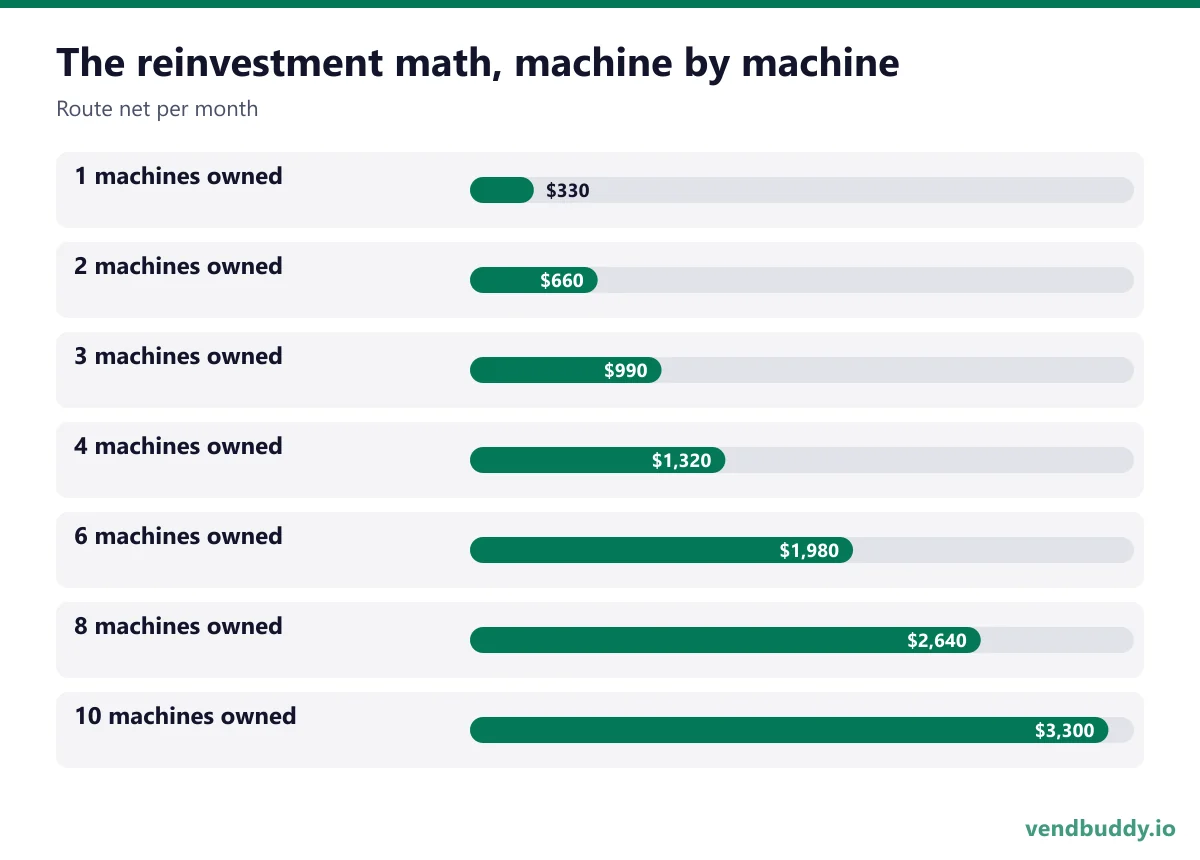
The second reason density matters is that it is what makes reinvestment survivable. Here is what compounding a single machine looks like with no outside money, assuming $330 a month net per machine and $2,500 all-in for the next used machine, card reader, first load of stock and moving included.
If you are still deciding which machine, the machine finder lists what is actually available at each price band with a conservative monthly estimate attached. It does not push you toward the expensive one.
| Machines owned | Route net per month | Months to fund the next machine | Roughly when |
|---|---|---|---|
| 1 | $330 | 7.6 | Month 8 |
| 2 | $660 | 3.8 | Month 12 |
| 3 | $990 | 2.5 | Month 14 |
| 4 | $1,320 | 1.9 | Month 16 |
| 6 | $1,980 | 1.3 | Month 19 |
| 8 | $2,640 | 0.9 | Month 21 |
| 10 | $3,300 | 0.8 | Month 22 |
Two honest asterisks. That table assumes you reinvest every dollar, which almost nobody does, and it assumes every machine lands at $330, which requires every placement to be a good one. Halve the reinvestment rate and the timeline roughly doubles — still a real business in four years from one machine and no capital. What it shows clearly is that the first machine is the slow one. Months one through eight buy a single machine; months twenty through twenty-two buy three. Most people quit during the slow part.
The constraint after about machine four stops being money and becomes locations. That is the point where growth is limited by how quickly you can find the next good site inside your radius, which is a different problem than saving up.
If your locations are already signed and the only gap is the capital to move faster than the table above, that is the narrow case where borrowing makes sense — 7 Figures Funding specializes in 0% intro business credit for operators adding machines. Borrow against a location you have already agreed, never against a guess, and read every financing route compared before you pick one.
Picture the machines paying you while you sleep
That’s the real promise of vending — income that doesn’t cost you your time, and a life on your own terms. VendBuddy turns this guide into a step-by-step plan so you actually build it instead of just reading about it. Start free today.
Start building free →The density rule, in practice
Four working rules that turn this from a nice idea into a decision you can make on a Tuesday:
Building a cluster deliberately is mostly a targeting problem, and it is the one thing the VendBuddy Lead Finder exists for: it scores venues by ZIP with traffic and business-density signals, so you can work a radius systematically instead of accepting whichever building says yes first. Getting to ten machines is not really a machine problem — it is finding the next nine locations without widening the map.
Density only helps if the buildings inside your radius say yes. The Vending Location Playbook is the walk-in script word for word with variants for offices, gyms, apartments and warehouses, twelve answered objections, and a plain-English placement agreement. $47 one-time, no subscription.
See the Location Playbook →Where the side hustle becomes a business
The switch is not a revenue number and it is not a feeling. It is the week servicing stops fitting into spare evenings, and it lands for most operators somewhere between machine six and machine ten. The symptoms are consistent: a restock you keep pushing to the weekend, a van you never fully unload, product you buy twice because you cannot remember what is in it, and the first location that mentions the machine was empty.
Three systems are what carry you across it, and none of them are software you need to buy:
- A restock log per machine. What went in, what sold, what was empty when you arrived. Two weeks of this produces par levels, and par levels turn a full van into a picked order. Restocking efficiently covers the mechanics.
- A profit and loss statement per machine, not per route. Route-level accounting hides the machine that has been losing money since April. Per-machine is how you find it, and it is also the document a buyer pays a higher multiple for if you ever sell the route. Vending bookkeeping has the setup.
- A standard planogram. The fewer distinct SKUs across the route, the faster the pick, the smaller the stock room, and the lower the shrink from expiry.
For the wider version of this transition, including the tax and structure side, when a vending side hustle becomes a full-time business takes it further.
When to hire, and what density does to that decision
The capacity ceiling for one person is roughly 15 to 25 machines full time on a dense route, or 6 to 10 part time around a job — the route capacity math derives those numbers. Density moves that ceiling more than effort does, because drive time and not restocking is what sets the limit.
Hire before you break, not after. The signal is simple: when servicing consistently costs more hours than you have, and when route revenue covers a part-time wage with margin left over. The first thing that slips when you are over capacity is restock frequency, and the second is the location relationship — and losing a good account costs far more than a few months of part-time wages. Hiring a route driver covers the pay structures and what to hand over first.
The next machine
The practical version of everything above is one question asked before every purchase: does this machine go somewhere I already drive? If yes, buy it. If no, it needs to be clearly better than your route average, not merely acceptable. Machine count is the vanity metric. Net per service hour is the one that decides whether you still want this business in year three.
For the stage-by-stage version past ten machines, the scaling playbook runs from one to a hundred, and the real math behind a 10-machine route shows what the numbers look like when you get there.
Frequently Asked Questions
Is it better to have more vending machines or closer vending machines?
Closer, up to the point where you run out of good sites inside the radius. Machine count sets your gross revenue but density sets your profit per hour, and profit per hour is what decides whether the business survives contact with your actual life. Eight machines inside a six mile radius routinely beat twenty spread across a metro on net per service hour.
How long does it take to grow from 1 to 10 vending machines?
On pure reinvestment with no outside capital, roughly 20 to 24 months. One machine netting about 330 dollars a month funds a 2,500 dollar replacement machine in under eight months, and each machine you add shortens the wait for the next one. The compounding is the whole strategy: months 1 to 8 buy one machine, months 20 to 22 buy three.
When does a vending side hustle become a real business?
The switch is operational, not emotional. It happens when servicing stops fitting into spare evenings, usually somewhere between machine six and machine ten, and it shows up as missed restocks and a van you never unload. That is the point where systems stop being optional: a restock log, par levels, and a profit and loss statement per machine rather than for the route as a whole.
How far apart should vending machines on a route be?
Aim to service three to five machines per trip inside a 30 minute driving radius. A stop that adds more than about 20 minutes of driving each way needs to earn meaningfully more than your route average to justify itself, and most do not. A second machine at an address you already visit is close to free capacity.
When should a vending operator hire help?
When servicing consistently costs more hours than you have, and when the revenue covers the wage with margin. Practically that lands around 15 to 25 machines full time or 6 to 10 part time around a job. Hire before you break rather than after, because the first thing that slips is restock frequency and the second is the location relationship.
Related: the scaling playbook, side hustle versus full-time, hiring a route driver, how many machines to make a living, multi-route logistics, and restocking efficiently.
What is selling, which buildings say yes, and the numbers before you buy a machine. Free, confirm from your inbox, unsubscribe in one click. Refer one friend and get 25 VendBuddy credits.
Walk-ins and cold emails find locations. A small site with your own machine photos and a request-a-machine form lets the next one find you. Around machine three to five, an AI builder drafts it in an evening. Wix is the mature site builder; Base44 also builds working tools like a quote form. Start with the AI website walkthrough or Wix vs Base44.
General information, not legal, tax or financial advice. Rules change, so check the official source. Revenue and income figures are examples, not promises. See our terms.