- A documented route sells for roughly 1–2x annual net profit (12–24x monthly net). A handshake route sells for 2–4x monthly net, because the buyer is only really buying machines.
- The multiple is bought, not negotiated. Signed assignable contracts, telemetry-backed revenue, machines under eight years old and no single account over ~25% of revenue are what move the price.
- Start preparing 12 months out. Clean books, re-papered agreements and a machine-by-machine P&L are worth more than any broker.
- Clean routes sell in 30–60 days. Undocumented ones get sold piecemeal at equipment value, which almost always nets less.
- Buying instead of selling? The mirror image is the acquisition due diligence checklist.
Almost every guide in this industry is written for the buyer. That is strange, because half of every route deal is an operator who built something and now wants out — and most of them leave money behind for reasons that were fixable a year earlier. This is the sell side: what your route is actually worth, what raises that number, and how the handover works.
Part of our complete guide: how much do vending machines make.
Two things to say up front. First, a vending route is a genuinely sellable asset, which is more than can be said for most side businesses. Second, what you get for it depends far more on your paperwork than on your machine count. The difference between the two prices below is not luck.
What a vending route is actually worth
How to value a vending machine business comes down to one multiple applied to one number: documented annual net profit. What decides the multiple is not the machines, it is how much of that profit a stranger can independently verify. You will see two very different figures quoted, and they are not contradictory once you know which deal each describes.
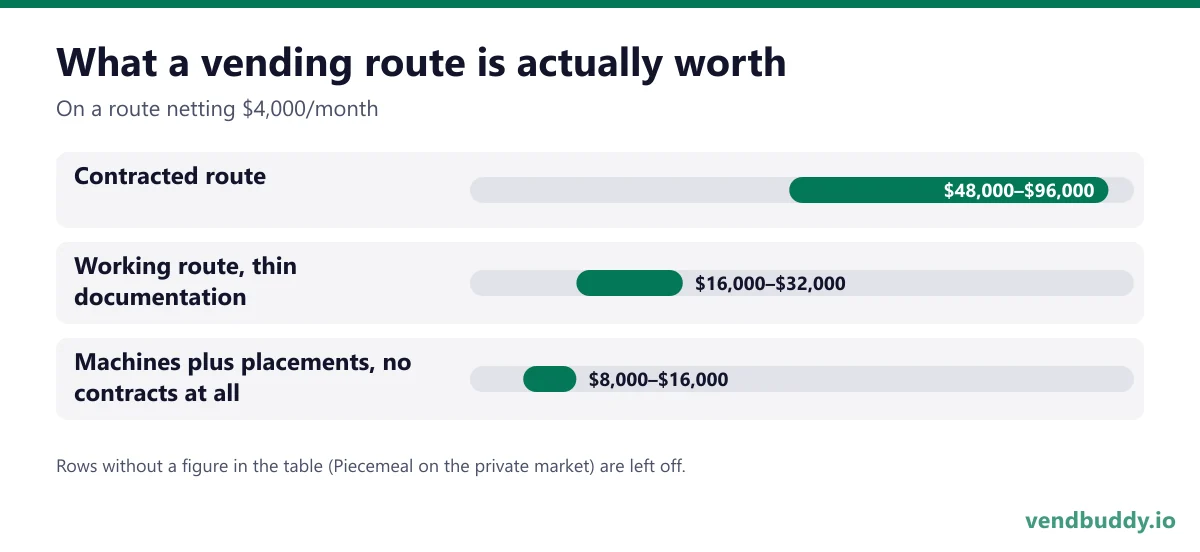
| What you are selling | Typical price | On a route netting $4,000/month |
|---|---|---|
| Contracted route: signed assignable agreements, telemetry, tax returns | 12–24x monthly net (about 1–2x annual net) | $48,000–$96,000 |
| Working route, thin documentation: verbal agreements, spreadsheet revenue | 4–8x monthly net | $16,000–$32,000 |
| Machines plus placements, no contracts at all | 2–4x monthly net, effectively equipment value | $8,000–$16,000 |
| Piecemeal on the private market | $1,500–$2,500 per machine | Depends on unit count, ignores the cash flow entirely |
Read that table twice. The same route, netting the same money, is worth six times more at the top row than the bottom. Nothing about the machines changed. What a buyer pays for is the certainty that the revenue survives the handover, and every document you can hand over is a piece of that certainty.
Before you name a number to anybody, put your own route through the route valuation calculator at both multiples and look at the two figures side by side. The gap between them is what twelve months of paperwork is worth, and seeing it as a dollar amount is what makes the preparation section below feel urgent rather than tedious.
If you want the paperwork done for you instead, the starter kit has the checklist and the fill-in templates in one download. It is a one-time $27, not a subscription.
If you want to see this from the other side of the table — including exactly which documents a careful buyer will demand — read the buyer’s due diligence checklist and how buyers negotiate the price down. Every lever in those posts is a lever you can close before anyone pulls it.
The four things that move your multiple
Everything else is noise. These four decide the number.
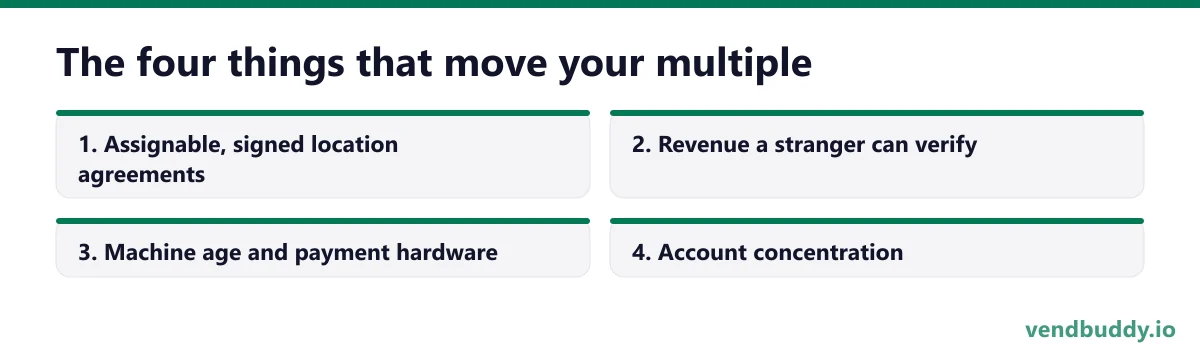
- Assignable, signed location agreements. A contract that transfers with the route is the single biggest value driver, because it converts “these locations probably stay” into “these locations are contractually mine.” A contract that dies on sale, or does not exist, drops you a full tier. If your agreements are silent on assignment, re-paper them before you list.
- Revenue a stranger can verify. Telemetry by machine, bank deposits that match, two years of tax returns, COGS invoices. A buyer discounts anything they cannot check, and they discount it hard. A route where the only record is your memory gets priced as equipment.
- Machine age and payment hardware. Machines under about eight years old with working validators and current card readers carry the price. A route of twenty-year-old units with dead selection motors tells the buyer to budget for replacements and subtract that from your number, and they will.
- Account concentration. If one location is 40% of route revenue, the buyer is buying one relationship with some machines attached. Under about 25% per account reads as a business. Over it reads as a risk, and gets a lower multiple or an earnout attached.
Picture the machines paying you while you sleep
That’s the real promise of vending — income that doesn’t cost you your time, and a life on your own terms. VendBuddy turns this guide into a step-by-step plan so you actually build it instead of just reading about it. Start free today.
Start building free →The 12-month preparation plan
The operators who get the top of the range decided to sell about a year before they told anyone. In rough order:
Where routes actually sell
The short version is below. If you want the channel mechanics — how each one is actually worked, what to say to a distributor rep, why a broker at 8 to 12 percent rarely earns their fee on a route this size, and the retiring-operator angle that decides who your buyer probably is — that is where to sell a vending machine route without paying a broker.
- The VendBuddy Marketplace. We built this because the sell side of vending had nowhere honest to go. Listing a route, individual machines or a location you cannot service is free — no listing fee, no success fee, and no commission on the sale price. Your email, phone and street address never appear publicly; a listing shows the type, a city or ZIP prefix, a price band and whatever you write. A person confirms it with you within 24 hours before it goes live, buyers holding the Priority Pass in your area are emailed the moment it does, and everyone else sees it seven days later. When a buyer raises their hand we ask you first and introduce you only if you want the intro. List it free here.
- Other local operators. The fastest and usually the best-priced channel. An operator two towns over already has the van, the warehouse and the wholesale account, so your route is worth more to them than to a newcomer. Tell your machine distributor and your card reader rep that you are open to offers; they know who is expanding.
- Business-for-sale marketplaces. Wide reach, mostly first-time buyers, slower deals and more tire-kickers. Expect to answer the same five questions thirty times.
- Vending groups and communities. Good for partial sales and for finding operators who understand what they are looking at without a month of education.
- Piecemeal on the private market. Individual machines move in one to seven days at $1,500–$2,500. This is the right answer only if your value really is the equipment, or if you need cash in two weeks.
How the deal is usually structured
Nearly every vending route sale is an asset purchase rather than a sale of the company — the buyer takes the machines, the contracts and the equipment, and leaves your entity and its history behind. That is normal and it is usually better for both sides.
Most first agreements are two pages, not twenty. The contracts walkthrough lays out the clauses that actually matter for the contract, including the termination language operators forget about until they need it.
Three structures come up repeatedly:
- Cash at close. Cleanest and lowest price. If a buyer is funding the whole thing on day one, expect them to want the bottom of the range for it.
- Seller note. You take part of the price over 12–36 months. It widens your buyer pool enormously and typically raises the headline price, at the cost of carrying risk. How seller financing is structured covers the mechanics from the buyer’s side, which is the side you now need to underwrite.
- Holdback or earnout. 20–30% of the price held back for 60–90 days pending the locations actually staying. Expect this if your contracts are weak. The counter is simple: bring assignable contracts and there is nothing left to hold back for.
The handover that protects your price
Most deals that go wrong go wrong after the money moves, when locations discover their operator changed by finding a stranger at the machine. Do it in this order instead: sign with the buyer subject to contract assignment, then introduce the buyer in person, account by account, with you present, then let the buyer service each account once alongside you before you hand over the keys. If you agreed a holdback, this walk-through is what releases it.
Read your agreements before any of that. Most require notice or consent before assignment, and a location that hears about the sale from someone else is a location that starts taking calls from your competitors.
When not to sell
Three situations where selling is the expensive option:
- You are selling because the route is undocumented and chaotic. That is precisely the condition that gets you the bottom-row price. Six months of cleanup can multiply the number.
- You are selling because the driving is killing you. That is often a density problem rather than a business problem — see route density versus machine count — or a hiring problem solved by a part-time route driver for far less than the value you are about to give away.
- You are selling at the bottom of a location cycle. If two good accounts closed last quarter and your trailing twelve months looks worse than your route does, wait for the numbers to catch up to reality.
And the honest opposite case: if you have hit the income you wanted, if the machine count that supports your life is behind you, and the route is documented and boring, selling a boring documented route is exactly when you get paid the most for it.
Frequently Asked Questions
How much is a vending machine business worth?
Routes with signed, assignable contracts and verifiable revenue generally trade around 1 to 2 times annual net profit, which is 12 to 24 times monthly net. Machine-plus-location private deals with handshake agreements trade far lower, often 2 to 4 times monthly net, because the buyer is really only buying equipment plus a hope. The gap between those two prices is documentation.
What makes a vending route sell for a higher multiple?
Four things, in order of impact: signed location agreements that are assignable to a new owner, revenue you can prove with telemetry and bank deposits rather than a spreadsheet, machines under about eight years old with working payment hardware, and no single location representing more than about 25 percent of route revenue.
How long does it take to sell a vending route?
A clean route with contracts and clean books typically sells to another operator in 30 to 60 days. A route with handshake agreements and no records can sit for months or end up sold piecemeal as individual machines, which almost always nets less than selling it whole.
Should I sell my vending business or just sell the machines?
Sell it whole if the locations are contracted and producing, because you are paid for the cash flow rather than the steel. Sell piecemeal if most of your value is equipment, if the contracts are not assignable, or if you need cash inside two weeks. Individual machines move on Facebook Marketplace in one to seven days at roughly 1,500 to 2,500 dollars each.
Do I have to tell my locations I am selling?
Eventually yes, and the sequence matters. Most agreements require notice or consent before assignment, so read every contract before you list. The usual play is to sign with the buyer subject to contract assignment, then introduce the buyer in person account by account, with the seller present. Telling locations before you have a buyer invites competitors in.
Related: the buyer due diligence checklist, route price and terms negotiation, seller financing a vending route, vending bookkeeping and profit first, vending contracts 101, and how many machines it takes to make a living.
What is selling, which buildings say yes, and the numbers before you buy a machine. Free, confirm from your inbox, unsubscribe in one click. Refer one friend and get 25 VendBuddy credits.
General information, not legal, tax or financial advice. Rules change, so check the official source. Revenue and income figures are examples, not promises. See our terms.