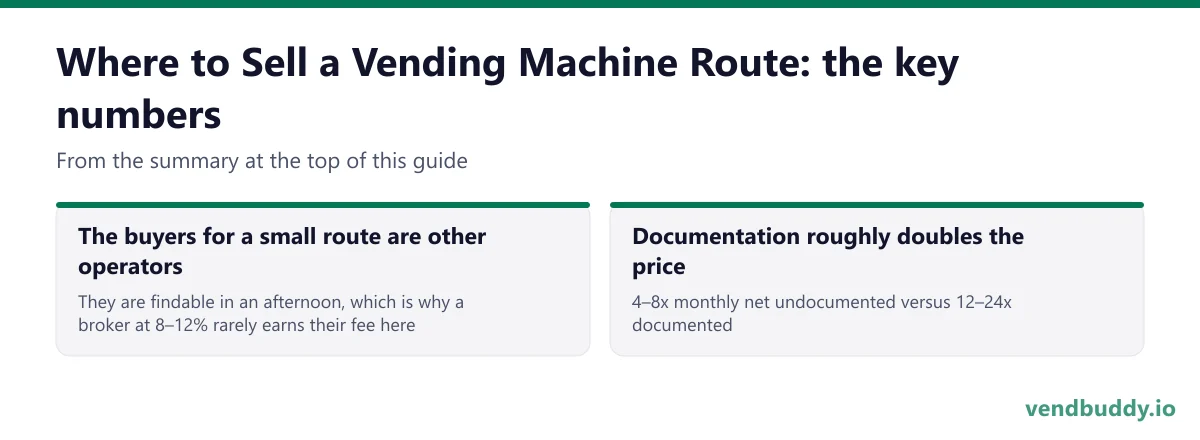
- The buyers for a small route are other operators. They are findable in an afternoon, which is why a broker at 8–12% rarely earns their fee here.
- Direct to local operators is the highest-yield channel. They already own the van, the shelving and the wholesale account, so your route is worth more to them.
- Your distributor rep and card reader rep know who is expanding. Two phone calls, twice a year, free.
- Documentation roughly doubles the price — 4–8x monthly net undocumented versus 12–24x documented.
- List it free, including with us. No listing fee, no success fee, no commission.
The market for a small vending route is thinner and less organized than the market for a restaurant or a laundromat, and most of it happens quietly. That is bad news if you were expecting a listing site to do the work, and good news if you are willing to make four phone calls, because the quiet part of a market is where the price is set by who asked rather than by who bid.
Part of our complete guide: how much do vending machines make.
This post is about the channels: where routes actually change hands, how each one is worked, and what it costs you. What your route is worth, the twelve-month preparation plan, the deal structures and the handover sequence are all in how to sell a vending machine business. Read that one for the number. Read this one for where to take it.
Start with the stance: no broker, no commission
Business brokers do real work in markets where the buyer pool is invisible to the seller. Vending is not one of those markets, at the sizes most operators sell at.
- The fee is 8 to 12 percent of the sale price on a typical main-street brokerage engagement. On a route selling at $60,000 that is $4,800 to $7,200.
- Most brokers will not take the listing anyway. A route that trades at $40,000 to $90,000 is below the threshold where a brokerage can justify the hours, so the ones who will take it are frequently the ones with the least to offer.
- The buyer pool is not hidden. The people who want your route are operators within a couple of hours of it. You already know how to find them, because you drive past two of them a week.
- The thing that actually moves your price is not reach. It is documentation, and no broker can retro-fit six months of telemetry or turn a handshake into an assignable agreement.
So the working assumption for a route under six figures is: sell it yourself, spend the money you would have paid a broker on preparation instead, and list it in the places that cost nothing.
Nothing about the machines changed. Documentation does not improve your route — it roughly doubles what your route is worth.
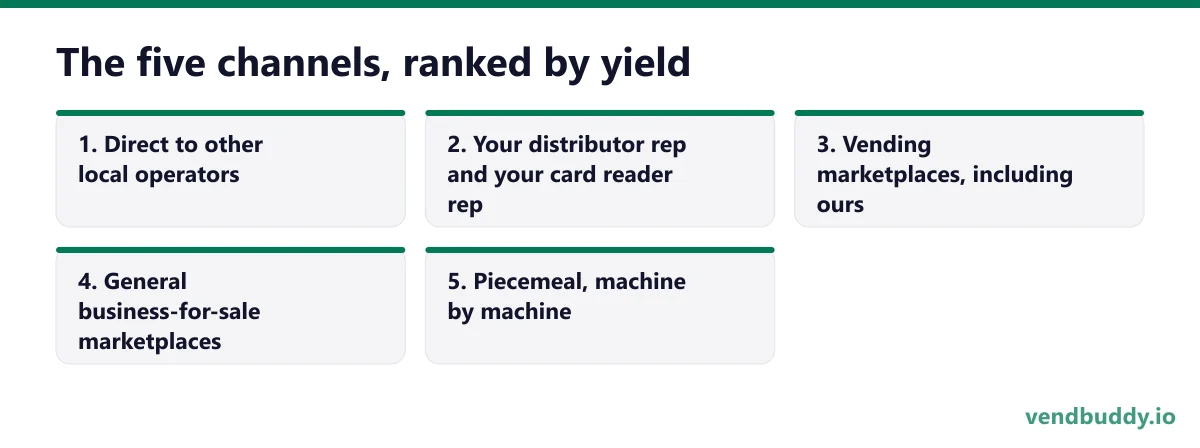
The five channels, ranked by yield
| Channel | Speed | Typical price | Cost to you |
|---|---|---|---|
| Direct to local operators | Fast | Highest | Your time |
| Distributor and card reader reps | Fast, but only when they happen to know someone | High | Two phone calls |
| Vending marketplaces | Medium | Fair, operator-to-operator | Should be free |
| Business-for-sale marketplaces | Slow | Asking prices run 15–30% above where deals close | Listing fee, and a lot of repeated questions |
| Piecemeal, machine by machine | Very fast | Lowest — equipment value only | Your locations, gone |
1. Direct to other local operators
The fastest and usually the best-priced channel, for a structural reason: an operator two towns over already has the van, the warehouse shelving and the wholesale account, so your route costs them less to absorb than it would cost a newcomer to start. Your machines are worth more to them than to anyone else on this list, and they can close in weeks because they are not learning the business while they diligence it.
Finding them is not subtle. Look at the machines in buildings near your route and note the operator sticker. Turn up at the distributor counter on a weekday morning. Join the state or regional vending association, which is where operators go to complain about being tired and, incidentally, to say they are expanding. Then make the ask specific: not are you interested in buying a route, but I have four machines in a two-mile cluster off the industrial estate, all on written agreements, netting about $1,400 a month, and I am selling in the spring. A specific ask gets a yes or a referral. A vague one gets politeness.
2. Your distributor rep and your card reader rep
These two people see the market before anyone else does, and neither of them charges you anything.
- The distributor rep sees who is suddenly ordering more product, which is what expansion looks like from behind the counter.
- The card reader rep sees who is activating devices, which is the same signal a month earlier.
Ask both, twice a year, in exactly these words: who is expanding? It costs one phone call each and the answer is frequently a name and a number. This is the same mechanism buyers use in reverse — asking who is winding down — and it is worth understanding both directions, because it tells you who is likely to be calling you.
3. Vending marketplaces, including ours
A vending-specific marketplace carries listings from operators rather than from brokers, which means the person reading it already knows what a coil machine is and does not need six emails of education before they can form a view.
We run one, and here is the honest version of what it is and is not. Listing a route, individual machines, or a location you cannot service is free — no listing fee, no success fee, no commission on the sale price. Your email, phone and street address never appear publicly; a listing shows the type, a city or ZIP prefix, a price band and whatever you write. A person confirms the listing with you within 24 hours before it goes live. Buyers holding the Priority Pass in your area are emailed the moment it does and everybody else sees it seven days later. When a buyer raises their hand we ask you first and introduce you only if you want the intro.
What it is not: a guaranteed buyer. It is a younger marketplace than the general business-for-sale sites and the depth in any given metro varies. Use it as one channel alongside the direct outreach above rather than instead of it. List it free here and keep working the phone.
4. General business-for-sale marketplaces
Widest reach, mostly first-time buyers, slower deals, more tire-kickers. Two things to know before you list there. Asking prices on these sites commonly sit 15 to 30 percent above where deals actually close, so do not calibrate your expectations from the listings you see. And expect to answer the same five questions thirty times — write the answers once, as a one-page summary you attach to the first reply, and the channel becomes tolerable.
5. Piecemeal, machine by machine
Individual units move in one to seven days at $1,500 to $2,500 privately. This is the right answer only if your value genuinely is the equipment, or if you need cash inside a fortnight. It ignores the cash flow, which is usually the expensive thing to ignore: a route netting $4,000 a month is worth $48,000 to $96,000 documented, and its machines liquidate for a fraction of that.
Picture the machines paying you while you sleep
That’s the real promise of vending — income that doesn’t cost you your time, and a life on your own terms. VendBuddy turns this guide into a step-by-step plan so you actually build it instead of just reading about it. Start free today.
Start building free →The reverse angle: the retiring operator nobody asked
Worth understanding even as a seller, because it tells you who your buyer probably is and what they are looking for.
Walk into a distributor counter in any mid-sized market and look at who is picking up product. A large share of the independent operators in this country are in their sixties and seventies. Many built a route over twenty or thirty years, never wrote anything down, never put a location on paper, have no kids who want it, and have no idea what it is worth. Those routes are going to change hands over the next several years and almost none of them will be listed anywhere.
Which means the operator most likely to buy your route is the one who has been asking around for one — and that operator has learned to expect handshake agreements and no records. Turning up with signed assignable agreements and twelve months of telemetry does not just raise your multiple. It marks you out from every other conversation they have had this year.
On telemetry specifically, Nayax is the default for a dull reason: it is the one most machine suppliers pre-wire for. Price the monthly against your slowest machine, not your best one.
It also tells you something about deal shape. When a route surfaces this way, the deal is usually shaped by what the seller actually wants, which is rarely a lump sum. They want the thing to be over and they want money arriving monthly. That is why seller financing is so common in vending, why the terms often beat a bank’s, and why the seller stays invested in a clean handover: they only get paid if the route keeps performing. If you are open to carrying a note, say so in the listing — it widens your buyer pool enormously and typically raises the headline price. Seller financing a vending route covers the mechanics.
Why documentation is worth more than any channel
Here is the number that should change how you keep records, and it is worth repeating even though it belongs to the valuation post.
| Same route, netting $4,000/month | Multiple of monthly net | Price |
|---|---|---|
| Signed assignable agreements, telemetry, clean tax returns | 12–24x | $48,000–$96,000 |
| Verbal agreements and a spreadsheet | 4–8x | $16,000–$32,000 |
Same machines. Same locations. Same revenue. What a buyer pays for is certainty that the revenue survives the handover, and every document you hand over is a piece of that certainty. Documentation does not improve your route. It roughly doubles what your route is worth.
Which is why the honest advice about channels is that they matter less than the twelve months before you use them. Operators who get the top of the range decided to sell about a year in advance: clean the books and re-paper the handshakes first, cut or rescue anything under about $250 a month next, get telemetry on everything after that, and build the data room last. The full sequence is in the selling guide, and vending contracts 101 covers the assignment clause that does most of the work.
What to put in the listing, whichever channel you use
- Machine count, type and age, and whether the card readers are on your merchant account or the machine’s.
- Verified monthly net, stated as net — gross minus product, commissions, card fees, a repair reserve and telemetry costs, before your own labour. A seller who switches metrics mid-conversation tells a buyer something, and you do not want to be that seller.
- Whether the agreements are written and whether they assign. This is the first question a serious buyer asks and volunteering it filters out the unserious ones immediately.
- Account concentration. If one location is 40 percent of revenue, say so. They will find out, and finding out late costs you the trust that was holding your price up.
- A geography, not an address. A ZIP prefix or a metro. Your locations are the asset; publishing them is handing a competitor a prospect list.
- Why you are selling. Boring reasons sell better than no reason. Silence reads as a problem.
The VendBuddy Marketplace exists because the sell side of vending had nowhere honest to go. No listing fee, no success fee, no commission. Your contact details stay private, a person confirms the listing with you before it goes live, and we only make an introduction if you want one.
Frequently Asked Questions
Where can I sell a vending machine route?
Five channels, roughly in order of yield. Direct to other local operators, which is the fastest and usually the best-priced. Through your distributor rep and your card reader rep, who know who is expanding before anyone else does. On a vending marketplace, including the free one we run, where listings come from operators rather than brokers. On a general business-for-sale marketplace, which has the widest reach and the most tire-kickers. And piecemeal on the private market, which is the right answer only if your value really is the equipment.
Do I need a broker to sell a vending route?
No, and for most routes a broker is the wrong instrument. Business brokers typically take 8 to 12 percent and generally will not take a listing under six figures, so on a route selling for $40,000 to $90,000 you are either too small to interest them or paying $3,000 to $10,000 for reach into a buyer pool you can access yourself in an afternoon. The buyers for a small vending route are other vending operators, and they are findable through the distributor counter, the regional association and a marketplace listing.
How much does it cost to sell a vending machine route?
It should cost close to nothing. A marketplace listing should be free, and ours is: no listing fee, no success fee and no commission on the sale price. The real costs of a sale are preparation rather than fees — re-papering handshake locations onto assignable written agreements, getting telemetry running for six clean months, and having an accountant produce a per-machine profit statement. Those are the things that move the price.
Why does documentation double what a vending route sells for?
Because what a buyer pays for is certainty that the revenue survives the handover, and every document is a piece of that certainty. A route netting $4,000 a month with signed assignable agreements, telemetry and clean tax returns trades at twelve to twenty-four times monthly net: $48,000 to $96,000. The same route, same machines, same revenue, on verbal agreements and a spreadsheet trades at four to eight times: $16,000 to $32,000. Nothing about the machines changed.
How do I find someone to buy my vending machines?
Ask the three people who always know first, in these words: who is expanding? Your distributor rep sees who is suddenly ordering more product. Your card reader rep sees who is activating devices. And whoever runs your state or regional vending association knows both. Each is one phone call, they cost nothing, and the answer is often a name and a number. The same trick run in reverse — asking who is winding down — is how buyers find routes that never get listed at all.
Related reading: how to sell a vending machine business (valuation and process), seller financing a vending route, buying a route: due diligence, route price and terms negotiation, vending contracts 101, and vending bookkeeping and Profit First.
What is selling, which buildings say yes, and the numbers before you buy a machine. Free, confirm from your inbox, unsubscribe in one click. Refer one friend and get 25 VendBuddy credits.
Every operator we talk to wants fewer cold calls. The ones who get there have a Google Business Profile and a simple site a manager can check before replying. AI builders make that an evening job now. Wix is the mature site builder; Base44 also builds working tools like a quote form. Start with the AI website walkthrough or Wix vs Base44.
General information, not legal, tax or financial advice. Rules change, so check the official source. Revenue and income figures are examples, not promises. See our terms.