- You have been standing in your best prospect break room for years. Distribution centres, plants, terminals and driver lounges are the highest-performing vending category, and you know which ones have a dead machine.
- Route logic is the skill most operators lack and you already have it. Sequencing stops geographically, pre-staging a load, knowing your real time on target rather than the optimistic one.
- The hours-of-service question is real. On-duty includes work performed for compensation for any employer, including yourself. Ask your carrier safety department before you plan fills into a break.
- Local and regional: build normally. OTR: you need a service partner from day one — and paid help only clears economically from about four or five machines.
- The honest objection is yours alone: you already drive 60 hours a week. If a windshield makes you tired, this is the wrong business and there is no talking you out of that.
Most side-business advice for drivers is written by people who have never sat in a driver lounge at 4am. It suggests dropshipping, or an app, or something that requires you to answer a message within the hour — which is exactly the thing your job makes impossible. So this page starts from the schedule rather than from the idea, and it is honest about the one version of your job where the answer is genuinely complicated.
The short version: you already run routes for a living, you already know where the best locations in your region are because you have been inside them, and the business fails for drivers in exactly one predictable way, which is servicing. Everything below is about those three facts.
Your unfair advantage is not driving. It is the buildings you have already been inside
Here is the thing that makes a driver a genuinely privileged entrant to this business, and it is not the one people expect.
The highest-earning vending location types in the country are 24-hour warehouses, distribution centres, manufacturing plants and logistics facilities. The reasons are structural: high headcount, workers who physically cannot leave during a shift, multiple shifts including overnight, and no food option within a mile after 6pm. A single-shift facility with 50 to 100 workers commonly grosses $1,500 to $2,800 a month. A 24-hour operation with 250 or more can reach $4,500 to $6,500. The full warehouse playbook is here, and the profit-by-location-type comparison is here.
Now: how does an ordinary aspiring operator find those buildings? Satellite view, guesswork and cold walk-ins at a gate that does not let strangers past the guard shack. It takes months and most of them never get past the front desk.
You have been inside them. You know which DC has 300 people on nights and one machine that has been out of order since spring. You know which plant makes drivers wait two hours in a lounge with a broken coffee pot. You know the receiving supervisor by name because you have been signing his paperwork for six years, and you know that the facility manager, not corporate, is the person who decides what goes in the break room. The decision-maker map for each property type is here — you will find you already know several of them personally.
That is not a networking tip. That is a prospect list you built over a career without meaning to. Write it down tonight: every facility you have been inside in the last two years, whether it had machines, whether they worked, and who you would ask. Ten names on that list is worth more than two months of cold walk-ins.
The second advantage is route logic itself. The single most common reason a small route becomes miserable is that it was built by geography-blind accretion — a machine here because someone said yes, another one twenty-five minutes the other way. You already think in stop sequences, deadhead miles and time on target. When you read the density-versus-machine-count argument, you will find it obvious in a way most new operators do not, and that instinct is worth several hundred dollars a month by machine five.
The hours-of-service problem, said plainly
This is the section that exists on no other page on this site, and it matters.
Federal hours-of-service rules define on-duty time to include work performed for any employer or for compensation — not only work for your motor carrier — and off-duty time requires that you be relieved of all obligation to perform work. Which means the intuitive plan (“I will fill my machines during my ten-hour break”) is not automatically the same thing as resting, and how it should be logged is a compliance question with real consequences attached to getting it wrong.
What to do with that, practically:
- Ask your carrier safety department before you build a schedule around it. Not a forum, not a driver on the CB, and not this page. They deal with outside-employment logging questions routinely and the answer is free.
- Design the route so it does not need break time in the first place. This is the better fix regardless. A route serviced on your home day, in your personal vehicle, off the clock entirely, has no ambiguity in it at all.
- Owner-operators and independents still have the same rules. Being your own carrier does not change the definition of on-duty; it just means the person you would be asking is you.
Nothing here is legal advice or a compliance opinion, and the rules have detail this page deliberately does not attempt. The point is only that this is a real question that applies to you and not to the other people reading this site, and that the clean answer — service on home time, in your own vehicle — is also the easier one to live with.
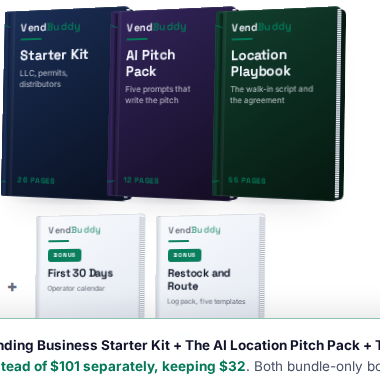
If you get to the end of this and the answer is yes, the kits are the shortcut past the blank page: a 26-page starter kit for the paperwork, a 55-page Location Playbook for the walk-in script and the agreement, and a 12-page AI Pitch Pack. Bought once, from $27, and you keep the files.
Look inside the kits →Picture the machines paying you while you sleep
That’s the real promise of vending — income that doesn’t cost you your time, and a life on your own terms. VendBuddy turns this guide into a step-by-step plan so you actually build it instead of just reading about it. Start free today.
Start building free →The three schedules, and the honest verdict on each
Local and P&D drivers, home every night
Verdict: build it normally, and you have a genuine edge. You are functionally in the same position as anybody with a full-time job, except that your job puts you inside commercial buildings all day.
The setup problem is the same one everyone has: walk-ins have to happen between 9am and 4pm on a weekday. If you start at 5am and finish at 3pm, you have a usable hour at the end of most days, and a driver in work clothes walking into a warehouse office at 3:15pm has considerably more credibility than a stranger in a polo. Use it.
Worked week: two 45-minute walk-in windows after your shift, one evening block for the target list and follow-ups, and a Saturday morning service run. First placement in six to ten weeks. Running: 90 minutes per machine per week.
Regional drivers, home most weekends
Verdict: workable, with one hard rule — everything inside one cluster within fifteen minutes of home.
Your service window is a single Saturday morning. That window will comfortably cover four machines in one cluster and will not cover four machines spread across a metro, and the difference is not effort, it is drive time you do not have. Build the route around a fifteen-minute radius from your house and refuse placements outside it, even good ones, until you have four inside it.
The walk-in problem is your real constraint, because Saturday is exactly when the person who says yes is not there. Two answers. First, any weekday home day — a reset day, a maintenance day, a slow week — is a walk-in day and should be treated as precious. Second, written outreach genuinely works on the larger properties: property management companies and corporate facility teams reply to email in a way that a small independent shop does not. The cold email scripts that get replies are here, and the version of this business that avoids walk-ins entirely is a legitimate strategy for exactly your schedule.
Worked week: 20 to 30 minutes of emails per evening on the road, one Saturday 8am to 11am service and admin block, walk-ins only on home weekdays. First placement in ten to sixteen weeks — slower than a local driver, and normal.
Over-the-road, out three to four weeks
Verdict: not without a service partner, and it is better to say that now than to let you find out in month two.
A machine in a busy building needs attention every 7 to 14 days. There is no configuration of an OTR schedule that covers that. What actually happens to OTR operators who start alone is a predictable four-step failure: the machine sells out in week two, the property contact texts and gets no reply, the building concludes you are unreliable, and by month four you are pulling the machine out of a location that was earning fine. That is not a discipline failure. It is arithmetic.
The two versions that work:
- A family partner. A spouse or adult child running the fills, with a real handoff: written fill sheet, product par levels, a key, and cash handling agreed up front. This is the common version and it works, provided the person actually agreed rather than was informed. If you are building this as a household project, the division-of-labour models for couples are here and they are worth reading before you assume who does what.
- A paid part-time stocker, roughly $15 to $25 an hour plus mileage in most markets. The economics of this are the whole decision: on one or two machines paying somebody eats most of the net. From about four or five machines it works, which means the OTR version of this business starts bigger than the local version, not smaller. How to structure and pay route help is here.
The honest third option: wait. If you intend to move to a regional or local job in the next year, building the target list and the relationships now and placing machines then is a better plan than placing them now and losing them. The prep work does not expire.
If you drive rideshare or delivery instead
Different shape, different advantages, and it deserves its own section rather than a footnote, because the constraint is almost the opposite of a trucker.
Your advantage is that your hours are genuinely yours. No dispatcher, no appointment, no hours-of-service clock. You can decide on a Tuesday morning that the next ninety minutes are walk-ins instead of fares, which is the single scarcest resource in this business and you have it on demand. Nobody else on this site can say that without asking permission.
Your second advantage is geographic literacy. You know which office parks are full at 10am and empty at 2pm, which apartment complexes are enormous, which gyms have a queue at 6pm and which industrial strip has forty small businesses on it. Most new operators are guessing at exactly the things you have watched for two years.
Your disadvantage is the one thing a salaried person does not have: direct opportunity cost. Every hour you spend on walk-ins is an hour of earnings you did not make, visible to the dollar. That is psychologically much harder than an employed person spending an hour of a salaried afternoon, and it is the actual reason drivers in this category stall. The defence is to budget it as a fixed weekly investment — three hours a week, treated as a cost, not as lost income — and to be ruthless about only walking into buildings worth the visit.
The other honest note: gig income is variable and often thin, which makes the $2,000 to $5,000 for machine one a genuine constraint rather than an accounting question. The low-capital routes are here, and the honest version is that securing a location first makes the equipment financeable, because a machine with a signed building behind it is collateral with a job.
The objection that only you have
“I already drive sixty hours a week. Why would I build a business that is also driving?”
That deserves a real answer rather than a reframe. Three parts.
First, the driving is not the same driving. A route is twenty minutes at a time in your own vehicle, no dock, no backing, no dispatcher, no appointment window, nobody watching a camera. Most drivers who do this report that it does not read as work in the same way. Some do. You know which one you are.
Second, the total volume is small and controllable. Four machines in a tight cluster is one morning a week and perhaps thirty miles. That is a shorter drive than your commute.
Third, and this is the honest part: if the sight of a windshield makes you tired, this is the wrong business for you and no amount of reframing fixes that. There are asset businesses with less driving in them — the trade-off is that they cost ten to a hundred times more to enter. The vending-versus-self-storage comparison covers that trade honestly, and the wider ranked list is here. Better to find that out on this page than after buying a machine.
You have a list of facilities in your head. VendBuddy scores real venues near you by traffic, headcount and category, gives you the best contact on file for each, and models what a machine would net there - so you can rank the ten buildings you have already been inside and spend your home time on the best two. Five free credits, no card.
When the honest answer is no
- OTR with no partner and no plan to get one. Covered above. This one is arithmetic, not attitude.
- If your carrier safety department is uncomfortable with the logging picture and you cannot restructure servicing onto home time. Do not improvise around a compliance question.
- If you are buying machines because you can move them. Having a truck and a dolly makes acquisition easy, which makes it easy to own three machines and zero locations. That is the single most common way drivers lose money in this business. Location first. Every time.
- If the goal is to quit driving in six months. Four machines is $600 to $1,400 a month net in a good case. Replacing a driver income is eight to fifteen machines and a couple of years. The real replacement number is here and it is higher than your gross pay.
The bottom line
The reason this fits drivers is not that both things involve a vehicle. It is that you already have the two things new operators lack: a mental map of the highest-earning building type in the industry, and the route discipline that keeps a small route from becoming a chore.
The reason it fails drivers is always servicing. Local and regional: build a tight cluster on home time and you will be fine. OTR: get the partner arranged before the first machine, or wait until you are home more. That single decision is the whole difference between this working and this quietly costing you a location.
Not sure whether to start anything yet? The readiness quiz scores you on capital, protected hours, risk tolerance and deadline in about two minutes. If the answer is already yes, the start page is the shortest route to a first location.
Related reading: the warehouse and distribution-centre playbook, route density versus machine count, hiring route help, starting a business while working full time, your first $100 in vending, and vending compared with a box truck business.
Frequently Asked Questions
Can a truck driver start a vending business?
Yes, and local and regional drivers are among the best-positioned people in the country for it, for a reason that has nothing to do with driving. Drivers spend years inside distribution centres, plants, terminals and driver lounges, which are exactly the 24-hour captive-audience sites vending performs best in, and they already know which ones have a dead machine and a two-hour detention wait. Over-the-road drivers can do it too, but honestly need a paid or family service partner, because a machine cannot wait three weeks for a fill. The scheduling model differs enormously between local, regional and OTR, and choosing the wrong one is the usual failure.
What is a good side business for drivers?
The filter for anyone who drives for a living is a business that does not require you to be reachable during your driving window and does not collapse when you are unavailable for days at a time. That eliminates client services, anything with a support inbox and anything with a same-day promise. It leaves owned assets that produce revenue while you are elsewhere. Vending is the cheapest of those to enter at $2,000 to $5,000 for a first placed machine, and it has the useful property that a missed week costs you a stockout rather than a customer. The honest caveat is that it is also a business built around a vehicle, which some drivers find restful and some find like more of the same.
Can I service vending machines during my 10-hour break?
This is the question specific to CDL drivers and it is the one to take to your carrier safety department rather than to a forum. Federal hours-of-service rules define on-duty time to include work performed for any employer or for compensation, which is not limited to work for your motor carrier, and off-duty time requires you to be relieved of all responsibility for performing work. Running your own business during a required break is therefore not automatically the same thing as resting, and log accuracy is a compliance matter with real consequences. Confirm how your carrier expects this to be recorded before you build a service schedule around break time.
Can an over-the-road driver run a vending route?
Only with a service partner, and it is better to plan that from the start than to discover it in month two. A machine in a busy location needs a fill every 7 to 14 days, and an OTR schedule of three or four weeks out cannot cover that. The workable versions are a spouse or adult child running the fills, or a paid part-time stocker at roughly $15 to $25 an hour plus mileage. Paying somebody makes the economics thin on one or two machines and reasonable from about four or five, which means an OTR driver should either wait until they go local or regional, or start with enough machines to support the help. Starting with one machine and hoping is how OTR operators lose locations.
Are distribution centres good vending locations?
They are among the best location types in the industry. Warehouses and distribution operations combine large headcounts, workers who cannot leave during a shift, multiple shifts including overnight, and almost no nearby food after 6pm. A single-shift facility with 50 to 100 workers commonly grosses $1,500 to $2,800 a month and a 24-hour operation with 250 or more workers can reach $4,500 to $6,500. Getting in usually means the facility manager or the safety and operations lead rather than corporate, and a driver who has been in the building has a route to that person that a cold caller does not.
How many hours a week does a vending route take?
About two hours per machine per week once the route is running, covering restocking, driving and admin, and the setup phase is heavier at 5 to 10 hours a week for six to eight weeks. For drivers specifically the number that matters is trips rather than hours: four machines within fifteen minutes of home is one service run, and four machines spread over a metro is four separate outings you will not make on a home weekend. Cluster tightly or the route will not survive your schedule.
Should I buy a vending machine before I have a location?
No, and this is the mistake drivers make most, because a driver has a truck, a dolly and the confidence to move heavy things, which makes acquiring machines easy and therefore tempting. A machine bought before a location has a storage cost and a psychological cost: it quietly pressures you into accepting the first site that will take it, and the difference between a good site and a bad one is the difference between netting $600 a month and $150. Sign the location first, every time.
What is selling, which buildings say yes, and the numbers before you buy a machine. Free, confirm from your inbox, unsubscribe in one click. Refer one friend and get 25 VendBuddy credits.
Every operator we talk to wants fewer cold calls. The ones who get there have a Google Business Profile and a simple site a manager can check before replying. AI builders make that an evening job now. Wix is the mature site builder; Base44 also builds working tools like a quote form. Start with the AI website walkthrough or Wix vs Base44.
General information, not legal, tax or financial advice. Rules change, so check the official source. Revenue and income figures are examples, not promises. See our terms.