- Ranked on five criteria, not on vibes: startup cost, financeability, time to first dollar, downturn resilience, and whether it earns on days you do not work.
- Vending scores 21/25 and tops the composite — and loses outright on speed. Commercial cleaning and ATM routes are within two points. We sell vending software, so read that ranking with the appropriate suspicion.
- The cheapest businesses have the hardest ceilings. Detailing and pressure washing start for under $2,000 and stop the day you stop. That is a trade, not a flaw.
- The most resilient businesses are the least available. Self-storage and laundromats score 5 out of 5 on downturn demand and 1 out of 5 on entry cost. Ranking resilience without ranking availability is how listicles waste your time.
- Startup cost is the wrong number. Capital at risk is the right one — the money that is gone if you stop in month eight.
Most lists with this title are ranking businesses by how good they sound. This one ranks ten of them on five things that can actually be checked, shows the score for each, and says where every single option loses — including the one we have a commercial interest in.
That last part matters, so here it is up front: VendBuddy is a vending software company. Vending finishes first on the composite below. You should read that the way you would read a car magazine owned by a car manufacturer, which is why every criterion, every score and every weakness is written out rather than summarised. Disagree with a score and the ranking changes, which is the point of showing them.
The five criteria — and why these five
Almost every business list ranks on profit potential, which is unfalsifiable and therefore useless. These five are all answerable before you spend anything.
| Criterion | The question it answers | Why it decides outcomes |
|---|---|---|
| Startup cost | What is the realistic all-in figure to be operating? | Not the marketing number. Include the thing everybody forgets — freight, insurance, first inventory, the deposit. |
| Financeability | Can the asset secure its own loan? | Equipment finances because it is collateral. Build-outs, deposits and marketing want cash you will not get back. |
| Time to first dollar | How long from decision to money collected? | The gap between spending and earning is where first businesses die, and it is where motivation dies first. |
| Downturn resilience | Does demand hold, and can fixed costs flex? | Low-ticket habitual purchases survive. High-ticket deferrable ones do not. A lease and payroll do not care either way. |
| Earns without your hands | Does it produce revenue on a day you do not work? | The difference between a business and a job you gave yourself. Most cheap businesses fail this one badly. |
Each is scored 1 to 5, so 25 is a perfect and non-existent business. Nothing here scores above 21, and that is the honest shape of small business: every option is a trade.
The ranking
| # | Business | Cost | Finance | Speed | Downturn | Hands-off | Total |
|---|---|---|---|---|---|---|---|
| 1 | Vending & unattended retail | 4 | 5 | 3 | 5 | 4 | 21 |
| 2 | Commercial cleaning | 5 | 2 | 4 | 4 | 4 | 19 |
| 2 | ATM route | 3 | 4 | 3 | 4 | 5 | 19 |
| 4 | Mobile detailing | 5 | 2 | 5 | 3 | 2 | 17 |
| 4 | Pressure washing | 4 | 3 | 5 | 3 | 2 | 17 |
| 4 | Junk removal & hauling | 3 | 4 | 4 | 3 | 3 | 17 |
| 7 | Self-storage | 1 | 4 | 1 | 5 | 5 | 16 |
| 7 | Laundromat | 1 | 4 | 2 | 5 | 4 | 16 |
| 9 | Digital services (agency of one) | 5 | 1 | 4 | 2 | 2 | 14 |
| 10 | Food truck or trailer | 2 | 3 | 3 | 2 | 1 | 11 |
Now the reasoning, in order, with what each one costs you.
1. Vending and unattended retail — 21/25
Realistic entry: $2,000 to $5,000 for a used combination machine placed, including freight and a first fill. The full cost breakdown is here.
It scores where it does for one structural reason that is easy to miss: the free half comes first. You secure a location by walking into buildings and asking, which costs afternoons rather than money, and only then do you buy a machine sized for a building whose traffic you have already seen. Almost nothing else on this list lets you validate demand before spending. The equipment finances against itself, holds resale value, and can be physically moved if a site disappoints. Demand is $2 purchases made habitually by people at work, which is about as recession-durable as small business gets — with the enormous caveat that this is decided entirely by which buildings you are in.
Where it loses: speed. Four to eight weeks from decision to first collected dollar is realistic, and the location alone can take three to six weeks. It is also not passive; a ten-machine route is 15 to 20 hours a week. And the whole business rests on a skill most people have not tested, which is walking into a building and asking a stranger for something. If that is a hard no rather than merely uncomfortable, this scores 21 for somebody else and about 8 for you — the ten-sign self-assessment is a more useful page than this one in that case.
2. Commercial cleaning — 19/25
Realistic entry: $500 to $2,000 for supplies, a vacuum, insurance and a business licence.
The most underrated business on this list. Office and medical cleaning is recurring contract revenue, billed monthly, in a category buildings cannot skip. It is genuinely cheap to start, and unlike most cheap businesses it does eventually run without you, because cleaning is trainable and the work happens on a schedule at night. Contracts of $800 to $3,000 a month per building are ordinary, and a five-building book is a real income.
Worth reading before you sign anything: the contract walkthrough covers which terms get pushed back on and which ones you can safely give away. Commission is rarely the clause that hurts you later.
Where it loses: financeability, because there is no asset to lend against, so growth is funded out of cash flow or not at all. And the moment you scale you are running payroll for a workforce with high turnover, which is a different and harder job than cleaning.
2. ATM route — 19/25
Realistic entry: $3,000 to $8,000 per machine placed, plus the cash float, which is the number people forget.
Structurally the closest sibling to vending, and it wins outright on hands-off: a placed ATM needs a cash load and very little else. Revenue is a surcharge per withdrawal, typically $2.50 to $3.50, and a decent site produces 150 to 300 transactions a month. The placement guide covers the site types that work.
Where it loses: the float is dead capital — several thousand dollars per machine sitting in a box earning nothing — and cash usage is in long-term structural decline, which is a headwind vending does not have. Good sites are also genuinely scarce and mostly already taken.
4. Mobile detailing — 17/25
Realistic entry: $1,000 to $2,500 if you already have a vehicle.
The fastest first dollar on the list. You can decide on Monday and be paid on Saturday, which is worth more psychologically than most people account for. Margins are excellent because the input is your labour and about $8 of chemicals.
Where it loses: it is a job with better hours. Revenue is hours times rate, it stops entirely when you are ill, and there is no asset at the end. Detailing scales only by hiring, and detailers are hard to hire and harder to keep to a standard.
4. Pressure washing — 17/25
Realistic entry: $2,000 to $6,000 for a commercial-grade unit, surface cleaner and hose reels.
Same shape as detailing with a slightly better asset and better commercial work available — recurring flatwork contracts for property managers and restaurant groups are the version of this business worth building. Highly seasonal in most of the country.
Where it loses: weather and winter. Half the country cannot work four months of the year, which turns a good annual number into an uncomfortable cash-flow shape.
4. Junk removal and hauling — 17/25
Realistic entry: $5,000 to $15,000 if you need a truck and trailer.
Demand is durable, pricing power is better than people expect, and the truck is financeable and resellable. It also generates its own inventory business: a meaningful share of operators resell what they haul.
Where it loses: it is physically brutal, it requires disposal-fee knowledge to price correctly, and it is competitive in every metro because the barrier is a truck.
7. Self-storage — 16/25
Realistic entry: $500,000 and up for a facility. Realistically not a first business unless you already have capital.
Scores a perfect 5 on both downturn resilience and hands-off, and deservedly. Storage demand rises when people downsize, tenants pay by autopay, and a well-run facility needs almost no staff. It is a genuinely excellent business.
Where it loses: availability. Ranking a business you cannot enter is a category error, which is exactly why it sits at 7 rather than 1. The direct comparison against vending is here.
7. Laundromat — 16/25
Realistic entry: $200,000 to $500,000 to acquire, or $250,000 and up to build.
Recession-durable, cash-generative and semi-absentee once the equipment is sorted. Buying an existing store with real books is far safer than building one.
Where it loses: the entry price, and the fact that you inherit a lease, a utility bill that is the single largest line item, and equipment with a known replacement clock. The unit-economics comparison is here.
9. Digital services — 14/25
Realistic entry: a laptop.
Nothing beats it on entry cost, and a competent freelancer can be billing within two weeks. If you already have a skill somebody pays for, this is the highest-earning use of a spare ten hours a week on the list.
Where it loses: everything else. Revenue is entirely your hours, there is no financeable asset, and client budgets are the first thing cut in a soft year — which is precisely when you would need it. It also has the worst hands-off score of anything here except a food truck.
10. Food truck or trailer — 11/25
Realistic entry: $50,000 to $150,000 built out, plus commissary, permits and inventory.
Included because it appears on every other list of this kind, and it should not. It is capital-intensive, permit-heavy, weather-dependent, perishable-inventory-based, and completely dependent on the owner being physically present in the truck. It can absolutely work and people love doing it. It is not a sensible answer to the question in the title.
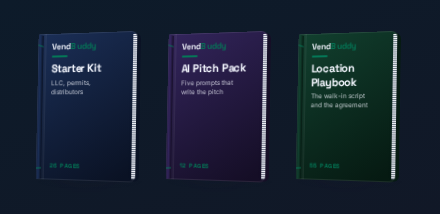
Everything above is free to read and free to do. The operator packs are the same material in fill-in-the-blank form — the 50-state distributor list, the LLC and permit checklist in unblocking order, the word-for-word walk-in script, and the placement agreement you hand a property manager. One-time purchase from $27, nothing renews.
See what is inside →Picture the machines paying you while you sleep
That’s the real promise of vending — income that doesn’t cost you your time, and a life on your own terms. VendBuddy turns this guide into a step-by-step plan so you actually build it instead of just reading about it. Start free today.
Start building free →How to actually use a ranking like this
The composite score is the least useful column. Three things matter more.
Weight the criteria to your own constraint. If you have $3,000 and no more, startup cost is worth triple. If you have capital but eight hours a week, hands-off is worth triple and detailing drops off the list entirely. The ranking above weights everything equally, which is right for nobody in particular.
Separate capital at risk from startup cost. These are not the same number and the difference is enormous. A $25,000 financed machine you can resell for $15,000 risks less real money than $8,000 of cash spent on a deposit and signage. Write down the number that is gone if you stop in month eight, and use that as the price of the experiment. The 2026 decision guide works through that arithmetic properly.
Check the speed column against your patience honestly. The single most common failure is not choosing a bad business; it is choosing a slow business while expecting a fast one, and quitting in month three when nothing has happened yet. If you need to see money quickly to stay motivated, that is a real constraint and you should pick for it rather than pretend otherwise.
If you are picking by budget rather than by score
- Under $2,000: commercial cleaning, mobile detailing, digital services. All three are labour-for-money and all three can start this month.
- $2,000 to $5,000: a first vending machine placed, or pressure washing with commercial-grade equipment. This is the range where an asset first becomes possible — the $5,000 comparison is here.
- $5,000 to $15,000: a small vending route or junk removal with a truck, or a first ATM placement. The $10,000 version covers this band in detail.
- $200,000 and up: laundromat or self-storage, and at that point you are buying an existing business with books rather than starting one.
The bottom line
The ten businesses above split cleanly into three groups. Cheap and fast but capped — detailing, pressure washing, digital services — where you get paid quickly and own nothing at the end. Expensive and durable but unavailable — self-storage, laundromats — where the business is excellent and the entry price is the whole problem. And a narrow middle band — vending, ATMs, cleaning, junk removal — where the entry cost is survivable, the asset is financeable, and the thing keeps earning when you take a week off.
That middle band is where most people should be looking, and it is unglamorous by design. Nothing in it will impress anybody at a dinner party. All of it still works in a bad year.
If the middle band is where you landed, the fastest way to test it is free: VendBuddy scores real buildings near you by traffic, headcount and category, hands you the best contact on file for each, and models net profit and payback before any money moves. Start with 5 credits, no card required.
Related reading: recession-proof businesses ranked for 2026, should you start a business in 2026, the best business to start with $5,000, the best business to start with $10,000, nine signs you should be your own boss, vending versus self-storage, and side hustle startup costs ranked.
Frequently Asked Questions
What is the best business to start in 2026?
On a composite of startup cost, financeability, time to first dollar, downturn resilience and how well it runs without your hands, vending and unattended retail scores highest of the ten businesses compared here at 21 out of 25. It is not the fastest to a first dollar and it is not the cheapest to enter. It wins because the equipment finances against itself, the location agreement is free and comes before the money, demand is small and habitual, and the route keeps earning on days you do not work. Commercial cleaning and ATM routes both score 19 and are genuinely close.
What business can I start in 2026 with very little money?
Mobile detailing, pressure washing and commercial cleaning are the three that reliably start under about $2,000, because the equipment is consumer-grade and the first customer can be found in an afternoon. All three trade that low entry for a hard ceiling: you are selling your own hours, so revenue stops when you stop, and the assets have little resale value. They are excellent first businesses and mediocre second ones.
Which small business makes money the fastest?
Service businesses where somebody can hire you today. Mobile detailing and pressure washing can produce a first paid job inside a week of deciding, because there is no equipment lead time, no location to secure and no inventory. Equipment and route businesses run four to eight weeks to a first dollar, and property-based businesses such as laundromats and self-storage run months. Speed to first dollar and size of the eventual business tend to move in opposite directions.
What businesses do well in a recession?
The pattern is small, frequent, low-ticket, habitual purchases, plus repairs rather than replacements, plus customers who work in jobs that do not disappear. Vending at essential-worker sites, laundromats, self-storage, ATMs and cleaning all held up in 2008 and 2020. What suffers is anything high-ticket and deferrable, anything dependent on discretionary corporate budgets, and anything carrying a lease and payroll that cannot flex when revenue drops 25 percent.
How much money do I need to start a business in 2026?
Ask what is unrecoverable rather than what it costs. A business needing $25,000 of financeable equipment placed against a signed customer risks far less real money than one needing $8,000 of cash for a deposit and a build-out, because the first can be resold and the second cannot. Most of the businesses on this list can be entered for $2,000 to $10,000 of actual capital at risk. Laundromats and self-storage cannot, which is why they score low on entry despite scoring high on resilience.
Is vending machine business still a good idea in 2026?
Yes, with the caveats stated plainly: it is slow, it is not passive, and the location half decides everything. A machine at a good building grosses $1,500 to $3,000 a month and nets $500 to $1,000 after product, commission and card fees, paying back a $1,500 to $3,000 used machine in roughly 12 to 14 months. That is a real small business and nothing like the version sold in short-form video. We are a vending software company, so weigh that ranking accordingly.
Prices move around more than any guide keeps up with. The machine finder is where we keep the current line-up, sorted by what a location that size can realistically support rather than by what looks impressive.
What is the easiest business to start and run alone?
Vending and ATM routes are the two on this list that a single person can run indefinitely without hiring, because the work is scheduled rather than demanded. One person comfortably services 15 to 25 vending machines part time, and the machines do not care which evening you show up. Service businesses are easy to start alone and hard to keep alone, because growth means either working more hours or hiring, and there is no third option.
Should I start a business in 2026 or wait?
Waiting has a cost that never appears as a loss, which is why it feels free. The defensible position is not to start something large or to wait for a better year, but to start something small alongside a job now. That converts a high-stakes timing question into a low-stakes one, and it removes the failure mode that actually kills first businesses, which is running out of money before the thing starts working.
What is selling, which buildings say yes, and the numbers before you buy a machine. Free, confirm from your inbox, unsubscribe in one click. Refer one friend and get 25 VendBuddy credits.
Walk-ins and cold emails find locations. A small site with your own machine photos and a request-a-machine form lets the next one find you. Around machine three to five, an AI builder drafts it in an evening. Wix is the mature site builder; Base44 also builds working tools like a quote form. Start with the AI website walkthrough or Wix vs Base44.
General information, not legal, tax or financial advice. Rules change, so check the official source. Revenue and income figures are examples, not promises. See our terms.