- Resilience alone is a misleading ranking. Self-storage is more recession-resistant than vending and costs $1,000,000 to enter. Availability has to be scored too.
- Five criteria: startup cost, financeability, hours a week, downturn demand, and time to first dollar. Scored 1–5, honestly, including where vending loses.
- Vending 22/25, ATMs 18, self-storage 16, laundromats 13 — for someone with a job and under $50,000. With $400,000 the order changes completely.
- Self-storage wins hands-off and loses on capital. ATMs win on hours and lose on a shrinking market plus a cash float you cannot finance.
- Vending wins on financeability and on costs starting after the location, not before. It loses on hours, glamour and passivity, and those losses are real.
There is a version of this article everywhere, and it is almost always useless for the same reason: it ranks businesses by how well they survive a downturn without asking whether the reader could actually start any of them. Self-storage is more recession-resistant than vending. It also costs a million dollars. Ranking it first is technically correct and practically worthless to somebody with a job and $20,000.
So this ranking scores five things instead of one, and it is written for the specific person reading it in 2026: employed, watching the cuts land in industries that were supposed to be safe, and trying to work out what to actually do about it rather than what is theoretically best.
Why the question is different in 2026
The reason the search volume for this exists right now is not academic. Two years of cuts landed in software and technology, in freight and logistics after the long correction in shipping volumes, and in manufacturing under slower orders and steady automation spend. Those were the categories people moved into for stability, and the roles were removed rather than backfilled, which is a different kind of event from being replaced.
The consequence is a reframe worth stating plainly, because it changes what “recession-proof” is for: a job is a single customer with the unilateral right to cancel the whole contract in one meeting. Nobody would run a company at 100% revenue concentration with the cancellation clause held entirely by the other side. Most of us run our household income that way and call it the safe choice.
That is not an argument for quitting. It is an argument that a second income line is a concentration-risk fix, and that the useful ranking is of things you could plausibly start beside a job. Which changes the criteria.
The five criteria, and why each one is here
- Startup cost. Not because cheap is good, but because a business you cannot enter is not a candidate. Scored on the realistic all-in figure to get one unit producing.
- Financeability. The most under-weighted criterion in every other ranking. Money that can be financed against an asset is a fundamentally different risk from savings converted into something unrecoverable. This is where most first businesses actually die.
- Hours a week. If you have a job, a business needing weekday availability is not compatible with it no matter how motivated you are.
- Downturn demand. Does the revenue hold when budgets tighten? Small, frequent, non-discretionary purchases hold. Big deferrable ones do not.
- Time to first dollar. How long from committing money to revenue arriving. Long gaps are where the capital runs out.
Each is scored 1 to 5. The total is out of 25 and is explicitly a ranking for someone starting with under $50,000 while employed. That framing is doing real work — change it and the order changes, which is the honest thing to say rather than to hide.
Picture the machines paying you while you sleep
That’s the real promise of vending — income that doesn’t cost you your time, and a life on your own terms. VendBuddy turns this guide into a step-by-step plan so you actually build it instead of just reading about it. Start free today.
Start building free →The ranking
| Vending route | ATM route | Self-storage | Laundromat | |
|---|---|---|---|---|
| Startup cost | 5 — $2k–$10k | 4 — $5k–$14k per unit incl. float | 1 — $1M+ facility, $250k–$350k down | 1 — $200k–$500k build, $300k–$1M buy |
| Financeability | 5 — machine is its own collateral; spend starts after the location | 2 — machine finances, cash float cannot | 3 — commercial debt exists, the down payment does not finance | 2 — equipment finances, leasehold build-out is sunk |
| Hours/week | 3 — 2–5 at one to three machines, 15–20 at ten | 5 — 2–4, mostly cash loading | 5 — near zero with gate software and a part-time manager | 3 — 10–25 unattended, more with an attendant |
| Downturn demand | 4 — strong at essential-worker sites, weak at corporate offices | 2 — holds in cash-heavy venues, structurally shrinking | 5 — downsizing and moving both increase demand | 5 — non-discretionary, and renting rises in downturns |
| Time to first dollar | 5 — days after placement | 5 — days after placement | 2 — months of diligence and closing | 2 — 90–180 days to acquire, 6–12 to build |
| Total | 22 / 25 | 18 / 25 | 16 / 25 | 13 / 25 |
Read the columns rather than the totals. The totals answer one question — what should someone with a job and limited capital start — and each column answers a different and equally valid one.
1. Vending routes — 22/25
Wins on: financeability, entry cost, speed to revenue.
Loses on: hours, and any claim to passivity.
The reason vending tops a ranking scored this way is structural rather than promotional, and it is worth being precise about because “low startup cost” is only half of it. A used snack-and-drink combination machine runs $1,500 to $3,000, and it finances readily precisely because the machine is its own collateral and holds a resale market. If a site disappoints, the asset physically relocates — you unbolt it and place it in a better building, and the capital survives the mistake.
The half that matters most is the ordering. The location agreement comes first and costs nothing. You walk into buildings, find the person who decides, and ask. Only once a building has agreed do you commit money, and you commit it to a machine sized for traffic you have already seen. That inversion — demand proven before capital spent — is the single biggest difference between this and the businesses that bankrupt first-time owners.
The honest costs. A machine at a good location grosses $1,500 to $3,000 a month and nets $500 to $1,000 after product at 40–50%, commission at 0–15% and card fees at 5–6%. Payback is 12 to 14 months. A ten-machine route is 15 to 20 hours a week. It is not passive, it is not fast, and a first machine takes four to six months to reach its real number. Full numbers in the costs and profit breakdown, and the pitch to distrust in the vending machine lie.
The downturn caveat that actually matters. Vending scores 4 rather than 5 because resilience is decided by building, not by category. In 2008–09 manufacturing, healthcare and distribution sites held flat or grew while corporate office placements fell 20–35%. In 2020 that gap widened to office machines collapsing 40–60% while warehouse and healthcare rose. Same business, opposite outcomes, entirely from location mix. The historical data behind that is the companion piece to this one.
2. ATM routes — 18/25
Wins on: hours, speed to revenue.
Loses on: a structurally shrinking market, and a cash float you cannot finance.
ATMs are the closest thing on this list to genuinely low-effort income. A machine runs $1,500 to $2,500 refurbished or $2,300 to $3,500 new, revenue is a surcharge of $2.50 to $3.50 per withdrawal, and a mixed portfolio realistically produces $125 to $900 per machine per month. There is no product to buy, nothing spoils, and the work is loading cash.
Two things drag the score down, and both are the kind of thing that gets left out of enthusiastic write-ups.
The cash float. Every machine needs several thousand dollars of your own cash sitting inside it. That capital is not financeable in any sensible way — borrowing at interest to leave money in a box is a poor trade — so unlike a vending machine, a meaningful part of an ATM route has to be money you already own. A five-machine portfolio can easily tie up $25,000 in float alone before you count the hardware.
The market is shrinking. This is a secular trend rather than a cyclical one and it deserves to be said plainly on a page like this. Cash usage has declined steadily for two decades and there is no visible reason for it to reverse. Cash-heavy venues — bars, nightclubs, smoke shops, certain neighbourhoods — remain genuinely good, and the business still works there today. But you are buying into a category with a headwind rather than a tailwind, which is a different proposition from a business that merely dips in a recession. The full placement economics are in the ATM placement guide.
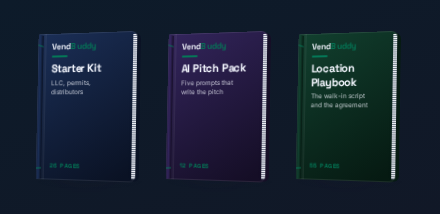
Everything above is free to read and free to do. The operator packs are the same material in fill-in-the-blank form — the 50-state distributor list, the LLC and permit checklist in unblocking order, the word-for-word walk-in script, and the placement agreement you hand a property manager. One-time purchase from $27, nothing renews.
See what is inside →3. Self-storage — 16/25
Wins on: hands-off operation, downturn demand, appreciation.
Loses on: capital, and only on capital.
This needs saying clearly on a vending site: self-storage is the better business. Margins are better, labour is lower, the asset appreciates, financing exists at commercial terms, and the exit is cleaner. Demand is genuinely counter-cyclical in a way vending is not — people downsize, move, and put things somewhere, and they keep paying a small monthly fee for years rather than confront the box. With gate software and a part-time manager a facility runs close to hands-off, which is a claim vending cannot make honestly.
It scores third here for one reason and it is not a small one. A facility at $1,000,000 to $1,500,000 requires roughly $250,000 to $350,000 down plus reserves, and that down payment is not financeable — it is cash you have to have. The commercial mortgage covers the rest, which is why financeability scores 3 rather than 1, but the entry ticket is the entry ticket.
And the risk at that size is asymmetric in a way the low scores understate. A facility at 90% occupancy throwing off $85,000 of NOI against $70,000 of debt service is comfortable. The same facility at 72% — entirely achievable if two competitors open nearby — throws off around $55,000 and you fund the gap personally, every month, on something you cannot sell quickly. The full head-to-head, including why these are life stages rather than competitors, is in vending versus self-storage.
If you have the capital, buy storage. That is the honest answer and it should not be a surprising one to read here. This ranking is for people who do not, yet.
4. Laundromats — 13/25
Wins on: downturn demand, which is genuinely excellent.
Loses on: entry cost, sunk capital, and costs you do not control.
Laundromats have the best demand story on this list. Washing clothes is non-discretionary, the customer base skews to renters, and renting increases in a downturn. Nothing about that is wrong.
The problem is the risk shape. Entry is $200,000 to $500,000 to build out or $300,000 to over $1,000,000 to acquire an existing store, and the large majority of a build-out is sunk into a leasehold. You cannot move it, you cannot resell it separately from the location, and if the neighbourhood changes or the lease renews badly, the capital does not follow you out. Add utilities — water, gas, electricity — as a major cost line you have no control over and cannot renegotiate, in an era where all three have been volatile.
It also takes 90 to 180 days to acquire or 6 to 12 months to build before the first dollar. That combination — large, unrecoverable, slow — is exactly the profile that ends first businesses, which is why an excellent demand story still finishes fourth here. The unit-economics comparison, including why laundromats get so much more content coverage than the numbers justify, is in laundromats versus vending.
The pattern underneath the ranking
Strip out the four names and what separates the top from the bottom is not category resilience at all. It is where the money goes and when.
| Top of this list | Bottom of this list | |
|---|---|---|
| Capital is spent | After a customer or location agrees | Before anyone has bought anything |
| Asset behaviour | Moves, resells, secures its own financing | Fixed to a site, sunk into a leasehold |
| If it does not work | Sell the equipment, lose the difference | Lose the down payment or the build-out |
| Time to first dollar | Days | Months to a year |
That is the whole finding, and it generalises well beyond these four. When people say a business is risky they usually mean something emotional. The actual mechanism is much more boring: the money ran out before the thing started working, because it had already been converted into things that could not be converted back. Businesses where that cannot happen are a genuinely different bet, and there are not many of them.
How to choose between them
- If you have $400,000 and want hands-off: buy self-storage. Nothing here competes with it and this ranking is not the relevant one for you.
- If you have $250,000 and want a strong demand story: a laundromat is a real business; go in knowing the capital is sunk and the utilities are not yours to control.
- If you have $30,000 and want minimum hours: ATMs, in genuinely cash-heavy venues only, with clear eyes about a declining market and a float you have to fund yourself.
- If you have under $10,000 and a job: vending is the one that is actually available, and the only one where the deciding half of the business is free and comes first.
- If you have under $10,000 and want no work: none of these. That is an investing question, not a business question, and the index-fund comparison is the honest place to start.
Whichever you pick, the same rule applies to the money: borrow against demand you already have, never against demand you expect. Every financing route compared covers equipment financing, 0% intro business credit, SBA microloans, seller financing and revenue-share, and which of them are underwritten on personal credit.
If the entry point that fits is a vending route, the free half comes first. VendBuddy scores real venues near you by traffic, headcount and category, gives you the best contact on file for each, and models net profit and payback before a dollar moves. 5 free credits, no card.
The bottom line
No small business is recession-proof. The honest question is how far revenue falls, how fast it recovers, and — the part every other ranking leaves out — whether you could enter the business at all without putting money you cannot lose at risk in advance.
Score all five and the order stops being about which category sounds safest and starts being about which one lets you be wrong survivably. For someone with a job and under $50,000 in 2026, that is a vending route, with ATMs a defensible second and both of the big-capital businesses waiting for a different stage of life.
Related reading: what actually held up in 2008 and 2020, vending versus self-storage, laundromats versus vending unit economics, 12 alternative machine businesses ranked, should you start a business in 2026, nine signs you should be your own boss, is the vending machine business right for you, and the goldmine hiding in broken vending machines.
Frequently Asked Questions
What are the most recession-proof businesses in 2026?
The categories that hold up are the ones selling small, frequent, non-discretionary purchases out of assets with low fixed costs: vending routes at essential-worker sites, self-storage, laundromats, and to a lesser extent ATMs. Ranking them by resilience alone is misleading, though, because self-storage and laundromats need several hundred thousand dollars to enter. For someone deciding what to actually start, resilience has to be scored alongside entry cost and how much of that cost can be financed.
If financing is the piece that is stuck, 7 Figures Funding works the qualification side of 0% intro business credit rather than you applying cold and collecting hard pulls. It is only worth a look if the placement is already confirmed.
Which recession-proof business is easiest to start?
Vending, by a wide margin on entry cost, and ATMs second. A used vending machine runs $1,500 to $3,000 and the location that determines its income costs nothing but your time. An ATM costs a similar amount but adds a cash float of several thousand dollars per machine that has to be your own money. Self-storage and laundromats are better businesses on several axes and effectively unavailable below roughly $200,000.
Is self-storage or vending better?
Self-storage is the better business and vending is the more available one. Storage wins on margins, labour, appreciation and genuine passivity; nothing in vending competes with it on economics. It also needs $250,000 to $350,000 of largely unrecoverable down payment on a facility over $1,000,000. These are life stages rather than competitors: if you have the capital, buy storage; vending is what you do at $3,000.
Are laundromats still a good business in 2026?
The demand side is genuinely strong and non-discretionary, and it strengthens slightly in a downturn as renting increases. The problem is entry: $200,000 to $500,000 to build out or $300,000 to over $1,000,000 to acquire, most of it sunk into a leasehold you cannot move, plus utility costs you do not control. It is a good business with a bad risk profile for a first-time owner, which is a different criticism from saying it is a bad business.
Is the ATM business still worth it with cashless payments?
It is the one entry on this list with a structural headwind rather than a cyclical one. Cash usage has been declining for two decades and there is no reason to expect it to reverse, so an ATM portfolio is a business with a shrinking addressable market that still pays well in specific cash-heavy venues. The second issue is the cash float: several thousand dollars per machine that must be your own money and cannot sensibly be financed.
What business can I start in a recession with little money?
Look for four properties together rather than for a category: low entry cost, equipment that can be financed because it acts as its own collateral, resale value if you stop, and expenses that begin after demand is proven rather than before. Vending is the clearest example because the location agreement, which is the half that decides income, is free to obtain and comes first. The general shape matters more than the specific business.
How much money do you need to start a recession-proof business?
Between about $2,000 and roughly $1,000,000 depending on which one, which is why entry cost belongs in any honest ranking. A single vending machine plus a first fill is roughly $2,000 to $3,500. An ATM is a similar machine cost plus $3,000 to $10,000 of cash float per unit. A laundromat starts around $200,000 and self-storage effectively starts at $1,000,000 with $250,000 to $350,000 down.
If you are still deciding which machine, the machine finder lists what is actually available at each price band with a conservative monthly estimate attached. It does not push you toward the expensive one.
Do recession-proof businesses actually exist?
Not in the strict sense. No small business is immune; the honest question is how far revenue falls and how quickly it recovers. What separates the resilient from the fragile is usually fixed costs rather than category: a business with a lease, staff and a loan owes all three in a 25 percent down month, while a business whose main variable cost is inventory it has not bought yet simply buys less. Resilience is mostly a cost-structure property.
What is selling, which buildings say yes, and the numbers before you buy a machine. Free, confirm from your inbox, unsubscribe in one click. Refer one friend and get 25 VendBuddy credits.
General information, not legal, tax or financial advice. Rules change, so check the official source. Revenue and income figures are examples, not promises. See our terms.