- The job is location acquisition. Not machines, not snacks. If you will not walk into a building and ask, nothing else on this page matters.
- Ten signs it fits, three that say it does not. The three are real disqualifiers, not softened objections.
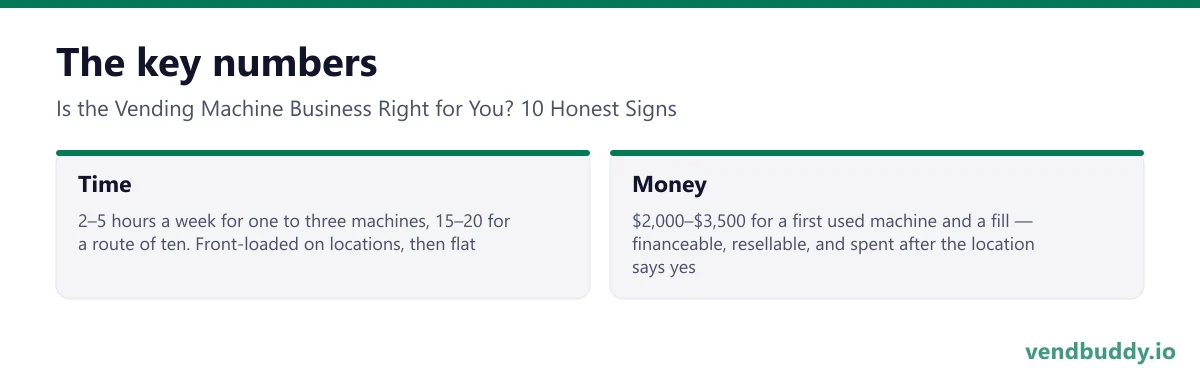
- Time: 2–5 hours a week for one to three machines, 15–20 for a route of ten. Front-loaded on locations, then flat.
- Money: $2,000–$3,500 for a first used machine and a fill — financeable, resellable, and spent after the location says yes.
- Timeline: four to six months for a machine to reach its real number. If you need income this month, this is the wrong business.
Most pages asking whether a business is right for you are written so that the answer is always yes. This one has three sections designed to talk you out of it, because a fit assessment that never disqualifies anybody is just an advertisement with a question mark on the end.
What follows assumes you already know roughly what the business is and roughly what it earns. If you do not, those are separate pages and better ones for that job: is vending a good business has the money math from real routes, and the vending machine lie covers the version of the pitch you should not believe. This page is only about whether you, specifically, would do well at it.
First, what the job actually is
Almost everybody arrives imagining the wrong daily reality. They picture buying machines and picking snacks. Both of those are real and neither is the job.
The job is getting locations. A machine in a building with 100 to 200 daily visitors nets $500 to $1,000 a month. The identical machine, with identical product, serviced by the identical person, nets $50 to $150 in a slow strip mall. Ten to twenty times the outcome, decided by an address. Everything else in this business is logistics around that one decision.
Which means the skill being tested is not mechanical, financial or culinary. It is walking into a building, finding the person who decides, asking, being told no roughly four times out of five, and going to the next building. Hold that in mind for the whole list below, because it is what most of the signs are really measuring.
10 signs it fits
1. You can ask a stranger for something without dying inside
Not confidence — willingness. Introverts do extremely well in this business, because the pitch is 90 seconds long, it is a business favour rather than a sale, and the follow-up is by email. What matters is whether “I need to walk into eight buildings on Thursday” reads as uncomfortable or as impossible. Uncomfortable is workable and gets easier by building four.
2. You can protect a few hours, including some daylight ones
Restocking is flexible and coexists with a job perfectly well. Location acquisition mostly does not, because the property manager is there between 9 and 5. Most people who make this work with a full-time job book a handful of half-days rather than trying to squeeze it into lunch breaks. If you can produce four or five weekday half-days over a couple of months, the timing works.
3. You want a small business, not an investment
These are different things and confusing them is the most common source of disappointment here. An investment is something you put money into. A business is something you run. Vending is unambiguously the second, with a genuinely good hours-to-income ratio and no pretence of being the first. If what you actually want is an asset that requires nothing from you, the comparison against index funds and rental property is a more honest place to look.
4. You are comfortable with a four-to-six-month ramp
A new machine does not open at its steady number. The building has to learn it is there. A first machine commonly grosses $600 to $1,200 in its first 60 days and settles into its real tier around month four to six. If you can look at a month-two number without concluding the business is broken, you will survive the part that removes most people.
5. You like optimising things
The difference between a mediocre route and a good one is small repeated decisions: which product to cut, when to raise a price by 25 cents, which slot sells out every Thursday, whether that machine is worth the drive. People who enjoy that find the business quietly satisfying. People who find it tedious end up with a route that slowly decays while they wait for it to be interesting.
6. You can absorb a slow month without it changing decisions
Not wealth — slack. If a $400 month instead of a $900 month would force you to sell a machine or skip a restock, the business will make its decisions for you and they will all be short-term. A few months of buffer, or a job still running alongside, is what lets you make the right call when a location underperforms instead of the panicked one.
7. You are fine being the person who fixes it
Machines jam. Card readers drop offline. A coil hangs a bag of chips at 4pm on a Friday and the property manager emails you about it. None of this is hard, most of it is a ten-minute fix and a YouTube video, but all of it is yours. If you would rather that be somebody else’s problem, that instinct is worth taking seriously now rather than in month three. The troubleshooting guide is a fair preview of the texture of it.
8. You want something you can start without permission
No licence body, no accreditation, no gatekeeper, no minimum investment, no franchise interview. You can decide on a Tuesday and have a signed location agreement inside three weeks. Very few real businesses have an entry that low, and for people whose main frustration is being unable to simply try things, that property is worth more than the margin.
9. Capital, not nerve, is what has been stopping you
This one is about the shape of the risk rather than about you. A used combination machine runs $1,500 to $3,000, finances readily because it is its own collateral, holds resale value, and physically moves to a better building if a site disappoints. And the half that decides everything — the location — is free, and comes first. If you have been held back by not wanting to put unrecoverable savings at risk in advance, this business is genuinely structured differently from the one you have been imagining. The 2026 decision guide works through that distinction properly.
10. Boring does not bother you
There is no dramatic version of this business. It is buildings, product, a spreadsheet and a van. The operators who compound are the ones who found that acceptable rather than the ones who found it exciting. If you have read this far and the flatness of it is reassuring rather than deflating, that is a good sign and a rarer one than enthusiasm.
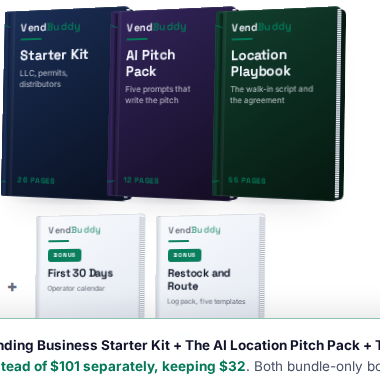
If you get to the end of this and the answer is yes, the kits are the shortcut past the blank page: a 26-page starter kit for the paperwork, a 55-page Location Playbook for the walk-in script and the agreement, and a 12-page AI Pitch Pack. Bought once, from $27, and you keep the files.
Look inside the kits →Picture the machines paying you while you sleep
That’s the real promise of vending — income that doesn’t cost you your time, and a life on your own terms. VendBuddy turns this guide into a step-by-step plan so you actually build it instead of just reading about it. Start free today.
Start building free →3 signs it is not for you
These are disqualifiers, not objections to be handled. If one of them is true, the honest recommendation is to look elsewhere, and we would rather you found that out on this page than after buying a machine.
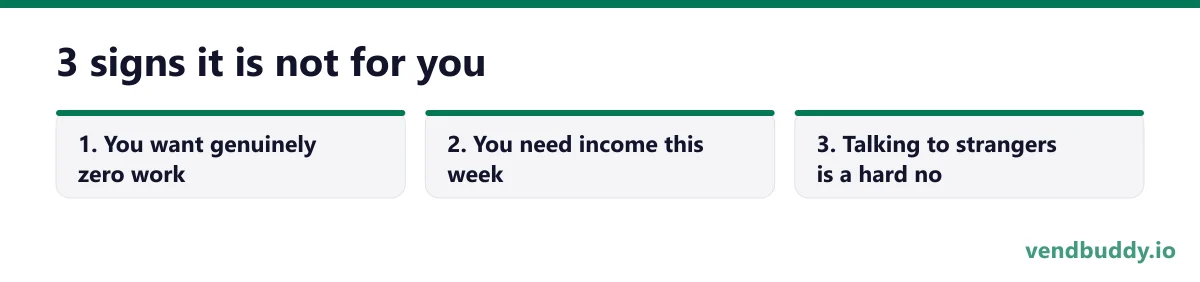
1. You want genuinely zero work
If the appeal is income that requires nothing from you, this is the wrong business and it will disappoint you specifically and expensively. A ten-machine route is 15 to 20 hours a week. A first machine is hands-on for months. Semi-passive is something you engineer later out of route density and telemetry; it is not what the machine arrives with. The version sold as passive from day one is the one we take apart in the vending machine lie, and the hours-per-week breakdown has the real numbers.
What to look at instead: something that is actually an investment rather than a business. Index funds and rental property compared on risk is the honest starting point, and it is not a consolation prize.
2. You need income this week
The timeline does not compress. Finding a location takes weeks. Getting the machine delivered and stocked takes more. Month one is not the real number and neither is month two. From decision to meaningful revenue is three to six months even when everything goes right, and that is before payback, which is another 12 to 14.
Every figure here is an average, and averages hide the building. The revenue calculator lets you plug in the property you are actually looking at and see the range for that type.
If rent is due and the vending idea is the plan for it, this is the wrong instrument and it will make the situation worse rather than better, because the money goes out first. Something that pays weekly is the correct answer for a cash emergency, and vending can be the thing you start once the emergency is over.
3. Talking to strangers is a hard no
Not “I would prefer not to” — almost nobody wants to. A hard no, the kind where you already know with certainty that you will find a reason not to go into the building.
Be honest about it, because this is the failure mode that looks like something else. It shows up as a machine bought first and then parked in a garage for eight months while the owner researches machines, or placed in whatever low-traffic site would take it without a conversation. The business did not fail. The outreach never happened, and there is no amount of capital, software or equipment that substitutes for it. If this is you and you still want in, the workable versions are a partner who does the location half, or buying an existing route with locations already attached — see route due diligence before you do, because that market has its own problems.
Scoring it
Any one of the three anti-signs is a no, regardless of how many of the ten you have. That is the whole point of them.
Past that: eight or more of the ten and the fit is strong — your remaining questions are practical rather than existential. Five to seven is a normal, workable profile, and worth noting which ones you are missing, because time and outreach willingness are the two that actually predict outcomes. Four or fewer and something else is a better use of the same money and the same year.
If you want the same assessment done for you with a plan attached rather than a score, the site has a 60-second quiz that asks about your situation and returns a four-week starting plan rather than a sales page.
Ten questions about your hours, budget and city. You get a four-week starting plan and an honest read on which of the routes into this business fits your situation — including when the answer is that it does not.
The bottom line
The people who do well at vending are not the ones who found it exciting. They are the ones who were willing to do the unglamorous half — walking into buildings and asking — and who could wait four to six months without concluding that a slow month meant a broken business.
If that is you, the entry cost is among the lowest of any real business, the capital is financeable, and the expensive part does not start until a building has already said yes. If it is not you, that is genuinely useful to know today, and there is nothing wrong with the answer being no.
Related reading: is vending a good business in 2026, the vending machine lie, nine signs you should be your own boss, should you start a business in 2026, recession-proof businesses ranked for 2026, the goldmine hiding in broken vending machines, how much time vending really takes, and why most operators fail in year one.
Frequently Asked Questions
Is the vending machine business right for me?
It fits if you are comfortable walking into a building and asking a stranger for something, you can protect a few hours most weeks including some daylight hours, you want a small business rather than an investment, and you can wait four to six months for a machine to reach its real number. It does not fit if you want something genuinely hands-off, you need income this month, or the idea of a cold walk-in is a hard no rather than merely uncomfortable. Location acquisition is the job; everything else is logistics.
Who should not start a vending machine business?
Three groups, and being in any one of them is enough. People who want truly passive income, because a ten-machine route is 15 to 20 hours a week and a first machine is hands-on for months. People who need money this week, because the honest timeline from decision to meaningful revenue is measured in months. And people who genuinely will not do the outreach, because no amount of capital substitutes for someone being willing to ask a property manager for the space.
Do you have to talk to people to run vending machines?
Yes, and this is the most commonly underestimated part of the business. Getting a location means walking in, finding the person who decides, making a short pitch and following up, and doing that many more times than you expect because most answers are no. Restocking is solitary and the machine is patient, but nothing gets to the restocking stage without the conversation first. Introversion is fine; unwillingness is disqualifying.
How much time does a vending machine business take?
One to three machines run roughly two to five hours a week once they are placed. A ten-machine route runs 15 to 20 hours a week including driving, restocking, cash handling, repairs and keeping locations happy. The front-loaded part is location acquisition, which can consume most of your available hours for the first month or two and then drops away almost entirely until you want to add machines.
Is vending a good business for someone with a full-time job?
It is one of the better fits, with one specific caveat. Restocking is genuinely flexible and can be done evenings and weekends, so the ongoing work coexists with a job well. The caveat is location acquisition, which mostly has to happen during business hours because that is when the decision-maker is there. Most people solve it with a handful of half-days rather than trying to do it around the edges of a work week.
How much money do you need to start vending?
A used snack-and-drink combination machine runs $1,500 to $3,000 and a first product fill is a few hundred more, so a realistic single-machine start is roughly $2,000 to $3,500 including freight. The number that matters more is capital-at-risk rather than total cost: the machine is financeable, holds resale value, and the location agreement that decides whether the business works costs nothing but your time and comes first.
Is vending machine income passive?
Semi-passive at scale, hands-on at the start, and never passive on day one. The honest version is a good hours-to-income ratio rather than an absent one. Passivity is something you engineer later with route density, telemetry that tells you which machines need a visit, and eventually a part-time stocker. It does not arrive with the machine, and any pitch that says it does is describing a different business than the one that exists.
Most operators end up on Nayax for telemetry because it is what the distributors already support. Their reader handles tap, chip and the telemetry feed in one box, and the monthly fee is the part to check against your per-machine volume before you commit the route to it. Affiliate link, so we may earn a commission at no extra cost to you.
What kind of person does well in vending?
The pattern across operators who last is unglamorous: methodical rather than brilliant, comfortable with rejection, willing to do the same small route tasks reliably for months, and interested in the numbers rather than the machines. People who enjoy optimising a system tend to enjoy this business. People who wanted an asset that runs itself tend to sell within a year, and usually at a loss.
What is selling, which buildings say yes, and the numbers before you buy a machine. Free, confirm from your inbox, unsubscribe in one click. Refer one friend and get 25 VendBuddy credits.
Walk-ins and cold emails find locations. A small site with your own machine photos and a request-a-machine form lets the next one find you. Around machine three to five, an AI builder drafts it in an evening. Wix is the mature site builder; Base44 also builds working tools like a quote form. Start with the AI website walkthrough or Wix vs Base44.
General information, not legal, tax or financial advice. Rules change, so check the official source. Revenue and income figures are examples, not promises. See our terms.