- The signal is behavioural, not emotional. Hating your job on a Tuesday means nothing. Redesigning systems nobody asked you to redesign, for years, means something.
- Nine signs, and three counter-signs. If you are chasing autonomy but want no responsibility for outcomes, working for yourself will feel worse, not better.
- You do not need an idea. Most people who go first pick a boring business that already works. Almost nobody invents anything.
- The real risk is capital-at-risk, not courage. The question is not whether you are brave enough. It is how much of your own money you cannot get back if you are wrong.
- Do not quit first. The paycheque funds the experiment. Replacement income is what makes quitting possible, not the other way round.
You are not reading this because you are curious about entrepreneurship. You are reading it because something at work has been quietly wearing at you, and you want to know whether the feeling means anything or whether everybody has it and you should grow up about it.
Honest answer: everybody does have it sometimes, and most of the time it means nothing. Bad quarters and bad managers produce a very convincing imitation of the urge to leave. What follows is an attempt to separate that from the real thing — nine signals that show up as behaviour, over years, rather than as a mood on a Sunday night. Then three counter-signals, because the honest version of this article has to include the case for staying. And then the part almost nobody writes down: what actually stops people who have all nine signs, which is not nerve and is not talent.
The question underneath the question
“Should I be my own boss” is rarely the real question. Underneath it is usually one of three others, and they have different answers.
- “Am I in the wrong job?” Sometimes the answer is a different employer, and that is a much cheaper fix than starting a business. If the specific manager, team or commute changed and the feeling would go, you have a job problem, not an ownership problem.
- “Am I safe?” This one has been getting louder since the layoff notices started arriving in places that were supposed to be safe. It is a real question and it deserves a real plan, but the plan is not necessarily quitting.
- “Is this it?” The one about the next ten years looking exactly like the last three. This is the one that actually predicts people going out on their own, and it is the one the signs below are trying to detect.
Keep track of which of the three is yours while you read. It changes what you should do on Monday.
The nine signs
1. You redesign systems nobody asked you to redesign
You walk into a process and immediately see the three steps that should not exist. You built the spreadsheet that half the department now uses. You wrote the doc that got adopted. Nobody asked you to. You did it because the inefficiency was physically uncomfortable to look at.
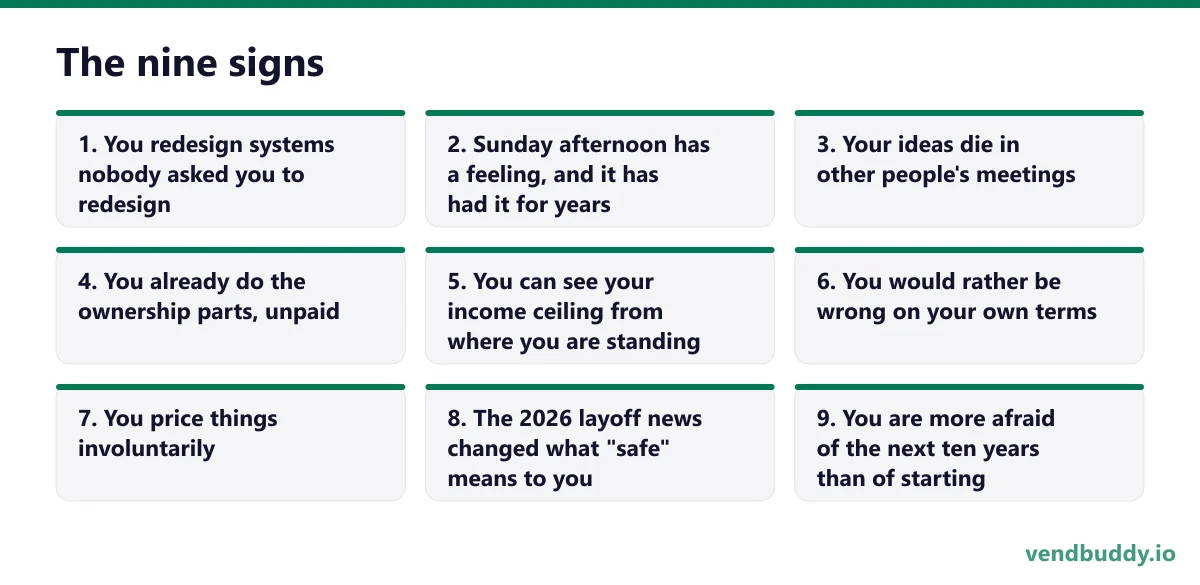
This is the single most reliable signal on the list, because it is not a preference — it is a reflex, and it is the core skill of running something. Businesses are systems with money attached. People who cannot stop improving systems tend to find employment maddening for a specific reason: they can see the fix and they do not control the switch.
2. Sunday afternoon has a feeling, and it has had it for years
Not Sunday night dread — almost everyone has some version of that. The tell is the duration and the shape. If the feeling arrives around 3pm on Sunday, is not attached to any specific task waiting for you on Monday, and has survived two job changes and a promotion, it is not the job. It is the arrangement.
A useful test: think about the last time you got promoted or moved teams. Did the feeling go away for good, or for about four months? A feeling that reliably comes back after every fix is telling you the fix is the wrong category.
3. Your ideas die in other people’s meetings
You have watched a good idea get talked to death enough times that you have started not bringing them. That last part is the real sign. The person who still argues in meetings is engaged. The person who has quietly stopped proposing things has already left; they are just still getting paid.
What people who go out on their own describe missing least, almost universally, is the gap between having an idea and being allowed to try it. Working for yourself does not make your ideas better. It makes the distance between idea and attempt roughly zero, which turns out to matter enormously to some people and not at all to others.
4. You already do the ownership parts, unpaid
You think about the business on the drive home. You notice when a customer is unhappy and it bothers you personally. You have opinions about pricing that nobody solicited. You feel responsible for outcomes that are, strictly speaking, above your pay grade.
This is worth being blunt about: you are already doing the emotionally expensive part of ownership. You are simply doing it without the upside. That is not an argument that you should quit — plenty of people do this happily for a career they believe in — but it does mean the jump would be smaller for you than you think. The mindset transition that people describe as the hard part is one you already made.
5. You can see your income ceiling from where you are standing
You know roughly what the person two levels above you earns. You know what the person five levels above earns. You can do the arithmetic on how many years and how many politics-heavy steps separate you from each, and you have done that arithmetic more than once.
Notice that the ceiling is not the problem. Plenty of people look at that number and find it perfectly acceptable. The signal is that you keep checking — that the ceiling is something you are measuring yourself against rather than something you have stopped thinking about.
6. You would rather be wrong on your own terms
Ask yourself honestly which of these two is worse: failing at something you chose, or succeeding at something you did not. Most people find one of those clearly worse than the other, and the answer sorts people fairly cleanly.
If failing on your own decisions sounds survivable and being carried along by someone else’s sounds unbearable, that is a genuine temperament fit for ownership. If the opposite is true, that is not weakness — it is useful information that will save you a great deal of money.
7. You price things involuntarily
You walk into a busy coffee shop and estimate the daily covers. You see a queue and think about throughput. You notice the vending machine in your building has been empty for three weeks and wonder who is losing money on that.
This is pattern-recognition for opportunity, and it is close to untrainable. People who do it do it constantly and assume everyone does. They do not. If you have ever caught yourself building a rough P&L for a stranger’s business while waiting in line, that is a business brain running in the background whether you asked it to or not.
8. The 2026 layoff news changed what “safe” means to you
For a long time the trade was legible: a job paid less than the upside of ownership but it was safe, and safe was worth the difference. Two years of cuts landing in engineering, logistics, freight and manufacturing — the places that were supposed to be immune — have made that trade harder to argue with a straight face.
The honest reframe is not “jobs are risky now.” It is that a job is a single customer who can terminate the whole contract in one meeting, and one customer is the most concentrated revenue risk in any business. Nobody would run a company that way voluntarily. Most of us do it with our own income and call it stability. If that sentence landed, this sign is yours. The mechanics of building a second income line are in how to build passive income and actually quit your job.
9. You are more afraid of the next ten years than of starting
This is the last one and the heaviest. Run the projection where nothing changes: same arrangement, same ceiling, ten more years, plus whatever the market does to your role in that time. Now compare it against the fear of starting something and it not working.
If the do-nothing projection is scarier than the failure case, you have your answer, and it is not really a preference any more. Most people who take the leap describe exactly this: not a moment of confidence, but a moment where standing still stopped feeling safe.
Picture the machines paying you while you sleep
That’s the real promise of vending — income that doesn’t cost you your time, and a life on your own terms. VendBuddy turns this guide into a step-by-step plan so you actually build it instead of just reading about it. Start free today.
Start building free →Three signs you should stay employed — for now
An honest list has to run in both directions, and these are not soft.
You want autonomy but not accountability. These arrive strapped together. When you work for yourself there is no one to escalate to, no one whose fault it partly is, and no one whose decision it was. If what you actually want is your current job without a manager, that is not ownership — that is a better manager, and it is a much cheaper thing to go find.
You need this month’s income to be certain. If your household cannot absorb a variable month, a business that must produce cash immediately will make every decision for you, and they will all be short-term ones. This is a timing problem, not a permanent disqualification. It says start alongside the job, not instead of it.
You are running from something rather than towards something. Burnout produces an urge that is indistinguishable from ambition for about six weeks. The test is simple: if a two-week holiday and a different manager would fix it, fix that first. Starting a business is a poor treatment for exhaustion, because it is more work, not less, in exactly the period when you have the least to give.
Five free guides cover the ground below in more detail than a blog post can — a 90-day launch plan, the location scouting checklist, the B2B pitch script with the twelve objections answered, tax deductions, and pricing. No card, delivered to your inbox in a couple of minutes.
Get the free guides →The part nobody says out loud: the real risk is capital, not courage
Here is where most articles on this subject end, with an encouraging line about betting on yourself. That is where the useful part actually starts, because the thing that stops people who have all nine signs is almost never nerve.
It is money, and specifically it is capital-at-risk: the amount of your own money that is gone and unrecoverable if the business does not work.
Look at how first businesses typically fail. It is rarely a dramatic collapse. It is that the money ran out before the thing started working, and it ran out because it was spent on capacity before there was any evidence of demand. The restaurant signed the lease, did the build-out, hired the staff and bought the inventory — and only then found out whether the neighbourhood wanted it. Every dollar of that was spent in advance, on a guess, and none of it came back.
That is one shape of business. It is not the only shape. Compare the two honestly:
| Capacity-first business | Demand-first business | |
|---|---|---|
| What you buy first | Space, build-out, staff, inventory | Nothing — you secure the customer or the site first |
| When money is spent | Before you know if it works | After a signed agreement exists |
| Can the capital be financed? | Partly — leases and build-outs mostly cannot | Often yes — equipment is collateral |
| Recoverable if you quit | Very little | Equipment has a resale market |
| Time to first dollar | Months | Days after placement |
The right-hand column is not a trick. It describes a real and fairly small family of businesses, and the reason it matters is that it changes what “risky” means. If the equipment can be financed rather than bought outright, and if the expensive part does not begin until a location has already agreed to have you, then being wrong costs you a payment stream and a resale, not a decade of savings.
A credit line is still a debt you personally guarantee, so the honest rule is to borrow only what a signed location can repay inside the intro window. 7 Figures Funding sequences the applications for you if you would rather not apply one card at a time.
That is a completely different bet from the one most people picture when they imagine starting a business, and it is the reason the answer to “should I work for myself” often depends less on you than on which business you pick.
What to actually do this month
Nothing here requires quitting.
- Keep the paycheque. It is the cheapest startup funding available and it has no equity cost. The job funds the experiment; the experiment eventually replaces the job. Doing it in that order is the single most reliable pattern among people who make the switch successfully.
- Filter on shape, not on passion. Score anything you are considering on four things: entry cost, whether the capital can be financed, whether the assets resell, and whether spending starts before or after demand is proven. That filter eliminates most of what people talk themselves into.
- Pick something boring that already works. Proven demand beats a clever idea for a first business almost every time, because you are learning to run something at the same time as everything else. Save the invention for business two.
- Define what “working” means before you start. A specific number by a specific date. Without it, you will either quit something that was fine or persist with something that was not.
One example of the shape, since it is the obvious question
If the four-part filter above is the criteria, it is fair to ask what actually passes it. Very few things do, which is the whole point.
Vending is one of them, and this is a vending company, so treat that as disclosed rather than hidden. The reason it clears the filter is structural rather than promotional: a used combination machine runs $1,500 to $3,000, equipment finances readily because the machine is its own collateral, machines hold resale value and can be physically moved to a better building if a site disappoints, and — the part that matters most — the free half comes first. You secure the location by walking into buildings and asking, which costs nothing but afternoons, and only then do you commit money to a machine sized for a building whose traffic you have already seen.
The honest numbers: a machine at a good location grosses $1,500 to $3,000 a month and nets $500 to $1,000 after product, commission and fees, paying back its own cost in roughly 12 to 14 months. That is a real small business and it is not a fast one. It is also nothing like the passive-income version sold in short-form video, which we took apart in the vending machine lie.
You do not have to pick vending. You do have to pick something with that shape if capital-at-risk is what is actually standing between you and going first — and for most people with nine out of nine signs, it is. The ranked comparison of the four main options puts vending next to self-storage, laundromats and ATMs on exactly these axes, and the 2026 decision guide works through the timing question if the layoff sign was the one that landed hardest.
The bottom line
Wanting to be your own boss is not a personality type and it is not a moral achievement. It is a fit question, and the nine signs above are the ones that hold up over years rather than over a bad week.
If you have most of them, the thing standing in your way is almost certainly not resolve. It is that every version of “start a business” you have imagined involved putting money you cannot afford to lose at risk in advance, on a guess. That version is optional. Pick a business where it is not the deal, keep the job while you test it, and let the arithmetic rather than the courage do the work.
VendBuddy scores real buildings near you by traffic, headcount and category, hands you the best contact on file for each, and models net profit and payback before you spend a dollar. Start free with 5 credits — no card required.
Related reading: should you start a business in 2026, is the vending machine business right for you, recession-proof businesses ranked for 2026, building passive income to quit your job, when a side hustle becomes the business, and is vending a good side hustle.
Frequently Asked Questions
How do I know if I should be my own boss?
Look for the pattern rather than the mood. Wanting to quit on a bad Tuesday is normal and means nothing. The real signals are behavioural and repeat over months: you redesign systems you were only asked to use, you keep pricing things in your head, your ideas need someone else’s approval to exist, and your income has a visible ceiling you did not set. If four or five of those describe your last two years rather than your last two weeks, the question has already answered itself and what is left is a plan.
What are the signs you should start your own business?
The consistent ones are ownership behaviour showing up where it is not required, tolerance for being responsible when things go wrong, an income ceiling you can see, and a specific problem you keep noticing that other people walk past. Notably absent from that list: having a brilliant idea, being fearless, and having savings. Most people who successfully work for themselves started scared, underfunded, and with an ordinary idea somebody else was already doing.
Should I quit my job to start a business?
Almost never on day one. The version that works for most people is to keep the paycheque while the business is being tested, because a business that has to pay your mortgage in month one forces bad decisions fast. Pick something you can start in evenings and Saturdays, get it to a number that covers a real bill, and let the job fund the experiment. Quitting is what happens when the replacement income exists, not the thing that creates it.
What if I want to be my own boss but have no business idea?
That is the normal starting position and it is not the blocker it feels like. The people who go first rarely invent anything; they pick an unglamorous business that already works, in a category with proven demand, and run it better than the incumbent. The useful filter is not what excites you but what you can start at a survivable cost, what pays you inside a few months rather than a few years, and what still has customers when the economy turns.
Is it too risky to start a business right now?
The risk that matters is not the economy, it is how much of your own money is unrecoverable if you are wrong. A business where the capital is financed, the assets can be resold, and most spending happens only after a customer is secured is a genuinely different risk from one that needs a lease, a build-out and a payroll before the first dollar. Judge the specific business rather than the general climate, because those two shapes fail very differently in the same conditions.
What is the biggest reason people fail at working for themselves?
Running out of money before the thing starts working, which is usually a sequencing problem rather than an income problem. Most failed first businesses spent their capital on capacity — space, equipment, inventory, branding — before they had any evidence of demand. The businesses with the highest survival rates invert that order and spend almost nothing until a paying customer or a signed location is already in hand.
Do I need savings to start a business?
You need capital, which is not the same as savings. Depending on the business, capital can come from equipment financing, a 0% intro business credit line, seller financing, a revenue-share arrangement, or simply from a business model where the money is spent after the customer is secured. The distinction matters because waiting until you have saved the whole amount in cash is what keeps most people employed for another decade.
What is the lowest-risk business to start first?
The lowest-risk shape has four properties: a small entry cost, financeable equipment, resale value if you quit, and expenses that begin after demand is proven rather than before. Very few businesses have all four. Route-based businesses that place equipment in buildings you have already secured have them because the location agreement — the part that decides whether the business works — is free to obtain and comes first.
What is selling, which buildings say yes, and the numbers before you buy a machine. Free, confirm from your inbox, unsubscribe in one click. Refer one friend and get 25 VendBuddy credits.
General information, not legal, tax or financial advice. Rules change, so check the official source. Revenue and income figures are examples, not promises. See our terms.