- Your unfair advantage is not discipline. It is the transition window. Terminal leave is the only block of weekday daytime most people ever get, and weekday daytime is the scarcest input in this business.
- Three skills carry over literally: route planning, preventive maintenance on a schedule, and executing a checklist on a bad day without motivation. That third one is why most operators quit and you will not.
- Veteran-owned is a door-opener with private property managers — and separately, SBA certification exists for federal set-aside work. Two different things. Verify both at the source.
- Three things to check before you form anything: outside-employment rules if you are still in, installation solicitation rules, and — if you are rated for Individual Unemployability — a conversation with an accredited VSO.
- You are the most marketed-to buyer in America right now. Every franchise and business-opportunity seller has a veteran discount. A used machine and a signed location costs less than most of their deposits.
There is a specific flavour of noise around this question, and it is worth naming before anything else. Somewhere between your first TAP briefing and your last day, you will be offered a business. It will have a veteran discount, a founder who served, a territory map, and a number on it somewhere between $15,000 and $60,000. Some of those offers are legitimate. Almost none of them are the cheapest way to find out whether you like owning a route.
So this page is not a pitch about grit. You have been told you have grit. What follows is the actual mechanics: what genuinely transfers from service to a vending route, what the transition timeline lets you do that a civilian cannot, the three rules you need to check before you form anything, and the honest list of reasons this might be the wrong business for you.
What actually transfers, and what does not
Most veteran-business content flatters. It is more useful to be specific, because three things transfer almost perfectly and one very important thing does not.
Route planning transfers completely. A vending route is a movement plan with fuel, time and load constraints. The instinct to sequence stops geographically rather than by urgency, to pre-stage the load the night before, and to know your actual time on target rather than your optimistic one is the difference between a five-machine route that takes two hours and one that takes five. Most new operators learn this the expensive way over about eight months. Density versus machine count is the whole argument, and you will find it obvious.
Preventive maintenance transfers completely. The single largest hidden cost in vending is the service call for something that was visible three weeks earlier: a bill validator that had been rejecting one note in ten, a door gasket weeping, a coil that had jammed twice. Operators who run a fixed inspection sequence at every visit spend a fraction of what operators who wait for a failure spend. If PMCS is a reflex, that is money. What the calls actually cost is here — and most of them are things you already have the temperament to catch.
Executing on a bad day transfers, and it is the real one. Vending does not fail on strategy. It fails in month five, when the novelty is gone, the first machine is netting $210 instead of the $600 in the video, and it is 6am on a Saturday and cold. The population of people who will do the boring thing on a scheduled day without wanting to is small, and you were selected into it. That is not a motivational line. It is the actual reason operator survival curves look the way they do. Year-one failure has a pattern, and it is almost never the machine.
What does not transfer: the tolerance for being told no by a stranger with no authority over you. This surprises people. You can be entirely comfortable with hardship and still find it genuinely grating to walk into a property management office in civilian clothes and have a twenty-six-year-old leasing agent say “we already have a guy” without looking up. Plan on twenty of those for one yes. It is a conversion rate, not a judgement, and knowing the number in advance is most of the defence.
The transition window is the whole opportunity
Here is the part nobody frames correctly.
The binding constraint in a vending business is not money, equipment or knowledge. It is weekday daytime availability. Landing a placement means physically standing in a building between roughly 9am and 4pm on a weekday, because that is when the person who can say yes is there. A civilian with a full-time job cannot do that without burning vacation days, which is precisely why so many aspiring operators stall at step one and stay stalled for a year.
Terminal leave, and whatever transition time your service and command allow around it, is a block of exactly that resource. Four or five mornings produces a first yes at a normal conversion rate. A person working forty hours takes two months to accumulate the same four mornings.
So the sequencing for a separating service member writes itself, and it is the opposite of what gets sold:
| Window | What you do | What you spend |
|---|---|---|
| Six months out | Ethics conversation if still in. Read the economics. Build a target list of buildings near where you will actually live — not where you are stationed now. | $0 |
| Sixty days out | Decide the metro. Score the ZIPs. Shortlist 40 buildings. Draft the walk-in script and rehearse it out loud until it is 40 seconds. | $0 |
| Terminal leave, week 1 | Walk in. Four buildings a morning, four mornings. Track every no and why. | Fuel |
| Terminal leave, week 2 | Follow up on the maybes. Expect the yes to come from a building you had ranked fourth. | Fuel |
| After the yes | Now buy the machine. Permit, insurance, freight, first fill. | $2,000–$5,000 |
The rule underneath the table: buy nothing until a location is signed. A machine in a storage unit has a monthly cost and it quietly pressures you into accepting a bad site, and the difference between a good site and a bad one is the difference between netting $600 a month and $150. The location-first argument in full is here, and the 30-day version of this sequence is here.
Before you commit a metro, it is worth two minutes with the free Opportunity Map, which scores any US ZIP on population, employment and income with no account. Choosing where to live after separation is a decision most people make for family reasons and then discover has a route inside it or does not.
Picture the machines paying you while you sleep
That’s the real promise of vending — income that doesn’t cost you your time, and a life on your own terms. VendBuddy turns this guide into a step-by-step plan so you actually build it instead of just reading about it. Start free today.
Start building free →Veteran-owned status: what it actually does
Two different things get blended together constantly, so hold them apart.
The private-market version, which matters from day one. Property managers, facility managers, gym owners, storage operators and small manufacturers are people making a low-stakes decision about who to trust with a corner of their building. Veteran-owned on a card, on the agreement and on the machine wrap is a small, honest credibility signal in exactly the situation where credibility is what is being evaluated. Some buildings will not care at all. Some franchise owners and family businesses will care a great deal. It costs nothing and it is true. Whether a wrap earns its cost is a separate question with a real answer.
The federal certification version, which matters later or never. Certification for veteran-owned and service-disabled veteran-owned small businesses is administered through the Small Business Administration and is what establishes eligibility to compete for certain set-aside federal contracts. That is a genuine program. It is also not how a first vending dollar gets earned, because your first dollar comes from an apartment building or a warehouse break room, not from a solicitation. Requirements, eligibility and the application process change, so read them from the source: the VA Office of Small and Disadvantaged Business Utilization is the right starting point for veteran business resources, and the SBA runs the current certification program itself.
What is not true, and gets implied constantly in the material aimed at separating service members: no certification, program or status obligates anyone to give you a placement, and nobody can sell you access to one. If an offer leans on your service as the reason it will work, that is marketing.
Three things to check before you form anything
These are the persona-specific ones. They do not apply to most readers of the other pages on this site, and two of them are genuinely consequential.
1. Outside employment, if you are still in. Private business activity by service members is governed by DoD ethics rules, service regulations and your command. The recurring failure points are using your official position, title or government resources in any way connected to the business, and anything that could look like it. Your ethics counsellor or legal assistance office will answer this in one appointment, for free. Have that appointment before you file an entity or ask anyone for a placement.
2. Solicitation on an installation. Retail and vending on an installation runs through the exchange service and installation authorities and has its own contracting process. You do not get to walk into a building on base and pitch the way you would at a private office park. The near-base economy, on the other hand, is ordinary private property and is genuinely underrated: contractor facilities, logistics yards, 24-hour distribution operations, storage, gyms and the industrial parks that ring an installation are full of shift workers with no food options after 6pm. Warehouse and 24-hour sites are the highest-performing category in vending, and you already know where they all are.
3. If you are rated for Individual Unemployability, stop and get advice first. VA disability compensation under the rating schedule is generally not means tested, but TDIU is a different benefit with rules about substantially gainful employment, and self-employment income is part of how that is evaluated. This is not a detail to resolve from a forum thread or from this page. An accredited Veterans Service Officer or VA-accredited representative will talk it through with you at no cost, and that conversation should happen before you earn a dollar, not after. Nothing on this page is legal advice or a statement about your rating.
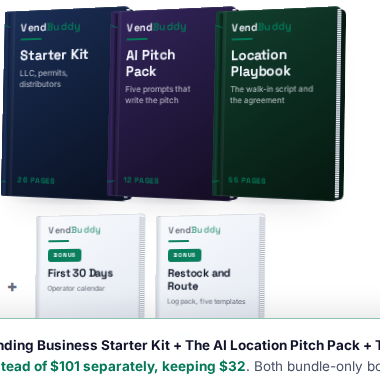
If you get to the end of this and the answer is yes, the kits are the shortcut past the blank page: a 26-page starter kit for the paperwork, a 55-page Location Playbook for the walk-in script and the agreement, and a 12-page AI Pitch Pack. Bought once, from $27, and you keep the files.
Look inside the kits →The worked weekly plan, by where you are in the transition
Three versions, because a separating E-6, a Guard member and a veteran eight years out have completely different weeks.
Separating within 90 days
Now through separation: 2 to 3 hours a week, all of it free. Target list, economics, script rehearsal, and the ethics appointment. Zero purchases.
Terminal leave: 4 mornings of walk-ins, one follow-up morning. Four buildings per morning is a good rate; six is a great one. Expect the yes in the second week.
Post-separation: 90 minutes a week per machine. Second machine at month four if the first is clearing $250 net. Do not stack machines faster than the first one proves the loop closes.
Guard or Reserve, working a civilian job
Setup: 4 to 6 hours a week, and the constraint is the same one every employed person has — you need weekday daytime and you do not have it. Two realistic sources: any hybrid or work-from-home day gives you a long lunch worth three walk-ins, and the day either side of a drill weekend is often already blocked off.
Running: keep the route inside one cluster you can service in a single trip, because a drill weekend or an annual training period removes an entire service window and a spread-out route is what turns that into three stockouts. If you deploy, you need one person with a key and a fill routine before you go — not after. What a paid stocker costs and how to structure it is here.
Veteran already in a civilian career
You are functionally in the same position as everyone else on the working-full-time page, with one genuine edge: you are more likely than the average reader to already have the relationships. Veterans cluster in logistics, facilities, security, public safety and manufacturing, and every one of those is a building with a break room and a facility manager who takes your call. That is not networking advice. That is a list of your first ten prospects.
The numbers, without the recruiting-poster version
To start: $2,000 to $5,000 all in for a first used machine. $1,500 to $3,000 for the machine, $150 to $500 freight, $200 to $400 for the first fill, and a few hundred for permit, insurance and a card reader. Freight and the first fill are the two everyone forgets and they are commonly $700 together. The line-item budget is here.
What one machine earns: an ordinary building grosses $300 to $800 a month and nets $120 to $350 after product, commission and card fees. A genuinely good site — a 24-hour warehouse, a 300-unit apartment complex, a hospital-adjacent building — grosses $1,500 to $3,000 and nets $500 to $1,000. The gap is the building, not the machine and not how hard you work.
What a route earns: before you build a plan around a number, run it. The Income Reality Calculator takes your capital, the hours you actually have and the income you need, and tells you how many machines and how many months that implies. It is deliberately unflattering, and it is the fastest way to find out whether your target is a plan or a wish.
Terminal leave is a finite number of weekday mornings and most of the location hunt is deciding which doors are worth walking through. VendBuddy scores real venues near you by traffic, headcount and category, gives you the best contact on file for each, and models what a machine would net there before you commit - so four mornings go to buildings that can actually say yes. Five free credits, no card.
When the honest answer is no
Four reasons to walk away from this specifically, written plainly because you will not get them from anyone selling you a territory.
- If you are rated for Individual Unemployability and have not spoken to a VSO. Not a maybe. Have the conversation first.
- If you want a team. This is solitary work. Ninety minutes alone with a hand truck, a route sheet and a radio. Plenty of veterans find that restorative and plenty find it hollow, and the second group usually knows within a month. If what you are actually missing is people, a business with employees or a trade with a crew will serve you better than a machine.
- If the plan requires income in sixty days. A first machine placed today produces its first meaningful cash in about a month and repays itself in eight to sixteen. That is a good asset and a bad emergency plan. Get income first, build second.
- If you are buying it to have somewhere to put the transition. This is the one worth sitting with. Separation is a genuine identity event and a business bought at the peak of that is bought at the worst possible moment for judgement. The location-first sequence above costs almost nothing for thirty days, which makes it a good test precisely because it is reversible. If you still want it on day thirty, that is information.
The bottom line
The thing you have that civilians do not is not discipline in the abstract. It is a window of weekday daytime, a reflex for preventive maintenance and route sequencing, and a demonstrated ability to run a checklist on a day you do not feel like it. Those three things map onto the three places ordinary operators fail.
What you also have is a target painted on you by everyone selling a business opportunity between now and your separation date. The defence is boring and effective: sign a location before you buy anything, keep the first machine cheap, and let one building tell you whether you like this work before you build anything on top of it.
Not sure whether to start anything at all yet? The readiness quiz scores you on capital, protected hours, risk tolerance and deadline in about two minutes, and it is willing to tell you not yet. If the answer is already yes, the start page is the shortest path to a first location.
Related reading: starting a business while working full time, the warehouse and 24-hour site playbook, your first $100 in vending, what vending repairs actually cost, route density versus machine count, and whether the vending business is right for you.
Frequently Asked Questions
Can a veteran start a vending machine business?
Yes, and the transition period is unusually well suited to it. Vending has no licensing barrier beyond ordinary state and local permits, the capital requirement is $2,000 to $5,000 for a first placed machine, and the one input that is scarce for everybody else - weekday daytime availability to walk into buildings and ask - is exactly what terminal leave and the transition window give you. The skills that carry over are real rather than flattering: route planning, preventive maintenance discipline, and the ability to execute a boring checklist on the same day every week without motivation.
Are there vending opportunities for veteran-owned businesses?
There are two separate things worth understanding here. The first is federal certification: the Veteran Small Business Certification program run by the Small Business Administration certifies veteran-owned and service-disabled veteran-owned small businesses, and certification is what makes a business eligible to compete for certain set-aside federal contracts. That is a real program with real eligibility rules, and it is worth reading the current requirements at the source rather than from a course. The second is much more ordinary and much more useful early on: many private property managers, franchise owners and facility contacts respond well to a veteran-owned vendor, and saying so on a business card and a machine wrap costs nothing. Neither is a guarantee of any placement, and any program that promises you contracts because of your service should be treated as a sales pitch.
Most first agreements are two pages, not twenty. The contracts walkthrough lays out the clauses that actually matter for the contract, including the termination language operators forget about until they need it.
Can I run a vending business while still on active duty?
Outside employment and private business activity by service members is governed by DoD ethics rules, your service regulations and your command, and the specifics are not something to source from the internet. The parts most people trip on are using your official position, rank or government resources in any way connected to the business, and doing business on an installation, which is separately controlled by the exchange service and the installation commander. Talk to your ethics counselor or legal assistance office before you form anything or ask anyone for a placement. That conversation is free and it is much cheaper than the alternative.
Does starting a business affect VA disability compensation?
VA disability compensation based on a rating schedule is generally not means tested, but Total Disability based on Individual Unemployability is a different benefit with rules about substantially gainful employment, and self-employment income is part of that picture. This is the single most important thing for some veterans on this page and the single easiest thing to get wrong from a forum post. Talk to an accredited Veterans Service Officer or a VA-accredited representative about your specific rating and situation before you start earning through a business. It is a free conversation and the downside of guessing is your benefit.
What is the best business for a transitioning service member with $5,000?
The honest filter is not which business is best in the abstract but which one produces evidence quickly and fails cheaply. A vending route qualifies on both: a single used machine placed in a measured building costs $2,000 to $5,000 all in including freight and the first fill, starts producing cash within days of install, and is resellable equipment rather than a sunk marketing spend. Compare that against the franchise and business-opportunity packages that get marketed hardest to separating service members, where the same $5,000 usually buys a licence, a binder and an obligation.
How do I use terminal leave to start a business?
Treat it as the one block of weekday daytime you will not get again for years, and spend it on location hunting rather than on equipment. Landing a placement requires being physically inside a business between about 9am and 4pm on a weekday, and roughly 20 walk-ins produce one yes. That is four or five mornings of work, which fits comfortably inside a terminal leave window while a full-time job would take two months to produce the same result. Buy nothing until a location is signed. Rules about what transitioning service members may do during leave and during any transition program vary by service and by command, so confirm yours with your transition office.
Is SDVOSB certification worth it for a vending business?
It depends entirely on whether you intend to pursue federal contracting, and for a first machine the answer is usually not yet. Certification opens eligibility to compete for certain set-aside contracts; it does not produce placements at private apartment buildings, gyms or warehouses, which is where almost every first-year vending dollar comes from. The sensible sequence is to build a small private route first, then look at certification if and when government or prime-contractor work is a realistic target. Requirements and processes change, so verify current eligibility and application steps with the Small Business Administration directly.
Can I put a vending machine on a military base?
Not by simply asking a building manager the way you would at a private office park. Retail and vending on installations is controlled by the exchange service and installation authorities, with its own contracting process, and unauthorised solicitation on an installation is a real problem rather than a paperwork one. The near-base economy is a different story and is genuinely underrated: the industrial parks, contractor facilities, gyms, storage yards and 24-hour logistics operations that ring an installation are ordinary private buildings with ordinary decision-makers and a lot of shift workers.
What is selling, which buildings say yes, and the numbers before you buy a machine. Free, confirm from your inbox, unsubscribe in one click. Refer one friend and get 25 VendBuddy credits.
Walk-ins and cold emails find locations. A small site with your own machine photos and a request-a-machine form lets the next one find you. Around machine three to five, an AI builder drafts it in an evening. Wix is the mature site builder; Base44 also builds working tools like a quote form. Start with the AI website walkthrough or Wix vs Base44.
General information, not legal, tax or financial advice. Rules change, so check the official source. Revenue and income figures are examples, not promises. See our terms.