- Location first. Machine second. A machine with no home is a $2,500 object with a holding cost that quietly pushes you into a bad site.
- The whole plan is 30 buildings, 20 walk-ins, one yes. That is four mornings of work, not a personality transplant.
- Four to eight weeks from deciding to first collected cash is the honest range, and almost all the elapsed time is the location step.
- Budget $2,000–$5,000 all in — and remember the two costs everybody forgets, freight and the first fill, which are commonly $700 between them.
- Your first $100 is not the point. It is proof the loop closes: ask, install, fill, collect. Everything after that is repetition.
The gap between reading about vending and having done it is not knowledge. It is a first collected dollar — the moment the abstraction becomes a coin box with money in it and the whole thing stops being a plan. This is the fastest honest route to that moment, in thirty days, in order.
Fair warning about what this page is not. It is not a claim that you will make $100 in thirty days; depending on where the location step lands, your first collection may fall in week five or six. What it is: the shortest sequence that produces a first collected dollar without needing luck, and without spending money on the thing everybody spends money on first.
The mistake that costs everybody four months
Almost every stalled beginner made the same move. They bought a machine.
It is completely understandable. Buying a machine feels like starting, it is a decision you can make alone on a laptop at 11pm, and it produces a physical object. Walking into a building and asking a stranger for space feels like starting a fight with yourself.
The problem is what an unplaced machine does to your judgement. It sits in a garage costing you storage, guilt and the vague sense that the clock is running — and then the first building that says yes gets accepted regardless of whether it is any good, because ending the situation has quietly become more important than picking well. That is how people end up with a machine in a 40-person office grossing $180 a month, concluding that vending does not work.
Inverted, everything gets easier. A signed location tells you which machine to buy, in what size, with what mix, and gives you a real deadline. It also makes the machine financeable, because equipment is its own collateral and there is now a demonstrable place for it to earn. The full version of that argument is here, and if you have already bought one, the recovery path is here — it is a setback, not a disaster.
Days 1–3: pick the ground, not the machine
You are choosing a radius, not a city. Three to five miles from home or from your commute, because every hour of driving is an hour not spent doing the thing that produces income, and a tight cluster is the whole basis of route economics later — see route density versus machine count.
Inside that radius, build a list of 30 buildings that share three traits: 50 or more people on site, no convenient food alternative, and a decision-maker who works in the building. That third one is the filter that saves you months. A building with a corporate facilities department in another state is a six-month sales cycle. A building where the owner is in the office is a ten-minute conversation.
The categories that fit, in rough order of how often they say yes:
- Small manufacturing, machine shops and trade contractors — shift workers, no nearby food, owner on site.
- Independent gyms and martial arts studios — captive, thirsty, and the owner is behind the desk.
- Self-storage facilities and car dealerships — long dwell time, bored people, one manager decides.
- Older multi-tenant office parks — the ones without a single facilities owner, where the machine is nobody’s job.
- Buildings with a dark or broken machine already in them — the highest-yield prospecting available, because the building already agreed to have vending once. That play is worth its own page.
Two minutes of scoping beats two weeks of driving. The free Opportunity Map scores any US ZIP on population, employment and income with no account, so your 30 buildings come from the strongest area near you rather than the closest one. The headcount thresholds are here if you want to kill weak candidates before driving to them.
Picture the machines paying you while you sleep
That’s the real promise of vending — income that doesn’t cost you your time, and a life on your own terms. VendBuddy turns this guide into a step-by-step plan so you actually build it instead of just reading about it. Start free today.
Start building free →Days 4–14: twenty doors
This is the whole business, compressed into ten days. Everything before it is preparation and everything after it is logistics.
The arithmetic: plan on 20 walk-ins for one yes. Some operators convert better, a few get lucky on door three, and 5 to 15 percent is the normal band. That number is not discouraging, it is liberating — because 20 doors is four mornings, and once you know the denominator, a no stops being a verdict and becomes a tally mark.
Go between 9am and 11am on a weekday, which is when managers are in and not yet buried. Walk in, ask for whoever handles the building or the break room, and say roughly this:
Four things are doing the work in that paragraph: it is short, it leads with their benefit, it names the cost as zero, and it ends with a question that has an easy answer. The full walk-in script with the twelve objections that come back is worth reading before day four, and the negotiation guide covers commission once somebody says yes.
Track every visit: building, person, answer, and a date to follow up. A meaningful share of first locations come from the second conversation rather than the first, and the operators who get them are simply the ones who wrote down the name.
Days 15–21: buy the machine the building asked for
Now, and only now, spend money — and spend it on what that specific building needs rather than on what looked good online.
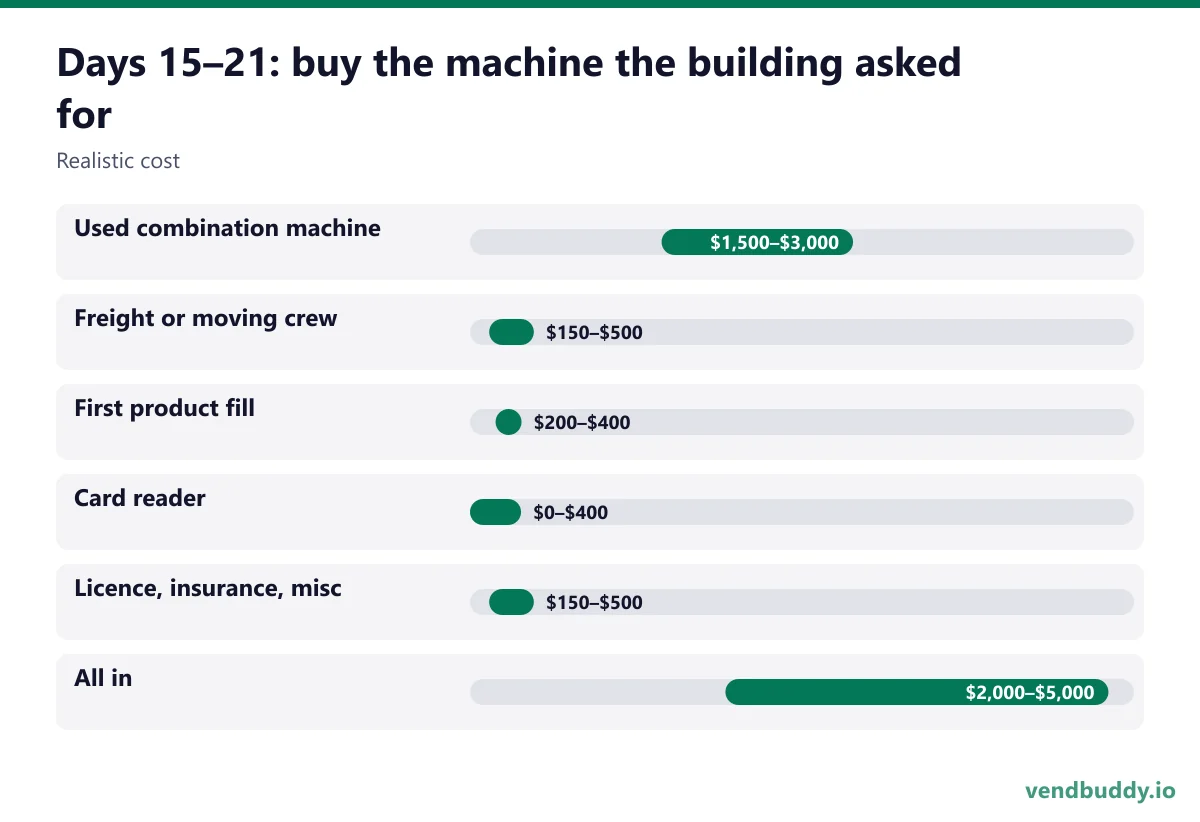
| Line item | Realistic cost | Note |
|---|---|---|
| Used combination machine | $1,500–$3,000 | Combo beats separate snack and drink units for a first placement. |
| Freight or moving crew | $150–$500 | The cost everybody forgets. Machines weigh 600–800 lbs. |
| First product fill | $200–$400 | The other cost everybody forgets. |
| Card reader | $0–$400 | Cash-only machines are invisible to most customers under 30. |
| Licence, insurance, misc | $150–$500 | Varies hugely by state. |
| All in | $2,000–$5,000 | Financeable against the machine once a location is signed. |
Buy used and inspect properly — the 15-point pre-purchase inspection is here, and it is the difference between a bargain and inheriting somebody else’s compressor problem. If cash is the constraint, every financing route is compared here, and the signed location is what makes those conversations go well.
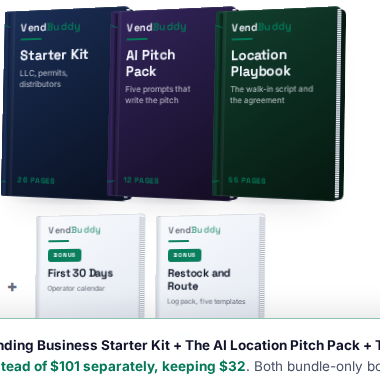
If you get to the end of this and the answer is yes, the kits are the shortcut past the blank page: a 26-page starter kit for the paperwork, a 55-page Location Playbook for the walk-in script and the agreement, and a 12-page AI Pitch Pack. Bought once, from $27, and you keep the files.
Look inside the kits →Days 22–30: install, fill, collect
Install. Do not move a full-size machine alone with optimism and a friend’s pickup — the solo move guide exists because people try. Position it where people already stand: near the entrance, the break room door, or the time clock. Three feet of difference in placement is worth more than any product decision you will make this year.
Fill it with 12 to 16 SKUs, not 40. Bottled water, a regular and a zero-sugar cola in 20oz, one sports drink, one energy drink, Doritos in two flavours, one other salty chip, three or four of the standard candy bars, one gummy, one protein or breakfast bar. Roughly 60/40 drinks to snacks by slot count, because drinks turn faster and carry the transaction. Price for 40–50% cost of goods. The full starter planogram is here.
Then leave it alone for ten days. This is genuinely hard and it matters. You will want to check it daily. Resist, because you are collecting data, and data taken too early is noise — the first few days at any new machine are novelty traffic that tells you nothing about the steady state.
Collect. Somewhere around day 26 to 30, open the box. That number will probably be small — $40, $90, $140 — and it does not matter what it is. What matters is that the loop closed: you asked, somebody said yes, you installed, it sold, and you took cash out of a machine that was not there a month ago. Everything from here is repetition and correction.
What the first $100 actually tells you
Very little about the money, and quite a lot about everything else.
It tells you the pitch works, which is the part most people never find out. It tells you which of your assumptions about the building were wrong, because the sales report will not match what you expected. And it gives you the only credential that matters in the second conversation with a property manager: you already run machines nearby.
What it does not tell you is what the machine earns. A new machine needs 60 to 90 days to settle as you correct the mix and the prices — reading the sales report properly is how you find the dead slot, and the fifteen revenue levers is what you work through once you have a baseline to improve.
The bottom line
Thirty days, four steps: pick a tight radius and list 30 buildings, walk into 20 of them, buy the machine the winning building actually needs, install it and leave it alone long enough to learn something. The order is the entire trick, and it is the opposite of what feels natural.
The first hundred dollars is not income. It is evidence — that the loop closes, that you can do the uncomfortable part, and that the next one is just this again with less guessing.
The slowest part of week one is deciding which doors to knock on. VendBuddy scores real venues near you by traffic, headcount and category, hands you the best contact on file for each, and models what a machine would net there before you commit. Start free with 5 credits, no card required.
Related reading: how long it takes to get your first vending location, machine or location first, you already bought a machine, now what, the complete startup guide, the cold pitch script that works, and what nobody tells you about your first machine.
Frequently Asked Questions
How do I make my first money with a vending machine?
Secure a location before you own a machine, then buy a machine sized to that building. The sequence that gets there fastest is: pick a two to three mile radius, list 30 candidate buildings, walk into 20 of them in ten days, get one yes, buy a used machine for $1,500 to $3,000, install it, and collect. Realistically that is four to eight weeks from decision to first collected cash, with most of the elapsed time sitting in the location step rather than anywhere else.
Prices move around more than any guide keeps up with. The machine finder is where we keep the current line-up, sorted by what a location that size can realistically support rather than by what looks impressive.
How long before a vending machine makes money?
A placed machine takes cash from day one, but your first meaningful collection is usually two to three weeks after install, once the first fill has partly sold through and the site has stopped being a novelty. From the day you decide to do this at all, four to eight weeks to a first collected dollar is the honest range, and the machine typically needs 60 to 90 days to settle into its real monthly number as you correct the product mix.
Should I buy the vending machine or find the location first?
Location first, essentially always. A machine without a location is a $2,500 object in your garage with a holding cost and no income, and it silently pressures you into accepting a bad site just to end the situation. A location without a machine is an asset: you can now buy the right size and type for a building whose traffic you have actually seen, and you have a deadline that makes you move. The only exception is a used machine at a genuinely exceptional price you can store cheaply.
How much does it cost to get your first vending machine placed?
Plan on $2,000 to $5,000 all in for a used combination machine: $1,500 to $3,000 for the machine, $150 to $500 for freight or a moving crew, $200 to $400 for a first product fill, and a few hundred for a business licence, insurance and a card reader. The two costs first-timers forget are freight and the first fill, and between them they are commonly $700.
Can I start vending with no money?
Not truly, but you can start with much less than the usual figure by inverting the order. Securing a location costs nothing but afternoons, and a signed location makes the machine financeable, because the equipment is its own collateral and there is now a demonstrable place for it to go. That is a genuinely different position from asking a lender to fund a machine with nowhere to put it. The realistic floor is a few hundred dollars of cash plus a financed machine.
How many buildings do I have to visit to get one vending location?
Plan on 20 walk-ins for one yes as a working assumption. Some operators do better and a few get lucky on the third door, but a conversion rate somewhere between 5 and 15 percent is normal and it is not a reflection on you. The number matters because it converts a vague fear into a schedule: 20 doors is four mornings. Most people who fail at this stage did not get rejected 20 times, they got rejected three times and stopped.
What is the fastest way to get a first vending location?
Target buildings where the machine is nobody’s job and the decision-maker is on site: small manufacturing and trade shops, independent gyms, self-storage facilities, older multi-tenant office parks, and car dealerships. Avoid anything with a corporate facilities department, because the decision is made in another state and takes months. Also look for buildings with a dark or broken machine already in them, which is the highest-yield prospecting there is.
How much does a first vending machine make per month?
A first machine at a modest building commonly runs $300 to $800 gross a month, netting perhaps $120 to $350 after product, commission and card fees. A genuinely good site grosses $1,500 to $3,000 and nets $500 to $1,000. The gap between those two outcomes is the building, not the machine and not the products, which is the entire reason this page argues for securing the location before spending the money.
What is selling, which buildings say yes, and the numbers before you buy a machine. Free, confirm from your inbox, unsubscribe in one click. Refer one friend and get 25 VendBuddy credits.
Every operator we talk to wants fewer cold calls. The ones who get there have a Google Business Profile and a simple site a manager can check before replying. AI builders make that an evening job now. Wix is the mature site builder; Base44 also builds working tools like a quote form. Start with the AI website walkthrough or Wix vs Base44.
General information, not legal, tax or financial advice. Rules change, so check the official source. Revenue and income figures are examples, not promises. See our terms.