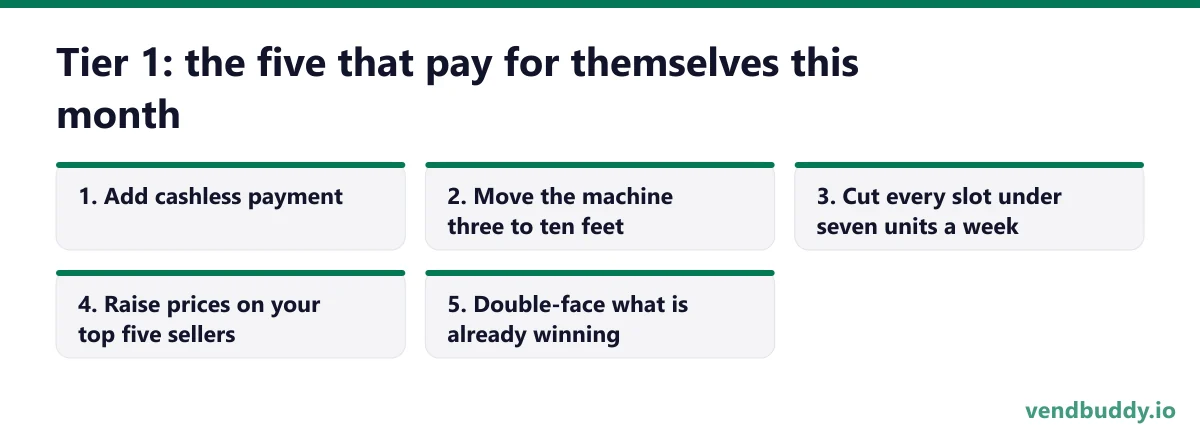
- Five changes move most machines 20–50% and none of them require buying equipment: cashless, placement, cutting dead slots, price on top sellers, double-facing.
- Cashless is the single biggest lever on a cash-only machine — 30–50% inside 60 days, because customers under 30 are not choosing against you, they cannot pay you at all.
- Three feet beats three new products. Machines earn from people who pause, not people who pass.
- Raise prices on your fastest movers, not across the board. 25 cents on a 20-unit-a-week slot is $260 a year from one coil at zero extra cost.
- Anything under seven units a week is a dead slot, not a slow one. Cut it in week two, not month three.
A machine that grosses $700 a month and a machine that grosses $1,600 a month are usually the same machine in the same building. The difference is a stack of small decisions, most of which cost nothing and none of which are secrets. Here are fifteen of them, ordered by return per hour of effort rather than by how interesting they are.
One framing note before the list. This page assumes the machine basically works — it is placed, it sells something, and the building has people in it. If sales are near zero rather than merely disappointing, that is a different problem with a different page: why a vending machine is not making money is the diagnostic, and it usually ends at headcount.
Tier 1: the five that pay for themselves this month
1. Add cashless payment
If the machine takes only cash, nothing else on this list matters as much. The lift is 30 to 50 percent within 60 days on the same foot traffic, and above 60 percent at gyms, offices and student housing. The mechanism is not preference — it is that a large share of customers under 30 carry no cash whatsoever, so a cash-only machine is not losing a comparison, it is invisible.
The economics are not close. A reader costs roughly $300 up front plus $7 to $13 a month and about 5.95 percent per transaction. On a machine grossing $1,000 that is around $70 a month in total, against $300 to $500 of additional sales. The full fee breakdown is here and the three-way reader comparison is here.
On the hardware itself: Nayax is the reader most multi-machine operators standardise on, largely because the telemetry and the payments arrive as one bill rather than two, and it is also the one live reader integration inside VendBuddy — a bias worth knowing about when you read that sentence. Pricing is quoted per route rather than published, so ask for hardware cost per machine, monthly fee per device and the transaction rate including the fixed per-transaction component, and hold the answer against your actual machine volume. (Affiliate link — VendBuddy may earn a commission at no extra cost to you. Cantaloupe and 365Pay are not affiliates of ours and we earn nothing if you pick them.)
2. Move the machine three to ten feet
The cheapest lever in vending, and the most consistently underused. Machines earn from people who pause, not from people who pass. Moving from a corridor into the break room, from beside a door to beside the time clock, from a dim corner into the light — these regularly produce double-digit revenue changes and cost one conversation with the property manager.
Walk the building at shift change and watch where people actually stop. That is where the machine goes. The placement guide covers the full set of micro-moves.
3. Cut every slot under seven units a week
Seven units a week is roughly one a day, and anything below it is a dead slot rather than a slow one. Pull the sales report weekly, sort by velocity, and cut anything in the bottom third for two consecutive weeks. Do not wait for a third data point and do not give it "a little longer" — every day a wrong item occupies a coil is revenue that had somewhere better to be.
The one exception: a high-margin item above about $3.50 retail moving five a week can be worth keeping if it fits the building. Reading the report properly is the skill underneath this whole tier.
4. Raise prices on your top five sellers
Not across the board — on the fast movers, by 25 cents, one machine at a time. A slot selling 20 units a week gains $260 a year from a single quarter with no additional cost of goods and no extra work.
If the spend is going on plastic anyway, the card choice is worth ten minutes. Most operators we talk to land on the Bilt card, not for what it pays on pallets but because the rent payment earns too. Referral link, and the honest caveat is that a carried balance beats what any of these points are worth. Affiliate link, so we may earn a commission at no extra cost to you.
Vending demand is far less price-sensitive than operators believe, because the customer is comparing against walking somewhere else, not against the supermarket shelf. Test for four weeks and watch unit velocity: if volume holds within 10 percent, the increase is free money and you should do it again next quarter. The price-adjustment framework is here.
5. Double-face what is already winning
When something moves at 1.5 to 2 times the velocity of its neighbours, give it two columns. Two facings mean more visual weight, fewer stockouts on your best earner, and a clear signal to the buyer. It is the rare change that increases revenue and reduces service effort at the same time.
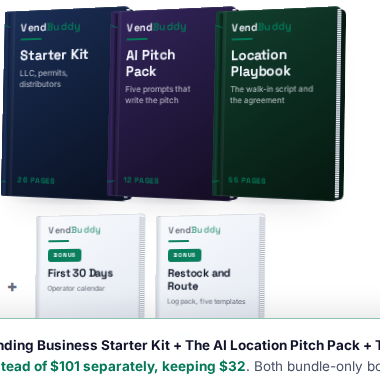
If you get to the end of this and the answer is yes, the kits are the shortcut past the blank page: a 26-page starter kit for the paperwork, a 55-page Location Playbook for the walk-in script and the agreement, and a 12-page AI Pitch Pack. Bought once, from $27, and you keep the files.
Look inside the kits →Tier 2: the product-mix levers
6. Stock for the building, not for a national list
Before ordering a single case for a machine, write down three things about the site: who works or lives there, what hours they are present, and what the nearest alternative is and how long it takes to get to. A 24-hour fulfilment centre and a 200-bed assisted-living facility are not the same machine with different branding.
Energy drinks dominate industrial and night-shift sites and barely move at a retirement community. Better-for-you snacks outperform in offices and die in a machine shop. The weird-winner patterns and regional bestseller data are both more useful than any national top-ten.
7. Rebalance toward drinks
Roughly 60/40 drinks to snacks by slot count is the default for a reason: drinks turn faster, carry the transaction, and are less sensitive to the guilt calculus that suppresses snack purchases. Machines skewed heavily to snacks are usually skewed that way because the operator likes snacks.
8. Trade candy bars for higher-margin items
Standard candy bars sit near a 43 percent margin, which is the worst use of prime shelf space in most machines. Instant ramen runs near 78 percent, energy drinks near 57, beef jerky above 55, and incidentals such as earplugs, lip balm and phone cables can exceed 90. The margin ranking across the full catalogue is here and the margin arithmetic is explained here.
Margin does not decide a slot on its own — a 90 percent item selling twice a month loses to a 45 percent item selling daily — but among items of similar velocity, margin is the tiebreaker and most operators never apply it.
9. Run two or three experiment slots permanently
Reserve two to three coils in every machine for things that do not obviously belong: household basics in apartments, PPE in industrial sites, premium protein in gyms, phone accessories almost anywhere. Run each for four weeks without touching it. Most will fail. The ones that do not tend to become the highest-velocity slot in the machine, because they are answering an urgent need with no nearby alternative.
10. Adjust seasonally, thirty days ahead
Operators who never rotate lose up to 40 percent of revenue in off-peak months. Winter wants hot beverages, instant soup and spicy snacks; summer wants extra water, sports drinks and electrolytes with chocolate pulled out entirely. Order the change 30 days before you need it rather than the week the weather turns.
Picture the machines paying you while you sleep
That’s the real promise of vending — income that doesn’t cost you your time, and a life on your own terms. VendBuddy turns this guide into a step-by-step plan so you actually build it instead of just reading about it. Start free today.
Start building free →Tier 3: the operational levers
11. Restock on data, not on a calendar
The metric that matters is stockout hours, not visit frequency. Any day your top seller is empty is a day the machine earns a fraction of its potential, and any trip to a machine that did not need one is an hour taken from sales. Telemetry converts a calendar route into a sales-triggered one and typically removes 20 to 30 percent of trips while cutting stockouts. Par levels and visit cadence are covered here.
12. Fix the small physical things
A flickering light, a scuffed front, a coin return that sticks, a delivery flap that needs two hands. Each one costs a small number of sales a week from people who decided the machine looked unreliable. The list of small touches is genuinely one of the highest-return hours in this business.
13. Put your best earner at eye level
The middle two rows outsell the top and bottom rows substantially. Whatever your highest-velocity item is, it belongs there, and the bottom row belongs to bulky low-margin filler.
14. Ask the building what they want
A three-question survey taped to the machine, or handed to the property manager to email around, does two things at once. It tells you what to stock, and it makes the occupants feel some ownership over the machine, which measurably increases usage. It is also an excuse for a conversation with the decision-maker that is not about renewing anything.
15. Build a combo or bundle price
A drink plus a snack at a small discount raises average transaction value more reliably than any single-item price change, because the customer who was buying one thing is now buying two. It works best where dwell time is long and the machine is the only option.

What order to do them in
Working top to bottom is the correct instinct, but the honest sequence for a single underperforming machine is slightly different:
- Week 1: pull four weeks of sales data. You cannot improve what you have not measured, and half the decisions below become obvious once you have it.
- Week 1: add cashless if the machine is cash-only. Nothing else competes.
- Week 2: ask to move it. The conversation costs nothing and the answer is usually yes.
- Week 2: cut every slot under seven a week, double-face the top five, move the best earner to eye level.
- Week 4: raise prices on the top five by 25 cents and watch velocity for a month.
- Month 2: rework the mix for the building, start two experiment slots, and set the seasonal calendar.
- Month 3: switch the restock cadence to sales-triggered and stop driving to machines that do not need you.
If you work that list and the machine still grosses under $400, the problem is almost certainly the building rather than anything you can stock. Rescue or pull is the decision framework for that, and it is not a failure — a machine that moves to a better site is the entire reason equipment beats a lease.
The bottom line
Almost nothing on this list is clever. Cashless, three feet, cut the dead slots, charge a quarter more, stack the winner twice. The reason machines sit at $700 instead of $1,600 is not that operators do not know these things — it is that none of them feel like progress in the way that buying another machine does.
Work the machine you have before you buy the next one. It is the cheapest route to a bigger route.
If you want to see which machine pays you the least for each restock trip before you decide what to fix first, the Vending Profit Spreadsheet lays every machine out on one sheet.
Before you conclude a machine is underperforming, check what the site can actually support. VendBuddy scores real venues by traffic, headcount and category, and models net profit and payback per location, so you know whether you have a stocking problem or a building problem. Start free with 5 credits.
Related reading: the most profitable vending products, vending machine profit margin explained, best products to stock, why a machine is not making money, when to adjust prices, restocking efficiently, and how to read your sales reports.
Frequently Asked Questions
How do I increase vending machine sales?
In order of return per hour of effort: add cashless payment if the machine is cash-only, move the machine three to ten feet toward where people already stand, cut every slot selling fewer than seven units a week and replace it with an experiment, raise prices on your top five sellers by 25 cents, and double-face anything moving at 1.5 times its neighbours. Those five typically move a machine 20 to 50 percent before you have touched anything structural, and none of them require buying equipment.
How much does a card reader increase vending machine revenue?
Operator surveys and route data consistently show a 30 to 50 percent lift within 60 days on a previously cash-only machine, and over 60 percent at gyms, offices and student housing. The mechanism is simple: a large share of customers under 30 carry no cash at all, so a cash-only machine is not losing a sale to a competitor, it is invisible to them. Against a roughly $70 a month all-in cost on a machine grossing $1,000, the lift covers the fees five to seven times over.
Should I raise my vending machine prices?
Usually yes, and specifically on your fastest movers rather than across the board. A 25 cent increase on an item selling 20 units a week adds $260 a year from one slot with no additional cost, and vending demand is far less price-sensitive than operators fear because the customer is comparing against walking somewhere, not against the supermarket. Test one machine for four weeks and watch unit velocity; if volume holds within 10 percent, the increase is free money.
What is the highest-margin vending machine product?
Non-food and prepared items beat snacks badly. Instant ramen sells at roughly a 78 percent margin, energy drinks near 57 percent, beef jerky above 55 percent, and incidentals such as earplugs, lip balm and phone cables can exceed 90 percent. Traditional candy bars sit near 43 percent, which is the worst use of prime shelf space in most machines. Margin alone does not decide a slot, though - a 90 percent margin item selling twice a month loses to a 45 percent item selling daily.
How often should I restock a vending machine?
Restock on sales data rather than on a calendar. Weekly is the default for a busy site and every two to three weeks is fine for a quiet one, but the number that matters is stockout hours: any day a top seller is empty is a day the machine earns a fraction of its potential. Telemetry converts a calendar route into a sales-triggered one and typically removes 20 to 30 percent of trips while simultaneously reducing stockouts.
Why is my vending machine not making money?
In order of frequency: the building has fewer daily visitors than assumed, the machine is placed where people pass rather than where they pause, the product mix was chosen from a national list rather than for that specific population, it is cash-only, or the prices are set from fear rather than from data. Only the first is difficult to fix, and it is the one that argues for measuring headcount before placing a machine rather than after.
Does moving a vending machine a few feet really matter?
More than almost anything else you can change. Machines earn from people who pause, not from people who pass. Three to ten feet - from a corridor into the break room, from beside a door to beside the time clock, from a dim corner to under a light - regularly produces double-digit revenue changes because it converts foot traffic into dwell time. It costs nothing except asking the property manager, and it is the first thing to try on an underperforming machine.
How do I get more vends per day from one machine?
Increase the number of people who see it, the number of seconds they spend near it, and the chance they can pay. That is placement, dwell time and cashless, in that order. Then work the slot level: cut anything under seven units a week, double-face your top five, keep the highest-velocity item at eye level, and stock for the building rather than for a national bestseller list. A well-matched top slot can hit 15 to 25 vends a day; a mismatched machine averages 3 to 5 across all slots.
What is selling, which buildings say yes, and the numbers before you buy a machine. Free, confirm from your inbox, unsubscribe in one click. Refer one friend and get 25 VendBuddy credits.
General information, not legal, tax or financial advice. Rules change, so check the official source. Revenue and income figures are examples, not promises. See our terms.