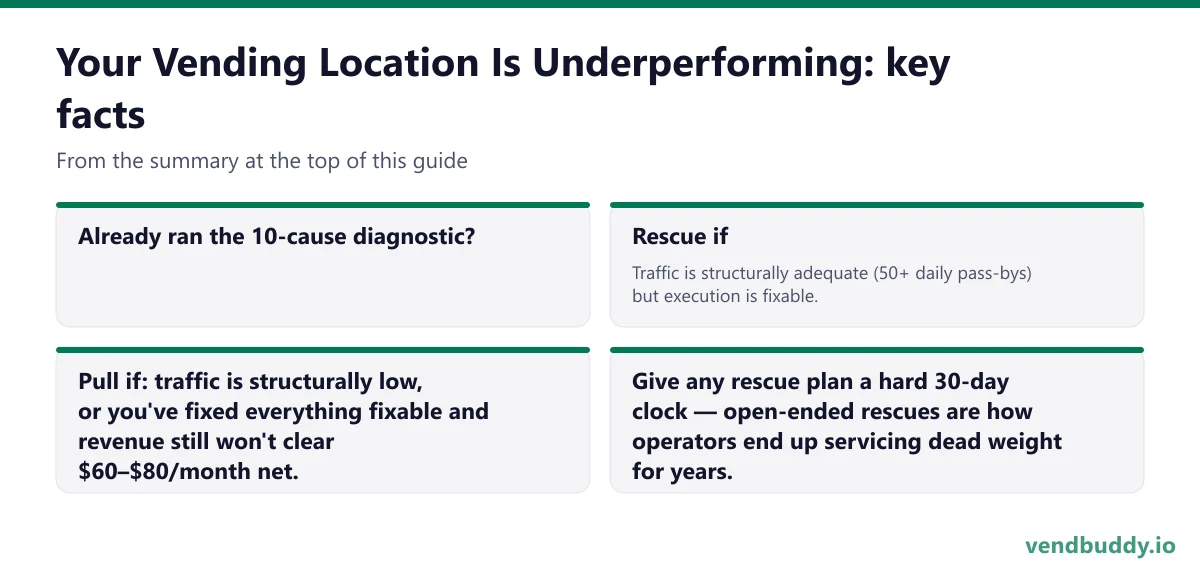
- Already ran the 10-cause diagnostic? This is the decision layer that comes after: rescue or pull.
- Rescue if: traffic is structurally adequate (50+ daily pass-bys) but execution is fixable.
- Pull if: traffic is structurally low, or you’ve fixed everything fixable and revenue still won’t clear $60–$80/month net.
- Give any rescue plan a hard 30-day clock — open-ended rescues are how operators end up servicing dead weight for years.
- Pulling a machine well keeps the relationship warm for your next pitch in that building.
Every operator eventually stands in front of an underperforming machine asking the same question: fix it, or pull it? Most guides stop at diagnosing what’s wrong. This one is about the decision itself — a scorecard for telling a fixable location from a dead one, a 30-day rescue clock so you don’t babysit it forever, and the exact words to use with the location owner when the answer is to pull the machine.
Part of our complete guide: scale a vending machine business.
The rescue-or-pull scorecard
Score the location honestly on these five factors. Each is worth up to 2 points (0 = bad sign, 1 = mixed, 2 = good sign).
| Factor | 0 points | 2 points |
|---|---|---|
| Confirmed daily foot traffic | Under 30 people pass the machine daily | 50+ people pass the machine daily |
| Ramp stage | Past 90 days in place, revenue flat since week 4 | Under 90 days in place, revenue trending up week over week |
| Hardware and cashless | Cash-only, or unresolved jam/reader errors | Cashless active, no open mechanical issues |
| Product-mix fit | Never adjusted planogram to actual sales data | Adjusted mix at least once using real sell-through |
| Location relationship | Contact unresponsive, commission demand escalating | Contact cooperative, open to trying changes |
7–10 points: rescue. You have a structurally sound location with a fixable execution problem. Run the 30-day plan below.
4–6 points: conditional rescue. Fix the cheap, fast items (cashless, product mix, cleanliness) first. If the score doesn’t move to 7+ within 30 days, pull.
0–3 points: pull now. You are optimizing a location that was never going to work. Every week you leave a machine here is a week it isn’t earning somewhere else. If you haven’t already run the full cause-by-cause diagnostic, our 10-cause breakdown of why a machine isn’t making money is the right next read before you finalize the score — it covers each of these factors in depth with fixes. This piece assumes you’ve done that homework and need the go/no-go call.
The 30-day rescue plan
If the location scored 7+, run this sequence. It is deliberately cheap — every step costs time, not capital, so you can abort at any point without sunk-cost pressure.
| Week 1 | Confirm cashless is active, run a mechanical audit, and pull 30 days of per-SKU sales data. |
| Week 2 | Swap the bottom 20–30% of SKUs for proven top sellers in the same category; deep-clean the machine exterior. |
| Week 3 | Ask the location contact for a 60-day trial reposition to a higher-traffic spot in the same building — framed as free and reversible. |
| Week 4 | Compare week-4 revenue to the week-1 baseline. Up 20%+ and trending: keep going. Flat or down: move to the exit script below. |
Note what this plan does not include: renegotiating commission down, which rarely moves the needle on a traffic problem, and buying new hardware speculatively before you’ve confirmed cashless and mechanicals are the actual gap. Spend on fixes only after the data tells you which of the five scorecard factors is actually broken.
The single biggest reason operators keep a dying location too long is having nowhere better to move the machine. VendBuddy’s Lead Finder and Opportunity Map surface higher-traffic prospects near you so you have a destination ready before you pull.
Picture the machines paying you while you sleep
That’s the real promise of vending — income that doesn’t cost you your time, and a life on your own terms. VendBuddy turns this guide into a step-by-step plan so you actually build it instead of just reading about it. Start free today.
Start building free →The signs a location can’t be rescued
- Traffic count under 30/day, confirmed by manual count. No amount of product or price optimization fixes a building with too few people in it.
- You’ve already fixed cashless, product mix, and cleanliness and revenue hasn’t moved in 30 days. You’ve exhausted the cheap levers; what remains is a structural traffic or demographic mismatch.
- The building population has permanently shrunk — a tenant moved out, a shift was cut, an office went remote-first. Check whether the drop is temporary or structural before writing it off; see our note on seasonality in the underperformance diagnostic guide.
- The commission ask keeps climbing while performance stays flat. A location contact demanding more for less is telling you they don’t value the placement — see commission rate benchmarks to know if the ask is even reasonable before you consider paying it.
- Net contribution after commission, COGS, and your allocated costs is under $60–$80/month even under a realistic best case. At that point the slot on your route is worth more elsewhere. Run the exact math with the VendBuddy ROI calculator before you decide.
The exit conversation, word for word
Pulling a machine badly burns a relationship you may want again in two years when the building changes hands or the competing vendor fails. Pulling it well keeps the door open. Use language that is honest, unemotional, and forward-looking — never framed as the location’s fault.
Opening: “I wanted to give you a heads-up in person rather than just send a notice. I’m going to be relocating the machine over the next couple weeks. It’s not a reflection on the space or on working with you — I’m consolidating my route onto higher-traffic stops so I can service everyone better, and the numbers here just haven’t supported keeping a dedicated machine.”
If they push back or offer concessions: “I appreciate that, genuinely. If the situation changes — more staff on site, a new shift added — I’d welcome the chance to come back and take another look.”
Logistics line: “I’ll coordinate pickup for [specific date] and make sure it’s quick and doesn’t disrupt anything on your end. Is there a time that works best for your team?”
Closing the door softly: “Thanks for hosting the machine — if you ever hear of another spot that could use one, I’d love an introduction.”
Notice what this script avoids: blaming the location, over-explaining the financials, or leaving the relationship on a sour note. Check your placement contract’s notice-period clause before you have this conversation — most agreements specify 30 days, and giving proper notice protects you if you ever need that contact as a reference. See vending contracts 101 for what your agreement should specify on termination notice.
Pulling the machine: logistics
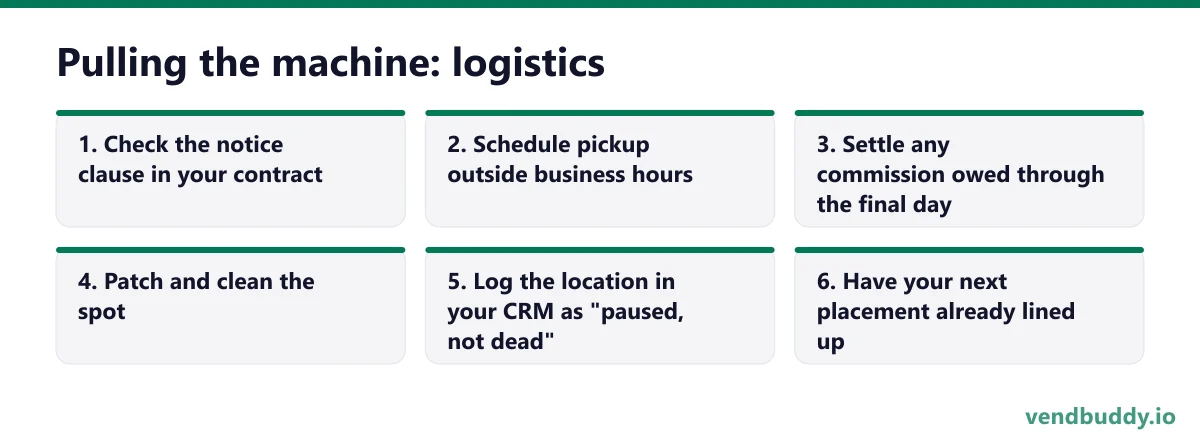
- Check the notice clause in your contract and give it in writing, even after the verbal conversation.
- Schedule pickup outside business hours where possible — early morning or after close minimizes disruption and leaves a good last impression.
- Settle any commission owed through the final day before you leave, so there is no dangling paperwork.
- Patch and clean the spot where the machine sat — leave the space as good as or better than you found it.
- Log the location in your CRM as “paused, not dead” with the reason and date, so a future team member (or you, in a year) doesn’t waste time re-pitching a spot without knowing the history.
- Have your next placement already lined up so the machine sits idle for days, not weeks. An idle machine is a depreciating asset earning nothing.
Frequently Asked Questions
How long should I try to rescue an underperforming vending location?
Cap it at 30 days per rescue attempt. If a location scores 7+ on the scorecard above and a 30-day plan doesn’t move revenue, it likely won’t with more time either — the exception is a location under 90 days old, which may still be in its normal ramp period.
Should I renegotiate commission before deciding to pull a machine?
Only if commission is the confirmed problem, not traffic or product mix. Renegotiating commission on a low-traffic location just delays an inevitable pull; see commission rate benchmarks to check whether the ask is actually out of line first.
What should I say to a location when pulling a machine?
Keep it short, honest, and forward-looking: frame it as route consolidation rather than the location’s fault, give proper written notice per your contract, and leave the door open for a future placement if conditions change.
Is it better to relocate a machine or sell it?
Relocating almost always beats selling. A machine that isn’t working in one spot is frequently a strong performer 10 minutes away in a better-fit location — selling locks in a loss on equipment that still has years of earning life left in it.
Related: run the full 10-cause diagnostic before you score a location, check whether the commission ask is reasonable in our commission benchmarks guide, and review vending contracts 101 for notice-period language. See what machines actually earn per month to set a realistic bar for what “working” looks like, and use the ROI calculator plus machine finder and opportunity map to line up your next placement before you pull.
What is selling, which buildings say yes, and the numbers before you buy a machine. Free, confirm from your inbox, unsubscribe in one click. Refer one friend and get 25 VendBuddy credits.
Every operator we talk to wants fewer cold calls. The ones who get there have a Google Business Profile and a simple site a manager can check before replying. AI builders make that an evening job now. Wix is the mature site builder; Base44 also builds working tools like a quote form. Start with the AI website walkthrough or Wix vs Base44.
General information, not legal, tax or financial advice. Rules change, so check the official source. Revenue and income figures are examples, not promises. See our terms.