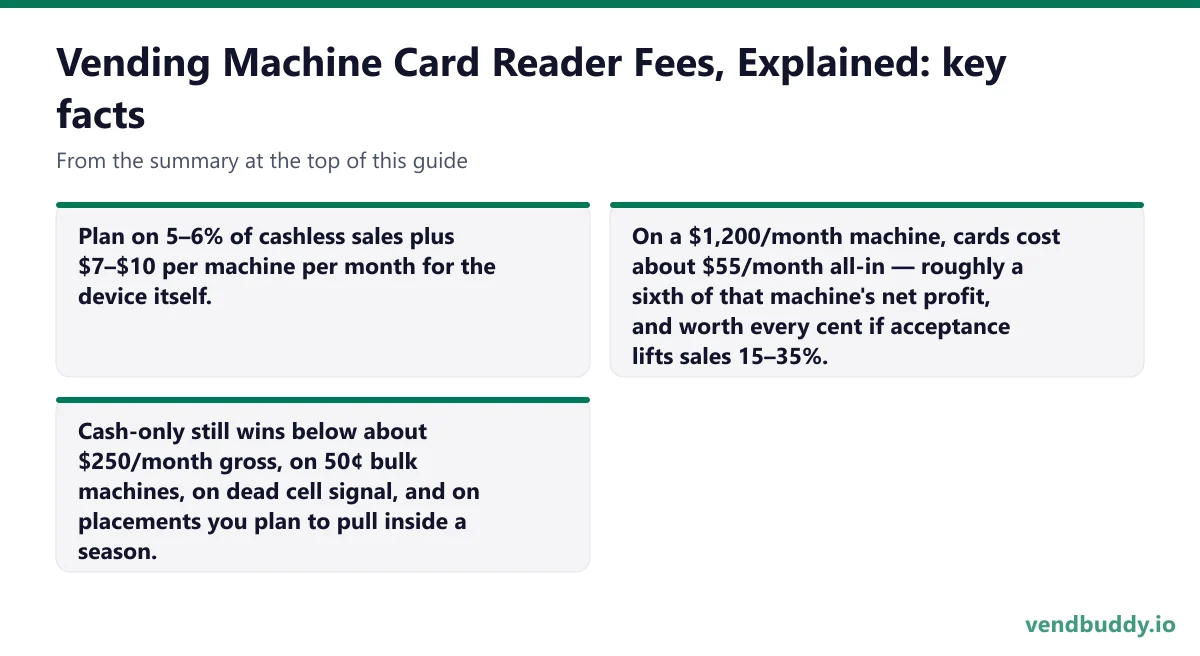
- Plan on 5–6% of cashless sales plus $7–$10 per machine per month for the device itself. That is the honest all-in number, not the headline rate.
- The fixed cents matter more than the percentage. A 2.9% + 5¢ deal costs 5.4% on a $2.00 snack, 6.9% on a $1.25 item, and 4.3% on a $3.50 energy drink. Same contract, wildly different bill.
- On a $1,200/month machine, cards cost about $55/month all-in — roughly a sixth of that machine’s net profit, and worth every cent if acceptance lifts sales 15–35%.
- Cash-only still wins below about $250/month gross, on 50¢ bulk machines, on dead cell signal, and on placements you plan to pull inside a season.
- Want the hardware comparison instead of the fee math? Start with the 2026 card reader comparison.
Every card reader quote you will get is written to look cheap. The percentage is small, the monthly fee is small, and neither number tells you what the thing costs on your route. This is the arithmetic underneath — per machine, per month, at volumes real operators actually run.
Cashless is not optional any more. Roughly two thirds of vends on a modern machine go through the reader, and machines without one lose sales to the ones next door that take a tap. The question is not whether to fit a reader. It is whether you understand what you are agreeing to, because the same headline rate can cost two very different amounts depending on what you sell.
The three fees, and which one people forget
Every vending cashless arrangement has three layers. Quotes usually lead with the smallest one.
- Hardware. A reader is roughly $250–$400 per machine outright, sometimes bundled into a longer contract at a lower upfront cost. Bundled almost always costs more over three years; run the total, not the monthly.
- The per-device monthly fee. $7–$10 per machine per month is normal in 2026. This covers the cellular connection and the platform that reports your sales. It is charged whether the machine sells anything or not, which is exactly why a dead location costs you money instead of merely earning none.
- The transaction fee. Quoted as a percentage plus a fixed amount — the classic shape is 2.9% + 5¢, though vending-native platforms often quote a single blended rate closer to 5–6%. This is the layer that behaves differently depending on your price points, and it is the one nobody models before signing.
Why the fixed cents decide everything
Percentage fees scale with the sale. Fixed per-transaction fees do not, which means the cheaper your average item, the more of it you hand over. Here is the same 2.9% + 5¢ contract applied to four real vending price points:
| Vend price | Percentage part | Fixed part | Total fee | Effective rate |
|---|---|---|---|---|
| $0.75 (bulk candy, gumball) | 2.2¢ | 5.0¢ | 7.2¢ | 9.6% |
| $1.25 (small snack, older price card) | 3.6¢ | 5.0¢ | 8.6¢ | 6.9% |
| $2.00 (typical snack) | 5.8¢ | 5.0¢ | 10.8¢ | 5.4% |
| $3.50 (energy drink, premium cold) | 10.2¢ | 5.0¢ | 15.2¢ | 4.3% |
Two things fall out of that table, and both change decisions.
First, a fee schedule is not a rate. The operator running $1.25 price cards is paying nearly 7% while the operator two towns over running $3.50 energy drinks pays 4.3% on the identical contract. If you are comparing two quotes, compare them at your average vend, not at the processor’s example.
Second, raising prices lowers your processing rate. Moving a snack row from $1.50 to $2.00 does not just add 50¢ of revenue — it drops the effective processing cost on that row from about 6.3% to 5.4%. That is a small effect, but it points the same direction as every other reason to reprice on a schedule instead of by feel.
Picture the machines paying you while you sleep
That’s the real promise of vending — income that doesn’t cost you your time, and a life on your own terms. VendBuddy turns this guide into a step-by-step plan so you actually build it instead of just reading about it. Start free today.
Start building free →What it actually costs per machine, per month
Now the number you came for. Assume 70% of sales go through the reader — a fair 2026 average across offices, gyms and warehouses — a 5.5% blended transaction cost, and a $9 per-device monthly fee.
| Machine gross / month | Cashless volume | Transaction fees | Device fee | Total card cost | Share of gross |
|---|---|---|---|---|---|
| $300 (weak placement) | $210 | $11.55 | $9.00 | $20.55 | 6.9% |
| $600 (small office) | $420 | $23.10 | $9.00 | $32.10 | 5.4% |
| $1,200 (solid workhorse) | $840 | $46.20 | $9.00 | $55.20 | 4.6% |
| $3,000 (warehouse, 24/7) | $2,100 | $115.50 | $9.00 | $124.50 | 4.2% |
The device fee is the reason the weak machine looks so bad. At $3,000 a month the $9 is a rounding error. At $300 a month it is nearly half the total card bill and 3% of gross on its own. Fixed costs punish weak locations — which is the same lesson as fuel, insurance and your own time, and one more argument for pulling an underperformer rather than nursing it.
Set against profit rather than revenue: the site canon for a $1,200/month machine is about $330 a month net after product, commission and everything else. Card cost of roughly $55 is about a sixth of that net. It is a real line item. It is also, at that volume, an obviously good trade.
The lift that pays for all of it
Card acceptance typically lifts machine sales 15–35%. Take the conservative end on that $1,200 machine: a 20% lift is $240 more gross a month, which at roughly 27% net is about $66 a month more profit — more than the entire card bill, device fee included. A $300 reader on that machine pays for itself in about five months and every month after that is upside. The same math on a $300-a-month machine is much less convincing, which is exactly why the answer differs by location.
Two failure modes are worth naming. Operators who fit readers everywhere including the dead machines pay device fees on locations that were never going to work. Operators who refuse readers entirely to avoid a 5% fee give up a 20% lift to save it — the most expensive kind of frugality in this business. Wallet support is part of the same decision, because whether vending machines take Apple Pay comes down to the NFC reader you fit rather than the machine behind it.
Fees by processor type
Pricing is quoted per route, so treat these as shapes rather than prices. What matters is which shape you are being sold.
| Type | Typical shape | Best for | The catch |
|---|---|---|---|
| Vending-native platform (reader plus telemetry) | Hardware $250–$400, $7–$10/device/month, blended 5–6% | Any route past two or three machines | Multi-year terms and per-device fees that keep billing after you pull a machine |
| General card processor with a vending interface | 2.6–2.9% + 5–10¢, plus a separate gateway or SIM cost | Operators with an existing merchant account and high average vends | The fixed cents punish sub-$2 price points, and the telemetry usually is not included |
| Smart cooler or micro market bundle | Payments baked into a software subscription, often $40–$100/month per installation | Single high-volume installations | You cannot separate the payment cost from the software cost, which makes comparison shopping nearly impossible |
| Cash only | $0 recurring, plus a bill validator to maintain | Bulk candy, dead-signal sites, seasonal placements | You are declining 15–35% of potential sales, and coin and bill handling is unpaid labor |
Whoever you talk to, get three numbers in writing before you commit: hardware cost per machine, monthly fee per device, and the transaction rate including any fixed per-transaction component. A quote missing any one of those three is not a quote.
The reader we see most often on profitable routes is Nayax, largely because the telemetry and the payments arrive as one bill rather than two, and it is the one live reader integration inside VendBuddy itself — a bias worth knowing about when you read that sentence. If you want their per-route numbers, ask Nayax for pricing on your machine count and hold the answer against the table above rather than against the brochure.
How telemetry quietly pays the fee back
Most operators justify a reader on card sales alone and then discover the data was the bigger win. The device fee buys you remote visibility into what sold and what did not, and that changes how you drive.
- Killed trips. If one $9 device fee stops one unnecessary 25-mile round trip a month, it has already paid for itself in fuel before a single card swipe. On a spread-out route that is not a hypothetical, it is most weeks.
- Stockouts you can see. A sold-out row earns nothing and quietly trains the location to stop looking. Telemetry turns that from a discovery you make three weeks late into an alert.
- Par levels that are real. Sales data per selection is what turns restocking from guesswork with a full van into a picked order.
- Evidence at renewal. When a property manager asks whether the machine is being used, a report beats a shrug. It also settles commission conversations with numbers instead of opinions.
When cash only is still the right answer
There are four honest cases, and pretending otherwise sells hardware nobody needed.
- Under roughly $250 a month gross. The device fee alone is 3.6% of that, and the location probably has a bigger problem than payment types.
- Bulk candy, gumball and capsule machines. At a 50¢ or $1 vend, a fixed 5¢ is 5–10% of the sale before any percentage applies. These machines were designed around coins and they still work that way.
- No usable cell signal. Basements, metal warehouses and rural sites. Check signal on your own phone at the exact spot before you order hardware, not after.
- Short-term and seasonal placements. If the machine leaves in four months, a $300 reader and a contract term is the wrong instrument. Move a reader you already own instead.
Everywhere else, the lift wins. And note what is not on that list: “my customers pay cash.” They pay cash because that is all you accept.
The 30-day test that beats any comparison table
Do not standardize an entire route off a review page, this one included. Fit one device on one machine, run it for 30 days, and compare that machine’s revenue against its own previous month rather than against your other machines. If the lift comfortably clears the fees, roll it out. If it does not, you learned that for the price of one device and one month.
Then feed the real numbers into the payback math rather than the assumed ones. A reader changes both sides of that equation — it raises revenue and it adds a recurring cost — and the only version of the calculation worth trusting is the one built on your own machine’s 30 days.
Frequently Asked Questions
How much do vending machine card reader fees cost per month?
Budget roughly 5 to 6 percent of your cashless sales plus a fixed device fee of 7 to 10 dollars per machine per month. On a machine grossing 1,200 dollars a month with 70 percent of that on cards, that works out to about 55 dollars a month in total card cost. On a 600 dollar machine it is closer to 32 dollars, and on a 3,000 dollar machine about 122 dollars.
What does 2.9 percent plus 5 cents actually cost on a vending sale?
It depends entirely on your average vend price, because the 5 cents is fixed. On a 2.00 dollar snack the fee is 10.8 cents, or 5.4 percent. On a 1.25 dollar item it is 8.6 cents, or 6.9 percent. On a 3.50 dollar energy drink it is 15.2 cents, or 4.3 percent. The cheaper your average item, the worse that pricing looks.
Is a vending card reader worth the fees?
For almost every machine grossing over about 250 dollars a month, yes. Card acceptance typically lifts machine sales 15 to 35 percent, and a 20 percent lift on a 1,200 dollar machine adds roughly 66 dollars a month in net profit against a device fee under 10 dollars. A 300 dollar reader on that machine pays for itself in about five months.
When is cash only still the right call?
Four cases: machines grossing under about 250 dollars a month, bulk candy and gumball machines where the vend price is 50 cents or a dollar and the fixed per-transaction fee is 5 to 10 percent of the sale on its own, placements with no usable cell signal, and short-term or seasonal placements you will pull within a few months.
How do I lower my vending card processing fees?
Four levers, in the order they actually move the number. First, raise your average vend price, because the fixed per-transaction cents are what make cheap items expensive to process - moving a $1.25 item to $1.75 cuts the effective rate by roughly two points on its own. Second, quote the whole route rather than one machine, since blended rates are priced off volume and most operators never re-quote after their first contract. Third, pull readers off machines grossing under about $250 a month, where the device fee alone is more than 3 percent before a single swipe. Fourth, get a current written quote for your actual machine count and hold it against what you pay now - ask Nayax for pricing on your machine count and compare it line by line against your existing statement, because the rate that matters is the one quoted to your route, not the one on any brochure. Affiliate link - VendBuddy may earn a commission at no extra cost to you, and Nayax sets its own pricing.
Do card reader fees come out before or after my location commission?
Processing fees are your cost, not the location cost, unless your agreement says otherwise. Commission is normally calculated on gross sales, which means you pay commission on the full sale price and then absorb the processing fee on top. Confirm which base your commission is calculated on before you sign, because on a 15 percent commission the difference is real money.
Related: the 2026 card reader comparison, ROI and payback period, the Nayax review, the full cost and profit breakdown, QR code payment adoption, and when to adjust vending prices.
What is selling, which buildings say yes, and the numbers before you buy a machine. Free, confirm from your inbox, unsubscribe in one click. Refer one friend and get 25 VendBuddy credits.
General information, not legal, tax or financial advice. Rules change, so check the official source. Revenue and income figures are examples, not promises. See our terms.