- Your replacement number is not your salary. It is take-home plus 25–30% for the benefits and employer taxes you are about to pay yourself. Most people plan against a number that is $12,000 a year too low.
- Filter on hours, not on interest. If the business needs you at 11am on a Tuesday, it is incompatible with your job, full stop. Everything else is a detail.
- Recurring beats big. A business that earns $1,200 a month reliably replaces a job faster than one that earns $6,000 twice a year, because you can only resign against a floor.
- The quit trigger is six consecutive months at the number — not one good quarter, and not the day the job becomes unbearable.
- Expect 18–36 months for an equipment or route business at part-time pace. Anything faster is either a fluke or a pitch.
There is a specific version of this question that most articles do not answer. Not "what business should I start" in general, but: what should I start if the actual goal is to stop going to this job — on a timeline I can survive, without gambling money I do not have, while still going to that job every day in the meantime.
That is a much narrower question, and it has a much shorter list of answers, because the job you are trying to leave is also the constraint on everything you can build. This page is the arithmetic and the filter. If you are earlier than this and still deciding whether you want out at all, the nine signs is the better starting point.
Step one: get your replacement number right
Almost everybody plans against the wrong figure, and it is the single most expensive mistake in this whole process.
You do not need to replace your salary. You need to replace what your salary does, which is a larger number than the salary line and a different number from your take-home pay. Work it out properly:
| Line | Worked example | Why it belongs |
|---|---|---|
| Gross salary | $60,000 | Where everybody starts, and it is not the answer. |
| Take-home after tax | $46,000 | What actually lands in the account. Closer, still not it. |
| + Health cover you now buy | +$7,000 | The employer contribution disappears the day you resign. |
| + Employer payroll tax you now pay | +$4,000 | Self-employment means paying both halves. |
| + Retirement match forgone | +$1,800 | Small, real, and permanently compounding. |
| Real replacement number | ~$58,800 net profit | Business net, not revenue. About 28% above take-home. |
Run your own version of that table before anything else, because it changes the target by around a quarter and therefore changes which businesses can plausibly get you there. Note the last row says net profit. Revenue is not the number. A business grossing $8,000 a month with $5,800 of costs has not replaced a $60,000 salary; it has replaced about $26,000 of one.
Step two: the keep-your-job filter
Three questions, in order. A no at any stage removes the business from consideration entirely, regardless of how much you like the idea.
Filter 1: can the work be moved?
Not "how many hours does it take" — when does it have to happen. This kills more employed founders than capital ever does.
- Incompatible: anything with walk-in customers, anything with a phone that must be answered during business hours, anything with weekday delivery windows, anything with staff who need supervising at 10am.
- Compatible: anything scheduled at your convenience — route work, contract cleaning done at night, evening and weekend service jobs, project work with deadlines rather than hours.
- Partly compatible, and this is where most real options sit: businesses whose ongoing work is movable but whose sales are not. Vending is exactly this. Restocking happens whenever you drive; getting a location means being in a building when the decision-maker is, which is a weekday. Most people solve it with a handful of half-days rather than trying to squeeze it around the edges of a work week.
Filter 2: does the money go out before or after a customer says yes?
This is the difference between failing cheaply and failing in a way that ends your ability to try again for a decade.
A business where you sign a customer or secure a location first, and only then buy the equipment to serve them, has a capital-at-risk figure close to zero at the point where most businesses die. A business where you sign a lease, fit it out and then find out whether anybody comes has spent everything before learning anything. Both can work. Only one of them is a sensible thing to attempt while you have a mortgage and a boss.
Filter 3: is the revenue recurring?
You cannot resign against a spike. You resign against a floor — the amount that arrives even in a bad month — which means recurring revenue is worth several times lumpy revenue of the same annual size.
A cleaning contract at $1,200 a month is worth more for this specific purpose than $30,000 of project work spread unevenly across a year, even though the project work is larger. One of them lets you write a resignation letter. The other lets you have a good year and still not know whether next year happens.
Picture the machines paying you while you sleep
That’s the real promise of vending — income that doesn’t cost you your time, and a life on your own terms. VendBuddy turns this guide into a step-by-step plan so you actually build it instead of just reading about it. Start free today.
Start building free →What actually passes all three
Not much, and the survivors are unglamorous.
- Route and equipment businesses — vending, ATMs, amenity equipment. Schedulable, financeable against the asset, recurring by construction. Sales are the weekday-shaped part.
- Recurring-contract services — commercial cleaning above all, because the work happens after hours by definition and the revenue is monthly contract income.
- Skilled freelance with retainers — passes filters 1 and 2 easily, passes filter 3 only if you deliberately structure retainers instead of projects. Most people do not, which is why so many freelancers never escape.
- Weekend-shaped service work — detailing, pressure washing, lawn care. Passes 1 and 2, fails 3 unless you build maintenance contracts rather than one-off jobs.
Vending is on that list, and this is a vending company, so treat it as disclosed rather than discovered. The reason it fits this particular question is the shape rather than the returns: the location agreement is free and comes first, a used machine runs $1,500 to $3,000 and finances against itself, restocking moves to whenever suits you, and revenue is monthly and boringly predictable once a machine has settled. It is also slow, semi-passive at best, and nothing like the version sold in short-form video — we spend a lot of words correcting that pitch. The wider ranked comparison is the top ten businesses to start in 2026.

Five free guides cover the ground below in more detail than a blog post can — a 90-day launch plan, the location scouting checklist, the B2B pitch script with the twelve objections answered, tax deductions, and pricing. No card, delivered to your inbox in a couple of minutes.
Get the free guides →Step three: the escape-velocity math
Once you have a replacement number and a business shape, the timeline stops being a mystery and becomes division.
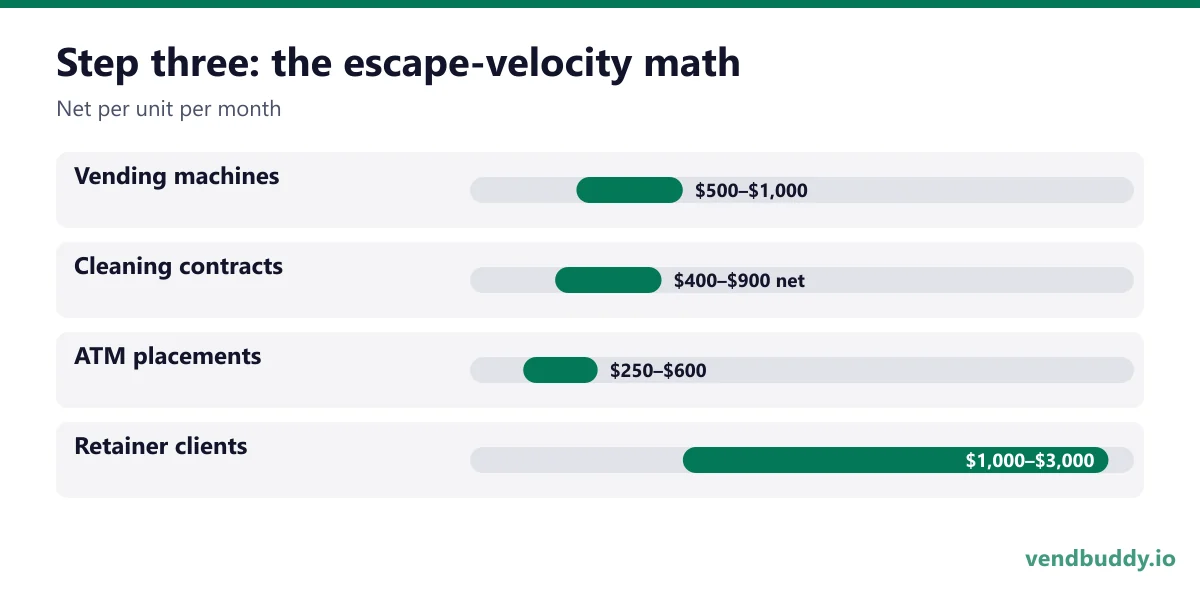
Unit economics × units = income. Take whatever the business earns per repeatable unit — a machine, a contract, a client, a truck — and divide your replacement number by it.
| Business | Net per unit per month | Units to replace $4,900/mo | Realistic pace |
|---|---|---|---|
| Vending machines | $500–$1,000 | 6–10 machines | 1–2 per quarter part time |
| Cleaning contracts | $400–$900 net | 6–12 buildings | 1–2 per quarter, faster with referrals |
| ATM placements | $250–$600 | 9–20 machines | Slower — good sites are scarce |
| Retainer clients | $1,000–$3,000 | 2–5 clients | Fast to start, hard ceiling, no asset |
Two things fall out of that table immediately. First, the number of units is small — six to twelve of something, not fifty. That is more encouraging than most people expect and it is why this is achievable at all. Second, the pace is the binding constraint, not the maths. Adding one unit a quarter gets you there in two to three years. Adding one a month gets you there in under one. The difference between those two outcomes is almost entirely how many hours a week go into sales rather than operations, which is the opposite of where most people put their hours.
For the vending version specifically, the per-machine income numbers are here and the full arithmetic on a ten-machine route is here. If you want the version where somebody did it with a genuinely odd product category, the Pokemon card machine route is the same escape maths at a different price point.
Step four: the quit trigger
Write this down before you start, because the version of you who is three months into a good run is not a reliable narrator.
Six months is not arbitrary. It is long enough to cross a seasonal dip, long enough to include at least one month where something broke, and long enough that the number is a trend rather than a season. Most businesses have a soft quarter, and finding yours while still on salary costs you nothing except patience.
The cash buffer is separate and non-negotiable. It is what stops the first slow month after resignation from turning into a fire sale of the thing you spent two years building.
The four ways this goes wrong
- Quitting on a good month. The most common one by a distance. A strong quarter gets extrapolated, the letter goes in, and a normal month arrives with no salary underneath it.
- Replacing revenue instead of net profit. Quietly ignores that the business has costs and that you are now buying health cover and paying both halves of payroll tax.
- Building a job instead of a business. If the thing only earns while your hands are moving, you have not escaped a job, you have changed employer to a harsher one. Check whether the unit keeps earning on a day you do not work.
- Hitting the number and staying anyway. Rarer, and worth naming. If the business cleared your number a year ago and you are still there, the constraint was never financial and no additional revenue will fix it.
The bottom line
Leaving a job is not a motivation problem and it is very rarely an idea problem. It is a shape problem. The business has to fit around the job that is funding it, spend money only after somebody has said yes, and produce the same amount next month as it did this month.
Get the replacement number right, run every idea through the three filters, divide the number by the unit economics to find how many units you need, and then do the boring thing of adding units while still collecting a salary. Six consecutive months at the floor and you have earned the right to write the letter.
The vending version of unit one is free to test. VendBuddy scores real buildings near you by traffic, headcount and category, hands you the best contact on file for each, and models net profit and payback before you spend anything. 5 free credits, no card required.
Related reading: nine signs you should be your own boss, building passive income to quit your job, quitting your job with Pokemon card machines, should you start a business in 2026, when a side hustle becomes the business, and how many hours vending really takes.
Frequently Asked Questions
What business should I start to quit my job?
One that passes three tests at once: it can be run outside your working hours, it does not need your savings before it has customers, and it produces recurring rather than one-off revenue. That combination rules out most retail, most food, and almost every business needing weekday availability. What survives is generally route and equipment businesses, recurring-contract services such as commercial cleaning, and skilled freelance work with retainer clients. Vending fits the first and second tests well and the third fully, with the caveat that securing locations mostly happens during business hours.
If you would rather not draft the contract from scratch, we keep a plain-English walkthrough at get vending machine contracts. It covers term, commission, exclusivity and how either side gets out.
How much income do I need before quitting my job?
Replace your take-home pay, not your salary, and then add roughly 25 to 30 percent for the benefits and employer taxes you are about to start paying yourself. On a $60,000 salary with $46,000 take-home, the honest replacement number is closer to $58,000 to $60,000 of business net profit, not $46,000. Then hold that number for six consecutive months before you resign, because one good quarter is a season and not a trend.
Can you start a business while working full time?
Yes, and it is the correct way to do it in almost every case. The constraint is not total hours but which hours. Anything requiring you to answer a customer at 11am on a Tuesday is incompatible with a weekday job no matter how motivated you are. Anything whose work can be moved to evenings and weekends is compatible with almost any job. Most people have six to fifteen genuinely free hours a week, which is enough to build something and not enough to build everything.
How long does it take to replace a full-time income with a side business?
For an equipment or route business, plan on 18 to 36 months to replace a median household income, assuming you reinvest nearly all profit. Vending is a useful worked example because the maths is public: a machine nets $500 to $1,000 a month, so replacing $5,000 a month of take-home needs roughly 8 to 12 placed machines, and most part-time operators add one to two machines a quarter. Anyone promising materially faster than that is selling something.
Should I quit my job to start a business?
Almost never at the start, and the reason is arithmetic rather than courage. Quitting converts a patient experiment into an urgent one, and urgency is what makes people take bad locations, bad clients and bad prices. A job plus a second income line is also a genuinely safer position than either alone, because a job is one customer holding the unilateral right to cancel. Quit when the business has held your replacement number for six months, not when you are sick of the job.
What is the safest business to start while employed?
The safest shape has three properties: the spending happens after a customer or location is secured rather than before, the asset can be resold if you stop, and the work is schedulable. Businesses with those properties fail cheaply, which is the only kind of failure a person with a mortgage can afford. Businesses needing a lease, a build-out or opening payroll fail expensively and should not be attempted from inside a job.
How many hours a week does a side business need?
Six to fifteen is the realistic honest range for an employed adult with a household, and it is not evenly distributed. What matters more is whether the hours are movable. A vending route of three to five machines runs roughly two to five hours a week once placed; the front-loaded part is location acquisition, which needs a handful of weekday half-days and then drops away almost entirely.
What is the biggest mistake people make when leaving a job for a business?
Quitting on a good month. The pattern is consistent: a strong quarter gets extrapolated into a year, the resignation goes in, and then a normal slow month arrives with no salary underneath it. The second most common is replacing gross revenue rather than net profit, which quietly ignores that the business has costs and that you now buy your own health cover and pay both halves of your payroll tax.
What is selling, which buildings say yes, and the numbers before you buy a machine. Free, confirm from your inbox, unsubscribe in one click. Refer one friend and get 25 VendBuddy credits.
Walk-ins and cold emails find locations. A small site with your own machine photos and a request-a-machine form lets the next one find you. Around machine three to five, an AI builder drafts it in an evening. Wix is the mature site builder; Base44 also builds working tools like a quote form. Start with the AI website walkthrough or Wix vs Base44.
General information, not legal, tax or financial advice. Rules change, so check the official source. Revenue and income figures are examples, not promises. See our terms.