- The lie is not that vending makes money. It is that the machine makes it. The building makes it. The identical machine nets $50–$150 a month in a poor spot and $500–$1,000 in a good one.
- Passive income from day one does not exist here. A ten-machine route runs 15–20 hours a week, and a first machine takes four to six months to reach steady state.
- The projection you were shown is gross, not net. Net is 25–30% after COGS at 40–50%, commission at 0–15%, and card fees at 5–6%. A $1,200 machine pays about $330.
- Guaranteed locations are the single loudest red flag. Locations are the valuable half. Nobody gives away the valuable half to sell you a machine at retail.
- The business is genuinely real. This page exists so you buy the real version instead of the advertised one.
There is a version of the vending machine business that shows up in short-form video, in cold DMs, and in the sales deck of every turnkey package sold to beginners. It goes: buy a machine, place it somewhere, collect money forever. Passive income, no employees, no experience needed.
Almost every word of that is technically true and the whole thing is a lie, because of what it leaves out. This page is about the specific thing it leaves out, why the arithmetic in the pitch reliably overstates your income by a factor of three or four, and the five checks that catch a bad deal before your money moves. It is not an argument that vending is a scam — the business itself is legitimate, the US industry is roughly $18 billion, and independent operators really do build good incomes in it. The pitch is what is broken, not the business.
The lie: “passive income from day one”
Take the claim apart into its two halves, because each fails differently.
“From day one” is false as a matter of arithmetic. A new machine does not open at its steady-state number. A first machine commonly grosses $600 to $1,200 a month during its first 60 days while the building learns it is there, and settles into its real tier somewhere around month four to six. Before any of that, you have to find the location, pitch it, sign an agreement, get the machine delivered, and fill it. The gap between handing over money and collecting meaningful revenue is months, not days, and every projection that opens at month-one steady state has already misled you before it reaches the numbers.
Worth reading before you sign anything: the contract walkthrough covers which terms get pushed back on and which ones you can safely give away. Commission is rarely the clause that hurts you later.
“Passive” is the bigger one. Vending is semi-passive at scale and hands-on at the start. A ten-machine route runs roughly 15 to 20 hours a week — restocking, driving between sites, handling cash, chasing a jam, keeping a property manager happy, watching what sells and cutting what does not. That is a genuinely good hours-to-income ratio compared with most small businesses, and it is the honest reason to be interested in vending. It is not the arrangement where you buy a machine and money arrives.
Underneath both halves sits the real lie, the one that costs the most money: the pitch puts the machine at the centre of the business. It is not. The building is. The identical cabinet, with the identical product, serviced by the identical person, nets $50 to $150 a month at a slow strip mall and $500 to $1,000 a month at a building with 100 to 200 daily visitors. Ten to twenty times the profit, decided entirely by an address. We wrote the full spread up in how much vending machines actually make, and it is the single most useful thing to internalise before you talk to any seller.
That is why a machine sold to you with a location attached is worth so much less than it appears, and why a machine sold to you without one is worth exactly what the metal is worth. The seller is selling the cheap half of the business at a premium.
The math the machine seller will not show you
Sales projections in this category are almost always gross revenue presented in a position on the page where your eye reads income. Sometimes that is deliberate. Often the person showing it to you genuinely does not operate machines and has never subtracted the middle.
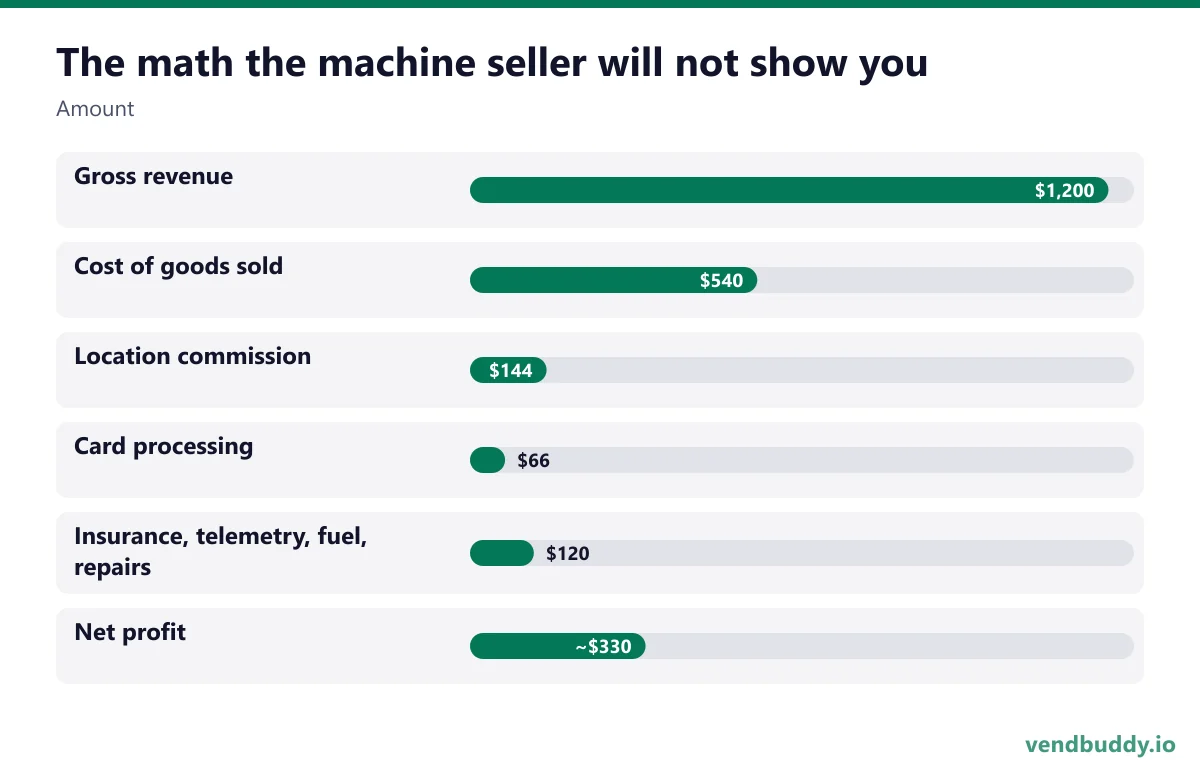
Here is the middle. Take a machine grossing $1,200 a month, which is a realistic average-to-good placement, not a pessimistic one:
| Line | Rate | Amount |
|---|---|---|
| Gross revenue | — | $1,200 |
| Cost of goods sold | 40–50% | −$540 |
| Location commission | 0–15% | −$144 |
| Card processing | 5–6% | −$66 |
| Insurance, telemetry, fuel, repairs | fixed | −$120 |
| Net profit | ~27.5% | ~$330 |
$1,200 becomes about $330. Not because anything went wrong — that is a normal, healthy machine. Net profit in vending runs 25 to 30% of gross, and any projection that does not show you the four subtractions above is not a projection, it is a headline. The full line-by-line version is in our costs and profit breakdown.
Three more things the projection tends to omit, in descending order of how often they surprise people:
- Your own time is not free. Nothing in the table above pays you for the drive, the restock, or the Saturday you spent walking into buildings. At a couple of machines that is a hobby cost. At ten it is a part-time job, and if you do not price it you will conclude the business does not work when what actually happened is you worked for nothing.
- The fixed costs do not shrink when the machine underperforms. Insurance, telemetry at $40–$100 a month per machine, and the drive to service it cost the same whether the machine grossed $1,200 or $300. This is why a weak placement does not simply earn less — it can net nothing at all.
- Payback is 12 to 14 months, not three. A typical machine at a typical location pays back its own cost in 12 to 14 months, and 6 to 9 at a genuinely high-traffic site. Any pitch quoting a payback measured in weeks is either quoting gross against cost, or quoting an outlier building you have not been shown.
None of this makes vending a bad business. A machine netting $330 a month against a $2,000 used cabinet is a perfectly good asset. It is simply a different business from the one in the advertisement, and the difference is entirely in whether someone did the subtraction in front of you.
The fastest way to spot an inflated quote is to know what the machine should cost and what the building should earn. The free Machine Finder compares machine types and real price ranges against 15+ property types — including the used and traditional options nobody makes a commission selling you.
Picture the machines paying you while you sleep
That’s the real promise of vending — income that doesn’t cost you your time, and a life on your own terms. VendBuddy turns this guide into a step-by-step plan so you actually build it instead of just reading about it. Start free today.
Start building free →5 red flags to check before you hand over money
Run all five. Any single failure is enough to walk away, and walking away costs you nothing except a deal that was going to cost you thousands.
1. Locations are promised rather than shown
The loudest signal in the whole category. If a seller offers guaranteed locations, or locations bundled into the machine price, treat the guarantee as the tell. Locations are the scarce, valuable half of a vending business — nobody who has genuinely secured good ones gives them away to move a machine at retail. In practice the guaranteed placements are low-traffic sites that were easy to get, priced into the package at many times what they are worth, and available to you free with a few afternoons of walking in.
The check: ask to see the actual signed placement agreement for a specific address, and ask to visit it. A real location has a real name, a real contact, a real door count. If what comes back is a promise, a region, or a “placement specialist will contact you after purchase”, you are buying a machine at a premium and nothing else.
2. The machine price does not survive an independent quote
A used snack-and-drink combo runs $1,500 to $3,000. A new combo runs $2,500 to $4,000. Those are ordinary dealer and private-sale numbers, and they have been stable for years. When a turnkey package quotes five figures for coil machines, the gap is almost never the equipment.
The check: get the exact make and model in writing, then price it yourself against dealers, Facebook Marketplace and our vending machine price buyers guide before you respond to anything. Smart and AI coolers genuinely do cost more and belong in their own comparison — but a premium on a smart cooler is not a justification for a premium on a coil machine sitting next to it in the same quote.
3. Revenue claims come as a spreadsheet instead of evidence
This one matters most when you are buying an existing route rather than a new machine. A projection is a document somebody typed. Evidence is bank statements, machine telemetry exports, or a tax return.
The check: ask for 12 months of bank statements or telemetry per machine, and ask to service the route for a day before closing. A genuine seller expects this question. The reaction to being asked tells you more than the answer does — and if the numbers are real, sitting in the passenger seat for one collection day will confirm it faster than any document. Route due diligence has the full checklist.
4. Nobody used the word “net”
Read the projection again with one question: were cost of goods, commission and card fees subtracted anywhere? If the document only contains gross revenue, you have been shown roughly three to four times your actual income.
The check: take whatever monthly number you were given, multiply it by 0.275, and re-evaluate the deal at that figure. If it still works, the deal might be real. If it collapses, you just saved yourself the money. Do the same to the payback claim: divide the machine cost by the net, not the gross.
5. There is time pressure, exclusivity, or a territory being sold
Three variations on the same trick. Time pressure — the price expires today, someone else is looking at it — exists to prevent exactly the four checks above. A legitimate seller will hold a quote for a few business days. Exclusive territory is being sold something that cannot be delivered: vending is entered building by building, and nobody can stop another operator pitching the office next door. And any packaged business opportunity sold in the US is generally required to give you a written disclosure document before you pay, so you can check the claims and contact prior buyers — if one is not offered, ask for it, and treat the answer as information.
The check: say you will decide in a week. Watch what happens. That single sentence is the cheapest due diligence available in this category.
Spot the lie before you buy: the 2026 checklist
The five checks above are the thorough version and they are worth running. But if you only ever remember one thing from this page, make it this, because it takes half a minute and it settles most deals on its own.
The 30-second check
Ask the seller to show you the machine’s last 90 days of real sales data. That is the whole check. Not a projection, not an annual average, not a photograph of a full cash box. Real data means one of three things: a telemetry export from the machine, a statement from the card processor, or the bank deposits that match it.
Most operators end up on Nayax for telemetry because it is what the distributors already support. Their reader handles tap, chip and the telemetry feed in one box, and the monthly fee is the part to check against your per-machine volume before you commit the route to it.
Ninety days is the right window on purpose. It is short enough that any machine actually in service has it sitting in an app right now, and long enough that a single good week cannot carry it. Ask for a full year and you invite a delay; ask for last month and you invite a cherry-pick.
Then watch what happens, because the response is the information:
- They send it inside a day. Normal. Operators with earning machines are usually a bit pleased to be asked, because it is the one thing that separates them from the people selling stories. Now you can do arithmetic on real numbers.
- They send a spreadsheet or a projection instead. That is not the thing you asked for, and the substitution was a choice. Ask once more, specifically, for the telemetry or processor export.
- They explain why it is not available. The machine is between locations, the reader was offline, the previous operator kept paper records. Sometimes true. Also the single most common shape of the whole category, and it always resolves the same way: no data, no premium. Price the machine as bare equipment.
- They get irritated, or the price suddenly expires. You have your answer and it cost you thirty seconds.
Refusal is the answer. You do not need to prove anything or argue the point — a seller who will not show ninety days of sales on a machine they say is earning has told you what the machine earns.
Ask for the last 90 days of real sales data. Not a projection - telemetry, processor statements, or bank deposits. Refusal is the answer.
The rest of the 2026 checklist, in order
Run these after the 30-second check clears, in this sequence, because each one is cheaper than the one after it:
- Multiply the monthly number by 0.275. Free, instant, and it kills most bad deals outright. If the deal only works at gross, it does not work.
- Price the exact make and model independently against ordinary dealer and used pricing before you reply to anything. Used combo $1,500–$3,000; new combo $2,500–$4,000.
- Ask to see the signed placement agreement for a named address — and to visit it. A guarantee is not an agreement.
- Say you will decide in a week, and watch. A legitimate seller holds a quote for a few business days.
- Divide the machine cost by the net, not the gross, to get your real payback. If it is not inside 12 to 14 months at a normal site, something in the quote is wrong.
Five steps, none of which requires expertise, money, or a difficult conversation. The reason they work is not that they are clever — it is that a deal built on a story cannot survive being asked for evidence, and a deal built on a real machine at a real building barely notices the question.
What the honest version actually looks like
Strip the pitch out and what remains is a decent, unglamorous small business:
- You secure a location first, for free, by walking into buildings and asking. This is the real work, it is where the money is decided, and it is the part the packages charge you to skip.
- You buy a used machine for $1,500–$3,000, or run a revenue-share deal on someone else’s idle machine if capital is tight — the routes in starting with no money and bad credit.
- It grosses $1,500–$3,000 a month at a good site and nets $500–$1,000. It pays back in 12 to 14 months.
- You spend a few hours a week on it, more as the route grows, and it becomes semi-passive only once density and telemetry make it so.
- You add machine two out of machine one’s profit, and repeat.
That is worth doing. It is also nothing like the advertisement, which is the whole point: people do not quit vending because the business failed them, they quit because they measured a real business against a fictional one. Is vending a good business works through the honest math from real routes, and why most operators fail in year one covers what actually goes wrong when it does.
The bottom line
The vending machine lie is not that the money is fake. The money is real. The lie is that it comes from the machine, arrives immediately, and requires nothing from you — three claims that exist because the machine is what somebody has to sell, and the location, which is what actually produces the income, is free.
Do the five checks. Multiply by 0.275. Go get a location before you buy anything. The people who do those three things buy the real version of this business, and the real version is good enough that it never needed the lie.
VendBuddy scores real buildings near you by traffic, headcount and category, hands you the best contact on file and a pitch on each, and models net profit and payback before you spend anything. Start free and get 5 credits — no card required.
Related reading: is the vending machine business legit, is vending a good business in 2026, how much vending machines actually make, what vending machines really cost, the mistakes that cost first-year operators the most, and route due diligence.
Frequently Asked Questions
What are the most common vending machine business scams?
Four shapes cover almost all of them. Machines sold bundled with guaranteed locations, where the guarantee is the tell and the locations are worth far less than the markup. Turnkey or business-opportunity packages priced at several times what the same equipment costs from a normal dealer. Exclusive territory rights, which are unenforceable in a business anyone can enter building by building. And route sales backed by revenue claims with no bank statements or telemetry behind them. The common thread is that you are being sold access to something that is actually free: the ability to walk into a building and ask.
Is vending machine passive income real?
Semi-passive at best, and never on day one. A ten-machine route runs roughly 15 to 20 hours a week of restocking, driving, cash handling, repairs and location relationship work. It is genuinely less demanding than most businesses at the same income, and it is not the buy-it-and-collect arrangement the pitch describes. Passive is something you engineer later with route density and telemetry, not something the machine arrives with.
How do I tell if a vending machine deal is a scam?
Run five checks before money moves. Price the exact machine independently against normal dealer and used pricing. Ask to see the location agreement itself rather than a promise of locations. Ask for revenue evidence in the form of bank statements or machine telemetry, not a spreadsheet. Read the projection for the words gross and net and check whether cost of goods, commission and card fees were subtracted. And check whether anyone is pressuring you to decide today. Any one of those failing is enough to walk.
Why do the numbers in a vending machine sales pitch look so good?
Usually because they are gross revenue presented as if it were profit. Net profit in vending runs 25 to 30 percent of gross after cost of goods at 40 to 50 percent, location commission at 0 to 15 percent, card processing at 5 to 6 percent, and the fixed monthly costs of insurance, telemetry, fuel and repairs. A machine grossing $1,200 a month nets roughly $330. A projection that shows $1,200 as your income has quietly kept three quarters of it.
Are guaranteed vending locations ever legitimate?
Treat the guarantee itself as the warning. Locations are the scarce and valuable half of a vending business, and nobody who has genuinely secured good ones needs to give them away to sell you a machine at retail. In practice the guaranteed placements tend to be low-traffic sites that were easy to get, worth far less than the price premium attached to them, and free for you to secure yourself with a few afternoons of walking in.
How much does a vending machine actually cost?
A used snack-and-drink combo runs $1,500 to $3,000 and a new combo $2,500 to $4,000 from ordinary dealers. That is the number to hold in your head when a turnkey package quotes you five figures for a machine, because the gap between the two is almost never explained by the equipment. Smart and AI coolers are genuinely more expensive and belong in a separate comparison rather than being used to justify the markup on a coil machine.
Is the vending machine business a scam?
No. The business is real, the industry is roughly $18 billion in the US, and independent operators genuinely do well in it. What is broken is the way it gets sold to beginners: as passive, as immediate, and as something you buy rather than something you build. A machine at a good location grossing $1,500 to $3,000 a month and netting $500 to $1,000 is an honest small business. It is just not the thing in the advertisement.
What should I ask a vending machine seller before buying?
One question does most of the work: show me the last 90 days of real sales data for this machine. Real means a telemetry export from the machine, a card-processor statement, or bank deposits — not a spreadsheet somebody typed and not an annual average. Ninety days is short enough that any operating machine has it to hand and long enough to expose a seasonal cherry-pick. A seller with a genuinely earning machine produces it in minutes and is usually pleased to be asked. A seller who cannot, will not, or redirects you to a projection has answered you, and the answer is no. If the machine has never been placed there is no data to show, which is fine and honest — but then you are buying bare equipment and it should be priced as bare equipment against ordinary dealer rates.
What should I do before buying my first vending machine?
Secure the location first. It is free, it needs no credit and no equipment, and it is the half of the business that actually determines your income — the identical machine nets $50 to $150 a month in a poor spot and $500 to $1,000 in a good one. Once you have a signed placement agreement you know the traffic, the hours and the competing food sources, which means you can size the machine to the building instead of buying first and hoping.
What is selling, which buildings say yes, and the numbers before you buy a machine. Free, confirm from your inbox, unsubscribe in one click. Refer one friend and get 25 VendBuddy credits.
General information, not legal, tax or financial advice. Rules change, so check the official source. Revenue and income figures are examples, not promises. See our terms.