- Bad credit does not block vending. It blocks one route into vending. Credit touches exactly one step — borrowing for equipment. Locations, agreements, product and servicing never run a check.
- Get the location first. A signed placement agreement costs $0, needs no credit, and is the only thing that makes every funding route below sane instead of reckless.
- Revenue-share is the real no-money path. Plenty of people own machines sitting idle. You bring the location and the labour, they bring the equipment, you split the net.
- Used machines run $1,500–$3,000, and private sellers routinely take $500 down plus $200 a month — a payment plan that never touches your credit file at all.
- Repair the file in parallel, not first. Business credit sits on a separate file from your personal one, and machine one is what starts it.
The direct answer: start with the location, not the machine — then use one of four routes that work with a damaged credit file. A revenue-share deal with someone who already owns idle machines. A used machine on a private-seller payment plan, commonly $500 down plus $200 a month. An SBA Microloan through a CDFI, which exists specifically to lend to people banks decline. Or a deliberate 90-day savings stake. None of those four begins with a credit pull, and the first one does not require money either.
This page is the half that the usual $0-down article skips. Our own $0-down startup guide lists six funding instruments, and almost every one of them quietly assumes a clean file: buy-now-pay-later approvals, 0% intro-APR business cards, vendor equipment financing. If your credit is damaged, half that list is theory. So here is what is left, in the order a real person should work through it.
What credit actually touches in a vending business
Write out the steps of getting your first machine earning, and mark the ones that run a credit check:
- Picking a target area and building a list of candidate buildings — no check.
- Walking in, asking for the decision-maker, pitching the placement — no check.
- Signing a placement agreement with the property — no check. Nobody has ever asked a vending operator for a FICO score before letting them put a machine in a break room.
- Registering the business and getting an EIN — no check.
- Buying product at a warehouse club — no check.
- Stocking, servicing, collecting revenue — no check.
- Acquiring the machine, if you borrow to do it — this is the one.
One step out of seven. That is the entire footprint of your credit score in this business, and it is a step with several workarounds. Beginners with damaged credit tend to assume the whole door is closed because the first article they read opened with a list of loan products. It is not the whole door. It is one hinge.
There is a second, more useful reframe underneath that. The scarce asset in vending is not machines — used ones are for sale in every metro in the country, all week, at prices that have not moved in years. The scarce asset is good locations. If you can get a signed agreement at a building with real traffic, you are holding the expensive half of the business, and machines will come to you. That is true regardless of your credit, and it is why the sequencing advice below matters more than any funding tip on this page.
If you would rather not draft the contract from scratch, we keep a plain-English walkthrough at get vending machine contracts. It covers term, commission, exclusivity and how either side gets out.
Path 1: Location first, machine second (costs nothing)
This is the path to work before any of the others, and it is free.
Go get a verbal yes, then a signed placement agreement, at a building with genuine foot traffic — before you own anything. It sounds backwards to people who think of vending as an equipment business, but it is how experienced operators sequence every machine after their first, and it is the single highest-leverage thing a broke beginner can do. Buying the machine first is the most common and most expensive mistake in vending, and it is materially worse when money is tight, because a wrong machine sitting in a garage is capital you cannot get back.
Once you hold a signed agreement, four things change at once:
- Revenue-share partners become reachable. A machine owner with an idle unit will take your call when you open with a signed location. They will not take it when you open with an idea.
- Private sellers get flexible. A payment plan is a much easier ask when you can show the seller the placement agreement the machine is going into.
- A CDFI loan officer has something to underwrite. A microloan application with a signed location and a revenue estimate is a different document from one without.
- You stop guessing at the numbers. You will know the headcount, the hours, and whether there is a competing food source within a two-minute walk.
The practical version: pick a ZIP, list every building type that works — small manufacturing, self-storage, car dealerships, medical suites, apartment buildings, gyms, trade schools — and start walking in. Our location acquisition playbook has the pitch, and the negotiation guide covers commission. Expect rejections. They cost nothing, which is the entire point of doing this step while you have nothing.
VendBuddy scores real buildings near you by traffic, headcount and category, and hands you the best contact on file and a pitch on each card. It is free to start, no card required — which makes it the right first step when capital is the constraint.
Picture the machines paying you while you sleep
That’s the real promise of vending — income that doesn’t cost you your time, and a life on your own terms. VendBuddy turns this guide into a step-by-step plan so you actually build it instead of just reading about it. Start free today.
Start building free →Path 2: Revenue-share with someone who already owns machines
This is the genuine no-money, no-credit route, and it is badly underused because beginners do not realise how many idle machines exist.
The supply is larger than you think. Operators quit. People buy a machine on impulse, discover it needs a location and never find one, and park it in a garage. Machines sit under-serviced in weak spots because the owner has newer, better placements and cannot be bothered driving out. Businesses inherit a machine when they buy a building. Every one of those is a person holding depreciating equipment that produces nothing.
Your offer to them is simple: you supply the location, the labour and usually the product; they supply the machine; you split the net. Fifty-fifty is the common starting split, typically running until the owner has recovered what the machine is worth, at which point you renegotiate or buy them out on terms. This is the same partner model our $0-down guide describes for people with capital and no time — you are simply running it from the other side of the table.
Where to look: Facebook Marketplace and Craigslist listings for used machines (message the sellers who have relisted more than once — they want out), local vending groups, and the buildings themselves. If you walk into a business with a dusty, half-empty machine in the corner, ask who owns it. Sometimes the answer is the building. Sometimes it is an operator two towns away who would rather split revenue than keep driving out.
Put it in writing regardless of how friendly the arrangement feels. Who owns the machine, who owns the location relationship, who buys product, how the split is calculated, and what happens if either side wants out. Vending contracts 101 covers the structure, and our contract generator will produce the placement side of it.
Path 3: Used machines and private-seller payment plans
A used snack-and-drink combo machine costs $1,500 to $3,000. That is the honest floor for owning equipment outright, and it is far lower than the numbers new operators absorb from smart-cooler marketing.
The part that matters for a damaged credit file: private sellers are not lenders and they do not pull credit. An individual selling one machine off a driveway wants it gone and wants to be paid. Offering $500 down plus $200 a month for six months on a $1,500 machine is a normal, frequently accepted deal — the seller holds the machine or the title as security, and no part of the transaction touches a bureau. That structure is already documented in our $0-down guide as a creative approach; for a bad-credit buyer it is not creative, it is the main event.
The maths works because the machine earns while you are paying for it. A machine at a decent location grossing $800 a month at roughly 50% margins nets about $400. Against a $200 monthly payment you are cash-flow positive from month one, and you own the machine free and clear in 12 to 15 months — after which every dollar is yours. How to buy a used vending machine covers inspection, and the price buyers guide covers what each tier should actually cost so you do not overpay on a payment plan and lock yourself into it.
One warning specific to this route: never buy a machine bundled with a promised location. Machine-plus-guaranteed-location packages are almost always a scam, they are priced at several times what the equipment is worth, and they market hardest to exactly the person searching for how to start with no money and bad credit. Real operators source their own locations, which is Path 1.
Path 4: SBA Microloans through a CDFI
If you want borrowed money and your file is damaged, this is the route that is actually designed for you, and it is consistently the least-known option on the list.
SBA Microloans are not issued by banks. They run through Community Development Financial Institutions — nonprofit lenders chartered to serve entrepreneurs the conventional market declines. The programme lends up to $50,000, the average loan is about $13,000, and terms run up to six years at below-market rates. Good credit helps. It is not the gate it is at a bank.
Two practical notes. It is slow — expect two to four weeks rather than an afternoon, which is another argument for working Path 1 while the application is in flight. And many CDFIs bundle free business advising with the loan, which is worth more to a first-time operator than the rate difference. Find your local CDFI through SBA.gov. Our full financing comparison puts microloans side by side with the other five routes and their real APR bands.
Path 5: Build a small stake on purpose, in 90 days
Unglamorous, and it belongs on the list because for some readers it is genuinely the fastest route.
The target is not a business fund. It is $500 to $800 — enough for a down payment on a used machine plus a first product fill. At $150 a week that is roughly five weeks; at $60 a week it is three months. Pick a number, automate the transfer the day money arrives, and keep it in an account you do not carry a card for.
Two things make this materially easier than generic savings advice. First, you can do it while working Path 1 for free, so you arrive at the end of the 90 days with a signed location and a down payment at the same time. Second, the target is small enough to be real. Most people who tell themselves they cannot start a business are picturing a $20,000 number, not an $800 one.
Financing when your credit is damaged
At some point the equipment loan question comes back, either because you want machine two faster than machine one can pay for it, or because a location you cannot afford to lose has come open. Here is the honest hierarchy when the file is not clean.
Skip first, come back later: conventional bank equipment loans and 0% intro-APR business credit cards. Both are underwritten on your personal credit with a hard pull and a personal guarantee, and a thin or damaged file means either a decline or a limit too small to buy a machine with. Our business card guide is worth reading now and applying to later — after a machine has been running and you have started a business credit file.
If you are still deciding which machine, the machine finder lists what is actually available at each price band with a conservative monthly estimate attached. It does not push you toward the expensive one.
Try in this order: a private-seller payment plan (no check at all), then vendor or dealer equipment financing where the machine itself is the collateral and underwriting is lighter than a bank, then a CDFI microloan, then a local credit union — credit unions underwrite more flexibly than big banks and are worth an actual conversation rather than an online form.
Refuse outright: merchant cash advances, daily-repayment online lenders, and anything quoting a factor rate instead of an APR. These products market specifically to damaged credit files and to new businesses, and their effective cost frequently runs into triple digits. A vending machine nets a few hundred dollars a month. It cannot outrun that, and operators who try lose the machine and the credit.
Between skip-first and try-next sits the question most readers actually have, which is whether the 0% business credit route is reachable at all with a file like theirs. It sometimes is, and the difference is usually application strategy rather than the score itself — applying cold, one issuer at a time, is how a thin file turns into three hard pulls and one useless limit.
7 Figures Funding specializes in helping new business owners qualify for 0% intro business credit lines. They look at your profile first and tell you what is realistic before anything gets submitted, then sequence the applications so approvals land together instead of fighting each other — which is the part a damaged or thin file most needs. Worth an answer before you start clicking apply buttons yourself, even if the answer is not yet.
Building business credit while the machine runs
The reason to start now rather than after a credit repair is that business credit sits on a separate file from your personal one, and the business has to exist before that file can start. The sequence is boring and it works:
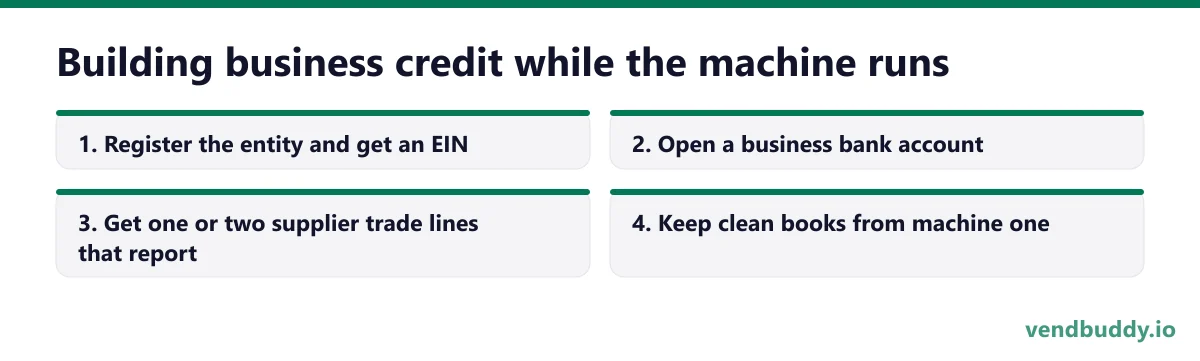
- Register the entity and get an EIN. Free, same day, directly from the IRS. A sole proprietorship counts as a business for most purposes, but an LLC separates the liability and is worth the filing fee once revenue starts.
- Open a business bank account in the business name. Run every dollar of machine revenue and every product purchase through it. Mixed personal and business banking is the thing that most reliably makes an operator un-lendable later.
- Get one or two supplier trade lines that report. Ordinary vending suppliers and warehouse accounts, paid on time, start the file.
- Keep clean books from machine one. Twelve months of tidy revenue records is what turns you from a credit score into a business a lender can underwrite — and it is what makes the equipment loan for machines two through five straightforward.
Meanwhile the personal file repairs the way it always does: on-time payments, lower utilisation, and time. The difference is that you are earning while it happens instead of waiting.
A realistic first 90 days
| Weeks | What you do | What it costs |
|---|---|---|
| 1–2 | Pick a ZIP. Build a list of 40–60 candidate buildings. Register the business, get the EIN, open the business account. | $0 to under $200 in filing fees |
| 3–6 | Walk in. Pitch. Expect a lot of no. Start the automated transfer toward the $500–$800 stake. If you want a microloan, start the CDFI application now. | $0 plus fuel |
| 6–9 | First verbal yes. Confirm headcount, hours and competing food sources. Sign the placement agreement. | $0 |
| 9–11 | With the signed agreement in hand: contact idle-machine owners about revenue share, and private sellers about a payment plan. Take whichever lands first. | $0 or ~$500 down |
| 11–13 | Delivery, install, first fill. Machine starts earning. Every dollar runs through the business account. | $200–$400 first product fill |
That is a real first machine on somewhere between nothing and about $700, with no credit pull anywhere in the sequence. It is slower than the version sold in a course. It is also the version that survives contact with a bank statement.
The bottom line
Bad credit does not disqualify you from vending. It disqualifies you from one specific way of buying a machine, at a moment when you should not be buying a machine anyway. The sequencing that bad credit forces on you — location first, equipment second, borrow only against something already signed — is the sequencing experienced operators use on purpose. You are being pushed into the correct order by circumstance.
Start walking into buildings this week. It is free, it is the scarce asset, and it is the only step that makes every other step on this page possible.
Lead Finder surfaces vending-ready buildings by ZIP and type with the best contact on file attached, the ROI calculator models whether a payment plan is covered by the revenue, and the contract generator produces the placement agreement. Sign up free and get 5 credits — no card.
Related reading: how to start a vending business with $0 down, every financing route compared, the complete startup guide, how to buy a used vending machine, how much vending machines actually make, and the mistakes that cost first-year operators the most.
Frequently Asked Questions
How do I start a vending machine business with no money and bad credit?
Start with the location instead of the machine. A signed placement agreement costs nothing, requires no credit check, and is the only asset that makes every funding route afterwards realistic. From there the four paths that work with a damaged file are: a revenue-share deal with someone who already owns idle machines, a used machine on a private seller payment plan (commonly $500 down plus $200 a month on a $1,500 unit), an SBA Microloan through a CDFI, which is designed for borrowers banks decline, or saving a deliberate small stake over 90 days. Nobody asks your credit score to let you put a machine in their break room.
Do you need good credit to start a vending machine business?
No. Credit touches exactly one step in vending: borrowing for equipment. Finding locations, pitching property managers, signing a placement agreement, buying product, stocking machines and collecting revenue involve no credit check at all. If you route around the equipment loan — by using a revenue-share machine, a private-seller payment plan, or a used machine bought outright — your credit score never enters the business.
Can I get a vending machine with bad credit?
Yes, through three routes. Private sellers on Facebook Marketplace and Craigslist sell used machines at $1,500 to $3,000 and routinely accept a down payment plus monthly instalments, because they want the machine gone and they hold it as collateral until you finish paying. SBA Microloans run through CDFIs, which exist specifically to lend to entrepreneurs conventional banks decline; the average microloan is about $13,000, with terms up to seven years. And a revenue-share arrangement gets you a machine with no purchase at all — the owner keeps title, you keep a share of the net.
What is a vending revenue-share deal and how is it split?
You supply the location, the labour and usually the product; the machine owner supplies the equipment. You split the net profit, most commonly 50/50 until the owner has recovered what the machine is worth, after which you renegotiate or buy them out. It is the same partner model used by operators with money but no time, run in the opposite direction. The people to approach are those who already own machines that are sitting idle in a garage or under-serviced in a weak location — there are far more of them than most beginners assume.
Will an SBA Microloan work with bad credit?
Often, yes. SBA Microloans are administered by Community Development Financial Institutions rather than banks, and CDFIs are chartered to serve borrowers the conventional market underserves. Good credit helps but is not a hard requirement. The programme lends up to $50,000, averages roughly $13,000, and runs terms up to six years. Expect it to take two to four weeks rather than the same afternoon, which is a reason to line up your location while the application is in flight, not after.
Should I fix my credit before starting a vending business?
Fix it in parallel, not first. Waiting for a score to recover costs you months of revenue you could have been earning on a revenue-share or a cash-bought used machine, and the machine income is itself one of the fastest ways to fund the repair. Business credit is also built on a separate file from your personal one, and it starts with the business existing — an EIN, a business bank account, and a trade line or two. Machine one is what starts the clock.
How much money do you actually need to start vending?
The honest floor is the cost of a used combo machine, which runs $1,500 to $3,000, plus a few hundred dollars of first product fill. On a payment plan, that becomes about $500 down. On a revenue-share deal it becomes the product fill alone. And a machine at a decent location grossing $800 a month at roughly 50% margins nets about $400, which covers a $200 monthly payment from month one and owns the machine outright in 12 to 15 months.
What should I avoid when starting vending with bad credit?
Three things, in order of how much they cost people. First, buying the machine before you have a location — that turns $0 down into $0 revenue with a payment attached, and it is the single most common failure in vending. Second, any operation selling machines bundled with guaranteed locations; that is almost always a scam and it targets exactly this search. Third, high-cost merchant cash advances or triple-digit-APR online lenders that market to damaged credit files — a vending machine does not earn fast enough to outrun that kind of money.
What is selling, which buildings say yes, and the numbers before you buy a machine. Free, confirm from your inbox, unsubscribe in one click. Refer one friend and get 25 VendBuddy credits.
Every operator we talk to wants fewer cold calls. The ones who get there have a Google Business Profile and a simple site a manager can check before replying. AI builders make that an evening job now. Wix is the mature site builder; Base44 also builds working tools like a quote form. Start with the AI website walkthrough or Wix vs Base44.
General information, not legal, tax or financial advice. Rules change, so check the official source. Revenue and income figures are examples, not promises. See our terms.