- The question is not whether to have a plan B. It is which one. The layoffs of the last two years landed in the industries that were supposed to be safe.
- Three variables decide it: time you actually have, capital you cannot get back, and whether demand survives a slow year. Not passion, and not the idea.
- Capital-at-risk is the one that kills people. Financeable equipment against a signed customer is a different bet from cash spent on a lease before anyone has bought anything.
- 2026 is a bad year for expensive businesses and a fine year for cheap ones. Same economy, opposite outcomes, entirely because of shape.
- Do not quit to find out. A job plus a second income line beats either alone while the economy is doing this.
Most articles with this title are trying to talk you into something. This one is trying to give you a framework that produces a real answer, including “no” and including “not yet” — because for a meaningful number of people reading this, those are the right answers and nobody has said them plainly.
Start with what actually changed, because the timing question in 2026 is genuinely different from the timing question in 2019.
What changed: the safe jobs stopped being safe
For most of the last two decades the trade was easy to explain. A job paid less than the upside of ownership, but it was predictable, and predictability was worth the difference. That argument depended on one assumption: that a competent person in a good industry keeps their job.
The last two years have made that assumption hard to defend. The cuts did not land where recession cuts historically land. They landed in software and technology, in freight and logistics after the long post-boom correction in shipping volumes, and in manufacturing, where slower orders and steady automation investment have been compounding. These were the categories people moved into for stability. Many of the people affected were not underperformers and did not see it coming, because it was not about them — roles were removed, not filled by someone else.
Here is the reframe that follows, and it is worth sitting with because it is doing all the work in this article:
That is not an argument for quitting. It is an argument that the question “should I start something” has quietly stopped being a question about ambition and become a question about concentration risk. Which is a much more boring, much more answerable question.
So: not whether you need a plan B. Which plan B, and priced how.
The three-variable framework
Every honest version of this decision comes down to three things. Passion is not on the list, and neither is your idea. Both matter later; neither predicts survival.
| Variable | The real question | What a failing answer looks like |
|---|---|---|
| Time | How many hours a week exist that are not already spoken for? | “I will find the time” — the hours were never counted |
| Capital at risk | How much of your own money is gone if this does not work? | Savings spent on capacity before a single customer exists |
| Downturn resilience | Does demand survive a slow year, and do fixed costs? | High fixed costs plus discretionary, high-ticket demand |
Score any business you are considering on all three before you get anywhere near the fun part. Most ideas fail at least one badly, and it is much cheaper to find out here.
Picture the machines paying you while you sleep
That’s the real promise of vending — income that doesn’t cost you your time, and a life on your own terms. VendBuddy turns this guide into a step-by-step plan so you actually build it instead of just reading about it. Start free today.
Start building free →Variable 1: the time you actually have
Count it rather than estimating it. Take a normal week, subtract work, commute, sleep, family obligations and the recovery time you actually need rather than the amount you think you should need, and write down what is left. For most employed adults with a household the honest number is somewhere between 6 and 15 hours a week, and it is not evenly distributed.
Now compare that against what the business requires, and be specific about when. This is where most side businesses die: not on total hours, but on scheduling. A business that needs you available during weekday business hours is incompatible with a weekday job no matter how motivated you are. A business whose work can be done on a Saturday morning and two weeknights is compatible with almost any job.
The filter is therefore not “how many hours” but “can the hours be moved.” Anything requiring a live response during the workday is out until you are full-time, and pretending otherwise is how people end up doing badly at two things at once.
Variable 2: capital at risk — the one that actually kills people
This is the section that matters, and it is the one that almost never gets written properly.
When people talk about the risk of starting a business they usually mean something emotional — failure, embarrassment, the disapproving relative. The actual mechanism of failure is much more boring. The money ran out before the business started working. Not because the owner was bad at it, and often not because demand was absent, but because the capital had already been converted into things that could not be converted back.
Two businesses can both cost $30,000 and represent completely different risks:
| Business A — capacity first | Business B — demand first | |
|---|---|---|
| The $30,000 goes on | Lease deposit, build-out, signage, opening inventory, first payroll | Equipment placed into locations that already agreed to take it |
| Financeable? | Mostly not — build-outs and deposits want cash | Often yes — the equipment is its own collateral |
| Spent before or after demand is proven | Before | After |
| Recoverable if you stop | Close to nothing | Resale market for the equipment |
| Time to first revenue | Months | Days after placement |
| Real capital at risk | ~$30,000 | Payments made, minus resale value |
Same headline number. One of them can end your ability to try again for a decade; the other ends with you selling equipment at a discount and being annoyed for a month. If you take one thing from this article, take that the headline cost of a business tells you almost nothing about its risk, and the two columns above tell you nearly everything.
Which leads to the practical point: a great deal of the right-hand column can be financed rather than paid for out of savings, and that is the difference between starting this year and starting in six years when the cash has been saved.
Where the money comes from if it does not come from savings
Two routes cover most first businesses of the demand-first shape. Equipment financing through the seller, where the asset secures the loan, which is why approval is more forgiving than it is for a general business loan. And 0% intro-APR business credit, which is what lets people buy an asset now and let the asset pay the balance down before interest starts — the closest thing to free money in small business, and the reason it is so often the route people actually use for their first unit.
The second route has a catch worth naming: applying cold, one card at a time, tends to produce several hard pulls and one small limit. 7 Figures Funding works the other side of it — they look at your credit profile first, tell you what you would realistically qualify for, and sequence the applications so approvals land together rather than fighting each other. That is most useful when your business credit file is thin or non-existent, which it is for everybody starting their first thing.
The hard rule with either route, and it is not negotiable in a slow economy: borrow against demand you already have, not demand you expect. Financing equipment before a customer or a location is signed is how “no money down” turns into no revenue with a payment attached. The full financing comparison runs through all six routes including SBA microloans, seller financing and revenue-share arrangements, and the bad-credit version covers what to do when the credit-dependent routes are closed to you.
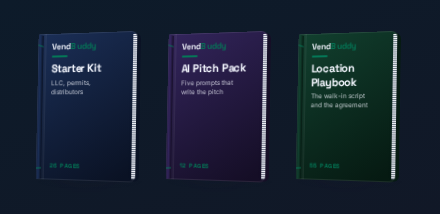
Everything above is free to read and free to do. The operator packs are the same material in fill-in-the-blank form — the 50-state distributor list, the LLC and permit checklist in unblocking order, the word-for-word walk-in script, and the placement agreement you hand a property manager. One-time purchase from $27, nothing renews.
See what is inside →Variable 3: does it survive a slow year?
Downturn resilience is not a vibe, and it is not the same as being “essential.” It comes down to two measurable things: whether demand holds, and whether fixed costs can flex when it does not.
On the demand side, what holds up in a soft economy is small, frequent, low-ticket, habitual purchases, and things that fix rather than replace. What does not hold up is big discretionary purchases and anything a customer can simply defer for six months without consequence. A $2 purchase made five times a week barely registers in a household budget squeeze. A $2,000 purchase gets postponed the week the news gets bad.
On the cost side, the question is what happens in a month where revenue drops 25%. A business with a lease, staff and a loan still owes all three. A business whose main variable cost is inventory it has not bought yet simply buys less. This is why identical revenue declines end one business and merely annoy another.
There is one more axis specific to right now: where your customers work. The 2008 and 2020 data on this is unusually clear for route businesses — sites tied to essential work such as manufacturing, healthcare, distribution and food processing held flat or grew, while corporate office sites fell hard. The category matters less than the building. Our older ranking of what actually held up in past downturns has the historical numbers behind that.
Scoring your own situation
Answer these five honestly. They are ordered so that a “no” high up makes the rest irrelevant.
- Can your household absorb a variable month? If no, the answer is not “do not start” — it is “do not quit,” and start something small alongside the job.
- Do you have 6–15 movable hours a week? If those hours are not movable, narrow the search to businesses that do not need weekday availability.
- What is the unrecoverable number? Write the actual figure that is gone if you stop in month eight. If it is more than you can lose without changing your life, the business is the wrong size, not the wrong idea.
- Does spending start before or after demand is proven? If before, ask what it would take to invert that. Sometimes it is possible. When it is not, that is the business telling you what kind of bet it is.
- Would this still have customers in a bad year? Low-ticket and habitual survives; high-ticket and deferrable does not.
Five yeses is rare. Four is a good business to start this year. Two or fewer and you have found something you want to do rather than something you should do right now, which is worth knowing before rather than after.
What actually passes all three
Very little, which is the honest and slightly disappointing finding. Most of what passes is unglamorous, equipment-based and route-shaped: things where the asset is financeable, holds resale value, and gets placed into a location that agreed to take it before you spent anything.
Vending is one of them, and this is a vending company, so read that with the appropriate suspicion. The structural reason it clears all three is worth stating plainly anyway: the time is movable, since restocking happens whenever you drive; a used combination machine costs $1,500 to $3,000 and finances readily against itself; and the location agreement — the half that actually decides whether the business works — is free and comes first. Demand is about as downturn-resilient as small business gets, with the enormous caveat that this is decided entirely by which buildings you are in.
It is also slow, semi-passive at best, and nothing like the version sold in short-form video. The honest money math is here and the pitch we spend the most time correcting is here. If you want the comparison against the other three businesses that clear the same bar, that is recession-proof businesses ranked for 2026, and if you want to know whether it fits you specifically rather than in general, the ten-sign self-assessment is more useful than any ranking.
The bottom line
Should you start a business in 2026? If the business needs a lease, staff and a build-out before its first customer, this is a poor year to find out whether you were right. If the business finances its equipment, spends after demand rather than before, and sells something small and habitual, this is a perfectly reasonable year and the risk of doing nothing has gone up enough to be worth pricing.
And in almost every case: not instead of the job. Alongside it, until the arithmetic makes the decision for you.
VendBuddy scores real buildings near you by traffic, headcount and category, gives you the best contact on file for each, and models net profit and payback before any money moves. Start free with 5 credits — no card required.
Related reading: nine signs you should be your own boss, recession-proof businesses ranked for 2026, is the vending machine business right for you, the goldmine hiding in broken vending machines, every financing route compared, the best business to start with $5,000, and vending versus self-storage.
Frequently Asked Questions
Should I start a business in 2026?
The useful version of that question is not whether the year is good, it is whether the specific business survives a slow year. Downturn conditions are genuinely bad for businesses that need a lease, a build-out and staff before the first customer, and roughly neutral or better for businesses selling small, frequent, low-ticket purchases out of equipment that was financed rather than bought. Same year, opposite outcomes. Judge the shape, not the calendar.
Is 2026 a bad year to start a business?
It is a bad year to start an expensive one and an unusually reasonable year to start a cheap one. Two things are true at once: hiring is soft and demand is cautious, which hurts anything needing rapid growth to cover fixed costs; and equipment, used inventory and commercial space are easier to negotiate than they were, while the risk of staying purely employed has visibly increased. The correct response to both is to lower capital-at-risk, not to wait.
What business should I start during a recession or downturn?
Look for four properties together: low entry cost, financeable equipment, resale value, and expenses that begin after demand is proven rather than before. Then add demand that does not disappear when budgets tighten — small everyday purchases, essential-worker sites, repairs rather than replacements. Businesses that combine both lists tend to be unglamorous route and equipment businesses rather than anything that looks impressive on a business card.
How much money do I need to start a business in 2026?
Less than the number in your head, if you pick the right shape, because the relevant figure is capital-at-risk rather than total cost. A business needing $30,000 of financeable equipment against signed customers is a smaller real risk than one needing $10,000 of unrecoverable cash for a lease and a build-out. Ask what you cannot get back if you stop, and use that number as the price of the experiment.
Should I start a business or wait for the economy to improve?
Waiting has a cost that is easy to overlook because it never shows up as a loss. Every year spent waiting is a year of income not built, and the timing you are waiting for is not knowable in advance. The defensible middle position is to start something small alongside a job now rather than something large without one later. That converts the timing question into a much less consequential one.
Is it safer to keep my job than start a business?
A job is one customer with the unilateral right to cancel, which is the most concentrated revenue risk in any business. That does not make employment a bad idea; it makes a job plus a second income line considerably safer than either on its own. The strongest position most people can reach in a soft economy is not quitting and not standing still, but running both until one clearly outgrows the other.
Can you finance a business instead of using savings?
For a lot of businesses, yes, and the distinction matters more than people expect. Equipment can often be financed because it acts as its own collateral, and 0% intro business credit lines exist specifically to bridge the gap between buying an asset and that asset producing revenue. What generally cannot be financed is the unrecoverable spending — leases, build-outs, marketing, launch payroll — which is one more reason to prefer businesses that do not need much of it.
What is the most common mistake first-time business owners make in a downturn?
Buying capacity before demand. It shows up as a bigger space than needed, inventory ordered on optimism, or equipment purchased before any customer or location is secured. In a good year revenue growth eventually covers the mistake. In a slow year it does not, and the business runs out of money while the owner is still doing everything right operationally.
What is selling, which buildings say yes, and the numbers before you buy a machine. Free, confirm from your inbox, unsubscribe in one click. Refer one friend and get 25 VendBuddy credits.
Walk-ins and cold emails find locations. A small site with your own machine photos and a request-a-machine form lets the next one find you. Around machine three to five, an AI builder drafts it in an evening. Wix is the mature site builder; Base44 also builds working tools like a quote form. Start with the AI website walkthrough or Wix vs Base44.
General information, not legal, tax or financial advice. Rules change, so check the official source. Revenue and income figures are examples, not promises. See our terms.