- At $5,000 the honest answer for most people is a service business with equipment — pressure washing, detailing or commercial cleaning. It buys the whole rig, and revenue starts in two to three weeks rather than two to three months.
- If you want an asset rather than a job, $5,000 places one vending machine with working capital left, or two used machines at two separate locations. The second configuration is worse on cash flow and better on risk, because it splits the one variable that decides everything.
- $5,000 is a one-shot budget, which is the real difference from the $10,000 version of this question. You cannot be wrong twice, so keep 20–25% back as working capital and buy things that hold resale value.
- Most famous options are simply out. Laundromats, car washes and food franchises need six figures. At $5,000 you would be buying a down payment plus a debt schedule, not a business.
- And the disqualifier: if the $5,000 is your emergency fund, the answer is none of these.
Five thousand dollars is the most common real-world starting budget there is, and it is also the budget the internet is worst at answering honestly. Search it and you get lists that include laundromats and franchises, which is not advice, it is a category error. Here is what $5,000 actually buys in 2026, ranked, with each option given its genuinely best case before any criticism — including the several that beat vending outright.
Start with what $5,000 rules out
This is more useful than the ranking, because it removes most of what you will read elsewhere. These are real entry costs, not the number in a listing:
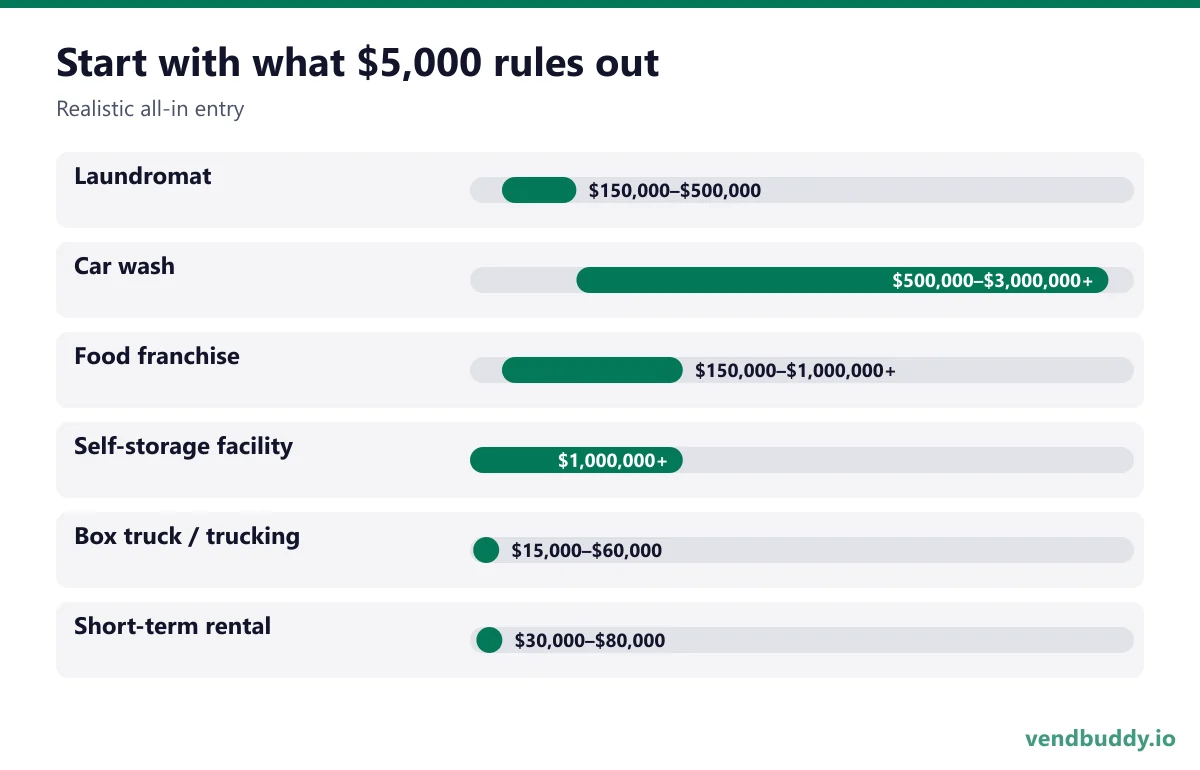
| Business | Realistic all-in entry | What $5,000 would actually be |
|---|---|---|
| Laundromat | $150,000–$500,000 | Roughly 3% of a down payment |
| Car wash | $500,000–$3,000,000+ | Not a fraction worth discussing |
| Food franchise | $150,000–$1,000,000+ | Less than most franchise fees alone |
| Self-storage facility | $1,000,000+ | Only reachable through a REIT or a fund |
| Box truck / trucking | $15,000–$60,000 | A deposit plus a payment you cannot yet cover |
| Short-term rental | $30,000–$80,000 | Furniture for a property you do not have |
That table exists because the single most expensive mistake at this budget is stretching into a model that needed twice the money. It shows up as a down payment plus a monthly obligation that starts before revenue does, and it is how a $5,000 budget turns into a $12,000 hole. The economics of the two most commonly suggested of those are worth reading anyway if the itch persists — laundromat versus vending unit economics covers why the laundromat is a genuinely excellent business at the wrong budget.
The four questions that separate good $5,000 options from bad ones
At $10,000 you can afford one mistake. At $5,000 you generally cannot, so the filter has to be tighter and one of these tests does not exist at higher budgets at all:
Picture the machines paying you while you sleep
That’s the real promise of vending — income that doesn’t cost you your time, and a life on your own terms. VendBuddy turns this guide into a step-by-step plan so you actually build it instead of just reading about it. Start free today.
Start building free →The options, ranked at exactly $5,000
Ranked on those four tests at this specific budget. Note that this ordering would change at $10,000, and several entries here would rank higher if you had more money — that is the whole point of a budget-specific page.
| # | Model | What $5,000 buys | Realistic net/mo | Time to first dollar | The honest catch |
|---|---|---|---|---|---|
| 1 | Pressure washing / bin cleaning | Commercial washer, surface cleaner, hoses, tank, insurance, basic marketing | $800–$3,000 | 2–3 weeks | Highest return per dollar on this list. It is a job you own — income stops the week you stop. |
| 2 | Commercial cleaning | Equipment, supplies, insurance, bonding — often under $2,000 | $1,000–$4,000 | 2–4 weeks | Lowest entry cost and recurring contracts. Night work, and staffing it is the whole difficulty. |
| 3 | Mobile detailing | Full kit, extractor, polisher, water tank, canopy | $700–$2,500 | 2–3 weeks | Needs a vehicle you already own, and pricing power depends heavily on your market. |
| 4 | Vending — 1 new combo placed | Machine, reader, stock, move, LLC, ~$1,000 working capital | $150–$400 | 6–12 weeks | Slow to start and entirely decided by one location. Keeps paying on weeks you do nothing. |
| 5 | Vending — 2 used machines, 2 locations | Two $1,500–$2,000 used combos, both placed and stocked | $300–$700 | 8–16 weeks | Splits the single biggest risk. Costs you almost all your working capital to do it. |
| 6 | Reselling / retail arbitrage | Inventory, scale, printer, shipping supplies | $400–$1,500 | 1–2 weeks | Best learning-per-dollar on this list. Working capital, not an asset — income stops when sourcing stops. |
| 7 | ATM route — 1 machine | One machine at $2,000–$3,000 plus $2,000–$3,000 of vault cash | $60–$250 | 6–12 weeks | Half your budget sits inside the machine as float doing nothing. One machine is a rounding error. |
| 8 | Digital products / courses | Tooling, a landing page, some ad budget | Median $0 | 3–12 months | Genuinely unbounded ceiling. The honest median outcome is zero, and there is nothing to resell. |
The case for each, made properly
Rankings without reasoning are just opinions. Here is the strongest honest version of each.
Pressure washing and bin cleaning win on the axis that matters most to most people: money, soon. Five thousand dollars buys a genuinely commercial setup rather than a homeowner unit, and a single driveway or house wash bills $200 to $500. Bin cleaning goes further — it is subscription revenue, billed monthly, with retention a vending route would envy. If your honest goal is to replace a few hundred dollars a month within the quarter, this beats every asset business on the list and it is not close. The catch is structural rather than financial: you are the asset. Stop working and revenue stops the same week, and selling the business without you attached recovers the value of used equipment. What it costs to start pressure washing has the full itemization, and the head-to-head against vending is worth reading before you decide. If you want month-one numbers rather than the category argument, pressure washing business ROI in the first month shows what a $5,000 rig actually bills before it has paid for itself.
Commercial cleaning may be the single best risk-adjusted use of $5,000 on this page, and it should probably rank first for anyone willing to work nights. The entry cost is often under $2,000, which leaves an unusually large cushion. The revenue is contracted and monthly. And unlike almost everything else here it scales by hiring rather than by capital, so the ceiling is genuinely high. What stops most people is not the economics, it is that the work is unglamorous, happens after hours, and the operator’s job becomes recruiting and retaining cleaners within about six months. If that does not put you off, take it seriously.
Mobile detailing is the same shape as pressure washing with a lower average ticket and a friendlier customer. It rates highly on time to first dollar and on equipment resale. It rates poorly on ceiling per hour, because you are physically limited to two or three cars a day and premium pricing depends on a market that will pay for ceramic coatings.
Vending is the asset option, and the case for it is narrow and real: it is the only model here where the money becomes a physical, relocatable, resellable thing that produces income on weeks you do nothing. A machine in a decent location nets $150 to $400 a month, about $330 as a working figure, and it does that whether you are on holiday or in hospital. It is also the only option on this list where the main risk — location quality — can be measured before you spend, rather than discovered afterwards. What it is bad at is speed. Six to twelve weeks to place, six to twelve months to pay back, and a single bad site pays $120 a month forever. The real earnings ranges and the itemized startup cost are the two pages to check before you commit.
Reselling and retail arbitrage deserve more respect than they get on lists like this. Return on capital can be extraordinary, feedback is immediate, and you learn sourcing, pricing and customer behavior faster than any other model here — skills that transfer. The honest limitation is that the $5,000 never becomes an asset. It stays working capital, cycling through inventory, and the day you stop sourcing is the day income stops. The direct comparison lays out both sides.
An ATM route is the closest structural cousin to vending and it is the option most hurt by a $5,000 budget specifically. A machine runs $2,000 to $3,000 and then you have to fill it, and the cash float is your money sitting inside a box in a gas station rather than working. At $5,000 you place exactly one, earning $60 to $250 a month depending entirely on transaction volume. At $15,000 the same model looks far better. It is a good business at the wrong budget. Vending versus an ATM route and the ATM startup costs have the detail.
Digital products get last place on these four tests and it is worth being precise about why, because the ceiling is genuinely the highest on this page. A product that works has near-100% margins, zero inventory and no service radius. The problem is the distribution of outcomes: the median result is zero, there is no salvage value when it fails, and you learn very little in the first six months because there is no feedback until you have traffic. It is an excellent second business funded by a first one, and a poor way to spend your only $5,000.
At $5,000 you get one shot at the location, so the pitch has to land. The Vending Location Playbook is the walk-in script word for word with variants for offices, gyms, apartments and warehouses, twelve answered objections, and a plain-English placement agreement. $47 one-time, no subscription.
See the Location Playbook →The two ways to spend $5,000 on vending, and why they differ
If you take the asset route, there are two real configurations and they are not close to equivalent.
Configuration A: one new combo machine, properly placed. Roughly $4,000 for the machine, card reader, first fill and the move, leaving about $1,000 of working capital. You get warranty coverage, a machine that will not need attention for years, and a clean start. Expected net is $150 to $400 a month from a single site. The risk is total concentration — that one location decides your entire outcome, and if it turns out to be a $120-a-month site you have one asset, no cash and a hard decision.
Configuration B: two used combo machines at two separate locations. Used combos run $1,500 to $3,000, so two at the lower end plus readers, stock and moves lands close to $5,000 with almost nothing left over. Expected net is $300 to $700. Crucially, it splits the single biggest risk in this business: if one site underperforms you still have a working machine and a real data point instead of a verdict. The equipment price guide covers what used actually gets you, and the trade-off is honest — you take on more maintenance risk and you have no working capital cushion.
A credit line is still a debt you personally guarantee, so the honest rule is to borrow only what a signed location can repay inside the intro window. 7 Figures Funding sequences the applications for you if you would rather not apply one card at a time.
Configuration A is the better choice if you are risk-averse about equipment and can wait. Configuration B is the better choice if you are risk-averse about locations, which is the risk that actually decides outcomes in this business. Most experienced operators would take B and accept the tighter cash position. If neither feels comfortable, that is useful information: it usually means the honest budget is closer to $10,000 and the right move is to wait, which is exactly the argument in the $10,000 version of this question.
The disqualifier
If the $5,000 is your emergency fund, the answer is none of these. Here is the arithmetic that makes that more than a platitude. Every option on this page ties the money up for at least six months, and most can lose part of it. If your car needs a $1,400 repair in month four, you are selling a business asset under time pressure — a used machine sold in a hurry fetches 40 to 60 cents on the dollar, a pressure-washing rig not much better. So a $5,000 emergency spend against a $5,000 business becomes a $2,000 to $3,000 permanent loss plus a dead business, and you still had to find the $1,400 somewhere.
The version that works is: emergency fund intact and separate, then $5,000 on top of it that can disappear without changing anything about your month. If that is not where you are, the correct sequence is to build the buffer first, and to treat the extra six months as part of the plan rather than a delay to it. What it actually takes to make $5,000 a month is a useful reality check on the timeline either way.
The verdict
If you need money soon and do not mind physical work, a service business is the correct answer at $5,000 and vending is not. If you want an asset that outlives your enthusiasm and you can wait two months for the first dollar and a year for your money back, vending is the strongest option on this page. If you have a sellable skill already, start there and ignore this entire list — a skill you can bill for beats a $5,000 purchase every time.
What is genuinely wrong at this budget is a down payment on something bigger, or a plan where the whole $5,000 becomes advertising. Both of those turn a small budget into a debt. Everything else on this page can work. The wider ranked view across every model is in the best cash-flow businesses of 2026, and the entry cost for every side hustle, cheapest first, is in side hustle startup costs ranked.
Frequently Asked Questions
What is the best business to start with $5,000?
For most people it is a service business built around equipment they can operate immediately — pressure washing, mobile detailing or commercial cleaning — because $5,000 buys the whole rig and revenue starts within two or three weeks. If you want something that pays without a job attached, one placed vending machine or one ATM is the realistic asset play at this budget. What $5,000 cannot buy is any business that needs a down payment plus a debt schedule, which rules out laundromats, car washes and food franchises entirely.
What business can I start with 5000 dollars?
Realistically: pressure washing or bin cleaning, mobile detailing, commercial cleaning, retail arbitrage and reselling, one ATM placement including its cash float, or one to two vending machines. Every one of those is a genuine business at $5,000 rather than a fraction of one. The category to avoid is anything where the money converts entirely into advertising, because a failed test leaves you with nothing you can sell.
Is $5,000 enough to start a business?
Yes, but it is a one-shot budget, which changes the decision. At $10,000 you can be wrong once and still have a second attempt. At $5,000 you generally cannot, so the filter should be tighter: buy things that hold resale value, keep 20 to 25 percent of the money back as working capital, and choose a model where revenue starts inside sixty days so you find out quickly whether it works.
What can you do with $5,000 that a $10,000 budget cannot?
Nothing — the relationship only runs the other way, and that is the honest framing. $10,000 buys everything $5,000 buys plus diversification: two or three vending machines at separate locations instead of one, or a service rig plus a marketing budget instead of just the rig. The single biggest disadvantage of a $5,000 budget is concentration, because one bad location or one bad first customer is your whole plan.
Should I use my emergency fund to start a business with $5,000?
No. If the $5,000 is the money that covers a car repair or a month without pay, the correct answer at this budget is none of these businesses. Every option here ties the money up for six months minimum and most of them can lose part of it. A business started with money you cannot afford to lose gets sold at the worst possible moment, usually at 40 to 60 cents on the dollar, which converts a slow business into a fast loss.
Which $5,000 business makes money fastest?
Service businesses, and it is not close. A pressure washer, a detailing kit or a commercial cleaning setup can be earning inside two to three weeks because the only gate is finding one customer. Asset businesses like vending and ATMs take six to twelve weeks to place and six to twelve months to pay back. The trade is that the service business stops earning the week you stop working, and the asset does not.
Related: the $10,000 version of this question, best cash-flow businesses 2026, side hustle startup costs ranked, what it costs to start a vending machine business, the vending machine price guide, and the $5k a month math.
What is selling, which buildings say yes, and the numbers before you buy a machine. Free, confirm from your inbox, unsubscribe in one click. Refer one friend and get 25 VendBuddy credits.
Every operator we talk to wants fewer cold calls. The ones who get there have a Google Business Profile and a simple site a manager can check before replying. AI builders make that an evening job now. Wix is the mature site builder; Base44 also builds working tools like a quote form. Start with the AI website walkthrough or Wix vs Base44.
General information, not legal, tax or financial advice. Rules change, so check the official source. Revenue and income figures are examples, not promises. See our terms.