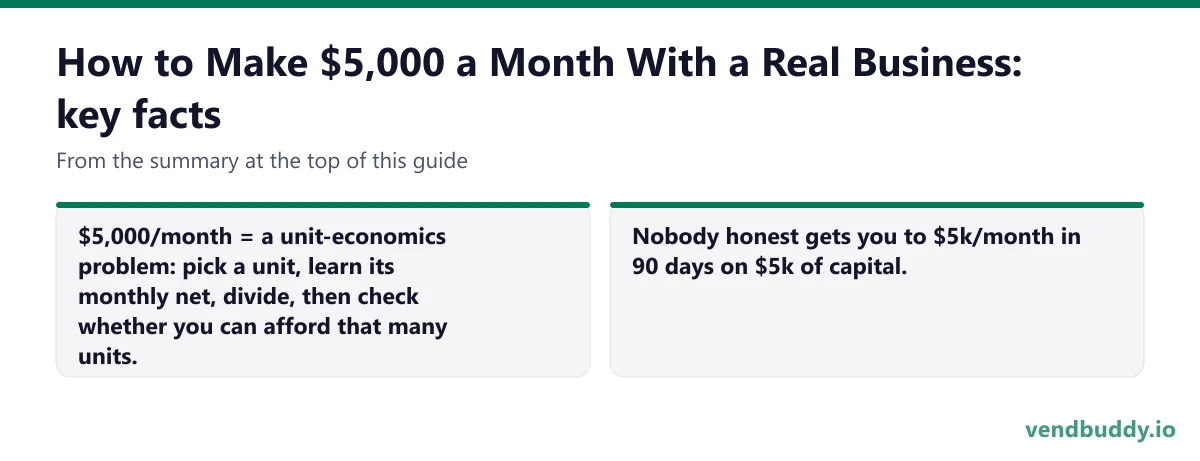
- $5,000/month = a unit-economics problem: pick a unit, learn its monthly net, divide, then check whether you can afford that many units.
- In vending the unit math reads: 15–20 decent machines, or 8–12 great ones — roughly $30k–$50k of used equipment built up over 12–24 months, largely self-funded from early machines’ cash flow.
- Service businesses reach $5k/month fastest (60–90 days) but never detach from your hours; rentals need ~$500k–$700k deployed; content is a lottery with skill-weighted odds.
- Nobody honest gets you to $5k/month in 90 days on $5k of capital. The compounding path is: first machine → reinvest → route.
$5,000 a month is the psychologically loaded number — roughly a median take-home salary in much of the US. It is the point where a side project becomes a resignation letter draft. The internet answers this question with vibes; here is the unit math for four real paths, including failure modes, because the difference between paths is not the ceiling — it is what happens when a unit underperforms.
- The only framework that works: unit × count × time
- Path 1: Vending — the smallest starting check that still compounds
- Path 2: Service routes — fastest to $5k, permanently attached to your hours
- Path 3: Rentals — $5k/month costs about $600k
- Path 4: Content and digital products — skill-weighted lottery
- The sequencing most people get backwards
- Frequently Asked Questions
Part of our complete guide: best cash flow business.
The only framework that works: unit × count × time
Every real path to $5k/month is the same equation: learn what ONE unit nets monthly, divide 5,000 by it, then be honest about whether you can acquire and operate that many units. Anyone selling a shortcut is selling the shortcut, not the income.
Path 1: Vending — the smallest starting check that still compounds
- The unit: one placed machine nets $150–$400/month at a decent location; $400–$800 at a great one (warehouses, hospitals, 24/7 facilities — full income breakdown).
- The count: $5,000/month means 15–20 decent placements or 8–12 great ones. This is why location quality is the whole game — it literally halves the business you have to build.
- The capital: $30k–$50k of used equipment total — but almost nobody writes that check up front. The standard path: 1–2 machines ($3k–$6k), prove the locations, then let the machines buy the next machines. 12–24 months to the full route (the scaling guide, financing options).
- The failure mode: guessing locations. A $12/day spot and a $40/day spot cost the same machine, the same gas, the same restock hour. Operators who measure foot traffic and pitch the actual decision-maker compress years out of this timeline.
Picture the machines paying you while you sleep
That’s the real promise of vending — income that doesn’t cost you your time, and a life on your own terms. VendBuddy turns this guide into a step-by-step plan so you actually build it instead of just reading about it. Start free today.
Start building free →Path 2: Service routes — fastest to $5k, permanently attached to your hours
Pressure washing, detailing, bin cleaning: $150–$400 per job, so $5k/month is 15–30 jobs — reachable in 60–90 days with hustle and $3k–$8k of equipment. The asterisk: month 60 requires the same hours as month 3 unless you hire, and hiring converts a great solo margin into a thin managed one. Perfect if income speed matters more than detachment.
Path 3: Rentals — $5k/month costs about $600k
At 2026 rates a leveraged door nets $200–$400/month, so $5k/month is 12–25 doors — roughly half a million dollars of deployed down payments (the $50k comparison). Real estate builds wealth; it does not build monthly income per dollar. Sequence it after cash flow, not instead of it.
Path 4: Content and digital products — skill-weighted lottery
The ceiling is unlimited, the median is zero, and the timeline is uncontrollable. Run it in parallel if you enjoy it; do not put the rent on it.
The sequencing most people get backwards
The mistake is treating these as either/or. The pattern that works: a semi-passive cash-flow base (vending route built over 12–24 months) funds and de-risks everything else — it is the boring engine that pays for the interesting bets. Vending remains underrated for exactly one reason: it looks small. $250/month per machine sounds like nothing until you own fifteen of them and the route runs on six hours a week (hours math).
The $12/day vs $40/day difference is decided before the machine arrives. VendBuddy scores real locations near you and finds the best contact on file — so your first unit proves the math instead of testing your patience.
Frequently Asked Questions
How long does it take to make $5,000 a month with vending machines?
Realistically 12–24 months, building from 1–2 machines to 12–20 by reinvesting cash flow. Faster is possible by buying an existing route ($60k–$120k at typical 1–2x annual net pricing) — slower is common when locations are chosen by guesswork.
The other side of buying a route is that somebody is always getting out. The marketplace is where operators post routes and machines for sale, and it is free to browse.
What business makes $5,000 a month fastest?
Service businesses (pressure washing, detailing) — 60–90 days is achievable. The trade: income stays permanently coupled to your working hours, unlike route-based assets.
Can you really make $10,000 a month with vending machines?
Yes — at roughly double the $5k math: 25–40 machines or a heavier mix of premium 24/7 locations. Operators at that level treat it as a primary business with part-time help, not a side hustle.
Keep going: the best cash-flow businesses of 2026, passive income ranked by realism, the warehouse $5k/month playbook, and what machines cost.
What is selling, which buildings say yes, and the numbers before you buy a machine. Free, confirm from your inbox, unsubscribe in one click. Refer one friend and get 25 VendBuddy credits.
Want the free 38-page Ultimate Vending Guide too? Get the guide
General information, not legal, tax or financial advice. Rules change, so check the official source. Revenue and income figures are examples, not promises. See our terms.