- Self-storage beats vending on almost every axis except the one that decides most people’s answer: the entry ticket. Facility acquisition realistically starts around $1,000,000.
- Storage is genuinely excellent — 60–70% NOI margins on stabilized facilities, very little labor, appreciating real estate underneath, and historically resilient in downturns.
- Vending starts under $5,000, produces revenue within weeks, and the asset relocates. A machine at a site that underperforms gets moved. A facility in a bad submarket does not.
- The honest verdict: these are not competitors, they are life stages. If you have $1,000,000, buy storage. Vending is what you do at $3,000.
- If you want storage economics at a small budget, buy the sector rather than a building — REITs and funds are covered below alongside the passive-versus-operated risk comparison.
This comparison usually gets written by someone who has already decided which side wins. So here is the conclusion first, before the argument: self-storage is a better business than vending on margins, on labor intensity, on asset appreciation and on recession resilience. It wins four of the five things you would normally compare. It loses one — you cannot start it — and for most people reading this, that single column decides the whole question. What follows is the honest version of both sides, including how to get storage exposure without a million dollars.
Head to head
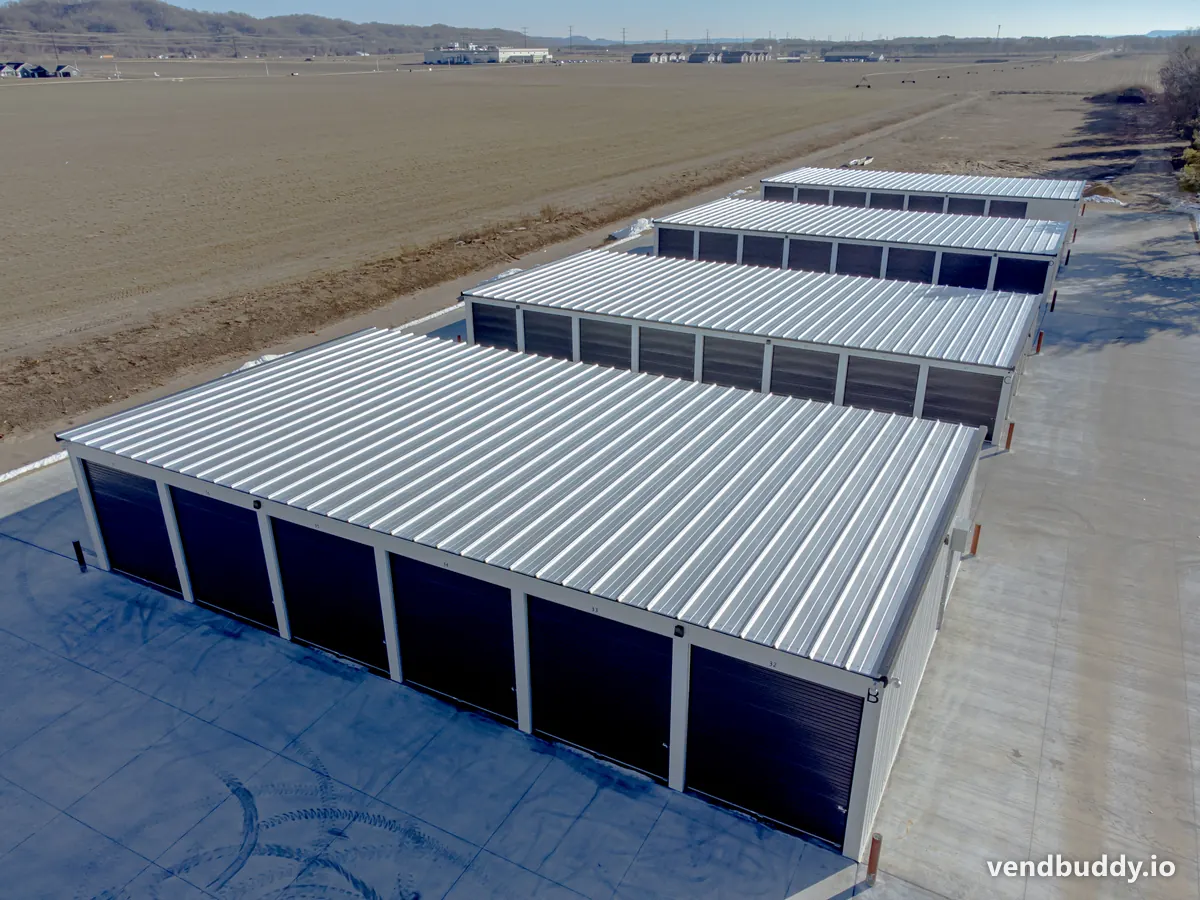
| Self-storage facility | Vending route | |
|---|---|---|
| Realistic entry cost | $1,000,000+ to acquire; 25–35% down plus reserves | $2,000–$4,000 for the first machine, all in |
| Time to first revenue | Immediate on an existing facility; 12–24 months for ground-up | 6–12 weeks, most of it spent finding the location |
| Operating margin | 60–70% NOI on a stabilized facility | 40–55% gross margin; 25–30% of gross as net |
| Labor per month | Near zero with smart-entry; a part-time manager at most | 1–2 hours per machine, plus driving |
| Does the asset appreciate? | Yes — real estate plus NOI growth | No — equipment depreciates; the route is the asset |
| Can you move it if the site fails? | No. The building stays where the submarket is | Yes. Unbolt it, load it, place it somewhere better |
| Recession behavior | Historically resilient; demand driven by life disruption | Resilient at low price points; workplace closures hurt |
| Financing available? | Yes — SBA and conventional CRE lending is mature | Limited. Mostly cash, cards, or equipment finance |
| Exit | Sold on a cap rate to institutional and private buyers | Sold at roughly 1–2x annual net, usually to another operator |
The honest case for self-storage
Storage deserves a proper hearing rather than the token paragraph these comparisons usually give the other side, because the economics are genuinely among the best in real assets.
The margins are exceptional and they are structural. A stabilized facility commonly runs 60 to 70 percent net operating income margin. That is not clever management, it is the nature of the product: there is no cost of goods, no inventory, no spoilage and no fulfilment. You are selling access to space that already exists. Compare that to vending, where roughly half of every dollar goes straight back out as product cost before you have paid for fuel, commission or card fees.
If the spend is going on plastic anyway, the card choice is worth ten minutes. Most operators we talk to land on the Bilt card, not for what it pays on pallets but because the rent payment earns too. Referral link, and the honest caveat is that a carried balance beats what any of these points are worth.
The labor intensity is close to zero. Modern facilities run on smart entry, online rental and remote management. Many operate with a part-time manager or no on-site staff at all. That is a fundamentally different relationship with your own time than any route business, where the income is permanently coupled to somebody physically visiting each unit. A storage facility does not need you to show up on Saturday.
You own appreciating real estate underneath it. This is the argument vending simply cannot answer. A vending machine is worth less every year and the value in a route is the contracts and the cash flow, not the steel. A storage facility sits on land, and the building can be refinanced, improved and revalued. Value goes up when you raise rents, because the asset trades on a multiple of its net operating income — a $50,000 annual NOI increase can add several hundred thousand dollars to the sale price at prevailing cap rates. That is forced appreciation, and it has no equivalent in vending.
Demand is driven by disruption, not discretion. People rent storage because they are moving, downsizing, divorcing, settling an estate, or shrinking a business. Those events do not stop in a recession — some of them accelerate. The sector held up notably better than most commercial real estate through the 2008 downturn, and that reputation is largely earned. Storage also benefits from a quiet pricing advantage: once someone has moved their belongings in, a rent increase is easier to absorb than the cost and hassle of moving out.
And it is financeable. Commercial real estate lending for storage is mature, which means leverage is available on reasonable terms, which means the return on your own equity is higher than the return on the asset. Vending has almost no equivalent. Nobody is writing a thirty-year note against three snack machines. The wider version of this argument — leverage, appreciation and passivity versus operator control — is covered in vending versus real estate at $50,000.
The honest counterweights are worth stating too, because a real steelman includes the risks. Storage development has been heavy in many US metros, and an oversupplied submarket can crush occupancy and street rates for years. Underwriting a facility is real work requiring real expertise, and the difference between a good and a bad deal is not visible to a first-time buyer. Interest rate movement affects both what you pay for the asset and what you can sell it for. And a facility is illiquid in a way a machine is not — selling takes months and costs a broker fee.
Picture the machines paying you while you sleep
That’s the real promise of vending — income that doesn’t cost you your time, and a life on your own terms. VendBuddy turns this guide into a step-by-step plan so you actually build it instead of just reading about it. Start free today.
Start building free →The number that decides this for most people
Everything above is true and mostly irrelevant if you cannot write the check. So here is the entry math without softening.
| Route into storage | Realistic minimum | What you actually get |
|---|---|---|
| Buy an existing facility | $250,000–$400,000 down on a $1M+ asset, plus reserves | Full control, full upside, full underwriting risk |
| Ground-up development | Higher again, plus 12–24 months of lease-up with no income | Best returns if it works, longest exposure if it does not |
| Private syndication or fund | $25,000–$50,000, usually accredited investors only | Sector economics, zero control, multi-year lock-up |
| Publicly traded storage REIT | Any amount, daily liquidity | Dividend income and share price exposure, no control at all |
| Vending route | $2,000–$4,000 for machine one | Full control of a small asset, revenue in weeks |
If you have $3,000, the storage row that applies to you is the REIT row. That is a genuinely reasonable thing to do and this page is not going to pretend otherwise — but understand what you are choosing. A REIT position pays a dividend and asks nothing of you. It also cannot be improved by your effort, cannot be leveraged on your terms, and does not become a business. If what you actually want is passive yield, buy the REIT and stop reading comparison articles about businesses; the vending versus index funds versus rental property risk comparison is the honest version of that decision.
If what you want is something you operate, control and can grow with effort rather than capital, that is where vending exists, and it is essentially the only real-asset business with an entry ticket that low. Priced out of real estate covers the same argument for people who arrived here from the rental property side.
The honest case for vending
Three things, and they are narrower than the storage case but they are real.
You can start this month. Two to four thousand dollars gets a machine placed, and the first revenue arrives within days of stocking it. There is no underwriting, no lender, no closing, no accreditation requirement. That is not a small advantage — it is the difference between owning something and reading about owning something for another eight years while you save. A machine netting the canonical $150 to $400 a month is small money, but it is real money arriving in month three rather than hypothetical money arriving in 2034.
The asset physically relocates. This is the one axis where vending genuinely beats storage and it is underrated. If your location stops performing — the office downsizes, foot traffic dies, a new manager wants the space back — you unbolt the machine, load it, and place it somewhere better. The capital survives the mistake. A storage facility in a submarket that added three competitors is stuck where it was built forever; your only levers are price and marketing. Deciding whether to rescue or pull a machine is a routine operating decision in vending and has no equivalent in real estate.
The learning curve is survivable on your own money. A bad vending location costs you a few hundred dollars a month and a Saturday moving a machine. A bad storage acquisition costs you a down payment you spent a decade saving. When you are learning how to underwrite a location — and location is the core skill in both businesses — it is worth a great deal to be learning it in units of $3,000 rather than units of $300,000. Vending is, among other things, a cheap education in the exact skill that storage requires.
What vending does not have: appreciation, leverage, meaningful margins by comparison, or genuine passivity. Those are storage’s columns and it keeps them. What machines actually earn is the unvarnished version if you want the numbers rather than the framing.
Both businesses live or die on reading a location correctly. The VendBuddy Lead Finder scores venues by ZIP using traffic and business-density signals, so you can practise that judgment on a $3,000 decision instead of a $300,000 one.
Open the Lead Finder →The disqualifier math, in both directions
This comparison has two wrong answers, and each of them has arithmetic behind it.
Wrong answer one: buying a storage facility with a stretched balance sheet. If a $1,200,000 facility needs $350,000 down plus reserves and you are assembling that from savings, a second mortgage and optimism, run the vacancy case before the base case. A facility at 90% occupancy throwing off $85,000 of NOI against $70,000 of debt service is comfortable. The same facility at 72% occupancy — entirely achievable if two competitors open nearby — throws off roughly $55,000 and you are funding the gap personally, every month, on an asset you cannot sell quickly. Storage is a great business and a stretched storage purchase is one of the more efficient ways to lose a decade of savings.
Wrong answer two: buying vending machines while telling yourself it is a path to a storage facility. Run that math honestly. Ten machines netting the canonical $330 each produce about $3,300 a month, or roughly $40,000 a year before tax. Saving even half of that toward a $350,000 down payment takes around seventeen years, and getting to ten machines takes you two years first. Vending is a genuinely good small business. It is not a capital-formation strategy for commercial real estate, and anyone who tells you it compounds into one is selling a course. If storage is the actual goal, the faster routes are a high-income career, a partnership, or a syndication — not a route.
Choose vending because you want a small business you control now. Choose storage because you have or can raise the capital and want an asset that appreciates while you do almost nothing. Do not choose one as a stepping stone to the other.
The verdict
If you have a million dollars, buy self-storage. That is the honest answer and it should not be a surprising one on a vending site. The margins are better, the labor is lower, the asset appreciates, the financing exists, and the exit is cleaner. Nothing in vending competes with that on economics.
Vending is what you do at $3,000. It is not the compromise version of storage — it is a different category of decision, made at a different stage of life, with a different risk profile. It gets you operating an income-producing asset this quarter instead of reading about one, it teaches the location judgment that every real-asset business eventually requires, and it does it in units small enough that being wrong is a lesson rather than a catastrophe. Those are honest advantages and they are the only ones being claimed here.
If you are still weighing the wider field of asset businesses at various budgets, the ranked cash-flow business comparison puts storage, laundromats, vending and the rest on the same axes, and laundromats versus vending runs the same head-to-head against the other high-capital favorite. If vending is where you are actually starting, the start-to-first-machine walkthrough is the practical next step.
Frequently Asked Questions
Is self-storage better than vending?
As a business, yes, on almost every axis that is not the entry ticket. Stabilized self-storage runs 60 to 70 percent NOI margins, needs very little labor, sits on appreciating real estate and has historically held up well in recessions. What it does not do is let you in for $3,000. A facility acquisition realistically starts around $1,000,000, so for most people the comparison is not vending versus storage, it is vending versus waiting.
How much does it cost to start a self-storage business?
Buying an existing facility realistically starts around $1,000,000 and commonly runs several million, with lenders typically wanting 25 to 35 percent down plus reserves. Ground-up development is usually more, once land, construction and lease-up are counted. There is no version of owning a facility that starts at a few thousand dollars, which is the single most important fact in this comparison.
Can you invest in self-storage with a small amount of money?
Yes, but as an investor rather than an operator. Publicly traded self-storage REITs give you exposure at any dollar amount with daily liquidity, and private syndications or funds typically start around $25,000 to $50,000 for accredited investors. You get the sector economics and none of the control — you cannot improve a REIT, and you cannot take a distribution as a wage.
What are the margins on a self-storage facility?
Stabilized facilities commonly run 60 to 70 percent net operating income margins, which is exceptional for any real asset class. The reason is structural: almost no cost of goods, minimal staffing once smart-entry systems replace an on-site manager, and low ongoing maintenance on a building that is essentially a roof and doors. Those margins are also why the assets trade at prices that put them out of reach at small budgets.
Why would anyone choose vending over self-storage?
Because of the entry ticket and the speed. Vending starts under $5,000, produces its first revenue within weeks of placement, and the asset physically relocates if a site underperforms — a storage facility cannot be moved when the submarket turns. Vending is what you operate at $3,000. Storage is what you buy at $1,000,000. They are stages, not competitors.
Is self-storage recession resistant?
Historically it has held up better than most commercial real estate, and the usual explanation is that demand is driven by life disruption — moving, downsizing, divorce, death, business contraction — which does not stop in a downturn. That is a real advantage and it should not be overstated. Individual facilities in oversupplied submarkets have still struggled badly, and storage development has been heavy in many metros.
Related: best cash-flow businesses 2026, vending versus real estate at $50k, laundromats versus vending unit economics, vending versus index funds versus rental property, priced out of real estate, and how to start a vending machine business.
What is selling, which buildings say yes, and the numbers before you buy a machine. Free, confirm from your inbox, unsubscribe in one click. Refer one friend and get 25 VendBuddy credits.
General information, not legal, tax or financial advice. Rules change, so check the official source. Revenue and income figures are examples, not promises. See our terms.